To apostille a marriage certificate from another state, use the competent authority for the jurisdiction that issued the record. Moving to Florida does not give Florida authority to apostille a New Jersey marriage certificate.
You usually do not need to travel back. However, you do need the correct certified record, any required preliminary certification, and a submission that follows the issuing jurisdiction’s rules.
Apostille de la Haya can coordinate those stages. We review the document’s origin, the destination’s requirements, and the available ordering and delivery arrangements before defining the work.
Which jurisdiction has authority over the record?
State and local marriage records follow the authentication route of their issuing jurisdiction. The relevant office is often a Secretary of State, but the agency name is not identical everywhere.
For example, New Jersey handles apostilles through the Department of the Treasury’s Division of Revenue and Enterprise Services. Sending a New Jersey record to a different state’s apostille office does not change its origin.
Your present address can matter for delivery or identity checks during a record request. It does not transfer authority over the public official’s signature on the marriage certificate.
The same principle applies to a destination wedding within the United States. Identify the office that holds and certifies the recorded marriage, even if neither spouse ever lived in that jurisdiction.
Why the federal office is not a substitute
The U.S. Department of State’s Office of Authentications handles federal documents and other documents within its authority. It does not replace the issuing state’s apostille process for an ordinary state marriage certificate.
For use under the Apostille Convention, follow the issuing jurisdiction’s state-document route. A state apostille generally does not need another federal apostille attached to it.
A destination outside the Convention may require a different authentication chain, potentially including federal and consular steps. Therefore, identify the destination and procedure before deciding where the documents must go.
Our overview of the marriage certificate apostille explains the distinction between authentication of the official signature and acceptance of the record for a foreign filing.
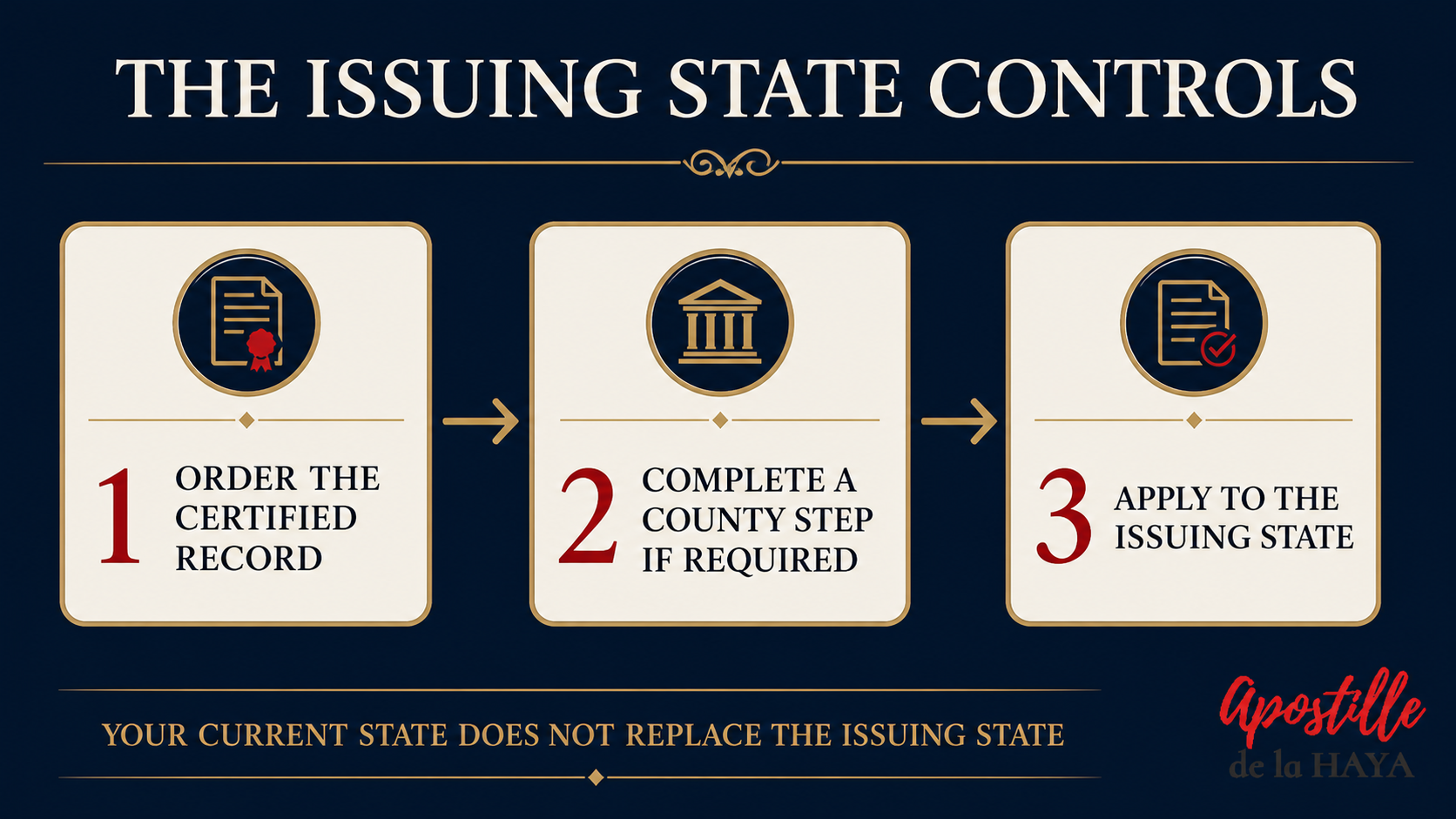
How to apostille a marriage certificate from another state
Begin by checking the record you already have. Read the issuing office, certification, signature, and issue date. A downloaded image or private photocopy is not automatically a substitute for the certified document the office requires.
If you need a replacement, order it from the appropriate custodian. Specify the intended foreign use when the application asks. Some offices issue a particular signature or certification format for apostille requests.
Next, confirm any county or other preliminary certification. Submit the completed package to the competent authority with its form, accepted payment, destination information, and return arrangements.
Keep the finished apostille with the document it authenticates. Do not detach it to make copying or mailing easier. The receiving office may also require a translation or additional supporting records.
New Jersey: request the record for apostille use
New Jersey’s Office of Vital Statistics and Registry tells applicants to indicate that they need a record for an apostille. It then supplies a certified copy bearing the appropriate original registrar signature.
The applicant must forward that document to the Department of the Treasury for the apostille. Ordering the vital record alone does not complete both stages.
New Jersey’s request process also requires identity information and, for certified copies, proof of the relevant relationship. A name change can require supporting documentation. Review those requirements before placing the order from another state or country.
The Treasury’s instructions distinguish records from January 1, 1923 onward from earlier records held through the State Archives route. The year therefore helps identify where to begin.
New York: check whether County Clerk certification is needed
New York requires County Clerk certification for marriage certificates issued by local or county officials. Use the County Clerk of the county where the document was issued.
New York City marriage records follow the City Marriage Bureau route and then the New York County Clerk certification step. This is not a requirement to visit several unrelated county clerks.
Qualifying certificates from the New York State Department of Health can proceed without County Clerk certification. They must bear the signature of the Director of Vital Statistics or the NYS Registrar.
Also check who actually issued the document. New York warns that local agencies may use words such as “registrar” or “vital statistics.” A New York heading alone does not establish that the State Department of Health supplied it.
Florida and Texas illustrate other differences
Florida’s apostille charge for a document certified by a Clerk of the Court includes a Certificate of Incumbency. A qualifying state Bureau of Vital Statistics certificate follows a different fee route.
The underlying records may also differ in content. Our guide to the Florida marriage certificate apostille compares the county and state options, including availability after a recent ceremony.
Texas lists certified marriage licenses and applications among its recordable documents. Its current instructions require certified records issued within the past five years for apostille eligibility.
That requirement concerns the certified record’s issue date, not whether the marriage occurred within five years. An older marriage may require a newly issued certified copy.
Texas also uses a “universal Apostille” certificate. Its function differs for Convention and non-Convention destinations, and further authentication may still be necessary outside the Convention. The label does not remove the need to check the destination’s route.
Ordering eligibility can affect the schedule
Access to certified marriage records varies by jurisdiction. Some records are public; others require proof of identity, relationship, or legal authority. A service provider must follow those restrictions too.
For instance, California distinguishes certified authorized copies from certified informational copies. An informational copy cannot establish identity, even though it is a certified copy. The requested use matters when choosing the document.
A name change can also require supporting records. Provide the names the ordering office requests rather than assuming your current surname alone will locate an older entry.
If a search finds no record, check the dates, names, and issuing county before concluding that the record is missing. In states with statewide marriage licenses, the ceremony county may differ from the county that issued the license.
Why local notarization does not replace the official record
A notary in your current state cannot turn a private photocopy into the issuing government’s certified marriage record. A notarization concerns the particular notarial act; the custodian’s certification concerns its official record.
Florida and Texas restrict notarial copy certification of vital or recordable public records. Therefore, do not assume that a local notary can provide a shortcut for an out-of-state marriage certificate.
Even where a separate notarial act is lawful, an apostille on that act authenticates a different official signature. The recipient may still require the certified marriage record itself.
Our explanation of which marriage certificate copy can be apostilled compares official records, abstracts, and private copies. Check the required document before paying for an additional notarization.
Compare processing stages rather than state names
An out-of-state request is not automatically slower than a local one. Timing depends on record availability, the ordering method, required certifications, current workloads, and delivery.
New York offers same-day walk-in apostille service at several locations, subject to its document and service requirements. That does not mean a mailed file or an incomplete record will finish the same day.
California publishes the receipt date of mail requests currently in process. It also says in-person submissions are typically processed within about 30 minutes after submission. Confirm current office arrangements before relying on a visit.
Florida likewise publishes the receipt date of apostille requests it is processing. Its FAQ describes receipt-order handling and walk-in service. These published indicators help with planning but do not guarantee a particular delivery date.
Check the current information for each stage. A fast apostille counter cannot compensate for a certified record that has not yet been issued.
Payment and shipping rules vary
Do not reuse one state’s payment instructions for another. Florida requires an accepted check or money order for its Department of State submission and does not accept cash or credit cards for that process.
New Jersey offers an online apostille request and payment service, followed by mailing or dropping off the document package. An online payment does not necessarily mean that the underlying record can remain entirely electronic.
Return methods also differ. Check whether the authority accepts a prepaid courier label, requires a particular return envelope, or uses standard mail. Tracking is available only when the chosen service provides it.
Before sending your only certified copy, consider whether another issued copy is needed for your records or a separate procedure. Retain a scan for reference, while recognizing that it does not replace the required certified document.
Coordinate documents from several jurisdictions
A marriage certificate from Illinois and a birth certificate from Puerto Rico follow separate issuing-jurisdiction routes. You cannot combine them into one state’s authentication request simply because they support the same foreign application.
However, independent requests can often proceed at the same time. That can reduce the total elapsed time when each package is ready and no stage depends on another document.
First identify those dependencies. One record may be needed to establish eligibility for another request, or the receiving office may impose a recent-issue requirement. Sending everything immediately is not always the best sequence.
Build the schedule around the last required document that will be ready. Include translation and final delivery where applicable, rather than averaging the different states’ estimated processing times.
What the French heading means
An apostille carries the French title “Apostille (Convention de La Haye du 5 octobre 1961).” The Convention requires that title, even when the issuing authority uses another language for the remaining information.
The heading is therefore not a sign that a U.S. apostille came from the wrong country. Review the issuing authority and certificate details as a whole.
If the foreign recipient questions the document, clarify its concern. It may be asking about the record format, translation, or a separate document connected to your current residence. Do not assume that every request involving your address misunderstands apostille jurisdiction.
Mistakes that can add another submission
Sending a record to your current state’s office is one avoidable error. Identify the issuing jurisdiction first, then confirm the specific authority within it.
Another is overlooking a preliminary certification. A New York local marriage certificate needs the relevant County Clerk step before the Department of State submission.
Also check the issue date and payment rules. A Texas record outside the current issuance window or an incorrect Florida payment can require attention before processing.
Finally, avoid promising yourself a completion date based only on a counter-service estimate. Retrieval, missing information, shipping, and the destination’s requirements can each affect the file.
How Apostille de la Haya supports an out-of-state file
We identify the record’s jurisdiction and the certification the recipient needs. The service can include locating and ordering an eligible certified copy, coordinating intermediate certifications, and submitting it to the competent authority.
For a file involving several states, we assess which requests can run together and which depend on earlier documents. The proposed scope also identifies payment and delivery arrangements.
You should expect a clear explanation of missing information or access restrictions. We cannot guarantee that a custodian will locate a record, issue it to an ineligible requester, or complete it by a fixed date.
Our role is to coordinate the required stages and explain the file’s status and limits. The foreign authority remains responsible for deciding whether the document satisfies its procedure.
Out-of-state marriage certificates: common questions
Can my current state apostille the other state's marriage record?
No. Follow the competent authority for the jurisdiction that issued the marriage record. A change of residence does not transfer that authority. A local notarization of a different statement does not replace the issuing government’s certified record.
Do I have to travel back?
Usually not. Many jurisdictions offer mail or other remote arrangements, and a provider can coordinate the work within the agreed scope. Check the record-ordering requirements separately from the apostille submission method.
How long will the process take?
There is no single out-of-state timeframe. First determine whether a suitable certified copy is already available. Then include any preliminary certification, the apostille office’s current workload, and delivery. Published counter times do not describe the whole process.
Can documents from two states proceed together?
They need separate jurisdiction-specific submissions, but independent requests can often run concurrently. Check whether one record is needed to obtain another and whether the destination imposes issue-date limits before choosing the sequence.
What if I no longer have a certificate?
A replacement certified copy may be available from the responsible custodian. You must identify the record and meet that jurisdiction’s request requirements. We can review the available information and include retrieval in the proposed service where permitted.
Arrange the correct route for your marriage record
Contact Apostille de la Haya to apostille a marriage certificate from another state. Tell us the issuing jurisdiction, marriage date, destination, and any filing deadline.
Call +1 (305) 500-0185 or write through WhatsApp. We can review the record and explain retrieval, authentication, and delivery options for your file.
This publication provides general information and does not constitute legal advice or a guarantee of acceptance. Requirements vary by jurisdiction, record, and destination. Confirm the current instructions for the document and procedure involved.