Apostille vs authentication is a question to settle before you send a U.S. document for certification. The two certificates serve different purposes. Familiarity with either name does not establish which certificate a foreign recipient requires. The route depends on the destination, the Convention relationship that applies, where the document came from and what the recipient asks for. This article compares the two certificates for readers who already hold a U.S. record and need to use it abroad.
The choice matters for a birth certificate, a marriage record, a federal report, a diploma or a notarized instrument. A document can be perfectly genuine and still end up with the wrong certification for what it is meant to do. Apostille de la Haya can look at the record and the receiving authority’s instructions and then explain which service fits. Review the certificate required for the actual destination before requesting either service.
Apostille vs authentication: start with the destination
An apostille is a certificate issued under the Apostille Convention framework that applies. An authentication certificate belongs to a different documentary route, usually one where the destination requires further legalization. Both deal with official signatures or seals. They differ in how they are recognized and in the steps that come after them. Neither one replaces the underlying document.
The HCCH Convention status table shows which countries participate, when the Convention entered into force for each of them and any relevant declarations. Finding a country’s name in a general directory of international organizations is not enough. Check this specific Convention and how it operates between the countries involved. A country may have deposited an instrument and still have an entry-into-force date in the future, and that date matters.
For the United States, the split between federal and state origin still matters once the destination question is answered. An apostille for a state official’s signature and one for an eligible federal document do not necessarily come from the same office. You need to identify both the correct certificate and the authority competent to issue it.
A decision table for your U.S. document
| Situation to verify | Certificate question | What still needs review |
|---|---|---|
| The applicable Convention relationship covers the document and destination | Is an apostille the right certificate? | Competent U.S. authority, admissible record, recipient format and translation |
| The destination requires an authentication and consular route | Which authentication certificate and later mission certification are required? | Document category, jurisdiction, prior certifications and destination-side requirements |
| The recipient only says “authenticated” | Does it mean an apostille, an authentication certificate or another verification? | Written clarification from the receiving authority before submission |
| The document was prepared for a different country | Does the existing certificate fit the new intended use? | The complete existing file and the second recipient's requirements |
Use the table to support the decision. It is not a list of countries, and it does not replace checking the current requirement. Start with the row that matches the request you actually received. If you do not yet know the destination or where the document originated, you are not ready to choose a certificate. The service scope should remain provisional until the document and intended use are clear.
What neither certificate proves
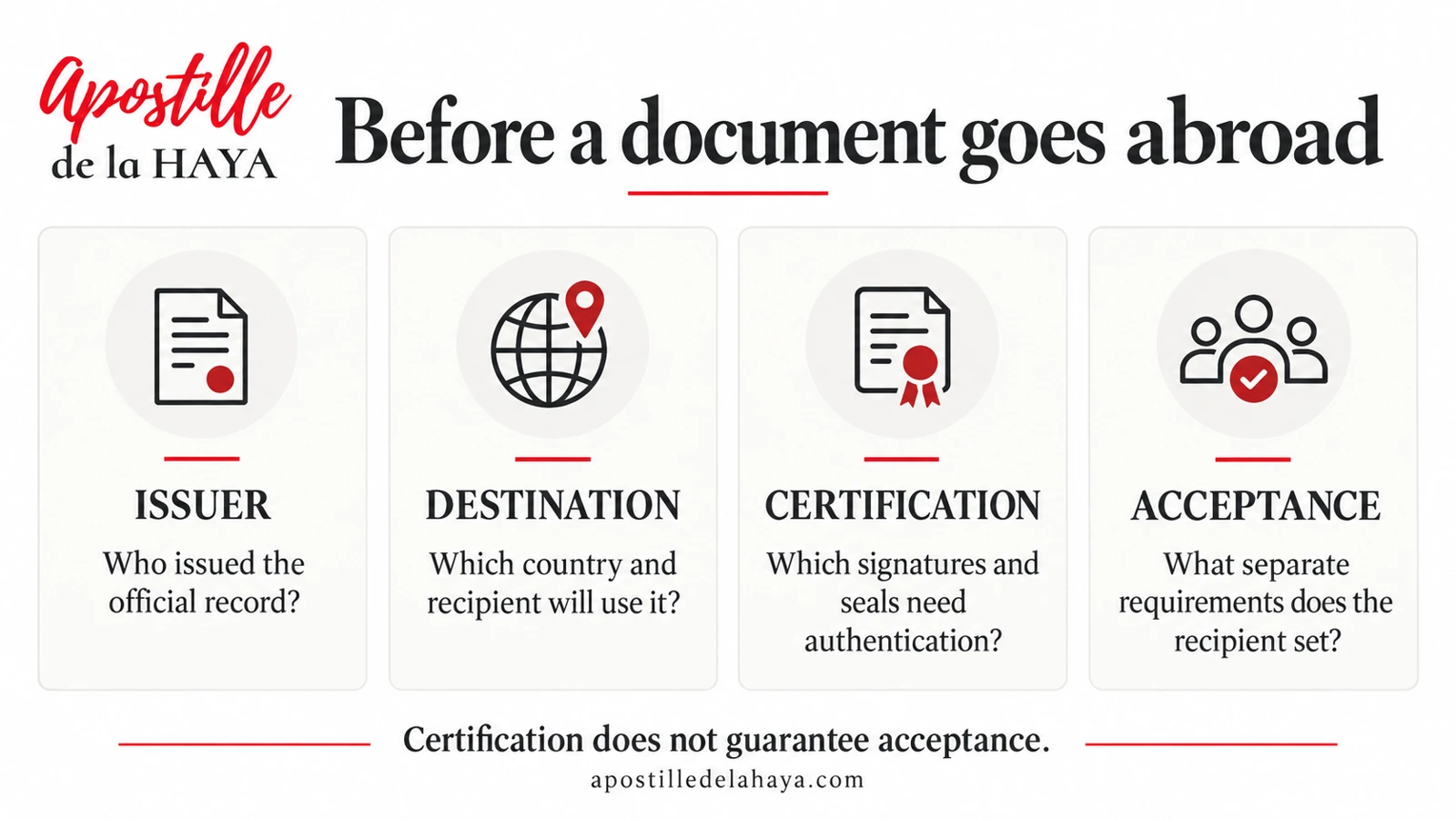
Certification deals with an official act connected to the document. It does not check every statement in it, correct a wrong record or decide how the foreign procedure will turn out. An apostille on a diploma does not by itself grant professional registration. Authenticating the signature on a power of attorney does not add powers the text never granted.
That is why the evidence the recipient asks for matters as much as the certificate. A civil registry may want a specific certified version of a record. An employer may want a transcript as well as the degree. If you prepare the wrong underlying item, getting the technically correct certificate may not solve anything.
Translation is a separate requirement again. The recipient may set the language, the scope and the formalities of the translation. A certificate does not translate the original, and a translation does not certify the issuing official. When you describe the service you need, keep these functions apart so you can tell which requirements have really been covered.
State and federal documents start from different reviews
A U.S. birth certificate is generally a record of the state or local system named on the document. An FBI report comes from a federal agency. A statement someone prepared privately may enter the official process through a notarial act. Those are three different origins, even if all three documents belong to the same person and travel in one package.
With a state record, find out which state’s authority can recognize the signature on it. The state where the applicant lives now may play no part at all. With an eligible federal record, identify the federal issuer and the certification format. Do not add a notarization to an official record just because it looks like an easy first step.
The federal apostille overview covers the Department of State context. Federal authentication of a birth certificate deals with a narrower question: a state record that needs a federal stage. The difference is useful, because knowing that a document is American does not tell you which office should receive it first.
Example: a birth record going to a new country
Take a hypothetical applicant who got a certified U.S. birth record and an apostille for one foreign procedure. Later, a second country asks for the same birth record through consular legalization. The applicant should not treat the earlier apostille as a universal pass for the document. The second destination’s requirement has to be reviewed on its own terms.
Keep the whole existing file together, including the apostille and any translation. Explain who the new recipient is, the purpose and the country. A reviewer can then separate the preparation that is still useful from work that may need a different record or certificate. Do not detach the old certificate or change the country reference so the file looks like a new application.
The opposite assumption causes unnecessary work too. If a document already fits the applicable apostille route, adding consular legalization because it sounds more thorough may be irrelevant. What you want is the certificate the recipient is entitled to require under the applicable framework, plus any legitimate presentation requirements. Piling up as many stamps as possible is not the goal.
Example: a recipient's email asks for authentication
Say a university abroad writes, “Please provide an authenticated diploma.” That phrase could mean a formal international certificate, a direct verification from the institution or a local administrative practice. Before you pick a service, ask the university what kind of authentication it means and which authority it expects to provide it.
Clarifying the requirement can prevent unnecessary certification when the university wanted a direct academic transcript. It can also show the reverse: a digital verification alone will not do, because the recipient expressly requires an official international certificate. Turn the broad word into a defined requirement instead of reading it through the first service you find online.
An original digital record, a scanned paper and an officially certified paper copy can each have different acceptance conditions. They are not interchangeable just because they show the same text. If electronic verification is involved, keep the original file and its verification features intact, and check whether the recipient accepts that format for this purpose.
Common errors in the apostille vs authentication choice
The first mistake is treating the applicant’s location as the destination. Someone living in the United States may need a record for a registry overseas, and someone abroad may be preparing a document for a third country. The destination that counts is where the document will be used. It is not necessarily the address where the courier delivers the finished package.
The second mistake is reading the certificate’s title as proof that nothing else is left to do. A properly authenticated document may still need a mission stage under the applicable route. An apostilled document may still need a translation or a supporting record the recipient asks for. Ask what the certificate completes and what the final receiving institution expects after it.
The third is borrowing the route for a different issuing country. Instructions for a British or Indian degree cannot tell you how to prepare an American one. The destination may be the same, but the officials and documents in the country of origin are different. Match the actual issuer before applying procedural guidance.
Last, do not use a stamp to cover a substantive error. A wrong name, an incomplete authorization or the wrong version of a record has to be fixed on its own. Certification can authenticate an official signature on a document without correcting any of those problems. Fix the underlying issue with the right issuer, recipient or professional before you treat certification as the next step.
Apostille vs authentication: what to check before submission
Write down the document’s title, issuer, official signature and the format you have. Add the country where it will actually be used and the receiving authority. Include any instruction that names the certificate or translation required. If the request is unclear, get it clarified before you go ahead. With these details in hand, the choice rests on facts and not on a generic question about which certificate is “better.”
If the file already carries stamps, list them and leave them in place. Note the earlier destination and purpose if you know them. Record any deadline and be clear about what has to happen by that date: the document coming back to the applicant, delivery to the recipient or acceptance for a formal filing. These can happen at different times, and shipping a document is not the same as having it officially processed.
If the route involves the Gulf region, use the page for that destination, such as UAE document preparation, and do not assume a neighboring country’s instructions apply. Our document legalization service can help organize the broader review and define the help you need for the route you choose.
How Apostille de la Haya helps you pick the right service
Apostille de la Haya can review the U.S. record, the destination and the recipient’s written requirement before explaining the certification service. The goal is to avoid ordering a certificate that does not fit, or missing the preparation the record needs to become eligible. If an authority has to clarify whether it will accept the document, that question should be settled openly and not buried inside a promise about completion.
The service scope should distinguish official certification, document preparation, any translation and transport. Conditions may vary with the nature, complexity and requirements of the assignment. Consult Apostille de la Haya directly with the complete file so the apostille vs authentication assessment addresses the correct document and destination from the start.
Frequently Asked Questions
Which is better, an apostille or authentication?
Neither one is better across the board. In the apostille vs authentication decision, each certificate serves a different documentary route, and the right choice depends on the destination, the applicable Convention relationship and the document. Pick the wrong one and the recipient’s requirement may still be open. Apostille de la Haya can review the record and tell you which service applies before you arrange certification.
Should I order both certificates just in case?
Don’t assume you need both, or that having both helps. Establish the correct route first, including what the receiving authority expects. Extra certificates cannot fix the wrong underlying record or a missing substantive requirement. Contact Apostille de la Haya to review the document and its intended use before you add more stages.
Does an apostille remove every foreign requirement?
No. An apostille covers the certification function within the applicable framework. It does not cover every requirement of a foreign filing or transaction. A translation, a supporting record or an assessment of substantive eligibility may still be pending. Apostille de la Haya can help you separate documentary certification from the questions the receiving institution still has to decide.
Can a state office authenticate a federal document?
A state office does not authenticate a federal official’s signature through the federal document route. Eligible federal documents belong with the U.S. Department of State. First identify the actual issuer and official signature; a separate notarized private statement is not the federal original. Apostille de la Haya can review that distinction before submission.
What if the recipient uses the wrong term?
Ask the recipient to clarify which certificate or format it expects instead of guessing. A short written requirement can settle whether “authentication” means an apostille, consular preparation or some other verification. Send that reply to Apostille de la Haya so the service is planned around the real requirement.
Choose the certificate before you commit to a route
Contact Apostille de la Haya with your U.S. document and the destination’s instructions. We can review the certificate choice and the preparation so the service meets the requirement your recipient actually has.
Contact Apostille de la Haya by phone or WhatsApp: +1 305 500 0185.