Marriage certificate attestation in Qatar may be the last document step for a U.S. marriage record. It can also show that earlier American or mission certifications were never done. Before you book a local service, review the whole packet and identify what has actually been completed. The document’s current location does not change its place of issuance or the requirements associated with that origin.
This guide covers a marriage certificate issued in the U.S. that will be presented in Qatar. It separates preparation in the United States from the destination stage and explains what to check when the record already carries certifications. Apostille de la Haya can assess the U.S. preparation and clarify the scope of the service. The Qatari recipient sets the requirements and decides the outcome of the wider application.
Marriage certificate attestation in Qatar starts with a packet review
Identify the public office that issued the marriage record, the state or jurisdiction and the official certification on the copy. Read every attached certificate and note which authority issued it. A state certificate, a Department of State authentication and a Qatari mission act each play a different role. If someone calls the packet «fully attested,» the actual documents should back that up.
Work out whether you have an official certified copy, an ordinary photocopy, a scan or some other record. A ceremonial certificate or an unused marriage license is not the same as the completed official marriage record. Some jurisdictions use a completed license-and-return format. So look at the content and the certification, and don’t decide from the heading alone.
Keep the full packet together during the review. Don’t remove an older apostille, separate official attachments or swap in pages from a clearer photocopy. A complete, legible copy is enough for a preliminary assessment, and the certified original stays untouched. With the history intact, it is easier to tell whether a stage is really missing or just described in unfamiliar terms.
Confirm that the underlying record is American
This article covers marriage records issued in the United States. A spouse’s U.S. citizenship does not make a foreign marriage certificate an American public record. In the same way, translating a foreign certificate into English or getting a private U.S. notarization does not move its origin-country authentication requirements to an American state office.
When a U.S. copy has to be obtained or replaced, USA.gov’s marriage record guidance helps you find the official source. State and local custodians can play different roles. Identify the public office that actually issued the certified copy, even if a private ordering service helped with delivery.
If the marriage took place abroad and your document comes from another country, drop the U.S. state-record assumptions and have that origin assessed. The right authority follows the document and the official act. Living in Qatar matters for delivery and local services. It does not tell you which country has to complete the earlier certification work.
Establish the Qatar recipient and purpose
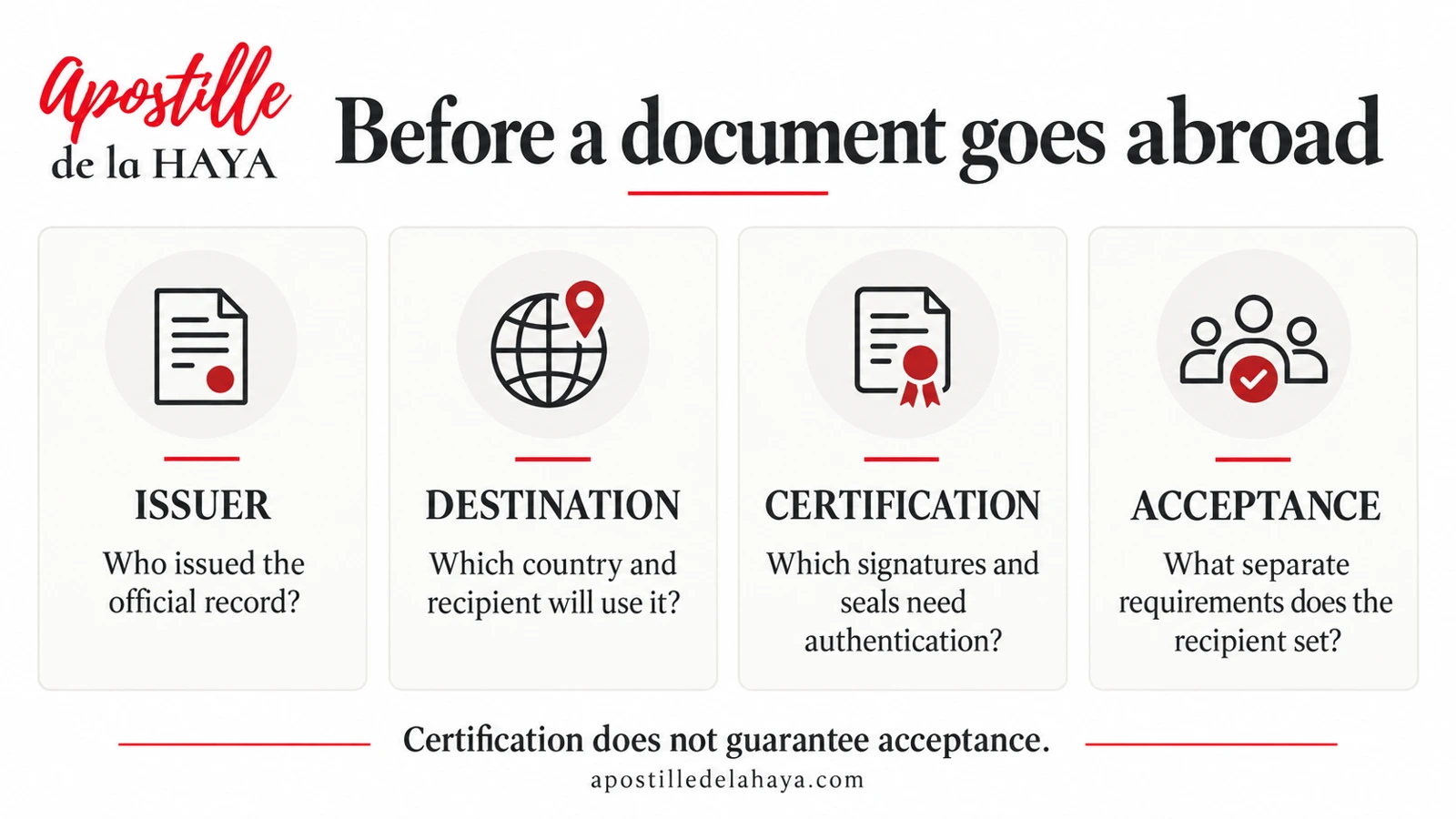
Ask the requesting institution for its current requirements in writing. A government family application, an employer’s benefits file and a separate marriage registration can each call for different supporting evidence. Find out whether the institution needs only the certified record, or another legal or administrative procedure on top of attestation.
Check whether the certificate is needed for a preliminary assessment or for the final filing. Ask too whether the recipient needs the original, an accepted electronic form or extra copies. A scan allowed early on may not satisfy the local attestation service or the final presentation requirement. Settle the final format before you arrange delivery.
Keep document preparation apart from eligibility. A completed attestation does not guarantee family residence, sponsorship approval or every form of legal recognition of the relationship. The responsible authority evaluates the wider application. Questions about those outcomes belong in the relevant official process or with a qualified professional.
Review the U.S. state and federal stages
The state authority has to be competent for the public official’s signature on the marriage record. The spouses’ current address does not let another state authenticate a record from the original issuer. Check the issuing jurisdiction’s rules for the certified copy you have, and find out whether any extra official preparation is needed.
A private notarized photocopy is not a universal substitute for the record certified by the custodian. A spouse’s declaration about a copy is a different document, and it may not meet the public-record requirement. If your copy won’t work, find out whether you need an eligible replacement before later certification goes ahead.
If the verified route calls for federal authentication, review the U.S. Department of State’s requirements and handle the necessary prior state certification. A U.S. marriage record does not become a federal original because a spouse holds an American passport. Using it overseas doesn’t change that either.
Check the Qatari mission act before choosing local completion
Confirm which Qatari mission in the United States handled the document, or should handle it, and what certification it issued. The consular information from the Qatar embassy in Washington is an official starting point for personal-document categories. Check the current requirements with the competent mission for your actual record and submission.
If the packet was prepared for another destination, don’t assume the existing apostille or legalization meets Qatar’s requirements. The marriage certificate apostille guide explains a related framework, but the Qatar route needs its own assessment. Keep the existing attachments in place while the correct next act is identified.
Ask any earlier service provider which stages it covered and what is still outstanding. A courier receipt proves delivery. It does not prove attestation. An invoice description may also be too vague to show which official act was completed. Look at the actual certificate and the service scope before you arrange another stage that might repeat work already done.
Marriage certificate attestation in Qatar through the local MOFA service
Qatar MOFA’s official attestation FAQ describes the local application and document-handling channels. For the service it describes, it mentions originals in Arabic or English, or originals with a certified translation. Confirm the category and accepted format for your U.S. marriage record, and check the final recipient’s own requirements separately.
The online process MOFA describes includes a review and physical handling through Qatar Post for the relevant service. Uploading a copy is not proof that the paper original is no longer needed. Keep the application reference. Then tell apart three things: approval to proceed, completed certification and return delivery.
Get current requirements from the official channel. Not every office or website offering «attestation in Qatar» is a government service. Confirm who collects the document, what act will be performed and where the finished packet goes back to. Those details mark where the service ends and who remains responsible for the final submission.
Handle missing origin-country work through the correct service
MOFA publishes a separate overseas attestation-completion service for foreign documents that still need work abroad. That is a different thing from presenting a fully prepared packet for a local act. Before choosing it, confirm whether it applies to your marriage record and check its scope, conditions and handling.
A local appointment does not automatically replace missing U.S. state or federal preparation. Find out exactly which certificate is missing and whether the underlying copy is eligible. A missing official act and an unsuitable source record are two different problems. The second may need a replacement from the U.S. custodian before certification can go ahead.
Compare the handling options in light of where the document is and when it is due. The plan should identify who obtains a replacement, who handles certification in the country of origin and how the record returns for the required Qatar stage. For marriage certificate attestation in Qatar, a vague promise to «finish everything locally» falls short unless it explains how the missing foreign work will be done.
Check names, translations and supporting evidence
Compare both spouses’ names with their current identification and with the recipient’s application. A former surname or a legitimate transliteration difference may call for linking evidence, and the marriage record itself may not need amending. Ask the recipient what it accepts. Never force a match by changing the source document or quietly swapping names in a translation.
If the record contains a genuine error, look into the issuer’s correction process. Attestation won’t fix a wrong marriage date or a wrong name. A corrected or replacement record may need its certifications and translation reassessed. So resolve material errors before you keep working on a version that may no longer be usable.
Confirm whether the translation must cover the entire packet, official attachments included, and who may prepare it. A translation accepted for one purpose may not meet another recipient’s procedure. Translation accuracy and authentication of the underlying record are separate matters. If a translator declaration or certification is required, name it explicitly in the file.
Prepare the final handoff and keep registration separate
Once the required certifications are done, compare the packet with the recipient’s written instructions. Check the certified copy, the names, the dates, the attachments, the translation and the case reference. Decide who will present the document to the requesting institution. Getting the packet back yourself is not the same as the recipient accepting it into its file.
If the institution requires a separate marriage registration or another personal-status procedure, confirm that process on its own. A document-attestation service does not record or recognize a relationship under the rules that apply to the couple. The same certificate can support a separate process without completing it.
Include additional supporting records only when they are required. A birth certificate, a divorce record or another civil document may have its own issuer and route. Assess each item separately. Marriage certificate attestation in Qatar for one record does not cover the whole family’s evidence. Keeping the file focused also avoids sending sensitive records for no reason.
Track problems by the stage that caused them
Keep separate references for U.S. issuance, certification, mission processing, the local application and courier delivery, where those stages apply. If the file is delayed, find out which office has it now and what action is still pending. A carrier’s «delivered» status is not a completed government review.
If the document comes back, keep the notice. Then work out whether the problem is the copy, a missing seal, the translation, the application details or a substantive requirement of the final recipient. Fix that problem before you resubmit. Adding another, unrelated certificate is unlikely to solve a problem with identity or with the underlying official record.
Leave time for a replacement or a correction when one is needed. A faster courier cannot make an incomplete or inaccurate document ready for acceptance. When you ask for help, explain the final recipient’s deadline. Keep in mind that a preferred completion date, an official processing estimate and a guaranteed outcome are three different things, and no document service controls the outcome.
Frequently Asked Questions
Can I start local attestation if my U.S. certificate lacks earlier seals?
Have the complete packet reviewed first. MOFA describes an overseas-completion service, but its scope differs from routine local attestation. Identify the missing origin-country work and confirm the right handling option. Being in Qatar does not remove the need for the certifications tied to the American record.
Is the English certificate acceptable without translation?
For the service it describes, MOFA’s general FAQ covers originals in Arabic or English, or originals with a certified translation. The final recipient may have its own rules. Confirm the applicable rule, the translator qualifications and the pages to be covered before you decide to skip or buy a translation for the actual filing.
Does an older certified copy need to be replaced?
Not automatically. Review its official format, condition, signature, existing certifications and any recipient rule about recent issuance. The marriage date and the date the certified copy was issued are two different dates. Get a replacement when the actual file requires one. Don’t assume all U.S. marriage certificates expire after the same fixed period.
Does MOFA attestation register our marriage or approve residence?
Don’t assume any automatic result. Document attestation supports the certification of the record. Registration and residence procedures can have their own requirements and decisions. Ask the responsible authority what additional process applies. A completed document packet does not guarantee the outcome of the wider family application.
What information is needed to review a partly completed packet?
Send the certified record with every attachment, and tell us the U.S. issuer, where the original is now, what the earlier service covered, the recipient’s instructions and your deadline. Include any translation or return notice. With that, the reviewer can tell completed work apart from a missing certification, a problem with the copy or a separate requirement of the final recipient.
Request a review of the remaining work
The Qatar embassy attestation service and the marriage certificate legalization service give the starting point for reviewing your U.S. record and its destination. Contact Apostille de la Haya on WhatsApp +1 305 500 0185 and send the complete packet. The review should make clear what U.S. preparation is needed, what mission or destination work remains, what assistance is permitted and where final delivery ends.