Can a document be notarized online? Yes, when the applicable law allows the act and the document, signer and notary meet its requirements. Remote online notarization, or RON, uses authorized audio-video technology to connect the participants. However, the recipient’s acceptance rules still need separate review.
A signature on a screen does not, by itself, establish a valid notarization. The notary must perform the required act and complete the certificate. Identity checks, witness arrangements and the document’s execution rules also matter.
Notary Public Center can discuss whether a proposed online session fits your document. This guide focuses on Florida requirements and explains why a general promise of acceptance across every state or country would be misleading.
What remote online notarization involves
In a Florida RON session, the participants communicate through the required audio-video system. The notary confirms identity, performs the appropriate act and completes the electronic notarial certificate. The process also creates records subject to statutory safeguards.
Florida’s electronic-journal rules require a journal and retention of the session recording. Those records can provide evidence of the act. Nevertheless, they do not settle every later dispute about coercion, authority or the document’s legal effect.
The distinction matters when comparing services. Ask what act the document requires and whether the proposed arrangement meets it. Our guide to public notary online services provides additional context for discussing an appointment.
Electronic signing and remote appearance are different
A person may sign a document electronically without obtaining notarization. Likewise, some electronic notarizations still require the signer and notary to meet physically. Therefore, the word “electronic” does not establish that remote appearance is available.
An ordinary video call also does not automatically qualify as RON. The authorized notary and service arrangement must meet the governing requirements. Confirm that distinction before treating a document upload or video meeting as a completed notarial act.
Can a document be notarized online under Florida law?
Florida permits qualifying online notarizations by registered online notaries. Under section 117.265, the online notary must be physically in Florida. A signer may be elsewhere, subject to the applicable requirements.
For a signer outside Florida, the notary must confirm consent to the act under Florida law. However, that does not establish acceptance by every foreign registry, lender or government office. Tell the provider where you will sign and where the document will go.
Our online notary USA guide explains Florida RON requirements in more detail. For another state’s notary, check that state’s current rules instead of transferring Florida’s conditions to the appointment.
California illustrates why state differences matter
At the time of this review, the California Secretary of State’s FAQ says California notaries cannot yet perform RON. The state distinguishes that service from electronic notarization with physical personal appearance.
California’s implementation law also depends on its technology project and registration requirements. The 2026 California Notary Public Handbook describes a January 1, 2030 target with a statutory notification exception. Therefore, do not treat that date as an unconditional service launch.
These rules concern California notaries. Whether a recipient accepts an act performed under another state’s authority is a separate question. Identify the notary’s jurisdiction and the recipient’s requirements before deciding that the two situations are equivalent.
Which documents need review before a RON appointment?
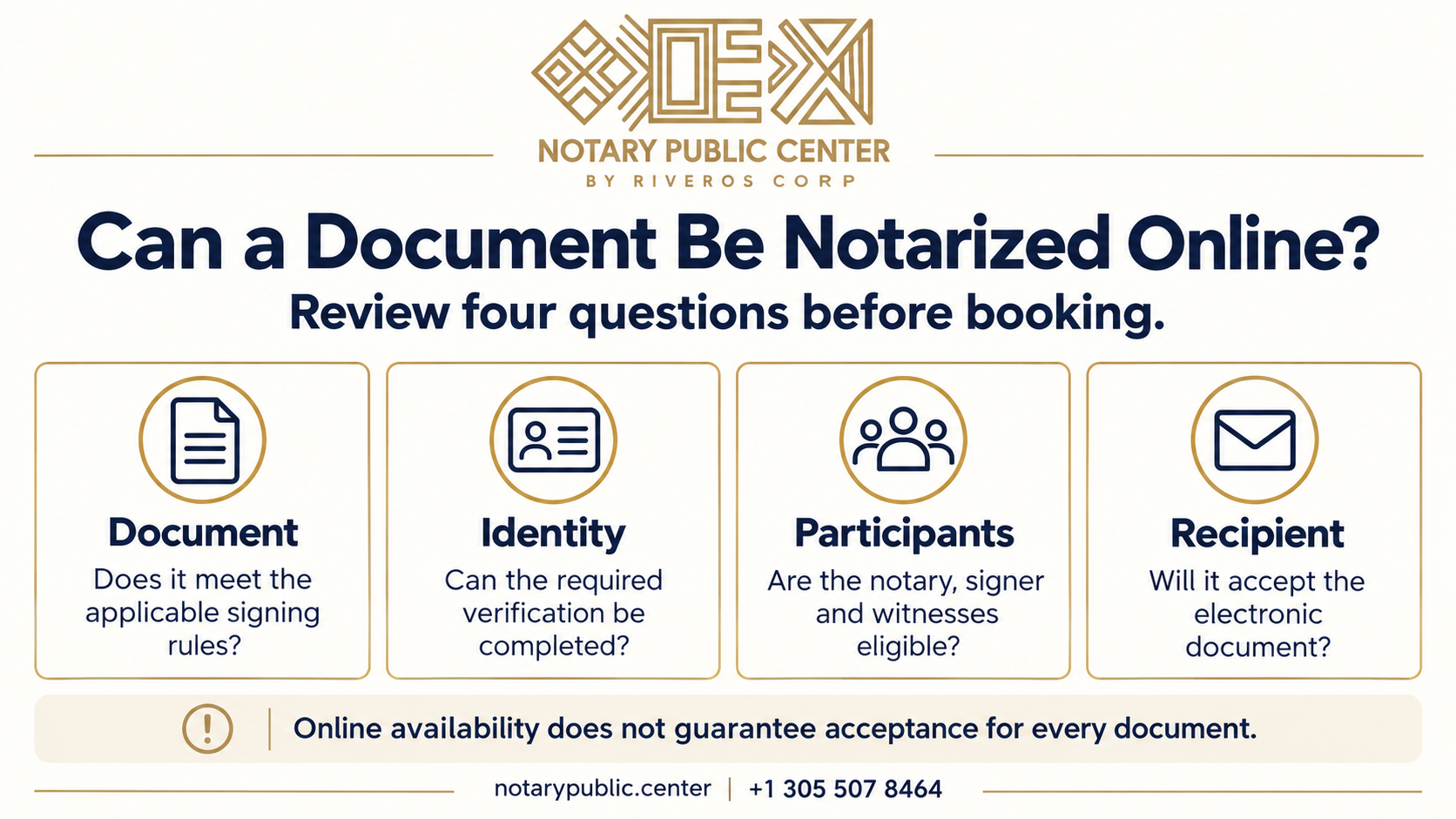
Affidavits, business instruments, property documents and powers of attorney may involve online notarization. However, a document’s general category does not answer every execution question. Its wording, governing law, witnesses and recipient can change the requirements.
For example, a lender or title company may specify the format and signing arrangement for a closing. A business document may require proof of the representative’s authority. Share those requirements before scheduling rather than assuming that any electronic seal will satisfy them.
Also, notarization does not validate every statement or legal term in the instrument. A notary who is not an attorney cannot advise you about the legal consequences of signing. Resolve those questions with a qualified attorney when necessary.
Estate documents require particular care
A will, trust or power of attorney can have requirements beyond the notarial act. Florida’s remote-witnessing statute includes additional safeguards for specified instruments. It also limits remote witnessing for vulnerable adults in the circumstances it covers.
Moreover, certain powers listed in section 709.2202 have their own execution conditions. Do not assume that an online notary can replace every physical witness requirement.
Our article on last wills online discusses related concerns. Obtain legal advice on the instrument itself before selecting the signing format.
Identity verification involves specific requirements
Florida allows the online notary to rely on personal knowledge or the required verification process. That process includes remote presentation of government-issued identification, credential analysis and identity proofing. These are not three interchangeable choices that every signer may freely select.
Consequently, a selfie or a first video meeting with an ID does not automatically replace the other checks. Nor should a provider promise that every foreign passport or identification circumstance will work through the same method.
Explain any identification concern before the appointment. For example, mention a name difference, a foreign-issued credential or difficulty with identity questions. The provider can then assess what the applicable requirements and available technology permit.
What if the identity checks do not work?
Ask which lawful alternatives are available for your document. A different appointment arrangement may be necessary, and the notary cannot simply waive a required check. Also, a successful verification attempt does not resolve unrelated witness or recipient requirements.
Avoid booking around an assumed fifteen-minute completion time. Identity review and document questions can require additional attention. Instead, explain your deadline and leave room for the provider to identify unresolved issues.
Witnesses and other participants need planning
Tell the service provider how many people must sign and whether the document requires witnesses. A witness has a different role from the notary. The required number and arrangement depend on the instrument and applicable law.
Under Florida’s remote-witnessing rules, a witness who appears remotely must confirm U.S. or U.S.-territory residence and physical location. This differs from the rules that may allow a principal to sign from another country. Therefore, do not assume that every participant may join from anywhere.
Also mention language needs and any practical difficulty using the technology. Clear communication is necessary for the notarial act. If someone assists with the connection, disclose that arrangement rather than assuming the person can answer for the signer.
Online, office and mobile appointments
The most useful format is the one that meets the document’s requirements and works for the participants. Compare the arrangements before booking, especially when the recipient expects paper originals or a particular witness setup.
| Arrangement | How participants meet | What to confirm |
|---|---|---|
| Remote online notarization | Through the authorized audio-video arrangement | Eligibility, identity checks, witnesses and electronic acceptance |
| Office appointment | Signer and notary meet physically | Document readiness, identification and required participants |
| Mobile notary | The notary travels to the agreed location | Location, availability and the document's execution requirements |
A mobile appointment does not automatically change the legal requirements. Likewise, an online service does not guarantee evening or weekend availability. Ask about the actual appointment and scope instead of relying on a general description of the service.
Documents that need a different kind of certification
An official birth, marriage or death record is different from a private document with a signature to notarize. In Florida, a notary cannot certify an ordinary photocopy of such a vital record as an official copy.
Section 117.05 addresses copy-attestation limits. The appropriate record custodian supplies the official certified copy. An online session does not remove that distinction.
A related affidavit or authorization may have its own notarization requirement. Therefore, identify exactly which document needs attention. Asking to “notarize my birth certificate” may refer to a different task from the one the receiving agency actually requires.
Prepare the document before the appointment
Provide the complete document for the agreed review, including its certificate and relevant attachments. Resolve material blanks in the applicant’s sections with the appropriate source. Florida generally prohibits notarization of an incomplete or blank document, subject to statutory exceptions.
If you already signed, tell the notary before changing anything. An acknowledgment may concern an earlier signature, while a jurat requires signing in the notary’s presence and an oath or affirmation. The form’s instructions may impose additional conditions.
Also check names, page references and the intended signing capacity. A company representative or agent should disclose that role early. A successful identity check does not establish that the person has authority to make every proposed declaration.
Confirm the practical arrangements
Ask what device and connection the service requires, and whether each participant can meet those needs. Plan for a setting where communication is clear. If the technology fails, the provider may need to pause or reschedule the act.
In addition, confirm how you will receive the completed electronic document. Keep the file in the form supplied and ask before making changes. Printing it does not automatically produce the paper original that a recipient may require.
International use may require another review
An overseas recipient may impose authentication, translation or format requirements beyond notarization. Confirm those requirements before the session. A valid Florida notarial act does not guarantee that every foreign office will accept its electronic format.
Likewise, an apostille authenticates the relevant official origin; it does not cure a defective document or approve its contents. Ask which authority and document form apply to the proposed submission. Avoid assuming that every online file can move through the same international route.
Notary Public Center can discuss the coordination involved. However, clarify the scope and timing before proceeding. The recipient’s decision and any separate government authentication remain outside a private provider’s control.
Frequently asked questions about online notarization
Can a document be notarized online in every state?
The notary’s authority and state requirements must support the act. Also, the document and receiving party may impose separate conditions. Identify the notary’s jurisdiction before booking. Do not equate a state’s future RON authorization with a service that is already operational.
Where must the Florida notary and signer be?
The Florida online notary must be physically in Florida. The principal may be elsewhere when the applicable requirements permit. However, remote witnesses have separate location rules, and the recipient may have additional conditions. Tell the provider where each participant will be.
Can I notarize a copy of a vital record online?
A Florida notary cannot turn an ordinary copy of a birth, marriage or death record into an official certified copy. Obtain the appropriate record from its custodian. If a separate affidavit or authorization needs notarization, identify that document and its purpose.
Does a video call alone satisfy identity verification?
No. The notary must follow the applicable identification requirements. Florida permits personal knowledge or the prescribed verification process. Showing an ID during a first video meeting does not automatically replace credential analysis and identity proofing.
Will every recipient accept the completed electronic file?
Confirm acceptance for the specific document and transaction. A recipient may require another format or supporting material. In addition, foreign use can involve authentication or translation. Resolve those questions before treating a completed online session as the last stage of the submission.
Discuss your online appointment with Notary Public Center
Contact Notary Public Center with the document type, participant locations and deadline. Include the recipient’s instructions and any witness or language requirements.
Request information by WhatsApp at +1 305 507 8464. The team can discuss whether the proposed online arrangement fits the document and explain any outstanding requirements.
This article provides general information and does not constitute legal advice. Reading it does not create an attorney-client relationship. Consult a qualified attorney about the document’s legal effect, signing authority or estate-planning requirements. Applicable law and the receiving organization’s rules govern the particular transaction.