

Corporations use a state filing to amend articles of incorporation when they need to change a charter provision. The amendment updates the filed record under the governing statute. Internal authorization, filing language and effective-date rules vary by state and by the type of change.
This guide explains when a corporation may need to amend articles of incorporation, which approvals may apply and when another filing may be more appropriate. It provides a planning overview rather than state-specific filing instructions.
What It Means to Amend Articles of Incorporation
The filed articles contain the corporation’s charter provisions. If the corporation wants to change a provision that appears in that document, internal records alone do not amend the state filing. The corporation uses the amendment method authorized by its state. The change takes effect under the statute and the filing’s permitted effective-date terms.
Internal governance changes often belong in bylaws or resolutions instead of the charter. A registered-agent change may also use a separate statutory form. The correct instrument depends on the provision and the state. Compare what articles of incorporation are with our guide to articles of incorporation vs. bylaws.
When You Need to Amend
Not every corporate change requires an amendment. However, several important ones do. The most common triggers are:
- Changing the corporate name. A rebrand or a name correction requires amending the articles so the legal name on file matches the name you use.
- Changing authorized shares. Increasing (or restructuring) the number or classes of authorized shares, often to bring in investors, requires an amendment.
- Changing the corporate purpose. If your stated purpose was specific and your business shifts, the purpose clause may need updating.
- Adding or revising provisions. Director liability limits, indemnification, or other provisions you want to add or change.
- Converting characteristics that are stated in the articles, depending on your state’s rules.
Some changes that people assume require an amendment actually use a separate, simpler filing, a change of registered agent, for example, is often its own form rather than a full amendment. Knowing which mechanism applies to your specific change is part of doing this correctly, and getting it wrong means filing the wrong document and starting over.
Approvals Needed to Amend Articles of Incorporation
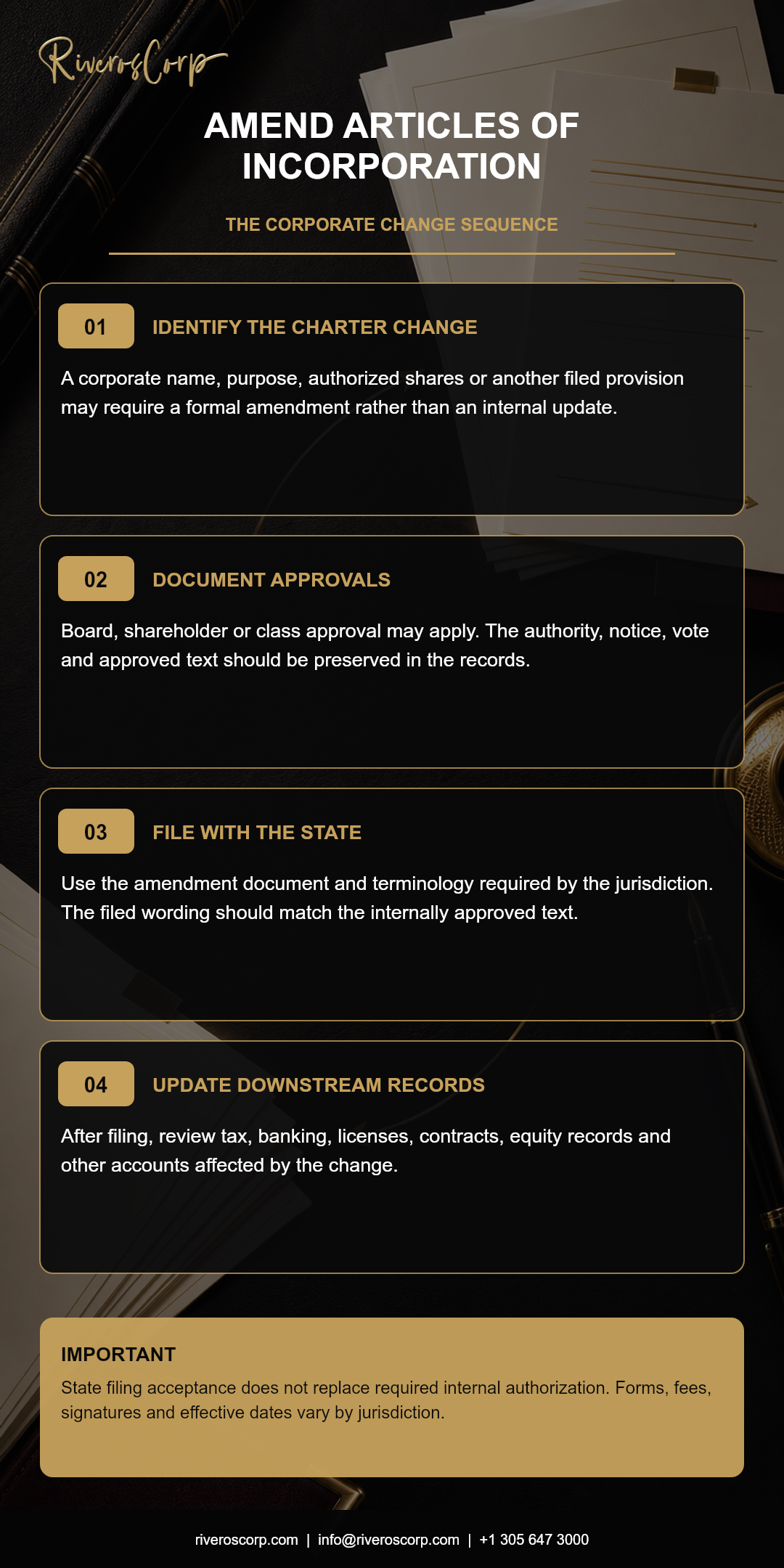
Many post-formation amendments require board action followed by shareholder approval. Exceptions can apply before stock issuance, for limited changes the board may make alone or under special nonstock rules. A class or series may also receive a separate vote when the amendment changes its rights. The corporation should document the authority, notice, vote and final text before filing.
The filing office reviews the submitted document under its administrative rules. That review does not replace the corporation’s duty to obtain and preserve the required internal authorization. Resolutions, consents, notices and vote records should match the filed amendment.
What the Amendment Process Involves
At a high level, the corporation identifies the charter change, confirms the required approvals and prepares the state’s amendment document. The filing may use the name articles of amendment, certificate of amendment or another statutory label. Fees, signatures, supporting statements and effective-date options vary. The filed record should match the authorized text exactly.
The Mistakes That Get Amendments Rejected
Common errors include using the wrong form, misstating the approved text and overlooking a required class vote. A proposed new name may also fail the state’s distinguishability rules. After a name or structural change, the corporation may need to update tax, banking, licensing and contract records under each recipient’s procedure. Those downstream updates do not occur automatically.
Why an Accurate Record Matters More Than You Think
It is tempting to treat an out-of-date article as a minor housekeeping issue, the business runs fine regardless. But the articles of incorporation are the document the outside world relies on to know your corporation’s legal identity, and a record that no longer matches reality creates friction precisely when you can least afford it. When you seek financing, an investor’s due diligence will compare your actual share structure to your authorized shares on file. A mismatch stalls the deal.
When you sell the company, the buyer’s counsel will expect the public record to line up with the corporation’s real name, ownership, and structure. When you open banking or licensing under a new name that was never formally amended, the inconsistency raises flags. In each case, the cost of the un-filed amendment is not paid when you skip it, it is paid later, with interest, when someone important notices the gap. Keeping the articles current is cheap insurance against expensive surprises.
Also, it is exactly the kind of maintenance that is easy to defer and painful to have deferred.
Amendment vs. Restatement: Knowing Which You Need
A corporation that has changed several times faces a related decision that founders rarely anticipate: whether to keep filing individual amendments or to consolidate everything into a single restated document. Each approach has its place, and choosing wrong makes your corporate record harder to work with. A single amendment is the right tool when you have one discrete change, a new name, more authorized shares. Also, want to record it efficiently.
Over time, though, a corporation that has filed amendment after amendment ends up with a fragmented record: to understand the current state of the articles, someone has to read the original document and then layer on each separate amendment in order, which is error-prone and off-putting to the investors and buyers who read these things closely.
That is when a restatement makes sense. Amended and restated articles gather the original articles and all prior amendments into one clean, current document that supersedes the tangle. Therefore, anyone reviewing your corporation sees a single authoritative version rather than a stack of patches. The trade-off is that a restatement is a more involved filing than a simple amendment. Therefore, it is not worth doing for every small change. However, it is very much worth doing when the record has accumulated enough amendments to be confusing, or when you are heading into a financing or sale where clean documents matter.
Knowing which instrument fits your situation, a targeted amendment, a full restatement, or in some states a simple change form, is part of handling corporate changes well. Also, it is exactly the kind of judgment that a self-service filing portal cannot offer. Our guide to amended and restated articles of incorporation covers the restatement path in detail.
Effective Dates and the Current Charter
An amendment does not stand alone. The corporation’s current charter consists of the original articles together with every effective amendment and any later restatement. A reviewer may need the entire sequence to understand the governing provisions.
Some states allow a delayed effective date or time. Others apply the filing date or another statutory rule. The corporation should confirm the effective date before using a new legal name, issuing shares under amended authority or representing that a purpose provision has changed.
After acceptance, obtain and preserve the filed evidence. A plain copy may work for internal records. Meanwhile, a bank, lender or foreign authority may request a certified copy. Ask the recipient what form it needs before ordering additional documents.
Voting Rights Can Change the Approval Process
A general shareholder vote is not always the complete analysis. An amendment that changes the rights of a class or series may trigger a separate class vote. The charter can also contain higher voting thresholds or protective provisions. Nonstock and nonprofit corporations follow different statutory rules.
Timing within the corporation’s life cycle matters as well. The incorporators or board may have limited amendment authority before the corporation issues stock. After issuance, the statute may require board and shareholder action. A short online form does not explain these internal distinctions.
Corporate records should identify who approved the amendment, the voting method and the final text. Written consents, meeting minutes and notices must satisfy the governing law and documents. If ownership or authorization is disputed, obtain legal advice before filing.
Amendment, Restatement or Separate Change Form
A targeted amendment works well for a discrete charter change. A restatement can consolidate the original articles and multiple amendments into one current document. Some states distinguish between a restatement that only consolidates existing text and one that also makes new changes.
Other updates do not change the charter. A registered-agent, principal-office or mailing-address change may use a separate filing. Annual reports sometimes update limited information without amending the articles. Using the correct instrument keeps the public record clearer and can reduce fees.
Records to Review After You Amend Articles of Incorporation
A name change can affect IRS records, bank accounts, licenses, insurance, contracts and vendor profiles. A share amendment can affect the equity ledger, subscription documents and investor approvals. A purpose change can affect licenses, tax classifications or contractual restrictions.
Create a recipient list based on the actual change. Do not assume that the state sends updates to another agency. Each recipient may request different evidence and apply its own processing time.
Keep the original filing, amendment, proof of acceptance and approval records together. If the corporation later restates the charter, preserve the historical documents as well. They may still matter for transactions that occurred before the restatement.
How Riveros Corp Helps Amend Articles of Incorporation
At Riveros Corp, we review the requested change, formation state and current charter. We can help identify the likely filing path, organize the available corporate approvals and prepare the state submission. Questions about fiduciary duties, voting disputes, tax effects or legal validity may require licensed counsel.
After filing, we can coordinate related administrative updates requested by the client. The state, IRS, bank and other institutions control their own records and acceptance. For ownership or name changes, review whether a foreigner can register a business in the USA and how the change may affect EIN records.
Need help deciding how to amend articles of incorporation? Contact Riveros Corp, call +1 305 647 3000, or use WhatsApp. We can review the requested change and coordinate the applicable filing.
Frequently Asked Questions
When do I need to amend my articles of incorporation?
When you change a core attribute recorded in the articles, the corporate name, authorized shares, purpose, or certain provisions. Internal changes like meeting procedures are usually handled in the bylaws instead. We determine whether your specific change needs an amendment or a simpler filing.
Do shareholders have to approve an amendment?
Many amendments require board action and shareholder approval. However, exceptions and class-vote rules vary. Review the state statute, charter and bylaws before filing. The corporation should preserve the resolutions, consents and vote record.
What is the document called that amends articles of incorporation?
Depending on the state, it is called articles of amendment or a certificate of amendment. It is filed with the same office that holds your original articles. We prepare it in the correct form for your state, see our guide to the certificate of amendment.
How long does an amendment take to process?
Processing time varies by state, filing method, workload and any available expedited service. Riveros Corp cannot control the filing office’s calendar. A complete submission can reduce avoidable correction requests.
Do I need to amend my articles to change my registered agent?
Often not, many states use a separate, simpler form to change a registered agent rather than a full amendment. Using the wrong mechanism wastes time. We identify the correct filing for your specific change and handle it.
What happens if I don’t amend when I should?
Your public record no longer matches your corporation’s reality, which causes problems during financing, a sale, or bank and license updates, a mismatch that stalls deals and raises flags. Keeping the articles current avoids those surprises. Also, we handle the amendments that keep them accurate.