An apostille in Washington DC can involve different authorities, depending on who issued or notarized the document. A federal agency record and a District of Columbia birth certificate do not follow the same route. Therefore, choosing an office simply because it is in the capital can send your request to the wrong place.
The practical concern is understandable: you need to send a document abroad without losing time on unnecessary travel or shipping. However, arranging delivery before reviewing the record can create another trip instead of resolving the request. The document’s origin, intended use, and required certification should guide that decision.
Apostille de la Haya reviews those details and coordinates the applicable administrative service. You can ask the team to assess the route and delivery arrangements before committing to a trip. The issuing authority controls certification, while the receiving institution decides whether the completed file meets its requirements.
Apostille in Washington DC: which authority applies?
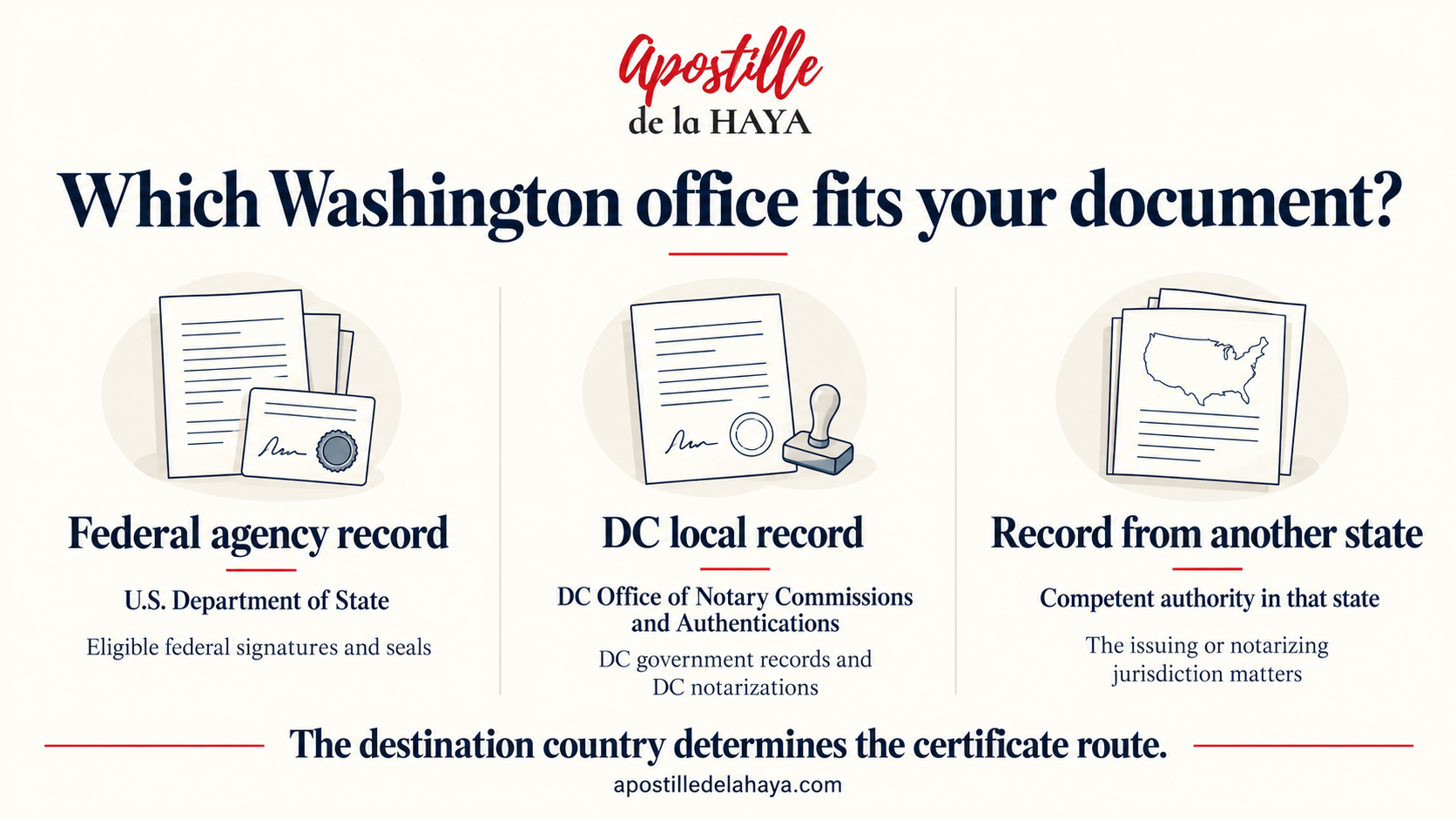
The U.S. Department of State’s Office of Authentications handles eligible federal agency records. These include FBI Identity History Summaries with the required federal certification. By contrast, the District of Columbia’s Office of Notary Commissions and Authentications, known as ONCA, handles eligible DC government records and DC notarizations.
Documents from another state generally belong with that jurisdiction’s competent authority for a Hague apostille. For example, living in Washington does not move a Florida-issued marriage certificate into DC’s authority. Likewise, a document’s intended use abroad does not make it a federal record.
There are also specific federal routes. Clerks and deputy clerks of federal courts can issue apostilles for their courts’ documents. Consequently, the phrase “federal document” does not always mean a submission to the Office of Authentications. Our guide to the US Department of State apostille explains that office’s role.
What a Washington apostille certifies
An apostille concerns the origin of a public document: the signature, the signer’s official capacity, and the relevant seal or stamp. It does not prove every statement in the document or determine the legal effect of the transaction. Therefore, a foreign employer or registry may still require a particular record format or translation.
The country of use also matters. When the Apostille Convention applies between the relevant jurisdictions, an apostille replaces the traditional legalization requirement for covered documents. Otherwise, the receiving country’s rules may require an authentication and consular legalization route.
This distinction affects both the certificate and the service scope. A request described casually as an “apostille” may actually need authentication for a non-Hague destination. Our comparison of apostille and authentication addresses that difference. Confirming the destination at the outset helps avoid ordering an unsuitable service.
Federal apostille in Washington DC: visits and mail
The Office of Authentications has separate arrangements for mailed requests and public visits. Its mailing intake is in Sterling, Virginia, while its public service office is in Washington. As a result, a mailing address and a walk-in address serve different purposes even when they concern the same federal request.
A delivery scan at a mail facility establishes a shipment event. It does not necessarily establish that an officer has reviewed the request. Therefore, status updates should distinguish delivery, processing, and return shipment instead of treating them as one event.
Routine drop-off is different from an emergency appointment
Current federal guidance provides routine walk-in drop-off and collection during a limited morning window, Monday through Thursday. It describes processing in seven business days. That service does not amount to a general same-day federal apostille option.
Emergency appointments have narrower eligibility. They concern qualifying international travel within two weeks because an immediate family member abroad has died, is dying, or has a life-threatening illness or injury. The office requires evidence. An approaching work or school deadline alone does not establish eligibility.
Before arranging travel, confirm the service available for your circumstances. The federal office’s schedule can change, and holidays affect public access. A representative’s presence in Washington cannot create an appointment category that the authority does not offer.
DC local documents follow a separate route
ONCA’s role concerns DC government signatures and DC notaries. Its published services include same-day walk-in authentication for eligible documents. However, that local service does not include federal records such as FBI background checks. Similar office names should not obscure their different authority.
A DC notarization also does not automatically replace the certification required for an original public record from another jurisdiction. The relevant question is which signature the recipient needs authenticated. Simply adding a local notarization can leave that question unresolved.
For example, a document package may contain a DC-notarized statement and a certificate from another state. Review each item separately before treating the package as a single local request. The place where you assembled the documents does not give one office authority over all their signatures.
Shipping an apostille request from outside Washington
You do not necessarily need to travel to the capital to arrange an apostille in Washington DC. Mailed submission and representative services may fit the applicable route. However, the plan should identify the eligible document, submission channel, and return destination before an original leaves your possession.
Tracked shipping provides delivery information, but it cannot remove every transit risk. Keep the distinction clear between carrier tracking and an authority’s processing status. A useful service update should say which stage the record has reached and what remains outstanding.
Return arrangements deserve the same attention as the outbound shipment. For instance, a requester may leave the country while the authority still holds the file. That change can affect the delivery plan, particularly when the intended recipient or address also changes.
When the requester lives abroad
Distance adds coordination questions, including international delivery availability and the recipient’s document deadline. Contact the team before sending an irreplaceable original. The review should establish whether the existing record is suitable or whether you need an eligible certified copy.
Also distinguish a scan used for preliminary review from the document required for certification. Sending an image electronically does not establish that the authority accepts that image as the formal submission. The available format depends on the specific record and route.
When a state record needs federal authentication
A state-issued record may require a federal stage when the destination calls for non-Hague legalization. In that situation, the file can involve state certification, federal authentication, and the relevant foreign mission. Therefore, saying that state records “never go to Washington” would be inaccurate.
The destination’s requirements determine the applicable chain. However, a federal authentication certificate does not convert the underlying state record into a federal document. That distinction helps explain why preliminary state certification can still matter.
A birth certificate illustrates the issue. Its issuing jurisdiction remains relevant even when a foreign embassy requires a later federal authentication. Our discussion of federal authentication of a birth certificate explains the distinction without assuming every certificate needs that additional stage.
Apostille in Washington DC: avoidable routing problems
Several issues can disrupt a request before the authority reaches the certification decision. They deserve attention during the initial review:
- Confusing local and federal offices. DC’s local authority does not process an FBI record merely because both offices operate in Washington.
- Assuming routine same-day federal service. Published walk-in and emergency services have different conditions. A private deadline does not change them.
- Using the wrong record format. An uncertified copy may lack the signature or seal that the relevant authority needs to authenticate.
- Choosing a route without the destination. The country of use affects whether an apostille or authentication route applies.
- Leaving return delivery unresolved. The submission plan should account for where the completed document must go and who can receive it.
These issues can require clarification or a different submission. However, the outcome depends on the actual file and authority. A review should identify a concrete concern without predicting rejection simply because a document looks unfamiliar.
Planning the complete timeline
A processing estimate covers a particular stage. Obtaining a suitable record, delivery to the authority, return shipping, and any later legalization can add time. Therefore, the date when you first contact a service provider is different from the date the authority receives an eligible request.
A destination may also impose its own requirements about the age of an underlying record. Those requirements need separate review; the apostille date alone may not resolve them. If you have an appointment abroad, share both the appointment date and the recipient’s written instructions.
Apostille de la Haya can discuss the available route and identify timing assumptions that need confirmation. However, neither a courier service nor an early submission can guarantee the authority’s decision or a foreign institution’s acceptance date.
What the service assessment should cover
The scope of an apostille in Washington DC depends on the record and its destination. Document review, certification coordination, delivery, and additional legalization are distinct services. Consequently, an assessment should explain which parts apply to your file before you approve the work.
A useful estimate identifies the documents involved and any unresolved requirements. For example, it should distinguish authentication support from obtaining a replacement record or arranging a translation. That clarity helps you compare the proposed service with what the receiving institution actually requested.
Contact Apostille de la Haya for an assessment based on your documents. Explain where the file will go and any known deadline. The team can then discuss the applicable scope instead of quoting a service that assumes the wrong authority or certificate.
How Apostille de la Haya coordinates your request
The review starts with the issuing authority, document format, destination, and receiving institution’s instructions. These details help distinguish a federal apostille in Washington DC from a local DC request or another jurisdiction’s service.
Depending on the agreed scope, support may include reviewing the file, preparing administrative request materials, coordinating submission, and arranging tracked return delivery. If the destination requires consular legalization, that additional work needs its own assessment.
You should also know what remains your responsibility. For example, the team may need an eligible record or clarification from the receiving institution before proceeding. Clear responsibilities make progress easier to follow and reduce avoidable misunderstandings about the service.
Apostille de la Haya is a private service provider. The competent public authority issues the certification and controls its processing. Our role is to help prepare and coordinate the request within those requirements.
Apostille in Washington DC: common questions
Does every federal document go to the same office?
No. The Office of Authentications handles eligible federal agency records, while federal court clerks have authority over their courts’ documents. Therefore, confirm the issuing body before choosing a submission route.
Can I get a federal apostille the same day?
Routine federal drop-off is not a general same-day service. Qualifying emergency appointments have separate eligibility requirements. By contrast, DC’s local office offers same-day service for eligible local documents, which excludes FBI records.
Can I arrange the service while living abroad?
You can contact the team from abroad to review the document and available service. However, confirm submission format and international return arrangements before shipping. A preliminary scan does not replace every required original.
Does an apostille guarantee acceptance abroad?
No. It certifies the document’s origin within its legal scope. The receiving institution still decides whether the record, translation, and supporting material meet its requirements. Therefore, share those instructions during the initial review.
How do I assess the likely timeline?
Separate document preparation, authority processing, delivery, and any later legalization. Also share the intended-use deadline. The team can discuss the applicable route, but the authority controls issuance and the recipient controls acceptance.
Discuss your Washington apostille request
Contact Apostille de la Haya with the document type, issuing jurisdiction, destination country, and recipient’s instructions. We can review the applicable authority and discuss the service scope.
Call +1 305 500 0185 or contact us on WhatsApp.
This article provides general information, not legal advice. Confirm current requirements before submission. Public authorities control certification, and receiving institutions control their document requirements.