
Florida is a common formation state for businesses with operations, owners or commercial relationships in the region. If you are looking at articles of incorporation in Florida, you are looking at the single document that brings your Florida corporation to life. Getting its contents right is what stands between a clean approval and a rejected filing, a corrective filing or later mismatch in the corporation’s records.
The search phrase articles of incorporation Florida usually refers to the charter filed to form a Florida corporation and the state-specific requirements that govern it.
This guide lays out what a Florida corporation’s articles of incorporation must contain, the state-specific rules that trip founders up, and the obligations that begin the moment your corporation exists. It is written for founders who want to understand the real requirements before they file. Also, it closes with how Riveros Corp prepares and files your Florida articles correctly, including for foreign owners with no Social Security Number.
What Are Articles of Incorporation in Florida?
In Florida, articles of incorporation are the legal document you file with the Florida Department of State, Division of Corporations (through the Sunbiz portal) to create a corporation. Florida’s business corporations are governed by Chapter 607 of the Florida Statutes. Nonprofit corporations fall under Chapter 617. Once the Division accepts your articles, your corporation legally exists as a separate entity that can sign contracts, own property, open a bank account, and provide shareholders with limited liability under applicable law.
The document is a public record. Anyone can look it up on Sunbiz. Its purpose is to put the state and the public on notice that your corporation exists, who receives legal notices on its behalf, and how it is structured at the highest level. If you want the broader context first, see our overview of what articles of incorporation are.
What Florida Requires in Your Articles of Incorporation
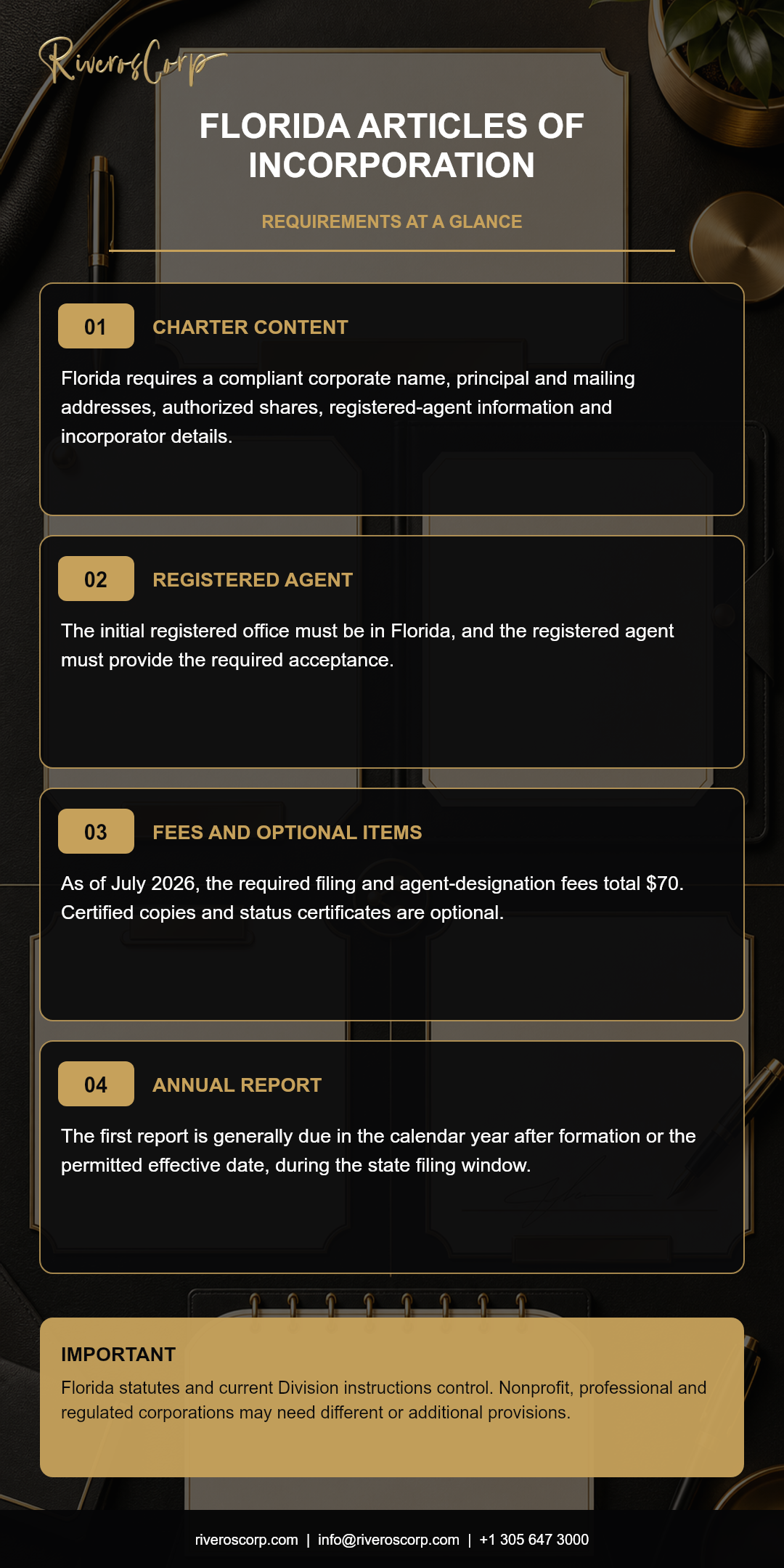
Florida asks for a specific set of core elements. Leaving any of them out, or getting one wrong, is what gets a filing rejected. A Florida for-profit corporation’s articles generally must include:
- Corporate name. It must be distinguishable from every other entity on file in Florida and must contain a corporate suffix. “Incorporated,” “Corporation,” “Inc.,” or “Corp.”
- Principal place of business and mailing address of the corporation.
- Registered agent and registered office. A person or company with a physical street address in Florida, not a P.O. box, authorized to accept legal documents, plus the agent’s written acceptance of the designation.
- Number of authorized shares the corporation is allowed to issue.
- Incorporator. The name and address of the person signing and submitting the articles.
- Officers and directors (optional in the articles for a Florida for-profit corporation. However, commonly included).
- Effective date (optional, you can specify a delayed effective date within the window Florida allows).
Nonprofit corporations under Chapter 617 have different requirements. An organization seeking section 501(c)(3) recognition must also satisfy the federal organizational test through its organizing document and applicable state law. We cover that in our guide to nonprofit articles of incorporation.
The Florida-Specific Rules That Trip Founders Up
The list of required fields looks manageable. What the form does not explain is the judgment behind each one. From forming Florida corporations for founders across the U.S. and abroad, these are the details that quietly cause problems:
- “Distinguishable” is stricter than it sounds. A name that looks available in a quick search can still be too close to an existing entity, triggering a rejection. A proper clearance check is more than a lookup.
- The registered agent must sign the acceptance. Florida requires the agent’s signature accepting the role. Naming an agent who has not agreed, or an address not genuinely staffed during business hours, creates a defect.
- Authorized shares are a strategic choice, not a default. The number you authorize affects control and future investment. Setting it carelessly can complicate bringing in shareholders later.
- The annual report is not optional. Every Florida corporation must file an annual report each year to stay active. Miss it. Also, the state can administratively dissolve your corporation, reinstatement then costs more than doing it right.
C Corporation vs. S Corporation in Florida
A frequent question is whether to be an S corporation or a C corporation in Florida. This is not a choice you make in the articles of incorporation themselves. You file the same articles to create the corporation, and the S election is a separate step with the IRS after formation. Florida has no state personal income tax, which changes the calculus compared with high-tax states, and A nonresident alien cannot be an S corporation shareholder.
A corporation that does not qualify for or make an S election generally remains subject to C corporation tax rules. Our comparison of articles of incorporation for C corp and S corp explains how the two relate.
Obligations That Begin the Moment You Incorporate
Filing your Florida articles is the start, not the finish. Once your corporation exists, it inherits ongoing responsibilities that keep it valid and keep your liability shield intact:
- Annual report filed with the Division of Corporations each year to remain active.
- A continuously valid registered agent, if the agent resigns or the address lapses, you must update it promptly.
- An EIN from the IRS, needed to open a corporate bank account, hire, and file taxes.
- Current federal reporting review. Beneficial-ownership reporting rules have changed. Confirm the rule in effect for the specific entity instead of relying on older summaries.
- Corporate formalities, bylaws, an organizational meeting, and share issuance, that a court looks at if anyone ever tries to pierce the liability shield.
The Most Common Florida Filing Mistakes
The errors we see most often are not exotic. They are ordinary oversights with expensive consequences: a corporate name that is not truly distinguishable and gets rejected. A registered agent that lapses and costs the corporation its good standing. Authorized shares set without regard to future fundraising. And, the quietest failure of all, forgetting the annual report and waking up to an administratively dissolved corporation. Each issue can create additional fees, status problems or records that need correction. Filing in Florida is easy. Filing in a way that holds up is where experience earns its keep.
Why Founders Choose Florida to Incorporate
Florida can be an appropriate formation state for a business with a genuine connection to its operations and compliance plans, and the reasons go beyond geography. Florida has no state personal income tax, which is meaningful for owners who will draw income from the business, and its filing process through Sunbiz is comparatively fast and modern. For entrepreneurs whose customers, suppliers, or families are in Latin America, Florida is the natural bridge into the U.S. market.
Miami in particular functions as a commercial gateway between the Americas, which is why so many international founders anchor their U.S. corporation here rather than in a distant state they will never set foot in.
Compare Florida with the State of Actual Operations
There is also a practical dimension that founders underestimate: incorporating where you actually do business avoids the cost and complexity of registering as a “foreign” corporation in a second state. Founders sometimes hear that Delaware is the default choice and assume they must incorporate there. Delaware makes sense for companies chasing venture capital or planning a public offering. However, for an operating business rooted in Florida or serving the region, incorporating in Florida may avoid a second-state qualification when the business is genuinely based there.
The right state is the one that fits your operations and goals, not a reflex. Also, that judgment is part of what we bring to every formation.
It is also worth knowing that Florida treats its corporations and LLCs through the same Division of Corporations. Therefore, the choice between them is a substantive one about structure and taxation, not about which office you visit. A Florida corporation carries more formality, a board, officers, shares, annual minutes. Meanwhile, a Florida LLC is lighter to run. Founders who want to issue stock, bring in investors, or project the credibility of an “Inc.” lean toward the corporation and its articles of incorporation. Those who want simplicity often choose the LLC.
Neither is universally better, and choosing based on a slogan rather than your actual plans is how founders end up refiling. We start from your goals and file the structure that genuinely fits.
Florida currently requires a profit corporation to file its first annual report in the calendar year after its filing or permitted effective date. The regular filing window runs from January 1 through May 1. As of July 2026, the profit-corporation annual-report fee is $150, and a report received after May 1 carries a $400 late fee. The current state schedule should be checked before payment.
Founders can also review Riveros Corp’s company formation service before selecting the state, entity and filing package.
How Riveros Corp Files Your Florida Articles
At Riveros Corp we form Florida corporations for entrepreneurs inside and outside the United States, including foreign founders with no Social Security Number. We handle the parts that quietly go wrong: clearing an available, compliant corporate name. Appointing a proper Florida registered agent with a valid acceptance. Structuring authorized shares sensibly. Preparing the articles with every required element under Florida law. And lining up your EIN so the corporation is operational from day one.
You do not deal with the Division of Corporations, decode Chapter 607 requirements, or discover a defect months later at the bank. We manage the filing end to end and keep your corporation in good standing afterward, including annual-report support intended to reduce avoidable status problems. If you are an international founder, our guide on whether a foreigner can register a business in the USA is a helpful companion, and after filing you will want your proof of EIN.
Need help reviewing articles of incorporation florida for your planned entity? Contact Riveros Corp, call +1 305-647-3000, or use WhatsApp. We can coordinate the formation filing and identify questions that require licensed legal or tax advice.
Frequently Asked Questions
What must Florida articles of incorporation include?
At minimum: a distinguishable corporate name with a proper suffix, the principal and mailing address, a Florida registered agent with a physical address and signed acceptance, the number of authorized shares, and the incorporator. Nonprofits and tax-exempt organizations need additional clauses. We review each required element before filing. The Division controls acceptance.
Where are Florida articles of incorporation filed?
With the Florida Department of State, Division of Corporations, through the Sunbiz portal or by mail. Once accepted, your corporation legally exists. We handle the entire filing so you can avoid managing the filing office directly.
Does a Florida corporation have to file an annual report?
Yes. Every active Florida corporation must file an annual report each year with the Division of Corporations. Missing it can lead to administrative dissolution. We keep your corporation compliant so this never catches you off guard.
Do I need a Florida address to incorporate in Florida?
You need a Florida registered agent with a physical street address in the state. However, you as the owner do not have to live in Florida or the U.S. We can serve as or arrange a compliant registered agent, which is exactly how foreign founders incorporate here.
How much does it cost to file articles of incorporation in Florida?
Florida sets its own filing fee, plus optional add-ons like a certified copy or certificate of status. Because state fees change, contact us and we will confirm the current amount and advise which add-ons your situation actually needs.
Can a non-U.S. resident form a Florida corporation?
Yes. There is no citizenship or residency requirement, and no SSN is needed, to own a Florida corporation. A foreign owner cannot elect S status. Therefore, the entity defaults to a C corporation. We handle the filing and the EIN so you can operate from anywhere in the world.