When you look at Florida’s incorporation options, you will see the phrase electronic articles of incorporation and may assume it is a different kind of document. It is not. “Electronic” simply refers to how the articles are filed, online, through the state’s system, rather than a separate legal instrument. But the distinction between electronic and paper filing does carry real practical consequences, and understanding them helps you avoid the assumption that filing online means the state is checking your work.
This guide explains exactly what electronic articles of incorporation are in Florida, how online filing differs from a paper filing, and why the convenience of e-filing does nothing to protect you from the errors that get corporations rejected or defectively formed. It is written for founders who want to understand the tool before they trust it. Also, it ends with how Riveros Corp files your electronic articles correctly so your Florida corporation is solid from day one.
What “Electronic Articles of Incorporation” Actually Means
Articles of incorporation are the legal document that creates a corporation. “Electronic articles of incorporation” are those same articles, filed through Florida’s online system with the Division of Corporations rather than printed and mailed. The governing statutory requirements remain the same. Meanwhile, the submission format and payment method differ. When the state accepts an electronic filing, your corporation exists exactly as it would from a paper filing, same public record, same document number, same obligations.
Florida offers online filing for for-profit corporations, nonprofit corporations, and LLCs, each through its own electronic form. The electronic route provides online payment and electronic correspondence. But the speed can create a false sense of security: a founder sees “filing accepted” and assumes everything was done right, when in reality the confirmation does not replace the Division’s examination or a separate business and legal review. If you want the full picture of the document itself, start with our overview of what articles of incorporation are.
Electronic Filing vs. Paper Filing in Florida
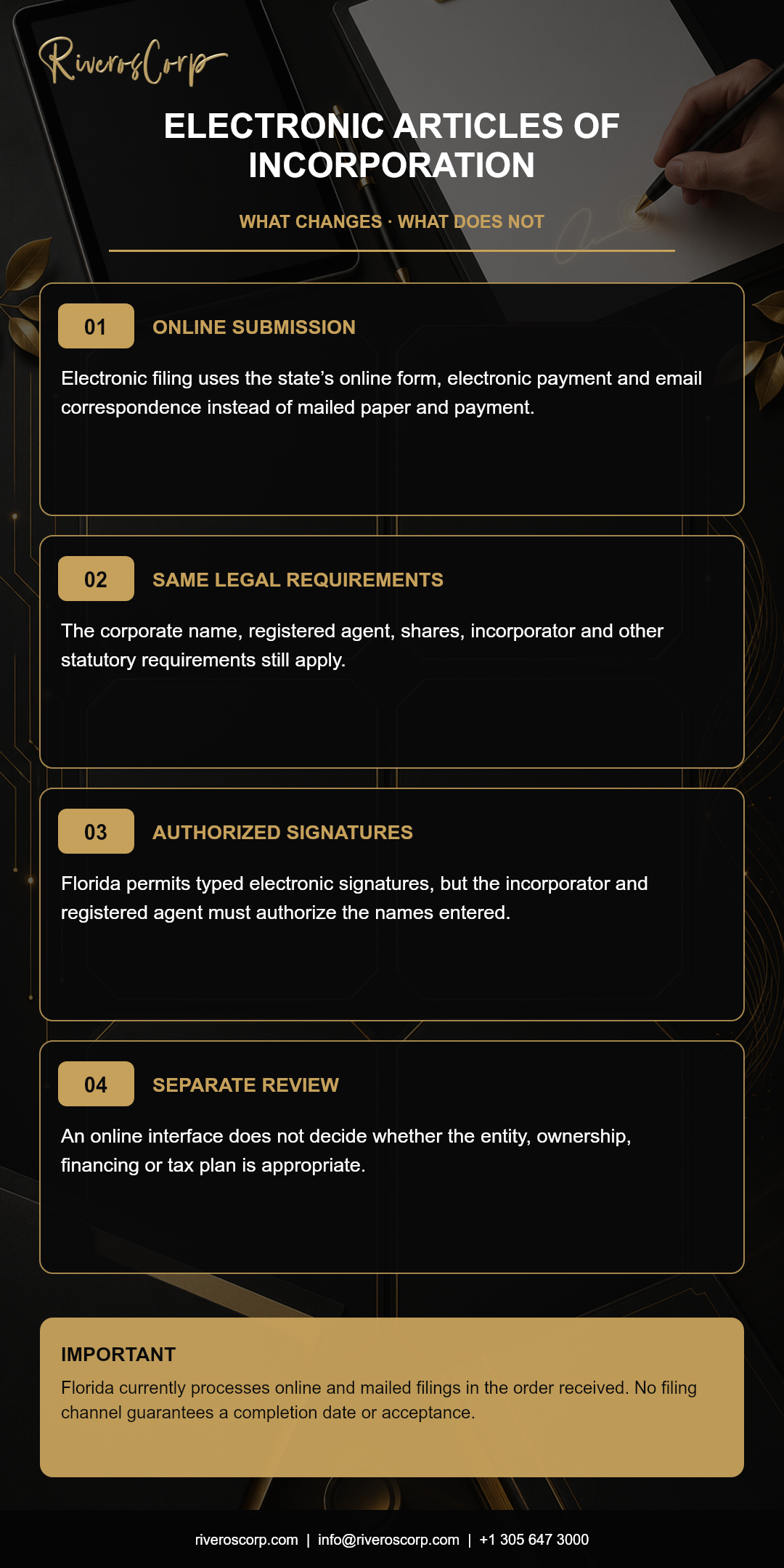
Both methods produce the same legal result, a validly formed corporation. However, they differ in speed, convenience, and the way errors surface. Online filing uses electronic payment and email correspondence. Mailed filing uses a paper form and mailed payment. Neither, however, changes the substance of what you are filing. A mistake filed electronically is just as damaging as one filed on paper. The online form does not review your choices any more than a mailed form does.
| Aspect | Electronic filing | Paper filing |
|---|---|---|
| Speed | Online submission, electronic payment and email correspondence | Paper submission and mailed payment. Processed in the order received |
| Legal effect | Identical, creates the corporation | Identical, creates the corporation |
| Error checking | Division examination for minimum statutory filing requirements | Division examination for minimum statutory filing requirements |
| Strategic review | None, the system does not advise | None, the reviewer does not advise |
The takeaway is simple: choosing electronic filing is a decision about convenience, not correctness. It saves time. Also, we use it for most formations. However, it is not a substitute for getting the underlying decisions right.
What the Electronic Form Does Not Do for You
The online form gives you fields, defaults, and a submit button. What it does not give you is judgment. From filing electronic articles for founders across the U.S. and abroad, here is what the system quietly leaves to you:
- Name clearance. The form blocks exact duplicates. However, Florida’s “distinguishable” standard is stricter, and a name that passes the field can still be rejected on review.
- Registered-agent validity. The form accepts an agent and address without confirming the agent has truly agreed or that the address is staffed during business hours.
- Share structure. The default share fields do not stop you from authorizing a number that will complicate a future investment round.
- The right entity. The system offers electronic articles of incorporation (a corporation) and electronic articles of organization (an LLC) side by side, and will not tell you which fits your goals.
- What comes after. The confirmation screen does not remind you to obtain an EIN, adopt bylaws, issue shares, or file your first annual report.
We deliberately avoid turning this into a field-by-field walkthrough. This is because the choices that determine whether your corporation is set up correctly depend on your specific entity, ownership, and residency. Also, that is the judgment we bring to each case.
The Convenience Trap: Fast Is Not the Same as Right
The biggest risk with electronic articles of incorporation is psychological. Because the online interface can be completed quickly, founders assume the ease of the process reflects the soundness of the result. It does not. We regularly see corporations that were e-filed in a hurry with a name that later drew a dispute, a registered agent who never accepted the role, or a share structure that had to be amended before investors would come in, each requiring a follow-up filing, a fee, and lost time to fix.
The online form is a fast road. However, a fast road to the wrong destination is not progress. The value is not in clicking submit quickly. It is in knowing what to submit.
Consider how the trap plays out in practice. A founder e-files on a Friday afternoon, gets an instant confirmation, and celebrates having “incorporated in ten minutes.” Weeks later a bank asks for the corporation’s documents to open an account and flags that the registered agent on file never formally accepted the role, or that the corporate name is confusingly similar to another entity the bank already knows. Now the founder is amending the articles, another filing, another fee, another wait, at exactly the moment they needed the account open.
The ten-minute filing has cost weeks. The lesson is not that electronic filing is bad. It is that the instant confirmation measures speed, not soundness. Also, founders who mistake one for the other pay for it downstream. A corporation is a legal foundation you will build on for years, and a foundation poured quickly but incorrectly is more expensive to fix than to lay properly the first time.
Who Can Safely Self-File, and Who Should Not
Electronic filing is a genuine convenience. Also, it would be dishonest to pretend no one should ever use it directly. A founder with a straightforward for-profit corporation may choose to use the state form directly after reviewing the current instructions and the consequences of each entry. The document is standardized, and their situation has few moving parts. For that narrow profile, the electronic form does most of what it needs to.
When Electronic Filing Needs Additional Review
More complex ownership, financing, nonprofit or cross-border facts call for additional review, and the ones who most need help are the ones most likely to assume the easy form makes expertise unnecessary. If you plan to raise investment, issue different classes of stock, or bring in co-owners, the share structure you type into the form has consequences the form will never flag. If you are forming a nonprofit, the electronic articles need IRS-specific clauses the standard fields do not prompt for.
And if you are a foreign founder, no U.S. address, no Social Security Number, the electronic path interacts with EIN issuance and banking in ways that trip people up constantly when done in the wrong order. In each of these cases, the speed of e-filing is precisely what lures founders into locking in a decision they did not know they were making.
The honest rule of thumb is this: the simpler your corporation, the more you can lean on the electronic form. The more your corporation involves investors, multiple owners, tax-exempt status, or foreign ownership, the more the form’s convenience becomes a liability rather than an asset. We tell founders plainly which category they are in. Also, we handle the filing for the ones who should not be gambling on a fast form. The goal is never to talk a simple case into complexity it does not need.
It is to make sure a founder who does have complexity is not lulled by a ten-minute form into treating it as if it were simple. Matching the level of care to the actual situation is the judgment that a form, by design, can never provide.
Florida permits an online signature by typing an authorized name in the signature block. The state treats that electronic signature as having the same legal effect as an original signature. Permission still matters: typing another person’s name without authority can create serious legal consequences. The incorporator and registered agent acceptance should be confirmed before the filing is submitted.
Founders can also review Riveros Corp’s company formation service before selecting the state, entity and filing package.
How Riveros Corp Files Your Electronic Articles
At Riveros Corp we file electronic articles of incorporation in Florida for entrepreneurs inside and outside the United States, including foreign founders with no Social Security Number. We use the speed of e-filing while supplying everything the form cannot: a genuinely clear corporate name, a proper registered agent with a valid acceptance, a sensible share structure, articles that contain every required element, and an EIN lined up so the corporation is operational from day one.
You can avoid completing the online form, decode its defaults, or wonder whether the instant confirmation hides a defect. We manage the entire filing and keep your corporation in good standing afterward, including annual-report coordination after formation. If you are an international founder, our guide on whether a foreigner can register a business in the USA is a helpful companion, and after filing you will want your proof of EIN.
Need help reviewing electronic articles of incorporation for your planned entity? Contact Riveros Corp, call +1 305-647-3000, or use WhatsApp. We can coordinate the formation filing and identify questions that require licensed legal or tax advice.
Frequently Asked Questions
Are electronic articles of incorporation different from regular articles of incorporation?
No. “Electronic” refers only to filing the articles online rather than on paper. The document, its legal effect, and its requirements are identical. The state accepts the same content either way. We file electronically for speed while making sure the substance is correct.
Is electronic filing faster than paper in Florida?
Generally, yes. Online filings use electronic submission and email correspondence. Meanwhile, paper filings depend on mailed forms and payment. Florida currently says both are processed in the order received. But speed does not equal correctness, the online form does not review your choices, which is where our work matters.
Does filing electronically mean the state checks my work?
No. The electronic form confirms only that required fields are completed and that the name is not an exact duplicate. It does not evaluate whether your name is truly clear, your agent valid, or your entity choice right. Those judgments are left entirely to you, or to us.
Can I file electronic articles of incorporation from outside the United States?
Yes. There is no residency requirement to own a Florida corporation, and e-filing can be done from anywhere. A nonresident alien cannot be an S corporation shareholder. If the corporation does not qualify for or make an S election, the C corporation tax rules generally apply. We handle the electronic filing and the EIN so you can operate from abroad.
Do I still need a registered agent when filing electronically?
Yes. Every Florida corporation must designate a registered agent with a physical in-state address, regardless of filing method. The electronic form accepts the designation but does not verify it. We can serve as or arrange a compliant registered agent for you.
What happens after my electronic articles are accepted?
Your corporation legally exists. However, the work is not done: you need an EIN, bylaws, issued shares, and your first annual report to keep the corporation functional and in good standing. The confirmation screen will not mention any of this, we handle the full sequence.