A state can accept a nonprofit corporation even when its organizing document does not support federal recognition under section 501(c)(3). That distinction is central to 501(c)(3) articles of incorporation. State filing rules create the entity. The Internal Revenue Service then applies a separate federal test to the document.
Good intentions do not repair inconsistent purposes, powers or asset provisions. Charitable operations do not repair them either. The organizing document must support the federal standard on its own terms.
The IRS calls this the organizational test. It is distinct from the operational test, which evaluates what the organization actually does. The organizational test focuses on the articles of incorporation and the law of the state where the corporation was created. Limits placed only in bylaws, internal policies or statements by officers generally do not substitute for the required limits in the organizing document.
This article covers six core issues:
- the exempt-purpose limitation;
- restrictions on non-exempt powers;
- permanent dedication of assets;
- the role of state law;
- Form 1023 and Form 1023-EZ; and
- additional requirements for private foundations.
The article provides a framework, not model clauses or a filing tutorial. Each provision must fit the organization’s mission, classification and formation state.
State Nonprofit Formation and Federal 501(c)(3) Recognition
Section 501(c)(3) covers organizations formed and operated exclusively for qualifying purposes. These purposes include charitable, religious, educational, scientific and literary work. They also include public-safety testing, certain amateur sports activities, and the prevention of cruelty to children or animals.
Federal recognition can provide exemption from federal income tax. Qualifying contributions may also be deductible under the applicable rules. However, those results do not arise merely because a state labels a corporation “nonprofit.”
The state filing and the federal exemption application therefore serve different functions. The state determines whether the corporation was properly created under its nonprofit or non-stock law and what the articles mean under that jurisdiction’s law. The IRS determines whether the organization meets federal exemption requirements. A state filing office can accept articles that satisfy its minimum fields even when the language is too broad, internally inconsistent or otherwise unsuitable for section 501(c)(3).
Also, do not confuse the entity’s legal form with its federal tax classification. Corporations, LLCs and unincorporated associations follow different organizing-document rules. Our comparison of corporations and LLCs explains this distinction.
For a corporation, the filed articles of incorporation are the primary organizing document the IRS examines. Choosing the state-law structure remains separate from seeking federal tax treatment.
What the IRS Organizational Test Examines
The organizational test asks three basic questions:
- Does the organizing document limit the corporation to one or more exempt purposes?
- Does it avoid granting broad powers for activities outside those purposes?
- Does it permanently dedicate the organization’s assets to exempt or qualifying public purposes?
The IRS reads these elements together. For example, a document may refer to section 501(c)(3) in one paragraph. Yet another paragraph may grant broader powers or direct assets to private persons. The favorable sentence does not cancel the conflicting language.
The analysis is also specific to the document and formation state. State law may affect how a term is interpreted. However, an organization must support a narrower state-law meaning with authoritative legal material.
Therefore, copying a clause from another state can be unreliable. The surrounding statute, filing form and legal interpretation may differ.
Bylaws remain important for governance, but they generally do not satisfy a limit that the federal organizational test requires in the creating document. Nor does evidence that the organization has operated charitably cure articles that authorize non-exempt purposes. The organizational and operational tests are complementary, not interchangeable.
The Purpose Clause and Limits on Corporate Powers
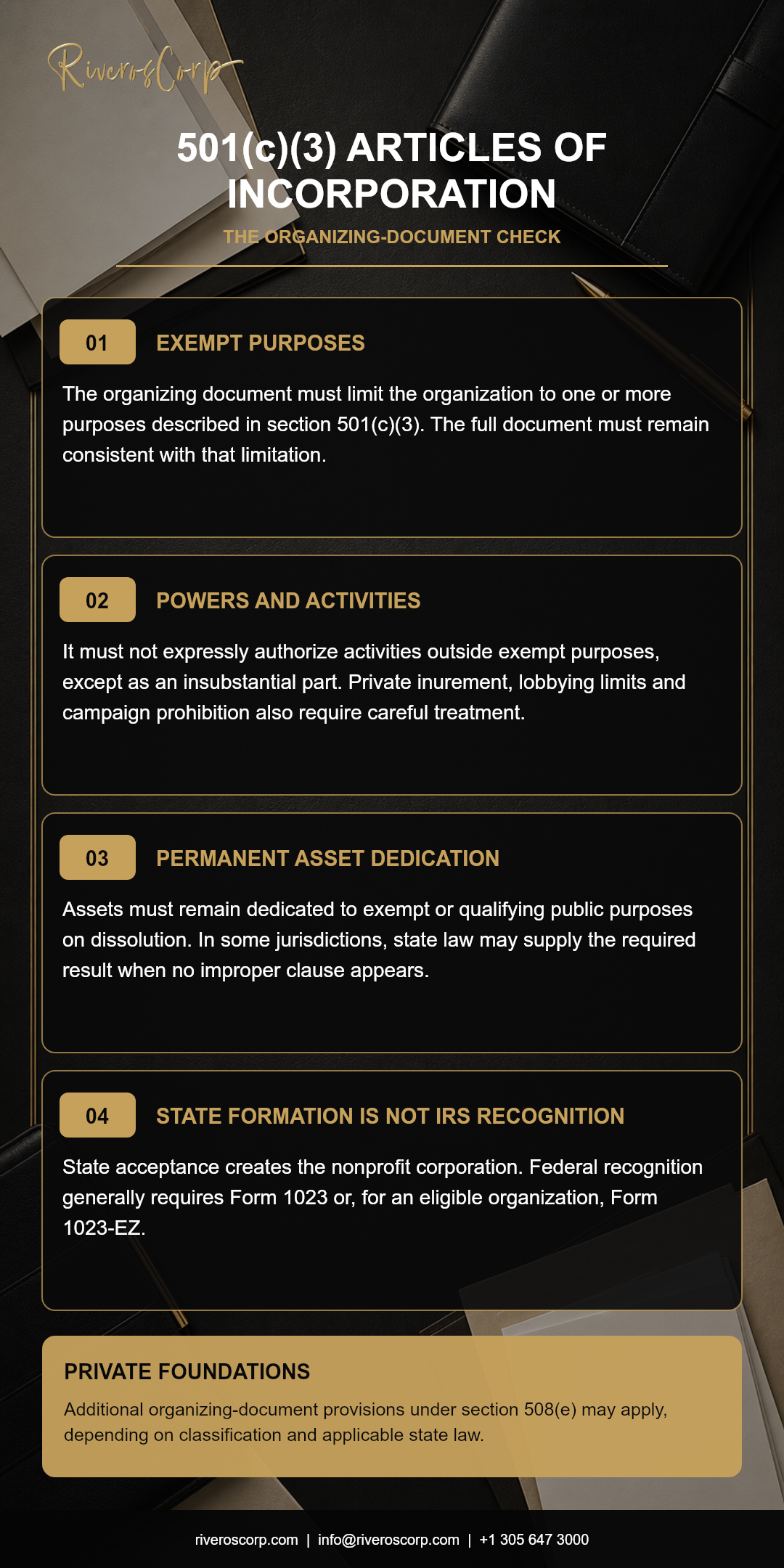
The purpose portion of the articles must limit the corporation to one or more purposes described in section 501(c)(3). A direct reference to the federal section can help establish the limit, but it is not a magic phrase. If the articles also authorize broader objectives, every provision must be reconciled before the organization relies on the clause.
Broad commercial language deserves particular attention. An ordinary business corporation may use a clause allowing any lawful purpose. For a section 501(c)(3) applicant, that clause can authorize activities outside the exempt categories.
Vague language can create the same problem. A mission may sound socially beneficial but still lack a recognized exempt purpose. It may also fail to explain how the organization will carry out the mission in a charitable manner.
In addition, the articles must not authorize more than an insubstantial amount of non-exempt activity. Current IRS instructions address several related limits:
- net earnings must not benefit private shareholders or individuals;
- the organization must not operate for private interests;
- lobbying cannot become a substantial part of its activities; and
- the organization cannot participate in a candidate’s political campaign.
These limits require careful treatment. Section 501(c)(3) does not prohibit every contact with lawmakers. An eligible organization may also consider the section 501(h) expenditure election. Still, substantial legislative activity and candidate campaign intervention remain restricted.
At the same time, the document must allow legitimate administration. Reasonable compensation and proper expense reimbursement are not distributions of net earnings. The risk arises when insiders can receive earnings or assets for private benefit.
Therefore, a careful draft connects the legal purpose, planned mission and corporate powers. It preserves useful flexibility while maintaining the required federal limitation.
Permanent Dedication of Assets and the Dissolution Clause
Permanent dedication of assets is the second major organizing-document issue. If the corporation dissolves, its remaining assets cannot be available for distribution to members, directors, officers or other private individuals. They must remain committed to one or more section 501(c)(3) purposes or be transferred to the federal government, or to a state or local government, for a public purpose.
An express dissolution clause is the clearest way to document that dedication. However, state law adds an important qualification. In certain states, the law can provide the required distribution result when the articles contain no clause.
That possibility does not make the issue optional. The applicable statute must supply the required result. Moreover, a favorable state default does not rescue an improper clause. The corporation must correct language that directs assets to insiders or a non-exempt purpose.
Naming one future recipient also requires care. That organization may cease to exist, lose its exempt status or become unable to receive the assets. Therefore, the articles should preserve an alternative distribution for a qualifying exempt or public purpose.
The same reasoning applies to later amendments. A corporation that changes its purposes, membership rights or dissolution provisions should evaluate whether the amendment affects the organizational test. State acceptance of the amendment confirms the state filing; it does not independently confirm continued federal qualification.
Form 1023, Form 1023-EZ and the Organizing Document
Most organizations that seek recognition under section 501(c)(3) apply through Form 1023 or, if eligible, Form 1023-EZ. Some organizations, including certain churches and organizations with normally very small gross receipts, may fall within filing exceptions, but the underlying exemption requirements still matter. Filing eligibility and substantive qualification should not be treated as the same question.
What Form 1023 requires
A full Form 1023 application includes the organizing document and any amendments. The organization also uploads its bylaws if it adopted them. The IRS can then review the provisions directly.
However, Form 1023 examines much more than the articles. It also covers activities, compensation, financial arrangements and public-charity classification. Passing the organizational test is necessary, but it does not prove operational compliance.
What changes with Form 1023-EZ
Form 1023-EZ is available only to organizations that complete the eligibility worksheet and meet every condition. It is not simply a shorter form for every small nonprofit.
The applicant attests that the organizing document meets the purpose, activity and asset-dedication rules. The organization usually does not submit the articles with the EZ application. However, the IRS may request them later during a compliance check or examination.
Therefore, the organizing document should be reviewed before either application is signed. If an amendment is needed, the state filing and federal application must remain consistent. The filed document, amendment date and application answers should all align.
Our guide for forming a U.S. company as a non-resident explains the broader difference between formation documents, EIN records and later compliance materials. A nonprofit adds another layer: the formation document must also support the exemption pathway.
Additional Considerations for Private Foundations
Every organization recognized under section 501(c)(3) is a private foundation unless it qualifies for a public-charity exception. That classification can affect the organizing document.
Private foundations must address the special requirements of section 508(e). Those rules cover:
- self-dealing;
- required income distributions;
- excess business holdings;
- jeopardizing investments; and
- taxable expenditures.
Those provisions may be stated in the organizing document or, in some jurisdictions, may be satisfied through applicable state law. The correct analysis depends on the organization’s expected classification and formation state. An article that discusses only a general charitable purpose and dissolution clause is therefore incomplete for a private-foundation file unless section 508(e) has also been evaluated.
Drafting and Filing Errors That Create Corrective Work
Common errors include:
- Using only the state’s minimum form. It may create the corporation without supplying the expected federal limitations.
- Copying a for-profit template. An unrestricted purpose or powers clause may be too broad.
- Relying on bylaws. Bylaws govern internal procedures, but they generally do not repair defective articles.
- Adding one favorable sentence. A section 501(c)(3) reference does not cancel conflicting powers or distribution rights.
- Treating every state alike. Dissolution rules and statutory defaults vary by jurisdiction.
- Naming an inflexible recipient. The recipient may not remain qualified or available at dissolution.
- Choosing Form 1023-EZ based only on revenue. The complete eligibility worksheet and the organization’s facts control eligibility.
- Confusing formation with exemption. State approval, an EIN and charitable activity answer different questions.
Finally, avoid unconditional statements about donor deductibility before the effective status is clear. Contributions may qualify when the IRS recognizes exemption with an appropriate effective date. Formation timing, application timing, classification and the IRS determination all matter.
How Riveros Corp Coordinates Nonprofit Formation
Riveros Corp treats nonprofit formation as a coordinated state-and-federal document project. We begin by reviewing:
- the proposed mission;
- the formation state;
- planned activities;
- the governance structure; and
- the expected public-charity or private-foundation classification.
That review separates the provisions that belong in the articles from the governance rules that belong in bylaws. It also identifies questions that require legal or tax advice.
Next, we coordinate the state filing with the section 501(c)(3) pathway in view. We review the purpose limitation, corporate powers, private-interest rules, lobbying limits and campaign restrictions. We also review asset dedication, state-law interaction and private-foundation provisions when applicable.
Finally, we organize the filed articles and amendments for consistent use in the federal application record. This process can reduce avoidable mismatches and corrective filings. However, it cannot guarantee IRS recognition, timing, an effective date or donor deductibility.
If you are planning 501(c)(3) articles of incorporation, review Riveros Corp’s U.S. company formation services or contact our team. Share the mission, formation state, planned activities and expected classification. This information allows the document to be evaluated before a generic filing creates a federal problem.
Frequently Asked Questions
Does state approval make a nonprofit a 501(c)(3) organization?
No. State approval creates the nonprofit corporation under state law. Federal recognition under section 501(c)(3) is a separate tax determination made by the IRS, generally through Form 1023 or Form 1023-EZ when an application is required. The filed articles must support the federal organizational test.
Can bylaws fix missing 501(c)(3) language in the articles?
Generally, no. The IRS states that limits required by the organizational test are not satisfied when they appear only in bylaws, internal rules or statements by officers. The creating document—and applicable state law—must provide the necessary limitation and asset dedication.
Must every nonprofit include an express dissolution clause?
The assets must be permanently dedicated to exempt or qualifying public purposes. An express clause is the clearest approach, but the IRS recognizes that certain state laws can supply the required result when no clause appears. An improper clause allowing private distribution must still be amended.
Do Form 1023-EZ applicants need compliant articles?
Yes. Form 1023-EZ is streamlined, but the applicant attests that its organizing document meets the purpose, activities and dissolution requirements. The IRS can request the document later. Eligibility for the EZ form does not lower the organizational-test standard.
Can 501(c)(3) articles say the corporation may pursue any lawful purpose?
That language can be too broad because it may authorize purposes outside section 501(c)(3). The full document and the formation state’s law must be reviewed. A federal reference in one sentence does not cure broader or conflicting authority elsewhere in the articles.
Do private foundations need additional organizing-document provisions?
Potentially, yes. Private foundations must satisfy section 508(e), which addresses several private-foundation excise-tax rules. The requirement may be met through provisions in the organizing document or applicable state law, depending on the jurisdiction and facts.
Are you forming a nonprofit corporation with a section 501(c)(3) objective?
Riveros Corp reviews the mission, formation state and organizing-document requirements, coordinates the state filing and helps reduce avoidable inconsistencies before the federal exemption application.
Call: +1 305-647-3000
WhatsApp: +1 305-647-3000
Email: info@riveroscorp.com
Legal and tax disclaimer: This publication provides general information and does not constitute legal or tax advice, create an attorney-client relationship, or guarantee recognition of exemption. Requirements depend on the organizing document, state law, classification, activities and current IRS rules. Consult qualified legal and tax professionals for advice concerning a specific organization.