How to authenticate your birth certificate depends on your copy. The one kept with your passport could be a certified copy or an older version issued for another purpose. It could also be a hospital keepsake, or a photocopy of a record held somewhere else. Work out which one you have, and what the foreign recipient asks for, before you send anything for international certification. This article covers your own U.S.-issued birth record when you need to use it outside the United States.
This guide focuses on your personal file. You check who issued the record, whether the copy is the right one and matches your current name, and where it is going. Then you decide what needs attention before it ships. Apostille de la Haya can look at the complete certificate together with the receiving authority’s instructions. That way you avoid unnecessary replacements and notarizations that do not fit. You also avoid assuming that an old certification automatically works for a new procedure overseas. It is better to settle those questions about the record you really hold before the next stage begins.
How to authenticate your birth certificate starts with the copy you hold
Take the certificate out of its folder. Look for the issuing public office, the certification statement, the signature, and any attached pages. Paper color, a raised seal, or the word “birth” at the top will not tell you enough. Whether the record can be used in the intended process turns on the official issuer and the certification. Appearance is a much weaker guide.
An ordinary photocopy can show every word of a certified copy and still lack its official act. A scan can help with an initial review. Whether it is acceptable for submission depends on the authority and the applicable document format. A hospital certificate may record details of the birth without being the official civil record the foreign authority expects. Call each item what it is instead of calling every version an original.
If someone else has the certified copy, find out who has it and whether it is complete. For example, you may live abroad while a relative keeps the record in the United States. That does not change the issuer or the destination’s requirements. It does change how the document is reviewed and delivered, so sort out who holds it and how it will be handled before you arrange any shipment.
Confirm which U.S. issuing system your record belongs to
Your citizenship and the document’s origin are two separate facts. A U.S. citizen born abroad may have a foreign birth certificate or a Consular Report of Birth Abroad instead of a state birth record. Those documents should not automatically follow instructions written for a certificate from a U.S. state vital records office.
The CDC’s guidance on foreign birth records separates records of births abroad and describes the types of evidence involved. If your certificate covers a birth outside the United States, identify the issuer before you pick a state authentication service. Your current home and your passport’s place of issue do not decide who can authenticate the birth record’s official signature.
For a state-issued record, go by the state or area tied to the birth and to the issuing office. The CDC directory can help you find the right vital records information. Convenience is not a reason to contact the nearest state office. What matters is whether that office has authority over the signature on your certificate. Knowing the issuer is the first real step in deciding how to authenticate your birth certificate.
Ask the recipient what it needs
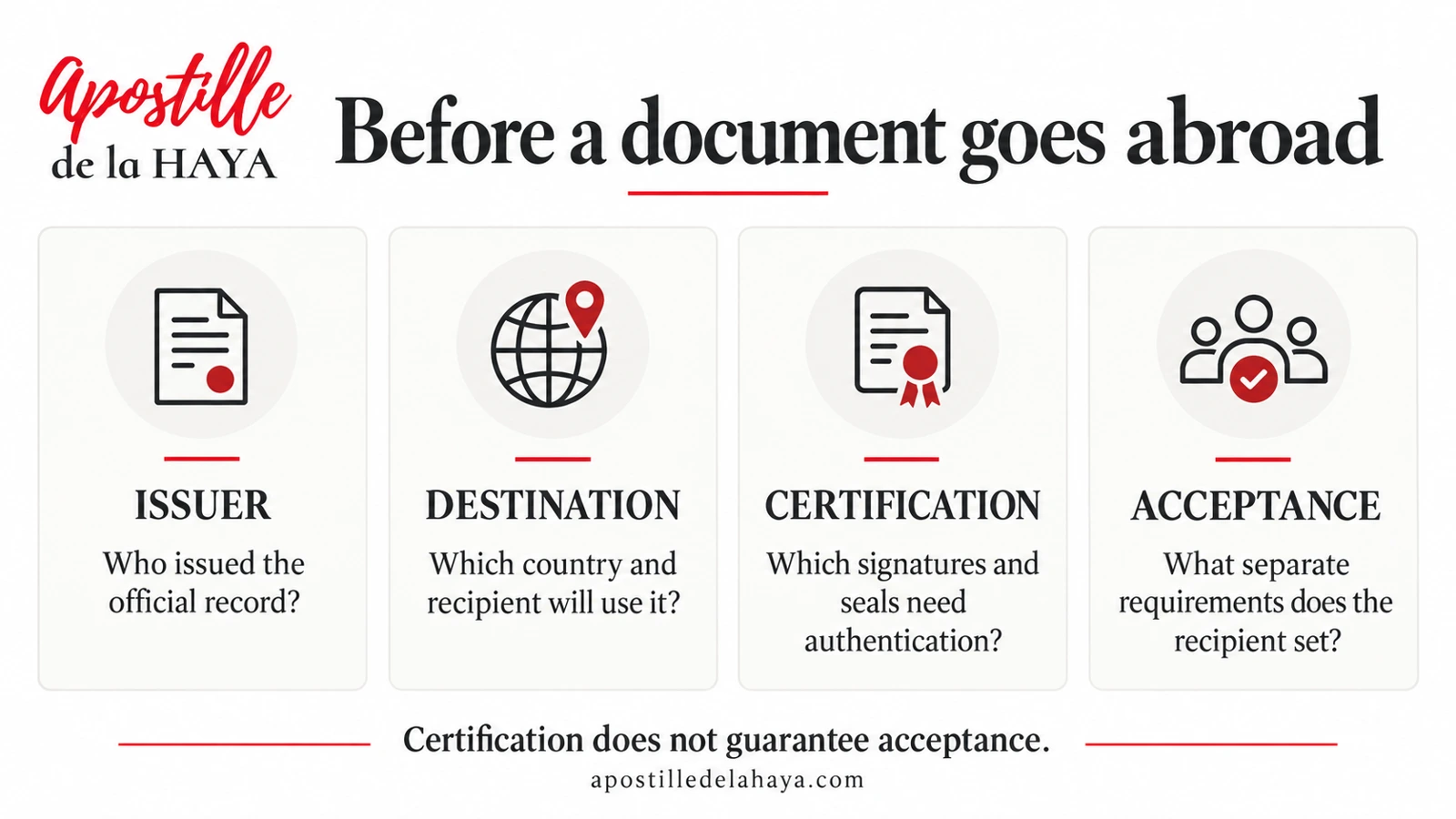
Start with who is asking for the certificate, and for what procedure. A civil registry, a school, an employer, or an authority may each want different evidence or presentation. Ask which version, certification, and language they need. Also ask about any condition on when the copy was issued. If the request only says “authenticated original,” ask them to be more specific.
If the recipient wants a recent copy, identify the actual period and the date it is measured from. Do not assume every birth certificate expires after the same number of months. The date of birth, the date the copy was issued, and the date of any later certification are different events. A specific condition from the recipient calls for a specific answer.
Also confirm the country where the document will be used. It may not be where you live now. The destination drives the international certification question, and the issuer tells you which authority at origin is competent. You need both facts to decide how to authenticate your birth certificate: with an apostille, or through authentication and legalization.
Check names and identifying details before certification
Compare the birth record’s name with the evidence you will give the recipient. A married name, a legal name change, or a different spelling on another document can raise a question. That can happen even when the birth certificate records the original event correctly. Ask the recipient what supporting evidence it wants in order to link the records.
Do not alter the certificate. Do not ask a translator to quietly swap the original name for your current one either. That hides the identity issue instead of resolving it. A translation should represent the source accurately within the applicable requirements. If the issuer made a mistake, start with the issuer’s correction procedure.
Dates, place names, and details about your parents may also matter, depending on why the recipient wants the record. Separate a real error from a simple difference in formatting or terminology. If the foreign procedure raises a substantive legal question, get guidance from the recipient or from an appropriate professional. Authenticating a signature does not decide how a foreign authority will weigh family or nationality evidence.
Decide whether you really need a replacement copy
Age alone is not a reason to order a new certificate. First check whether the format, issuer, signature, and condition of the one you have meet the requirements. You may still need a new copy. If so, it should be the correct certified version for a clear requirement.
The reverse is also true. Having used the record at home does not mean it is ready for international use. A record used for a passport, a driver’s license, or school enrollment may need a different certification or official form abroad. The explanation of certified birth records covers the difference between getting the record and authenticating its official signature.
If you need a new version, confirm you are eligible to request it and check the issuer’s current procedure. Access to personal vital records can be restricted. Do not assume a private service can obtain anyone’s certificate without the necessary authorization. Apostille de la Haya can review the preparation and explain what information or action the proposed assistance needs from you.
How to authenticate your birth certificate when state rules differ
Check the relevant state’s current rules for your copy’s signature. Some procedures treat a state registrar’s signature differently from a local issuing official’s signature. A state name printed on the paper does not, by itself, tell you every preliminary certification you may need.
New York’s apostille and authentication instructions show this distinction: certain state-issued vital records are handled differently from documents issued locally. Those instructions should not be applied to a certificate from another state. The useful lesson is to identify the issuer and the official signature before you choose a route.
Your destination may require a federal authentication step after the state stage. That is a separate question from obtaining your birth record, and the federal birth certificate authentication discussion covers it. Do not mail the certificate straight to a federal office just because the document is American.
Plan translation and delivery around your situation
Does the recipient want a translation? Then confirm the accepted language, the scope, and the formalities before you order it. Ask whether the certification pages must be included and whether the translator’s declaration needs separate treatment. A translation you already have may need another look if the document set has changed since it was done.
Tell the service where you are and where the document is. The two can be different without causing a problem, as long as the handling is clear. Settle who can release the certified copy, which route it follows, and where the finished file goes. Do not assume it must come back to the address it left from.
Keep shipping references and submission details in one place. Tracking shows that a package reached a location. It does not prove that an authority has finished the certification. Intake, examination, completion, return, and presentation to the recipient are separate stages. Keeping them apart helps you read updates correctly when you are working toward a personal deadline.
Mistakes to avoid with your only certified copy
Do not detach an existing apostille or authentication certificate. It may look simpler, but keep the full set available for review, especially if it was prepared for another country. An older certification tells you something about the record’s history. Whether it helps with the new destination has to be checked, not assumed.
Do not laminate, annotate, or otherwise alter the record to preserve it or make it clearer. Check the authority’s requirements first. If the certificate is damaged or hard to read, describe its condition. A proper replacement may be a better answer than an unofficial repair to the document being certified.
A search for “birth certificate authentication” may point you to an office. Do not mail personal records there before confirming the office, origin, destination, and purpose. That phrase shows up in contexts that have nothing to do with the international service you need. Reviewing the whole request keeps you from picking a legitimate service that simply does not apply to your case.
How Apostille de la Haya reviews your personal file
Use the birth certificate authentication service as your point of contact. It covers the review of your U.S. record and how you plan to use it abroad. Explain which copy you have, who issued it, any certifications already attached, the destination, and the recipient’s instructions. With that information, the preparation can be discussed in concrete terms.
If a legalization route specific to the destination applies, identify it during the document review. The general legalization service explains the wider assistance. The scope should state clearly what is included and what stays with you, the issuer, or the receiving authority. Personal appearances, record corrections, and substantive legal decisions should not be buried under a broad promise to finish everything.
Once the issuer and destination are clear, confirm the precise service scope. Identify any replacement record, translation, certification and delivery still needed, together with the person responsible for each task. Conditions may vary with the nature, complexity and specific requirements of the file; consult Apostille de la Haya directly.
Frequently Asked Questions
Can I use the birth certificate I keep with my passport?
Possibly. Its issuer, certification, version, condition, and the destination’s requirements all need review. Past use for a domestic purpose does not by itself show that it is ready for use abroad. Show Apostille de la Haya the complete record. The assessment can then tell whether your current copy works or a particular replacement is needed.
What if my current name differs from my birth certificate?
Ask the recipient what evidence it needs to connect the two names. Do not alter the birth record or quietly change the translation. Depending on the procedure, a name-change record or another supporting document may be relevant. Apostille de la Haya can review the document preparation, while questions about substantive acceptance stay with the recipient.
Can I arrange the service while I am outside the United States?
The practical review has to establish where the document is, who has it, and how it must be delivered. Your location does not change what the issuing authority requires. Send those details to Apostille de la Haya. It can then explain the documentary assistance available and anything you need to do yourself.
Does an old certificate always need to be replaced?
Do not assume a universal rule. The recipient may set a specific issue-date requirement. The format or signature on your copy may also need review. Work from the actual condition instead of replacing the document because of its age alone. Apostille de la Haya can check the copy against the stated requirement before you order another one.
What should I send for an initial assessment?
Use the agreed intake channel. Send a complete view of the record and its certifications, plus the issuer, destination, recipient instructions, and deadline. Mention any name difference or earlier use in another country. With those facts, Apostille de la Haya can review the preparation without guessing which record or service you need.
Get your own birth record reviewed before submission
Still working out how to authenticate your birth certificate? Contact Apostille de la Haya with the U.S. certificate you hold and the foreign authority’s request. We can review the copy and its preparation so the next step is based on the file you actually have.
Contact Apostille de la Haya by phone or WhatsApp: +1 305 500 0185.