Egypt embassy legalization for U.S. documents starts with two decisions. Which Egyptian mission is competent, and what category does the document fall into? A commercial instrument, a marriage record, an academic certificate and a privately signed power can each need different preparation. If you send every file to Washington under one generic checklist, a document may come back before it can ever be used in Egypt.
This guide explains how to choose and check the route for documents that originate in the United States. It covers existing copies, earlier certifications, submission arrangements and what the final recipient requires. Apostille de la Haya can discuss the U.S. preparation help that is permitted. The applicant still has to follow any rule the competent mission sets on direct dealings or personal attendance.
Egypt embassy legalization requires the correct jurisdiction
Begin with the official directory of Egyptian consulates in the United States. It shows the districts served by Washington, New York, Chicago, Houston and Los Angeles. The right office is not simply the one whose website you know best or the one closest to you.
Give the state where the document was issued or where the notarial act took place, plus any residence details the service asks for. If those facts point to different districts, ask the mission to confirm which one is competent before you ship anything. Don’t hide a document’s link to one state or replace it with the mailing address you would prefer to use.
Keep the current service instructions from the responsible mission. The directory tells you which office to use, but it doesn’t list every requirement for each category. Don’t apply Washington’s attendance or packaging details to another consulate without checking. Confirming the district early keeps completed U.S. certifications from landing at an office that won’t process the file.
Classify the document before you request certificates
Work out whether the item is a public record, a privately signed instrument, an academic record or a commercial document. Read what it says and look at its certification, instead of going by the file name. A power that authorizes a commercial act may fall into a different category from a personal declaration, even when the same person signed both.
For a civil record, find the lawful custodian and check whether the copy is officially certified. With a private instrument, identify the signer and the notarial act. For an academic record, identify the institution and the educational verification required. One packet can hold several categories, and sharing an envelope doesn’t give them the same certification requirements.
The embassy’s legalization information is a good first stop for finding the relevant service. Build the preparation plan from the specific category instructions and the competent mission’s confirmation. If you aren’t sure of the category, settle that question before you order certificates that may not fit the final route.
Review public records through the issuing authority
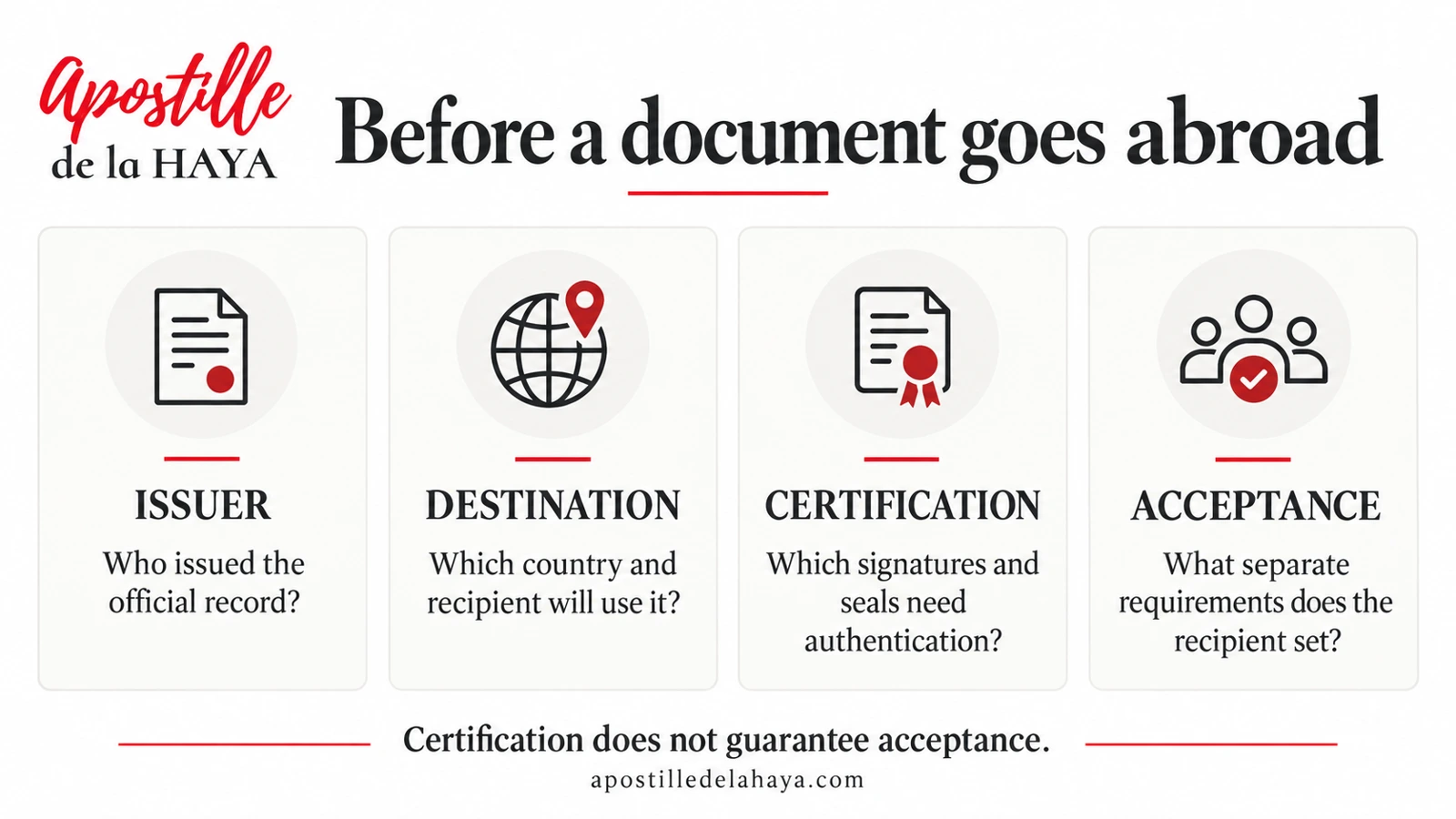
A U.S. birth, marriage, divorce or court record should be judged by who issued it and whose official signature it carries. A decorative certificate, an ordinary photocopy or a private declaration about a copy may not be the official record you need. When necessary, get an eligible certified version from the lawful custodian. Private notarization is not a reliable replacement for public-record certification.
As a rule, the state connected to the official record decides which authority handles the first certification. Where the applicant lives now does not let them pick any state office. USA.gov’s authentication overview explains how document origin affects who certifies what. Apply that framework to the actual record, then check Egypt’s requirements for its category.
Washington’s guidance on signature and document legalization sets federal authentication requirements for specified categories, including commercial documents and certain court and family records. That guidance does not mean every Egyptian consular service follows the same sequence. Confirm the category and the prior certifications that apply to the document in your hands.
Treat commercial documents as a separate preparation task
The Washington mission publishes its own procedure for authenticating commercial documents. It sets out notarial, state, federal and consular stages for the commercial route it covers. Check the instrument and the signature requirements that apply before you use that sequence for a company filing or a privately signed agreement.
Find out who is authorized to sign the commercial instrument and whether the Egyptian recipient wants supporting corporate evidence. Authentication won’t give a signer authority they didn’t have, and it won’t fill in missing contract terms. A company resolution, an agency authorization or a registry record may serve a separate purpose as evidence, and that should be reviewed with a suitable legal professional.
For background on official corporate records, read our articles of incorporation apostille discussion. It deals with a related document type under a different certification framework, so it does not set Egypt’s route. For an Egyptian transaction, the actual issuer, the document category and the mission’s instructions decide the preparation.
Tell powers of attorney apart from direct consular acts
A power signed before a U.S. notary and a signature act done directly before an Egyptian consular officer are two different services. Eligibility, identification, attendance and prior certification can all differ. Find out which route applies to the principal before signing, and before assuming a mailed document can replace personal participation.
The Washington guidance includes restrictions tied to nationality, identification and certain powers. Confirm the principal’s actual circumstances with the competent mission. No document service can promise to appear for the principal where attendance is required. It also cannot act as an intermediary where the mission requires direct dealings with the citizen.
Our power of attorney legalization service can help you talk through the U.S. preparation. Settle the legal wording and the intended authority with the recipient and a suitably qualified professional before signing. Certification does not replace a review of the legal consequences of the powers being granted.
Give academic records their own Egypt embassy legalization review
A diploma, a transcript and an institutional verification are separate documents. Identify the awarding institution, the qualification and the recipient’s requirements before getting certifications. An unofficial student copy can help with a preliminary review, yet it may not meet the standard for an official academic record or direct verification.
Washington’s published guidance sends U.S. academic documents through the Egyptian cultural office before they reach the consulate. Confirm the current requirements for your record with the relevant academic and consular authorities. Don’t use a commercial-document checklist just because both processes end up at an Egyptian mission.
Academic certification is also different from recognition of studies, admission or professional licensing in Egypt. Those decisions may call for more evidence and involve a separate authority. A properly prepared diploma does not by itself establish equivalency, permission to practice or acceptance for a particular job. Ask the recipient which substantive process applies to your intended use.
Check the federal step and the correct certificate
Where Department of State authentication is required, check the current federal requirements. Confirm the prior state certification where it applies. A state-issued record does not turn into a federal original because it is headed to Washington or because its owner is a U.S. citizen.
An apostille is not another name for the authentication certificate the mission needs. Washington’s signature legalization page says clearly that it does not accept apostilles for the route it describes. If a packet was prepared earlier for another country, keep all attachments in place and have it assessed before you order more work or remove a certificate.
Get the federal office’s current application and delivery details from the Department of State itself. A foreign mission’s page may still show old contact details for an American office. Confirm the American stage with the American authority instead of copying an outdated address from a secondary instruction page.
Coordinate language, originals and supporting evidence
Confirm whether the recipient needs Arabic, a bilingual instrument or a certified translation. Check who may translate and whether the translation needs its own declaration or certification. Timing depends on two things: whether later authentication pages must be included, and whether the translated record needs further official treatment.
Compare names, dates, company details and document references across the original, the translation and the application. A legitimate name change may call for evidence linking the two names, while an issuer’s error may need correcting. Neither a translator nor a legalization service should quietly change source information so the file looks consistent. If the issue affects the document’s identity or purpose, fix it before further certification.
Keep official originals and attachments intact, and keep a complete legible copy for review and your records. If the mission accepts an issuer-certified copy for a given category, get that requirement stated clearly. A private notary’s seal somewhere in the packet does not make an ordinary photocopy acceptable.
Check submission and return arrangements right before dispatch
Follow the competent mission’s current instructions on application, carrier, packaging and return. Washington’s published legalization pages set specific USPS requirements, so check them for your service instead of switching to a courier you prefer. The federal return method may differ from the consulate’s, so handle each delivery leg on its own.
Confirm whether the applicant must submit in person or deal directly with the mission. Note any copies or supporting records requested, and make sure the document category matches the actual document. A private preparation service should spell out those applicant responsibilities in its scope. It should not suggest that every consular act can be outsourced.
Track delivery and processing separately. A carrier’s delivered status does not show that legalization is complete. If a submission is returned or held, keep the notice and note the stated reason before you start again. A problem with jurisdiction, document type, a missing certification, identification or packaging needs a specific fix, and another generic stamp won’t solve it.
Frequently asked questions
Can every U.S. document be sent to the Egyptian embassy in Washington?
No. Consular districts and document-specific requirements matter. Use the official directory and confirm which mission is competent for the document and the applicant. Washington’s instructions don’t automatically apply across the country. If the document’s issuing state differs from where the applicant lives, clear that up before arranging shipment or attendance.
Does every document need the same federal authentication step?
Don’t assume one rule covers every category and consular act. Identify the document and read the mission instructions that apply to it. Commercial, court, family, academic and direct signature services can have different requirements. For Egypt embassy legalization that includes federal authentication, follow the Department of State’s current rules for the document’s actual origin.
Can I use an apostille obtained for another country?
Have the whole packet reviewed. Washington’s published signature legalization guidance does not accept apostilles for the route it describes. Don’t remove an existing certificate, and don’t assume it can be relabeled as an authentication. The right preparation depends on the current destination, the document category and the competent mission.
Does legalization guarantee the Egyptian recipient will accept the document?
No. Egypt embassy legalization supports the relevant official signatures and certifications. The recipient may have separate requirements on legal wording, registration, academic recognition or substantive eligibility. Confirm those before you finish the route, especially if the document will support a property transaction, a court matter, a professional application or a family procedure.
What information do you need for a preparation review?
Send the document type, the issuing state or institution, a complete copy, any existing attachments, the intended Egyptian recipient and the relevant consular district. Add the recipient’s instructions and any return notice. Say whether the document is unsigned, already signed or already certified, and mention any attendance limits or deadlines.
Confirm the route before sending originals
Our Egypt embassy legalization service can help assess the U.S. preparation your file actually needs. Contact Apostille de la Haya on WhatsApp +1 305 500 0185 and send the complete document along with the destination instructions. The review should identify the correct category, the competent authorities and the assistance permitted under the applicable consular rules, while respecting any consular rule that requires the applicant to take part directly.