Degree attestation for Kuwait involves two separate things: certifying a U.S. academic document and assessing the qualification behind it. This guide deals with degrees issued by U.S. institutions. Before you arrange any document service, identify the awarding institution and the Kuwaiti recipient. Then work out whether the applicant needs consular legalization, cultural-office authentication, academic recognition or more than one of these.
The distinction matters because the cultural-office instructions available online can be aimed at specific groups of Kuwaiti students. They don’t automatically apply to every foreign professional with an American degree. Apostille de la Haya can review the document preparation your actual file needs. Academic and professional decisions stay with the relevant authorities. The document legalization service explains the wider certification assistance; the destination and document category still need their own review.
Degree attestation for Kuwait starts with the qualification and its purpose
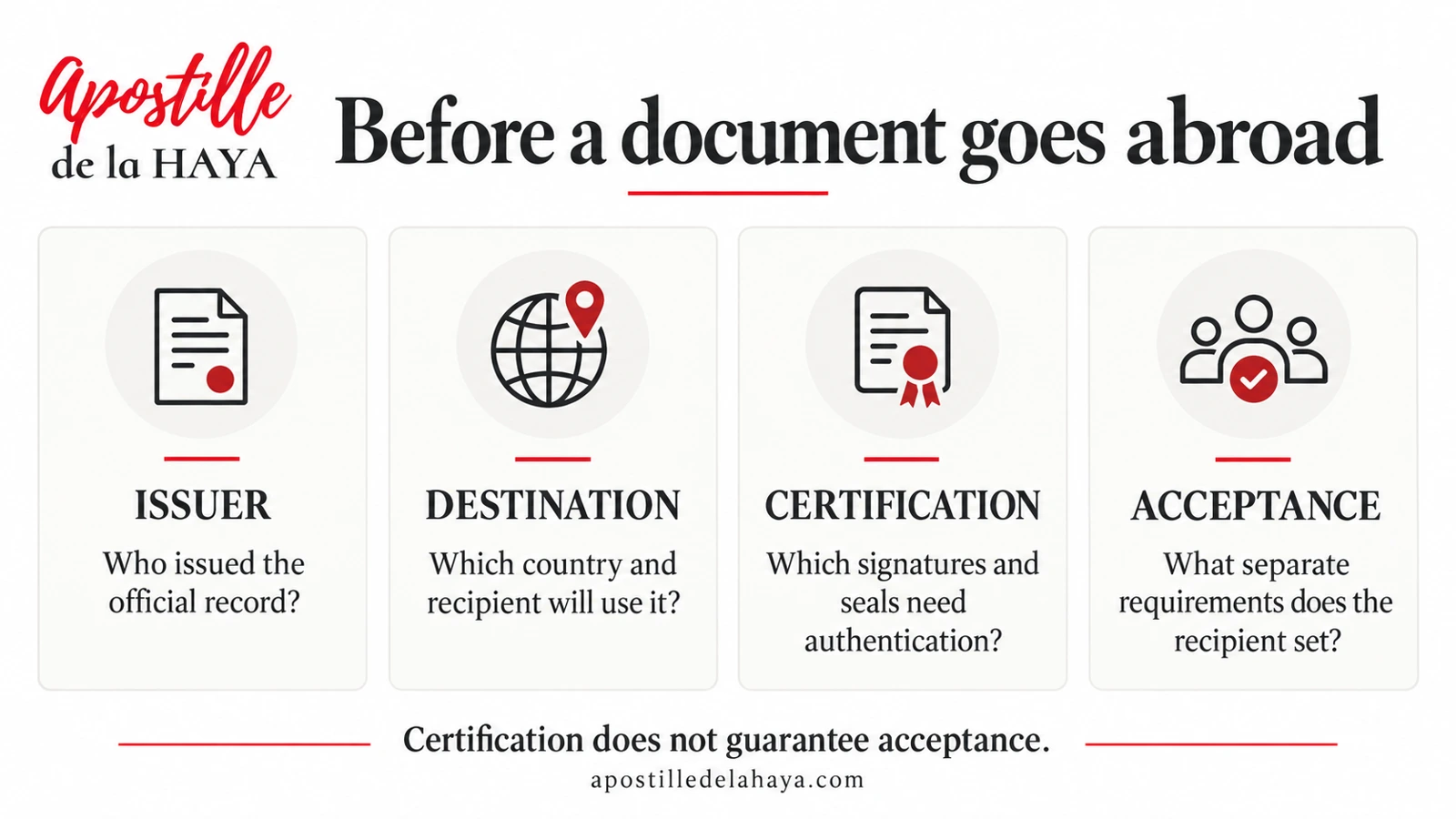
Write down the institution’s exact name, the campus, the qualification title, the award date and the graduate’s name. Note whether the document is a final diploma, a provisional award, a transcript or a completion letter. A record issued before the degree was conferred may not prove a completed degree. Ask the recipient which version it needs for your purpose.
Check whether the U.S. institution issued the document itself or whether another awarding body did. Branch campuses, joint programs and affiliated teaching centers can make the origin less clear. An American-sounding name or a diploma in English does not show that a U.S. certification route applies. Confirm the actual issuer before arranging state or federal services.
Be clear about the purpose: employment, further study, a government personnel process, professional licensing or something else. Different recipients may ask different questions about the same degree. Get the current requirements in writing from the institution making the decision. A recruiter’s shorthand instruction to “get the degree stamped” is not enough to go on.
Identify which academic authority has a role
The Kuwait Cultural Office in Washington describes academic authentication services for specific audiences and document types. Its information separates services for Kuwaiti students from those for certain professional training records. Read that scope before deciding whether a given application belongs in the process.
The Los Angeles cultural office’s page on degree authentication also separates degree levels and student situations. It directs sponsored students and those studying privately to the relevant advisers. That shows academic handling depends on the context of the file. It is not a universal checklist for every non-Kuwaiti employee preparing a U.S. diploma.
Ask the recipient and the appropriate authority which office should review the actual qualification. Give them the applicant’s relevant status, the institution, where the studies took place and the purpose. A cultural-office authentication, a consular legalization and an employer’s verification may all use the word “authentication” while doing different jobs. Know what you need to deliver before opening an application or sending originals.
Gather the academic records the recipient asks for
A diploma shows that a degree was awarded in a particular form, and a transcript gives the academic detail. A verification letter confirms information directly through the institution. Find out which records are needed and whether the recipient expects them straight from the registrar. An unofficial student copy won’t meet every request for an official record.
If other institutions supplied transfer credit, the academic reviewer may want evidence from them too. Confirm the actual requirement, because the final university’s diploma may not answer every question. When asked for the full academic history, describe it accurately, including where credits came from and which institutions hold the underlying records.
Make an inventory of what you already have and what still has to be issued. Note whether the transcript is final and whether it shows the degree awarded. If a required record is still pending, ask whether interim evidence is accepted and when the final version is due. Never present a provisional qualification as complete to meet a submission deadline.
Work with the registrar on direct verification
The institution’s authorized records office can tell you about official transcript channels, how to replace a diploma and which verification statements it offers. Give it the actual request from the Kuwaiti recipient or academic authority. A generic request for “a notarized degree” may not produce the record or certification the next office needs.
Where direct delivery is required, keep the channel running from the institution to the recipient. A file forwarded by the graduate may not satisfy a request for records sent by the registrar, even if the contents look identical. Confirm the addressee and the reference so the institution can match the record to the right application.
Keep this academic verification apart from any physical certification packet. A diploma may go through state, federal or consular preparation while a transcript goes straight to an academic reviewer. Tracking them as separate items stops you from assuming that receipt of one means the other is done. Record each issuer, destination and confirmation reference.
Describe accreditation and program information accurately
Identify the institution’s accreditation and any program accreditation the intended use calls for. The U.S. Department of Education’s accreditation resources and the CHEA institution search give useful background. Match the exact institution, not a school with a similar name or an unrelated campus.
Don’t present accreditation evidence as automatic recognition in Kuwait. A receiving authority may look at the institution, the program, the mode of study or other criteria under its own rules. Ask which evidence is required and provide it accurately. A document service can’t fix an academic eligibility problem by adding another notarial or consular stamp.
If a school has merged, closed or changed its name, find the lawful custodian of its records. Get supporting information from the institution where the recipient asks for it. An unrelated school can’t verify the qualification. A replacement certificate should not carry a name different from the historical awarding institution unless there is an official explanation.
Use student-specific instructions only for the right file
Cultural-office student procedures may mention sponsorship, advisers, approved programs or Kuwaiti education systems. Those details can be essential for applicants within that service and irrelevant for anyone else. Read who the service is for before copying a checklist or asking someone for records they can’t properly provide.
The Los Angeles guidance for private undergraduate students is one example. It describes a defined student process and direct academic records. It is not the universal procedure for every American degree used for work in Kuwait. Confirm whether the person falls into that category and whether the current instructions cover their qualification.
Professional training can follow another route. The cultural office’s information on graduate studies and residency deals with specific postgraduate and clinical-training records. A residency or fellowship certificate is not an ordinary undergraduate diploma. Identify the exact training and the responsible reviewer before deciding which supporting letters or institutional records you need.
Degree attestation for Kuwait is not academic recognition
Where the confirmed route calls for American authentication, identify the relevant official or notarial signature and the competent state authority. A private university’s document is not a federal original just because the institution receives federal funding. How it is prepared depends on the actual document and on what the next office requires.
When the federal stage applies, the U.S. Department of State’s authentication requirements govern the preparation. Confirm the state preparation first. Authentication supports the relevant official signatures. It does not calculate degree equivalency or decide whether the holder meets the qualifications for an occupation in Kuwait.
For background on the American stage, see our U.S. Department of State certification guide. You still need to confirm the right certificate and the later Kuwaiti requirements for your file. If a packet was prepared for another country, have it reviewed intact. Official seals already on it don’t mean it is ready for degree attestation for Kuwait.
Coordinate translation and identity evidence
Confirm which language the recipient accepts and whether a translation is required. Find out who may prepare it and whether the translator’s declaration needs its own certification. Ask whether the translation must cover the full certification packet or only the academic record. The answer can change the order of the work.
Keep the degree title faithful to the source. A translator should not turn it into a different qualification or suggest that a formal equivalency decision exists. If the recipient needs the academic level or program structure explained, get that explanation from the institution or the relevant recognition authority. It should not be invented inside the translation.
Compare the graduate’s name with current identification. A former surname may need evidence linking the two names, and a genuine error in school records may need correcting. Don’t alter a scan or ask the translator to hide the difference. If it affects which person the academic record identifies, settle the identity question before certification.
Plan the final submission around separate milestones
Where each one applies, track separately the institution’s issuance, direct verification, U.S. certification, Kuwaiti processing, translation and final delivery. A transcript reaching an academic office doesn’t mean a diploma has finished consular legalization. In the same way, an attested document doesn’t mean an employer has made its final decision.
Before originals go out, confirm the current document, application and return requirements of the mission or office involved. Keep official attachments in place and hold on to a complete copy. Don’t use a mailing checklist from a Kuwaiti embassy in another country, or one for another academic category, without checking. Each stage should have a known purpose and a responsible authority.
If a file comes back, find the stated reason before you submit again. An academic eligibility issue calls for a different response from a missing state certification or a wrong delivery reference. Keep the notice and share it during the review. Faster shipping won’t fix a substantive problem that the right institution hasn’t dealt with.
Frequently asked questions
Does every U.S. graduate have to use a Kuwait Cultural Office student process?
Don’t assume so. Cultural-office procedures are meant for specific audiences and purposes. Identify the applicant’s status, the qualification and the intended recipient, then confirm which academic or consular service applies. A checklist for a sponsored or private Kuwaiti student should not be presented as the rule for every expatriate professional.
Is a diploma enough without a transcript?
It depends on the recipient and on the academic review that applies. A diploma and a transcript give different information. Ask whether the transcript must be final, whether it must show the award and whether the institution has to send it directly. Don’t add or leave out records just because another graduate did so for a different purpose.
Does authentication mean the degree is academically recognized?
Not necessarily. Degree attestation for Kuwait certifies signatures, and institutional verification, recognition of studies and professional licensing are separate processes. Find out which decisions the recipient needs and which authority makes each one. A completed document certification is no guarantee of academic equivalency, employment or permission to practice.
What if some courses were online or transferred?
Describe the academic history accurately and get any required supporting records from the institutions involved. The relevant authority should apply its criteria to the actual program. Avoid sweeping claims that all such studies are accepted or rejected. Never hide the mode of study or the source of credits in a verification request.
What should I send for a preparation review?
Send the awarding institution, the qualification, the diploma and any transcripts you have, existing certifications, the recipient’s instructions and the applicant’s relevant status. Say whether direct verification or a cultural-office process has been requested. Include your deadline and where the originals are, so the document work and delivery requirements can be assessed realistically.
Talk through the academic file before ordering certifications
Our Kuwait embassy legalization service can help assess the U.S. preparation for your degree and related records. Contact Apostille de la Haya on WhatsApp +1 305 500 0185 and send the complete file with the recipient’s written requirements. The review should keep document handling apart from academic decisions and set the right scope before you commit originals or arrange further work.