
If you are searching for an «apostille notary,» you need this direct answer first: a notary public cannot issue an apostille. A notary’s job is simply to witness your signature on a document. The apostille—a separate international certificate that proves the notary’s signature is genuine—is issued exclusively by a government office, such as the Secretary of State or the U.S. Department of State.
Attempting to navigate the gap between notarization and the government apostille on your own often leads to immediate document rejections, lost fees, and ruined international timelines. Whether you are dealing with dual citizenship, a foreign marriage, or overseas corporate filings, the sequence of authentications must be flawless. At Apostille de la Haya, our specialists manage this entire lifecycle. We provide the legally required notarization and meticulously route your documents through the correct county, state, or federal channels to secure your apostille quickly and without complications.
The Difference Between Notarization and an Apostille
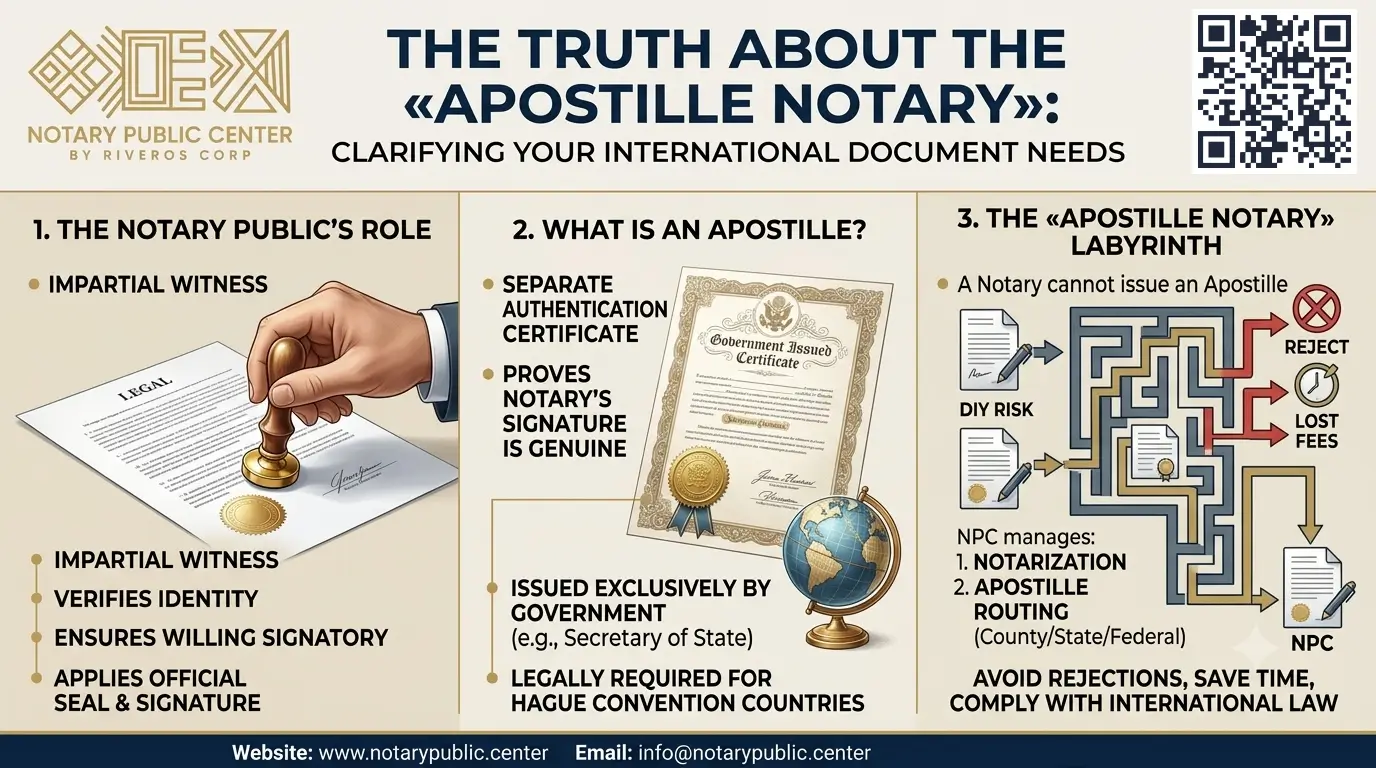
The confusion surrounding an apostille notary stems from the fact that these two processes are intimately connected, but executed by entirely different authorities.
What the Notary Public Does
A commissioned notary public acts as an impartial witness on behalf of the state. When you present a private document (such as a Power of Attorney or a corporate affidavit), the notary verifies your identity, ensures you are signing willingly, and applies their official seal and signature. The notary only verifies you; they do not validate the contents of the document, and they do not have the jurisdiction to legalize the document for international use under the 1961 Hague Convention.
What the Apostille Does
An apostille is a highly specific authentication certificate attached to your notarized document. It is issued by the Secretary of State (for state-level documents) or the U.S. Department of State (for federal documents). The apostille’s sole purpose is to verify to a foreign government that the notary public (or state official) who signed the document was legitimately commissioned at the time of signing.
The Step-by-Step Authentication Process (And Why DIY Fails)
Many people assume they can simply take a document to a local shipping store for notarization and then drop it in the mail to the Secretary of State. This «DIY» approach is the leading cause of apostille rejections. The authentication process is rarely a simple two-step procedure.
Step 1: Proper Notarization
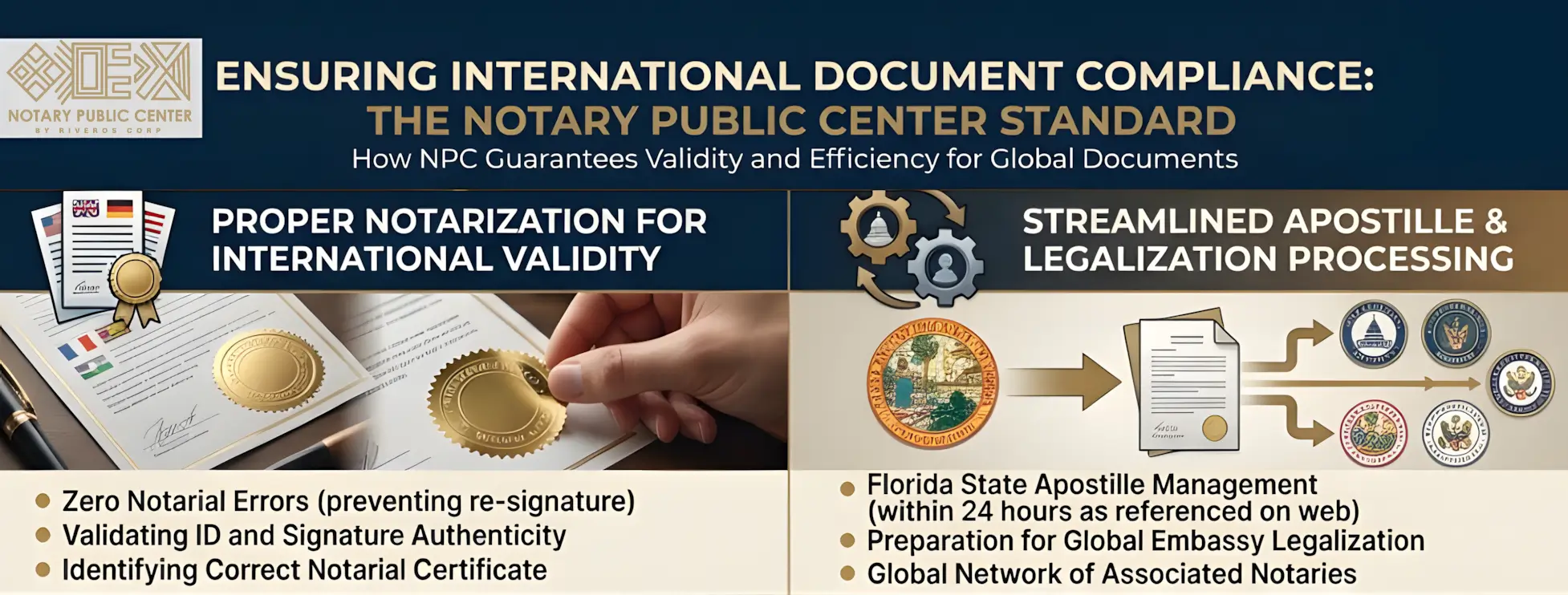
The process begins with the notary. However, if the notarial certificate (the jurat or acknowledgment block) is missing a single piece of required wording, or if the notary’s stamp is smudged, the state will instantly reject the document. Notary Public Center ensures that the initial notarization is executed with absolute statutory compliance.
Step 2: County Clerk Authentication (The Hidden Hurdle)
Depending on the state where the document is notarized, sending it directly to the Secretary of State might result in a rejection. In states like New York and occasionally depending on specific county mandates in Florida or elsewhere, the notary’s signature must first be authenticated by the County Clerk where the notary is commissioned. Generic local notaries rarely inform clients of this prerequisite.
Step 3: Secretary of State Apostille
Only after the document is flawlessly notarized (and potentially authenticated by the county) can it be submitted to the Secretary of State. Each state has different application requirements, cover letters, and fee structures. Submitting a Florida document to the Texas Secretary of State, for example, will result in a return to sender.
What «Apostille Notary» Really Means
The phrase «apostille notary» describes two connected steps that people often confuse. First, a notary public verifies a signer’s identity and witnesses a signature, producing a notarized document. Second, a competent state authority issues an apostille, a certificate that authenticates the notary’s signature and seal so the document is recognized in another country under the 1961 Hague Convention. In other words, the notary does not issue the apostille—but a correct notarization is what makes the apostille possible. Getting both steps aligned is exactly where most delays happen, and where a single provider who understands both worlds saves you time.
Why Notarized Documents Need an Apostille
A notarization is valid within the United States, but foreign governments cannot verify a U.S. notary on their own. The apostille solves that problem by having a state authority—usually the Secretary of State—confirm that the notary who signed your document was duly commissioned. Common notarized documents that later require an apostille include powers of attorney, affidavits, parental authorizations for travel, company resolutions, and copies of documents certified by a notary. If your paperwork is heading to a Hague Convention country, the apostille is what transforms a domestic notarization into an internationally accepted instrument.
State vs. Federal Apostilles: A Critical Distinction
Another area where the concept of a simple apostille notary breaks down is jurisdictional routing.
State-Level Documents: Private documents (like affidavits and agreements) and state vital records (like birth, death, and marriage certificates) must be apostilled by the Secretary of State in the state where they were issued or notarized. Note: Vital records do not get notarized; they must be original certified copies issued by the Department of Health or Vital Statistics.
Federal-Level Documents: Documents such as FBI Background Checks, Certificates of Naturalization, or IRS forms cannot be authenticated at the state level. They must bypass state offices entirely and go directly to the U.S. Department of State in Washington, D.C.
Apostille or Legalization: Know Which One You Need
Not every country accepts an apostille. The apostille only applies between members of the Hague Apostille Convention. If your document is going to a country that is not a member, it will instead need a longer process called legalization, which involves authentication by the destination country’s embassy or consulate. Sending an apostille to a non-member country—or attempting embassy legalization when a simple apostille would do—is a common and costly mistake. Confirming the destination country’s status before you begin determines the entire route your document will take.
Documents We Commonly Notarize and Apostille
While almost any notarized document can be apostilled, a few come up again and again:
- Powers of attorney used to authorize someone to act on your behalf abroad.
- Parental or travel authorizations for minors traveling internationally.
- Affidavits and declarations required by foreign courts or agencies.
- Company documents such as resolutions, agreements, and certified copies.
- Educational and professional records notarized before submission.
Each of these carries its own formatting expectations. A document that is perfectly acceptable for domestic use may still need adjustments before it can be notarized and apostilled for a specific country, which is why an acceptance-first review at the start protects your deadline.
Why Trust Notary Public Center?
When your international visa, business merger, or property purchase is on the line, you cannot afford bureaucratic delays.
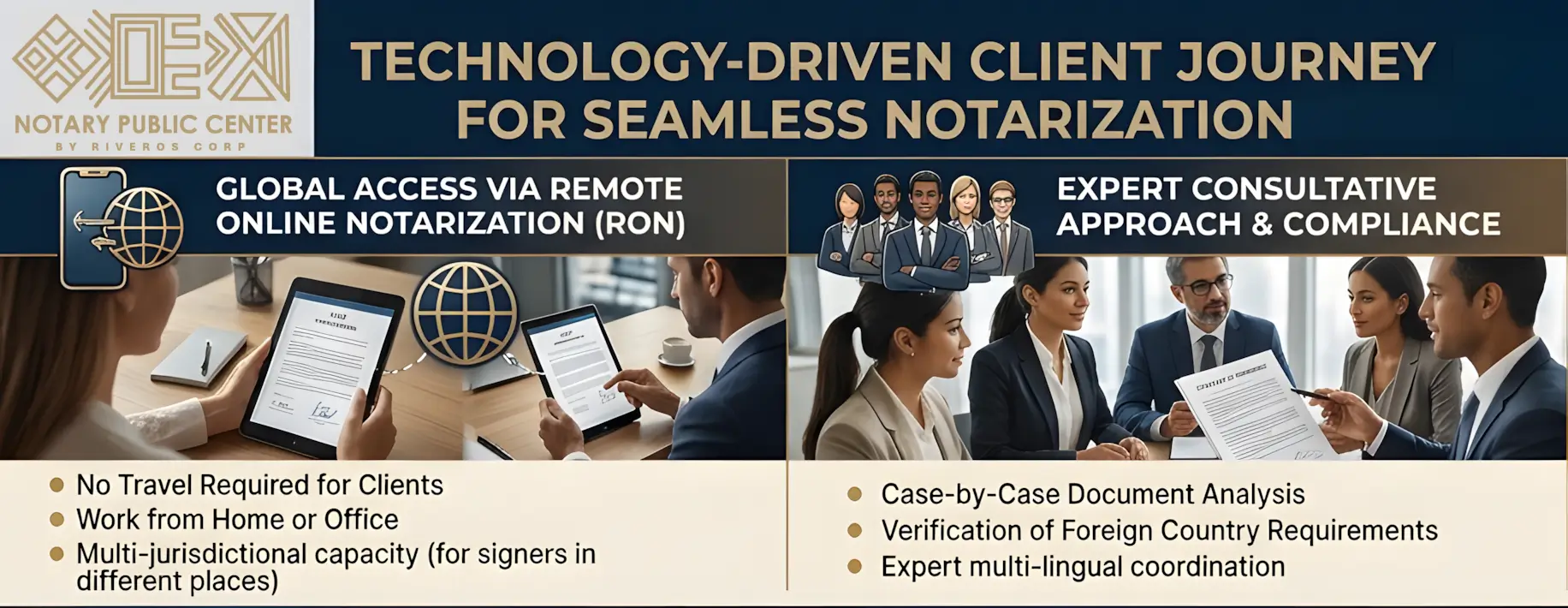
At Notary Public Center, we eliminate the guesswork. We do not just notarize your document and leave you to figure out the government labyrinth. Our specialists review your specific document type, execute a compliant in-person or Remote Online Notarization (RON), secure any necessary county-level certifications, and expedite the final apostille through the correct state or federal channels.
Stop searching for a mythical apostille notary and partner with an agency that handles the entire logistical chain. Contact Notary Public Center today to ensure your documents are authenticated correctly the very first time.
Frequently Asked Questions (FAQ)
What exactly is an apostille notary?
The term «apostille notary» is actually a common misconception. A notary public cannot issue an apostille. A notary only witnesses signatures and verifies identities. An apostille is a government-issued certificate attached to a notarized document to make it valid internationally. You need a notary first, and then the government issues the apostille.
Can I get an apostille on a photocopy of a document?
Usually, no. For private documents like powers of attorney, the original document with your wet-ink signature must be notarized and then apostilled. For public vital records (like birth certificates), you must use an original, certified copy issued by the state or county; you cannot use a notarized photocopy.
How long does the apostille process take?
Timelines vary drastically depending on the jurisdiction. Some states process apostilles in 3 to 7 business days, while federal apostilles through the U.S. Department of State can take several weeks. Utilizing the managed services at Notary Public Center prevents the massive delays caused by submitting incorrect paperwork.
Does every country accept an apostille?
No. Apostilles are only accepted by countries that are members of the 1961 Hague Apostille Convention. If your destination country is not a member (such as the UAE, until recently, depending on region), your document requires a longer process known as «legalization» through that country’s embassy or consulate.
Why was my notarized document rejected for an apostille?
Common reasons for rejection include: an incomplete notarial certificate, an expired notary commission, missing a required County Clerk authentication, submitting a document to the wrong state, or attempting to apostille a vital record signed by an outdated health official.
The information contained in this publication is provided for general informational purposes only and does not constitute legal advice. Reading or using this content does not create and is not intended to create an attorney-client relationship. No reader or user should act or refrain from acting based on the information presented herein without first consulting an attorney duly licensed to practice law in their jurisdiction.