

Can a family member notarize a document? Sometimes, but the answer depends on the state, the relationship and the notary’s interest in the transaction. There is no single nationwide rule that bans every relative. Before signing, identify the law that governs the notarial act and explain any family or financial connection.
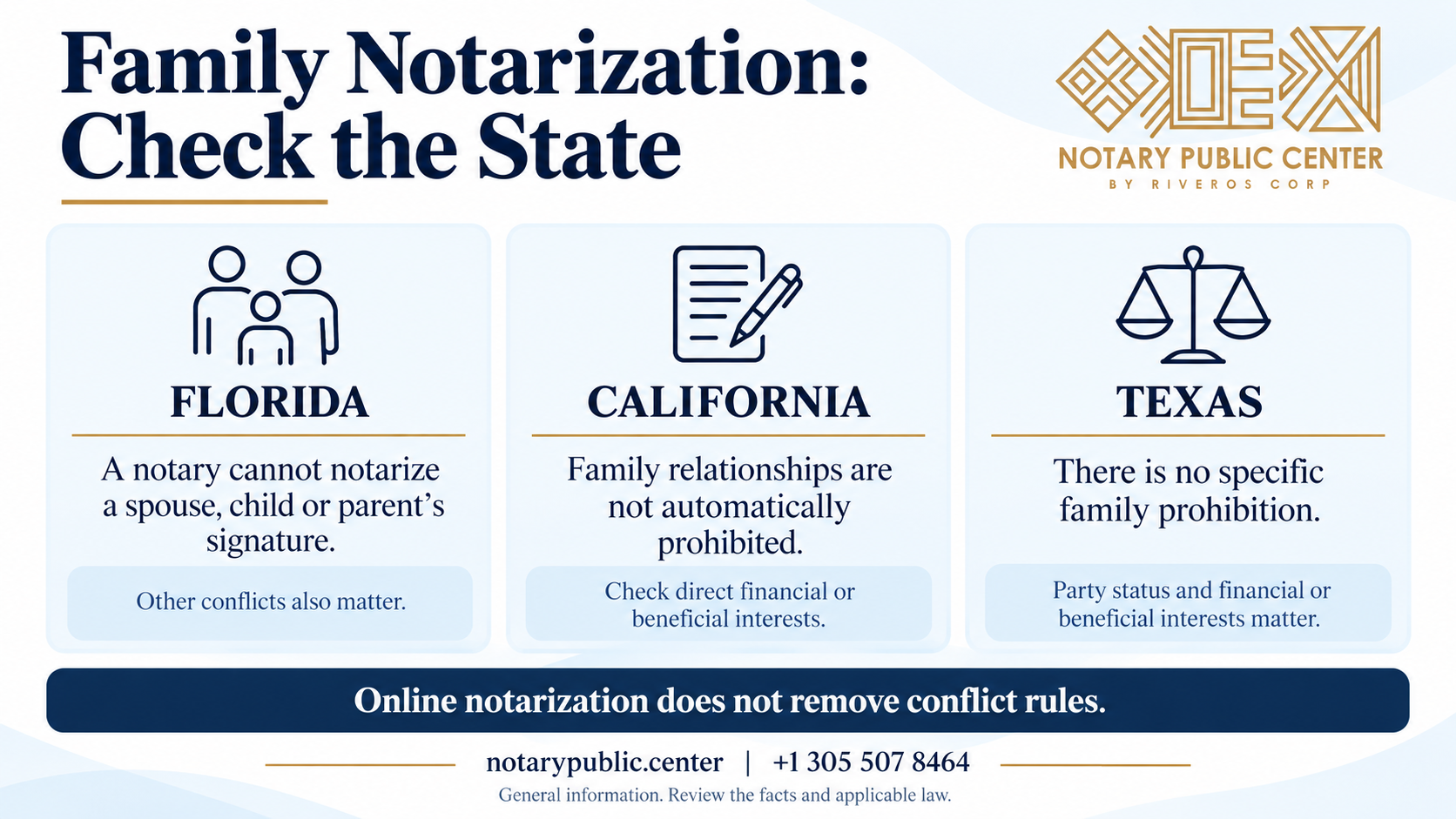
Florida prohibits a notary from notarizing a spouse’s, son’s, daughter’s, mother’s or father’s signature. California and Texas approach family relationships differently. However, a state that allows some family notarizations still requires the notary to follow its conflict rules and other duties.
Notary Public Center can review the appointment requirements and help arrange an eligible notary. Choosing someone outside the family can simplify the conflict review. It does not replace the need to check the document, the requested act or the receiving office’s requirements.
Can a family member notarize a document in Florida?
Florida Statutes section 117.107(11) identifies the prohibited relationships for notarizing signatures. A notary cannot perform that act for their spouse, son, daughter, mother or father. A different last name does not change the relationship or remove the restriction.
Brothers, sisters, cousins and in-laws are not included in that specific list. Nevertheless, their absence from the list does not mean every transaction is acceptable. Section 117.107(12) separately addresses a notary who has a financial interest in the transaction or is a party to it.
For example, a notary should not assume that notarizing a sibling’s signature is permitted when the notary is also a party to the agreement. Both the relationship and the underlying transaction need review. Describe the connection before the appointment rather than waiting until the certificate is ready.
Also, do not confuse notarizing a signature with performing a marriage ceremony. Those are different notarial functions with different rules. This article concerns signatures on documents; a restriction discussed here should not automatically be applied to every act a Florida notary may perform.
Can a family member notarize a document in other states?
California’s 2026 Notary Public Handbook allows notarization for relatives unless the notary has a direct financial or beneficial interest. Its guidance calls for care with a spouse or domestic partner because community property rules may matter. Being related therefore does not produce an automatic nationwide answer.
Texas likewise has no specific prohibition against notarizing for a spouse or relative. Its Secretary of State explains that a notary should not act when they are a party to the instrument or financially or beneficially interested. The facts of the transaction determine whether the act is proper.
These examples show why a Florida answer should not be presented as a rule for every state. They are also not a complete survey of state law. Check the current requirements for the notary who will perform the act, especially when the signer and recipient are in different places.
A business or receiving office may also require a particular process. Ask about those requirements before arranging a family notarization. If a transaction raises a legal conflict question, obtain legal advice instead of relying on a short summary or an assumption based on another state.
Why the notary’s role in the transaction matters
A notary must assess more than the signer’s identity. The notary also needs to determine whether they may perform the requested act. A person who benefits from a transaction may face a restriction even when they have no family relationship with the signer.
For instance, consider a document transferring property to the notary personally. An unrelated signer does not remove the notary’s interest in that transaction. Conversely, a family relationship that a state permits does not excuse failures in identification, personal appearance or completion of the certificate.
Disclose relevant roles, such as being a party, a recipient of property or someone named to receive a benefit. The legal meaning of a prohibited interest depends on the state. A notary who is unsure should resolve that question before proceeding or refer the appointment to another eligible notary.
Impartiality also requires attention to what happens during the appointment. The signer must act as required by the applicable rules. A family member should not answer identity questions for the signer, pressure them to sign or treat the notary’s presence as a substitute for their own decision.
Questions to resolve before the appointment
Use the following questions to organize the discussion. This review helps identify a possible problem early, but it does not decide the legal effect of a document.
| Question | Why it matters |
|---|---|
| Which state governs the notarial act? | Family restrictions and conflict rules vary. The signer’s home address alone does not answer this question. |
| What is the actual relationship? | A spouse or parent remains a relative even if the parties use different surnames. |
| Does the notary have an interest in the transaction? | Party status or a prohibited financial interest can prevent an otherwise eligible notary from acting. |
| What does the recipient require? | The office receiving the document may have instructions about certificates, witnesses or the signing format. |
Bring the complete document and the instructions you received. If you do not know which notarial act is required, ask the document’s preparer or receiving office. A notary who is not acting as your attorney should not choose legal terms or draft a legal instrument for you.
Before asking a family member to notarize a document
Start by explaining the document’s purpose and where it will be used. The appointment requirements may differ for a sworn statement, a deed or a power of attorney. A familiar signature and a notary stamp are not enough to resolve those differences.
Next, confirm which people must attend. The signer, the notary and any required witnesses perform separate roles. A relative who cannot notarize a signature may face a different set of rules when serving as a witness. Do not assume that eligibility for one role establishes eligibility for another.
Prepare identification that the notary can accept under the applicable rules. Personal knowledge, where legally available, is also subject to those rules. Being related does not allow a notary to disregard required identification or recordkeeping steps.
Finally, ask whether to sign before the appointment or in the notary’s presence. The answer depends on the act. For an acknowledgment, the signer acknowledges execution; a jurat ordinarily requires signing in the notary’s presence and taking an oath or affirmation. Follow the instructions for your actual document.
Powers of attorney, property documents and affidavits
Documents involving property or authority over another person’s affairs deserve careful preparation. Their requirements extend beyond whether a family member may act as notary. The document may need witnesses, specific language or a particular method of execution.
For a power of attorney, review who will grant authority and who will receive it. Those roles can create questions about conflicts, capacity and execution. Our guide to the power of attorney notary process explains the notarial appointment separately from the legal drafting of the power.
Similarly, a will may involve witness rules and a separate self-proving affidavit. Notarizing a signature does not, by itself, establish that the entire estate plan complies with the law. Ask a qualified attorney to review legal requirements rather than treating a stamp as confirmation of validity.
A sworn statement also needs the appropriate oath or affirmation. If your document concerns marital status for use abroad, our single-status affidavit guide discusses the document’s purpose. Confirm the recipient’s instructions, including any separate authentication requirement, before selecting a signing method.
Can a family member notarize a document online?
Remote online notarization does not remove family restrictions or conflicts of interest. A Florida online notary cannot use a video session to notarize a signature that Florida law prohibits them from notarizing. The technology changes the method of appearance, not the underlying relationship.
However, an online appointment may help a signer reach an eligible notary outside the family. The notary must have the required authorization and follow the applicable online process. An ordinary video call is not automatically a valid online notarization.
For a Florida online act, the notary must be physically in Florida. The signer’s location can create additional requirements, especially outside the United States. Identity verification, the document type and the recipient’s acceptance also need review. Some documents or signing circumstances may require a different arrangement.
Before booking, explain where each signer will be and how the finished document will be submitted. Our guide to a public notary online covers the appointment process. Notary Public Center can evaluate whether an available online service fits the stated requirements without promising universal acceptance.
What if a relative has already notarized the document?
Do not assume that every family notarization is invalid. First identify the state, the relationship and any interest the notary had in the transaction. A notarization permitted in one jurisdiction should not be judged solely by a different state’s family prohibition.
If a restriction may have been violated, keep the document and the information about its execution. Ask the receiving office what issue it has identified. For questions about validity, liability or the effect on a deadline, consult an attorney who can examine the facts and applicable law.
A new appointment with an eligible notary may be part of the solution. However, the required correction depends on the problem. Do not erase a certificate, reuse a seal or ask another notary to backdate an act. Any new notarization must accurately reflect what occurs.
The possible consequences also vary. A notary may face disciplinary action for violating applicable duties, while the effect on the underlying document requires separate analysis. Rejection, correction and legal invalidity are different outcomes; none should be promised or assumed without reviewing the particular situation.
When an employee notarizes for an employer
An employment relationship is not the same as a prohibited personal interest in every transaction. Florida law allows an employee to notarize for an employer under the stated conditions. The employee must not receive a benefit beyond their salary and the legally authorized notarial fee.
Nevertheless, other restrictions still apply. An employee who is also the signer’s spouse cannot ignore Florida’s family rule merely because the document concerns work. Likewise, an employee’s separate role in a transaction may require closer review.
Explain both relationships when requesting the service. A business may choose an outside notary for practical reasons, but that choice does not guarantee the validity of the contract. The notary remains responsible for the act performed, and the parties remain responsible for obtaining legal advice when needed.
Family notarization: common questions
Can a family member notarize a document with a different surname?
A different surname does not change the relationship. Check the applicable state restriction and the notary’s interest in the transaction before proceeding.
Can my spouse notarize my signature in Florida?
No. Florida prohibits notarizing a spouse’s signature on a document. Use an eligible notary and check any separate witness or document requirements.
Can a sibling act as a Florida notary for me?
Siblings are not in Florida’s specific family prohibition. However, financial interests, party status and all other notarial requirements still need review.
Does online notarization remove a family conflict?
No. An online notary must follow the applicable conflict rules. A remote appointment may help you find another eligible notary instead.
Does a family notarization automatically void the document?
No universal rule determines that result. An attorney must evaluate the applicable law, any violation and its effect on the particular document.
Arrange an appointment with Notary Public Center
If you are asking whether a family member can notarize a document, tell us the relationship and the document type. Also explain where the signer will be and which office will receive it. These details help us review the appointment requirements.
Contact Notary Public Center or message +1 305 507 8464 on WhatsApp. Start with a description of your needs. Agree on an appropriate channel before sharing identification or other private documents.
This article provides general information, not legal advice, and does not create an attorney-client relationship. Consult an attorney licensed in the relevant jurisdiction about legal conflicts, document validity or correction of an earlier notarization.