If you need help certifying a birth certificate for citizenship, school, immigration, banking, marriage, or another procedure abroad, the first step is obtaining the correct official certified copy. A household photocopy or keepsake certificate usually does not satisfy a receiving authority’s requirements.
Subject to the issuing state’s eligibility and authorization rules, Notary Public Center assists eligible applicants with obtaining the appropriate certified copy and coordinating the apostille or authentication path required for its destination. The objective is to reduce avoidable delays and rejection risks—not to promise acceptance by an independent authority.
What “certifying a birth certificate” means in the United States
In this context, certifying a birth certificate is generally not a notarial act. It means requesting an official certified copy from an authorized state or local vital-records office in the jurisdiction where the office recorded the birth. The federal government does not maintain ordinary state birth records.
A certified copy normally contains the issuing authority’s seal, the registrar’s signature or certification, and other security or filing information required by that jurisdiction. A notarized photocopy generally does not replace this government-issued copy, and the authority of a notary to attest copies varies by state and by document type.
Important: An apostille authenticates the signature, seal, or official capacity associated with a public document. It does not certify that every statement contained in the birth record is factually correct, nor does it decide whether a receiving institution will accept the document for a particular transaction.
How Notary Public Center assists
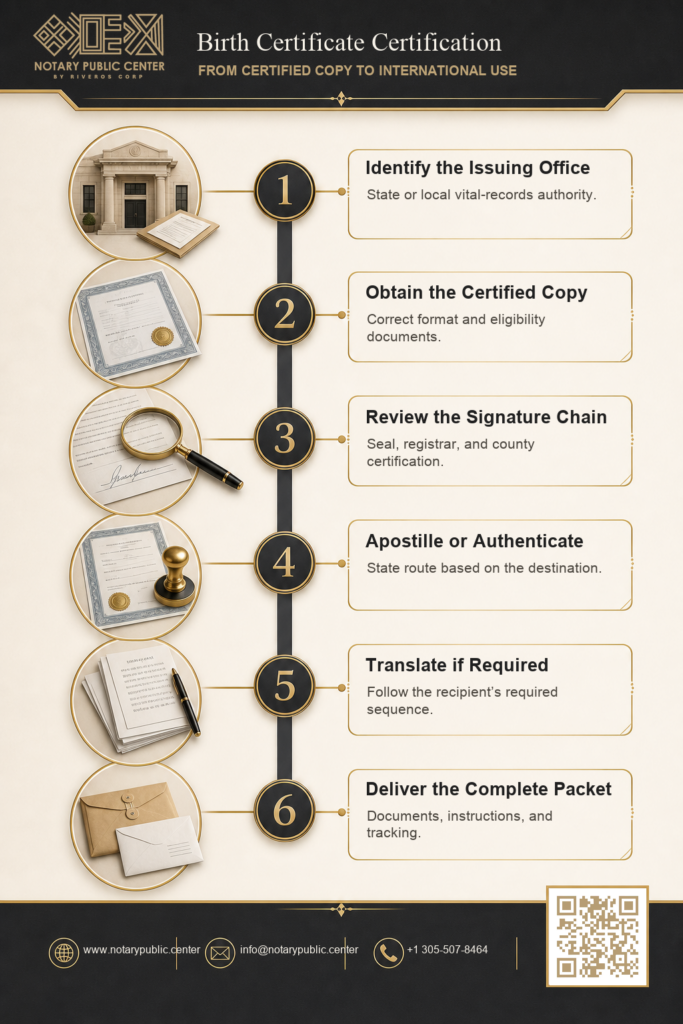
1. We identify the correct issuing office
We begin with the state and locality of birth, the purpose of the request, the applicant’s relationship to the person named in the record, and the destination where you will present the document. Those details determine the appropriate vital-records office and the available ordering method.
Each jurisdiction controls eligibility, identification, authorization forms, acceptable signatures, and delivery options. A third-party service cannot override those rules, so we review them before preparing the request.
2. We help identify the appropriate certificate format
Depending on the jurisdiction, the issuing authority may offer a birth record in long-form, short-form, abstract, informational or authorized-certified formats. The terminology and information shown on each version are not uniform nationwide. We review the available formats against the receiving authority’s written requirements before coordinating the order.
If the recipient has not explained which version it requires, we recommend requesting written confirmation before the order is placed. This is especially important for consular registrations, dual-citizenship applications, marriage abroad, immigration matters, and other procedures that may expect a particular registrar’s signature or record format.
3. We review the signature and certification chain
Once the certified copy is available, we review the seal, signature, title of the issuing official, and place of issuance. These details determine which authority can authenticate the document.
Some state-issued certified copies may proceed directly to the competent authority of the issuing state. Others—particularly certificates signed by certain local officials—may require an intermediate county-clerk certification or a newly issued state-level copy. California, for example, may require an additional step when a local health officer or registrar signed the record.
4. We coordinate apostille or authentication
The destination country and the status of the Apostille Convention determine the general route. When the Convention applies and the receiving authority requests an apostille, a state-issued birth certificate normally goes to the competent authority in the state that issued it. For a non-Convention destination, an authentication certificate and possibly consular legalization may be required.
It is important to distinguish state records from federal records. An ordinary birth certificate issued by a U.S. state follows the state route. Federal birth-related records, such as a Consular Report of Birth Abroad issued by the U.S. Department of State, follow the applicable federal authentication route.
5. We coordinate translation and delivery when required
A receiving authority may also require a translation, a translator’s certification, notarization of the translator’s statement, or a specific order between apostille and translation. Because these requirements vary, we review the receiving authority’s instructions regarding the requested sequence before coordinating the additional service.
Processing and delivery times depend on the issuing office, authentication authority, destination, shipping method, seasonal volume, and whether corrections or intermediate certifications are necessary. We quote available shipping options separately as an added convenience.
Apostille or authentication: how the route is determined
The country where the document will be used is essential, but country membership alone is not the final instruction. “The Apostille Convention must be in effect between the country where the document was issued and the country where it will be used, and the receiving authority must determine what it expects for the intended procedure.
- Apostille route: generally used when the Apostille Convention applies and the receiving authority requests an apostille.
- Authentication route: generally used for a destination outside the Convention framework and may be followed by embassy or consular legalization.
- Domestic use: an apostille is not ordinarily used for presenting a U.S. public document inside the United States.
State examples
Florida
Florida requires an original certified copy for the apostille process; an ordinary photocopy is not acceptable. The signature on a birth certificate must also be one the Florida Department of State can authenticate.
Texas
Texas can apostille an original Texas birth or death record or a Texas-issued certified copy issued by a city, county, or state authority. Recorded vital records should not be converted into notarized photocopies as a substitute for the certified record.
California
California can apostille signatures of specified state and local officials.A certificate bearing a signature that the California Secretary of State cannot authenticate directly may require county-clerk certification or a newly issued certified copy from the county recorder or the California Department of Public Health bearing an acceptable signature.
Common mistakes that cause delays
- Submitting a household photocopy: it generally does not replace an official certified copy.
- Ordering before checking eligibility: restricted records may require identification, proof of relationship, authorization, or a court order.
- Assuming every “long form” is identical: names and contents vary by issuing jurisdiction.
- Sending a local signature directly to the state: an intermediate certification may be required.
- Using the federal route for a state record: ordinary state birth certificates normally require action by the issuing state’s competent authority.
- Translating in the wrong order: the recipient may specify whether translation occurs before or after apostille.
Information to prepare before requesting assistance
- Full name shown on the birth record and any later legal name.
- Date and city or county of birth.
- Names of the parents as recorded, when required by the issuing office.
- Your relationship to the person named in the record.
- The purpose of the document and the destination country.
- Any written instructions supplied by the receiving authority.
- Your desired delivery method and relevant deadline.
A coordinated process from certified copy to delivery
Handling the request as one coordinated process makes it easier to identify dependencies before you submit the documents. Our workflow is:
- Confirm issuing jurisdiction, eligibility, purpose, and destination.
- Coordinate the request for the appropriate certified-copy format through an authorized channel, subject to the applicant’s eligibility.
- Review the registrar’s signature, seal, and any intermediate certification requirement.
- Coordinate the applicable state apostille or authentication route.
- Add translation or consular legalization when the receiving authority requires it.
- Arrange final delivery and provide available verification information.
For additional background, see our explanations of notarization and the federal authentication of birth-related records. These resources help distinguish a state certified-copy request from a federal authentication matter.
Request help with a certified birth certificate
Need a certified birth certificate for use abroad? Contact Notary Public Center to review the issuing state, your eligibility, the destination country, and the required certification process.
Frequently asked questions
What does certifying a birth certificate mean?
It generally means obtaining an official certified copy from an authorized vital-records office in the state or locality where the office recorded the birth. It is different from making or notarizing a household photocopy.
Can a notary certify a photocopy of a birth certificate?
A notarized photocopy generally does not replace a certified copy issued by the records custodian. Notarial authority varies by state, and many jurisdictions restrict copy certification when an official certified record is available.
Who is eligible to request a certified copy?
The issuing jurisdiction determines eligibility. The person named in the record, a parent, certain relatives, a legal representative, or an authorized agent may qualify. The jurisdiction may require identification, proof of relationship, written authorization or a court order.
Does the certificate need an apostille or authentication?
That depends on where and why you will use the document. When the Apostille Convention applies and the receiving authority requests it, a state apostille is generally appropriate. Other destinations may require authentication and consular legalization.
Will a translation also be required?
The receiving authority decides whether a translation is necessary and what certification it must carry. We review the destination instructions before coordinating translation so the steps occur in the requested order.
Legal notice
This publication provides general information and does not constitute legal advice or create an attorney-client relationship. Requirements vary by jurisdiction, document, destination, and receiving authority. Consult a qualified attorney when you need legal advice.