

A certificate of amendment of articles of incorporation records an authorized change to a corporate charter under the law of the formation state. Other jurisdictions may use the label articles of amendment or certificate of amendment. The statute determines the required approvals, statements, signatures and effective date.
This guide explains the certificate of amendment of articles of incorporation, its relationship to a restatement and the records that support the filing. It provides a national planning overview. The formation state’s current statute and form control the actual submission.
What a Certificate of Amendment of Articles of Incorporation Is
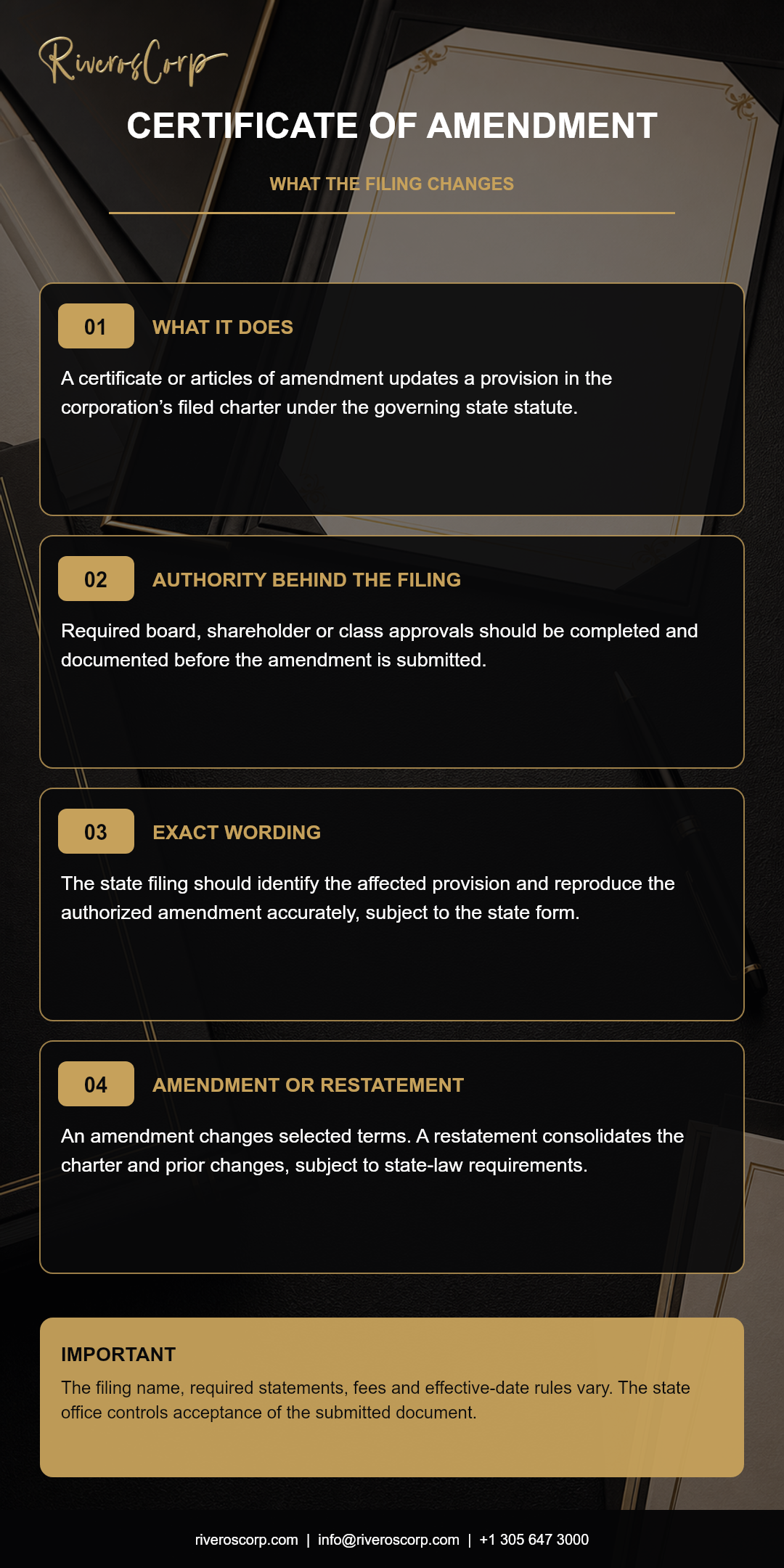
The certificate is a state filing that changes one or more charter provisions. Editing an internal copy does not alter the filed record. A typical filing identifies the corporation, states the amendment and includes statutory information about authorization. Its change takes effect under the governing law and any permitted delayed-effective-date provision.
Precision matters in this document. It does not restate your whole charter (that would be a restatement). It records a specific change, a new corporate name, a revised number of authorized shares, an updated purpose clause, or a similar modification. Because it becomes part of the permanent public record, accuracy matters: the certificate says, on the record, what your corporation changed and when. For the underlying document and the broader process, see our overview of what articles of incorporation are and our guide to amending articles of incorporation.
Certificate of Amendment vs. Articles of Amendment vs. Restatement
The labels depend on the jurisdiction. A certificate or articles of amendment usually records one or more specific charter changes. A restatement consolidates the charter and prior amendments into a current document. Some restatements also include new amendments and therefore require additional approvals. Our guide to amended and restated articles of incorporation explains that distinction.
Approving a Certificate of Amendment of Articles of Incorporation
Many corporations authorize a post-formation amendment through board action and shareholder approval. The state statute may provide exceptions, special procedures or separate voting rights for an affected class or series. Before filing, the corporation should confirm the authority, notice, vote threshold and exact amendment text.
The filing document and internal record should tell the same story. Board resolutions, shareholder consents, meeting notices and class votes may form part of that record. Administrative acceptance by the filing office does not decide every question about internal corporate authorization.
Filing a Certificate of Amendment of Articles of Incorporation
At a high level, the corporation identifies the change, documents the required approval and prepares the state form. It then pays the applicable fee and submits the certificate to the filing office. Name changes remain subject to the state’s naming rules. Stock changes may trigger separate class-vote or disclosure requirements. The filed text should reproduce the authorized amendment accurately.
The Mistakes That Undermine a Certificate of Amendment
Common errors include using the wrong filing, misstating the approved text and overlooking an affected class vote. A name may also fail the distinguishability test. Some registered-agent changes use a separate form instead of a charter amendment. After a name change, the corporation may need to update tax, bank, license, insurance and contract records under each recipient’s procedure.
Why Precision on the Record Matters
The accepted certificate generally becomes part of the corporation’s state record. Banks, investors, courts and agencies may compare it with the current charter and internal approvals. Clear wording and consistent records can reduce questions during due diligence. If the corporation discovers an error, the correction method depends on the state and the nature of the defect.
A Name Change Is More Than One Filing
A corporate name change illustrates the downstream work. The state amendment changes the charter under state law. However, it does not automatically update IRS, banking, licensing, insurance, contract or marketing records. Each institution sets its own documentation process. The corporation should create an inventory and update the records in a controlled sequence.
The state filing usually comes before updates that require proof of the legal name change. A bank or agency may request a filed copy, certified copy or certificate of status. The corporation should confirm the requested evidence before ordering records. Timing and acceptance remain with the receiving institution.
This is why we frame a name change as a project rather than a single form. The certificate of amendment is the legal core of it. However, a name change handled well means the certificate plus a coordinated update of everywhere the name lives, in the right order. Therefore, that after the dust settles your corporation presents one consistent identity to the state, the IRS, your bank, and everyone you do business with. Founders who file only the certificate and stop are often still untangling stray old-name records months later, at moments when the mismatch is genuinely inconvenient.
What the Certificate Should Match
The filed certificate should match the amendment text that the corporation authorized. It should also use the corporation’s exact current legal name and state file information. A mismatch between the resolution and the filing can create uncertainty about what the board and shareholders approved.
Stock amendments need special care. The certificate may change authorized shares, classifications, par value or rights. Those provisions can affect existing holders and future issuances. The corporation should compare the amendment with the current capitalization table and charter before submission.
A purpose or name amendment creates different follow-up work. The corporation may need new licenses, tax-record updates or contract notices. The certificate changes the state charter. It does not automatically rewrite every private agreement.
Administrative Acceptance and Corporate Authorization
The filing office usually performs an administrative review. It may confirm that the form contains required statements, signatures and fees. That review does not necessarily establish that every internal vote complied with the charter, bylaws and statute.
For that reason, preserve the approval trail. The record may include a board resolution, shareholder or member action, class votes and notices. It should identify the final language and the authority for the filing. If the corporation used written consent, confirm that the governing law and documents permit that method.
A later challenge can focus on authorization even when the public filing appears regular. Corporations with disputed ownership, missing records or conflicting documents should obtain legal advice before submitting the certificate.
Certificate of Amendment, Correction and Restatement
An amendment intentionally changes the charter. A certificate of correction may address a defect in an earlier filing when the state statute permits that remedy. A restatement consolidates the charter and prior amendments. These documents serve different purposes.
Do not use a correction filing to make a substantive change that requires corporate approval. Likewise, a restatement may require more than administrative consolidation if it introduces new provisions. The state’s statutory definitions and forms determine the available route.
If the corporation has several amendments, a restatement can simplify future review. Banks and investors can read one current document instead of reconstructing the charter from a stack of filings. Historical amendments should still remain in the corporate record.
After a Certificate of Amendment of Articles of Incorporation
Confirm the effective date and obtain the filed evidence. Then update the corporation’s internal charter copy and minute book. Directors, officers and recordkeepers should use the amended provision in later actions.
For a name change, create a list of tax agencies, banks, licenses, insurers, counterparties and digital accounts. A share change calls for updated equity records and a review of later issuances. When the purpose changes, review regulated activities and contractual restrictions.
Each recipient controls its own evidence and timing. Some may accept a filed copy. Others may request certification or a certificate of status. Riveros Corp can coordinate administrative requests. However, it cannot compel another institution to accept the document.
Questions to Resolve Before Filing
Confirm whether the proposed change actually belongs in the charter. Ask whether the state offers a separate form for the registered agent, office address or another administrative update. Then identify the exact charter section that the corporation plans to amend.
Review the approval path before drafting the certificate. Determine whether the board must recommend the change, whether shareholders or members must vote, and whether an affected class receives separate voting rights. The corporate record should support the statements that will appear in the filing.
Check the effective-date plan and downstream deadlines. A future effective date may help coordinate a name change, contract closing or equity transaction when the statute permits it. However, the corporation should not use the new provision before it takes effect.
Finally, decide which filed evidence the corporation will need. Internal records may use the filing confirmation. Meanwhile, a bank or foreign recipient may request a certified copy. Planning those requests early can prevent a later document-order delay.
How Riveros Corp Coordinates a Certificate of Amendment
At Riveros Corp, we review the requested change, formation state and current charter before preparing a certificate of amendment of articles of incorporation. We can organize the client-provided approvals, prepare the state submission and coordinate administrative updates. Legal disputes, fiduciary questions and tax consequences may require licensed advisers.
After filing, we can help coordinate the requested follow-up records. The state, IRS, bank and other recipients control processing and acceptance. For related planning, review EIN records and whether a foreigner can register a business in the USA.
Need help with a certificate of amendment of articles of incorporation? Contact Riveros Corp, call +1 305 647 3000, or use WhatsApp. We can review the change and coordinate the applicable state filing.
Frequently Asked Questions
What is a certificate of amendment of articles of incorporation?
It is the state filing that formally changes one or more provisions of your articles, a new name, revised authorized shares, an updated purpose, and the like. Once the state accepts it, the change is legally effective and part of the public record. We prepare and file it in your state’s required form.
Is a certificate of amendment the same as articles of amendment?
In most contexts, yes, they are two names for the same filing that records a specific change to your articles, with the label depending on the state. Both differ from a restatement, which consolidates the whole charter. We use whichever your state requires.
Do I need shareholder approval to file a certificate of amendment?
Many amendments require board action and shareholder approval. Exceptions and separate class votes may apply. Confirm the state statute, charter and bylaws before filing, and preserve the supporting corporate records.
How is a certificate of amendment different from a restatement?
A certificate of amendment records one or a few specific changes. A restatement rewrites the entire charter to consolidate all changes into one clean document. Use a certificate for a discrete change and a restatement to clean up a fragmented record. We help you choose the right one.
Can a certificate of amendment be rejected?
Yes. The filing office may reject a noncompliant name, missing statutory statement, signature problem, fee issue or incorrect form. Internal approval defects can also create later questions even if the office accepts the filing. Careful preparation reduces avoidable errors but does not guarantee acceptance.
What do I need to update after filing a certificate of amendment?
Depending on the change, your EIN records, bank accounts, contracts, licenses, and marketing may need updating so everything matches the amended articles. Overlooking this leaves a mismatched paper trail. We help you update the downstream records the change touches.