A special power of attorney lets you authorize someone to handle a defined transaction or a limited category of tasks. You might need an agent to sign closing documents while you are away or handle a particular account matter. The document should explain what that person may do and when the authority ends.
Limited authority still requires careful drafting and proper execution. A short document can leave important questions unanswered, especially when a bank, lender, or registry must rely on it. The governing state and the transaction determine the requirements.
This guide uses Florida law for its main examples and compares selected rules in New York and California. Notary Public Center can coordinate the notarial appointment. A qualified attorney should address legal drafting, disputed authority, or whether the proposed powers fit your needs.
What a special power of attorney authorizes
The principal grants authority; the agent exercises it on the principal’s behalf. A special or limited power identifies the transaction or tasks within that authority. It can also exclude acts the principal does not want the agent to perform.
For example, a principal might authorize a sale of identified property and specified closing tasks. That does not automatically authorize gifts, changes to beneficiaries, or unrelated withdrawals. However, the exact wording and applicable law determine the reach of the grant.
Florida section 709.2201 permits specifically granted authority and authority reasonably necessary to carry it out. Therefore, it would be too broad to say that every supporting act needs a separate clause. Even so, describing the expected transaction clearly can prevent disputes over what a supporting act includes.
Also, a general statement allowing the agent to do anything the principal could do does not supply specific authority under that Florida provision. Broad language cannot reliably repair an unclear grant.
Limited authority and durability answer different questions
A limited power describes the scope of the agent’s work. Durability addresses whether the authority continues after the principal’s later incapacity. Consequently, a special power of attorney can also be durable.
In Florida, durability requires wording that shows this intent under section 709.2104. It does not extend the document beyond its stated expiration or completed purpose. Moreover, durability does not allow the agent to continue using the power after learning that the principal has died.
Starting authority later is another question. Florida generally makes a power exercisable when executed and restricts powers triggered by a future date or event. Statutory exceptions include certain older instruments and deployment-contingent military powers. Do not add a delayed start without legal review.
If you need ongoing financial management, compare the types of power of attorney before choosing a narrow instrument. Repeatedly replacing a one-transaction document may not address the principal’s longer-term needs.
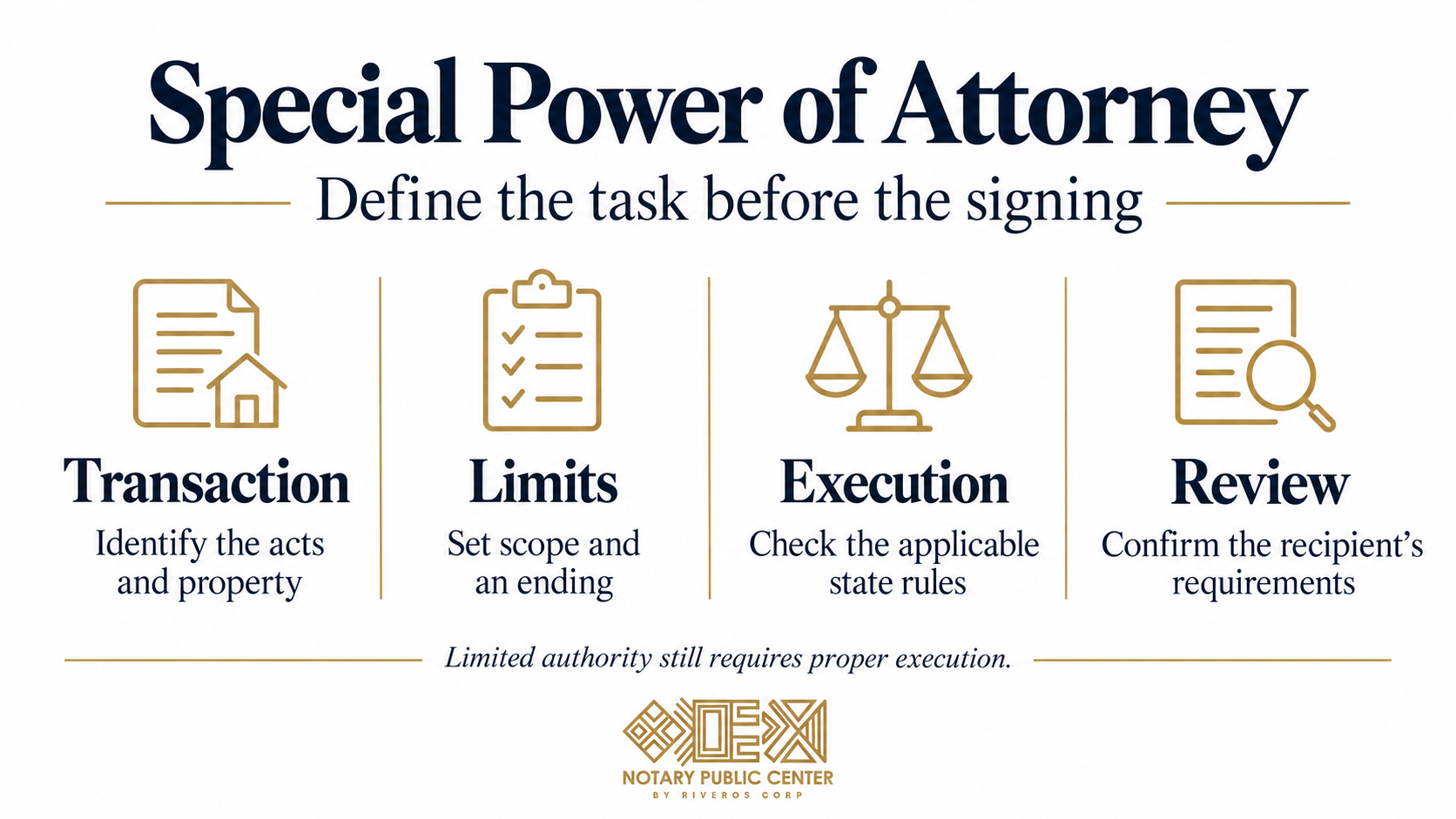
Define the transaction before the signing
Identify the property and the permitted acts
Describe the transaction with enough detail for the receiving party to match it to its records. For a property matter, the attorney and closing office can identify the necessary legal description and documents. For a vehicle, the relevant title authority can explain its identification and form requirements.
Then review the full sequence of tasks. Will the agent sign documents, receive funds, deliver a title, or correct a filing? Each question helps reveal a gap before the principal becomes unavailable.
In addition, distinguish a sale from a gift. The same property can be involved in either transaction, but the required authority may differ. A document authorizing a sale should not become permission to transfer the asset without payment through an informal assumption.
Set an ending that fits the work
Under Florida section 709.2109, completion of the power’s purpose can terminate it. The document may also state its own termination point. Accordingly, define the purpose carefully enough to identify when the authorized work has finished.
An expiration date can help limit authority, but a closing delay may make that date impractical. Discuss this risk before signing. Do not assume that the agent can extend an expired grant simply because some work remains.
If another person may need to step in, ask about naming a successor agent. A successor provision addresses the availability of the agent; it does not automatically expand the authorized transaction.
Special power of attorney signing rules vary by state
The following comparison concerns ordinary powers covered by the cited state provisions. Special statutory forms, older instruments, and powers signed in another jurisdiction can follow different rules. Confirm the law that applies to the actual document.
| State | Selected execution requirements | Point to check |
|---|---|---|
| Florida | Principal’s signature, two subscribing witnesses, and acknowledgment under section 709.2105. | Check exceptions and any authority requiring separate initials or signatures. |
| New York | Principal signs, initials, and dates as required; acknowledgment and two qualified witnesses apply under section 5-1501B. | The acting agent also signs and dates with an acknowledged signature. Additional statutory content rules apply. |
| California | Execution date and the required signature, plus notarized acknowledgment or at least two qualified witnesses under Probate Code section 4121. | Witness qualifications and the requirements of the intended transaction still matter. |
In New York, the person taking the acknowledgment may also serve as one witness. The witnesses cannot be named agents or permitted gift recipients under the provision. Therefore, count the required roles and check who may fill them before the appointment.
Some procedures use government-prescribed forms. Florida section 709.2103 excludes specified categories from its Power of Attorney Act, including powers on prescribed government forms for governmental purposes. Thus, do not apply the ordinary Florida execution checklist to every document labeled “power of attorney.”
Some Florida powers need separate approval
For powers subject to section 709.2202, the principal must sign or initial next to each covered grant. The categories include creating a living trust, specified changes to a trust, gifts, and changes to survivorship rights. They also include beneficiary changes, certain survivor-annuity waivers, and disclaimers of property or powers of appointment.
Separate initials alone do not remove the provision’s other conditions. For example, an agent’s authority to change a trust depends partly on what the trust allows. Gift authority also carries statutory limits unless the instrument provides otherwise.
A limited document therefore needs the same attention to sensitive grants as a broader one. If the sole transaction changes a beneficiary, the drafting and execution must address that authority directly.
Other acts remain outside an agent’s permitted role under Florida section 709.2201. These include executing a will for the principal and voting in a public election. A special power cannot authorize every act merely by naming it.
Banking language should fit the authority intended
Florida section 709.2208 provides a way to incorporate a defined set of banking or investment powers by reference. However, a statutory package may be broader than the principal wants for a single task. Ask the drafting attorney which powers are necessary and which should remain excluded.
Conversely, the absence of that statutory reference does not automatically invalidate every specifically granted banking power. The scope of the actual grant matters. Avoid copying broad banking language merely because someone describes it as mandatory in every limited document.
Give the bank a copy for review before the transaction date. Ask what identification or supporting evidence the agent must provide. This allows time to address the institution’s questions without treating its preferred form as the only possible valid document.
Recipient review has legal limits
Under Florida section 709.2120, a third person must accept or reject a power within a reasonable time. Four days, excluding Saturdays, Sundays, and legal holidays, are presumed reasonable for specified banking and investment powers. This is a statutory presumption with defined conditions, rather than a universal four-day deadline for every recipient.
The same section prohibits requiring an additional or different power-of-attorney form for authority already granted in the presented document. Nevertheless, the statute permits rejection on specified grounds, including certain questions about validity or authority.
Section 709.2119 also allows requests for supporting material in the circumstances it describes. These can include an agent’s affidavit, a certified English translation, an opinion of counsel, or the notary’s electronic journal or record.
If a recipient objects, identify the objection in writing and have counsel assess it. A document may need clarification, or the refusal itself may raise a legal issue. Simply promising that every institution must accept every notarized power would misstate the law.
Remote signing requires a separate review
Online notarization and remote witnessing are different functions. A video call with a notary does not automatically provide the subscribing witnesses the document requires. Confirm where the principal and each witness will be and which acts the session will cover.
Florida section 709.2202 restricts remote witnessing for its separately enumerated powers when the principal is domiciled in Florida. Under that rule, a remotely witnessed power is ineffective to grant those listed authorities. It should not be treated as a general ban on every online notarization.
Section 117.285 adds screening rules for specified electronic documents when fewer than two witnesses are physically present. The provision addresses impaired decision-making, daily-living limitations, assistance with daily care, and vulnerable adults. Its scope and exceptions require attention; age alone does not answer the question.
For a signing involving these issues, arrange legal review before choosing the remote format. You can also review power of attorney signing considerations for an elderly parent when family members need help preparing for the appointment.
The agent’s duties continue within the limited scope
A Florida agent who accepts appointment acts as a fiduciary. Section 709.2114 requires the agent to stay within the authority granted, act in good faith, and respect applicable duties to the principal. A narrow transaction does not remove those obligations.
Keep records of receipts, payments, and transactions. Also preserve the instructions and documents that explain how the agent completed the authorized work. Those records can help the principal review the result and answer later questions.
The agent should not keep acting after learning that the authority has ended or become suspended. Florida law includes protections for certain good-faith acts without knowledge of termination. However, those protections do not give an informed agent permission to ignore a revocation or the principal’s death.
Use abroad and appointment preparation
If a foreign office will receive the document, obtain its requirements before signing. Confirm the language, notarial form, translation, and apostille or legalization route. Authentication verifies the relevant public signature or seal; it does not decide whether the foreign authority accepts the powers granted.
For the appointment, provide the completed document and the instructions supplied by counsel or the recipient. Then confirm acceptable identification, witness arrangements, and whether the principal needs accommodations. A notary’s role does not include choosing the principal’s legal powers.
Finally, request a quote that identifies the services involved. Our guide to power of attorney cost components separates notarization from drafting, witnesses, translation, and authentication. Knowing which services are needed helps avoid booking an incomplete appointment.
Special power of attorney: common questions
How does a special power differ from a general power?
A special power limits authority to identified tasks or transactions. A general power usually covers broader categories. The document’s actual terms and applicable law determine the authority; the title alone does not establish its scope.
Does a limited power need witnesses and notarization?
The governing law controls. Ordinary Florida powers covered by section 709.2105 require two subscribing witnesses and acknowledgment. California permits acknowledgment or qualified witnesses under its general provision, while New York has different requirements. Special forms and jurisdictional exceptions need separate review.
When does a special power of attorney end?
Under Florida law, possible ending events include completion of its purpose, its stated expiration, revocation, or the principal’s death. Incapacity can also affect authority, depending on durability and court proceedings. Review the document and applicable law before assuming it remains usable.
Can an agent sell property or a vehicle?
A properly authorized agent may handle an eligible transaction within the granted powers. Confirm the property description, required acts, and title or recording rules. Florida homestead transactions can also require a spouse’s joinder. A general sales instruction does not resolve every requirement.
Can a special power also be durable?
Yes. Limited scope and durability can coexist. In Florida, the document needs wording showing the required intent for durability. However, durability does not override an expiration, completed purpose, or other applicable termination rule.
Must a bank accept the document immediately?
No. Florida provides a reasonable-time rule and a four-day presumption for specified banking and investment powers. The statute also regulates rejection and requests for supporting material. Submit the document early and obtain legal help if the recipient’s objection remains unresolved.
Arrange the signing for your specific transaction
Notary Public Center can help coordinate notarization for your special power of attorney. Share the completed document, signing location, recipient instructions, and deadline so the appointment requirements can be reviewed. Call +1 (305) 507-8464 or contact Notary Public Center on WhatsApp.
This publication provides general information, not individual legal advice. A qualified attorney should determine the appropriate authority, drafting, and governing-law requirements for your transaction.