

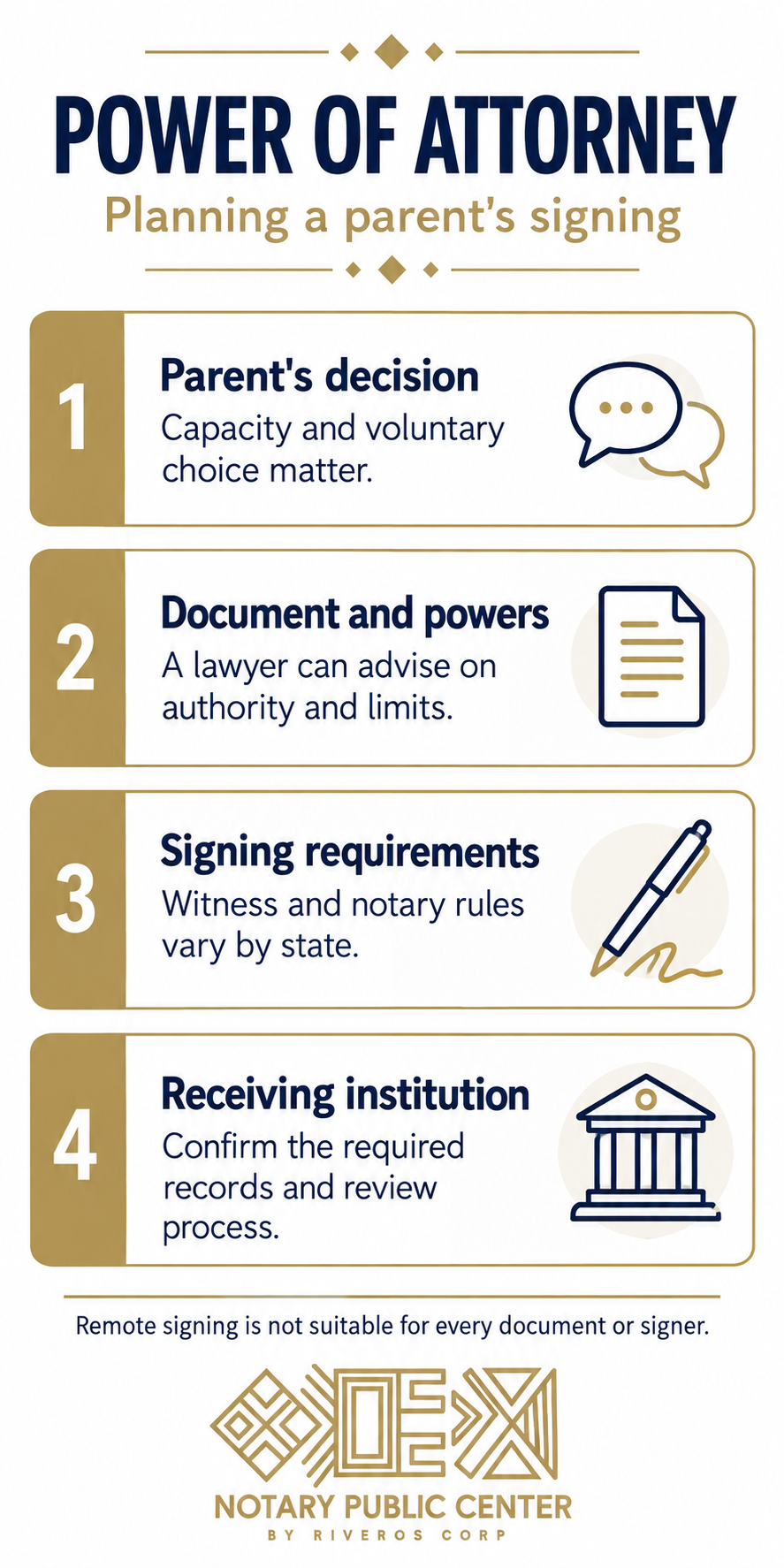
A power of attorney for an elderly parent allows a parent to give another person authority to act on their behalf. The document must reflect the parent’s decision, grant the needed powers, and meet the applicable signing rules. A notarized signature alone does not answer all three questions.
Families often seek help when managing accounts or attending appointments becomes difficult. However, age does not by itself establish incapacity. The parent’s understanding and voluntary choice remain central to the process.
Notary Public Center coordinates notarization and signing arrangements for eligible documents. A licensed attorney should advise on the powers, legal wording, and any capacity concerns. This article explains common execution issues, with particular attention to Florida and selected differences in other states.
Power of attorney for an elderly parent: whose decision is it?
The parent is the principal. The person appointed to act is the agent, sometimes called the attorney-in-fact. That title does not mean the agent is a lawyer, and being an adult child does not automatically create authority.
The principal must have the legal capacity required to execute the document. A diagnosis alone may not resolve that question. Conversely, the ability to sign a name does not necessarily establish the understanding that the law requires.
Therefore, concerns about memory, confusion, medication, or pressure should reach the advising attorney before the appointment. A family member should not answer substantive questions for the parent or treat the signing as a way to bypass a capacity problem.
What if the parent already lacks capacity?
A person who lacks the necessary capacity cannot solve the problem by signing a new power of attorney. First, counsel can examine whether an existing valid document already grants the needed authority. Its scope, durability, and current effect matter.
Other lawful arrangements may also address particular needs. Florida courts describe guardianship as appropriate only when no suitable, available, less restrictive alternative meets the person’s needs. Consequently, guardianship is not automatically the only option in every case.
If court involvement is necessary, its scope depends on the facts and applicable law. The notary cannot create authority that the parent cannot legally grant. Nor can an apostille or additional witness cure that underlying problem.
Durability and the parent's continuing rights
A durable power of attorney can continue despite the principal’s later incapacity, subject to the governing law and document. In Florida, section 709.2104 permits the statutory durability wording or similar language showing that intent. The title alone should not carry the entire burden.
Durability differs from the date on which authority begins. Florida generally makes a power exercisable when executed. Its restrictions on future-event powers have exceptions, including certain older documents and military instruments. An attorney should review any proposed condition that delays effectiveness.
Also, granting authority does not itself declare the parent incompetent or remove the parent’s own decision-making rights. The agent must act within the document and legal duties. Our overview of different types of power of attorney explains related distinctions.
Power of attorney for an elderly parent in Florida
For a Florida execution under section 709.2105, the principal signs, two subscribing witnesses sign, and the principal acknowledges the document before a notary or other authorized officer. These are separate requirements. Booking a notary does not automatically arrange the witnesses.
The signing plan should identify everyone who must attend and the method they will use. If the parent has a physical limitation, discuss it in advance. Florida provides a specific procedure for a notary to sign for a physically unable principal at the principal’s direction.
That procedure does not allow a relative to improvise a substitute signature. It also does not replace capacity or voluntary consent. Our article on a Florida power of attorney provides additional context for the document and execution requirements.
Why a form from another state may differ
Witness and acknowledgment requirements vary. Therefore, a form’s appearance or a prior family’s experience is not enough to establish the correct process. The execution location, governing law, intended transaction, and receiving institution all deserve attention.
| State example | Basic execution distinction | Additional issue to review |
|---|---|---|
| Florida | Principal's signature, two subscribing witnesses, and acknowledgment | Special powers and remote-witness restrictions |
| New York | Acknowledged principal signature and two qualified witnesses; acting agent also signs with acknowledgment | Required notices, form requirements, and permitted witness roles |
| California | Dated document and required signature, with acknowledgment or two qualified witnesses under Probate Code section 4121 | Witness qualifications and requirements for the intended use |
This comparison is not a complete execution checklist. Older instruments, special forms, and particular transactions can involve additional rules. A lawyer should assess the document before the family relies on a general state comparison.
New York witnesses and acknowledgment
New York’s financial-power statute excludes named agents and permissible gift recipients from serving as witnesses. The person taking the acknowledgment may serve as one witness. However, it would be inaccurate to say that every witness signature must also receive a separate acknowledgment.
The principal’s signature and the acting agent’s signature have their own acknowledgment requirements. The statute also addresses signing at the principal’s direction and when authority becomes effective. Consequently, the family should follow the document’s applicable requirements carefully.
Choosing powers before scheduling the signing
A power of attorney for an elderly parent should address the actual tasks the agent may need to perform. Paying bills, selling property, changing beneficiaries, and making gifts are different acts. A broad-sounding title does not establish authority for each one.
In Florida, an agent generally needs a specific grant of authority and any authority reasonably necessary to carry it out. A clause purporting to authorize everything the parent could do does not supply every specific power. Therefore, the drafting discussion matters before notarization.
The parent and attorney can consider limits, successor agents, and recordkeeping expectations. The parent’s wishes should guide those choices. A notary service cannot choose legal powers merely because a family wants the appointment completed quickly.
Florida powers that require separate approval
Section 709.2202 requires a signature or initials beside specified powers. They include certain trust changes, gifts, beneficiary changes, and survivorship rights. The statute also imposes conditions and limitations on their exercise.
These powers can affect ownership and inheritance. Consequently, they should not become routine boxes to initial without advice. Appointment of an adult child does not remove the agent’s duties or make every transfer appropriate.
Banking authority and institutional review
Florida section 709.2208 provides wording that incorporates specified banking or investment authority without separately listing each covered transaction. However, that statutory wording is not the only possible way to grant every individual financial power. The document’s actual language needs legal review.
A bank may request permitted supporting material, such as an agent’s affidavit or an opinion of counsel. Florida also limits improper demands for a different form when the presented instrument already grants the authority. Neither principle creates automatic acceptance of any document bearing a notary seal.
For specified banking and investment powers, Florida presumes four days to be a reasonable acceptance or rejection period, excluding weekends and legal holidays. This concerns the response to the power, not guaranteed completion of the transaction. Lawful rejection grounds and supporting-document requirements still matter.
Financial and health care authority
A financial grant does not automatically authorize medical decisions. Nevertheless, Florida law permits a durable power of attorney to grant health care decision-making authority expressly. Separate health care surrogate designations and other advance directives are also available.
Therefore, it is too broad to say that financial and medical authority can never appear in one instrument. The document must provide the appropriate authority and comply with the applicable rules. Chapter 765 addresses health care directives and related decision-making requirements.
The family should also distinguish consent to treatment from paying medical bills or obtaining information. These tasks may involve different provisions. An attorney can coordinate the documents so that the intended representatives understand their roles.
Can a power of attorney for an elderly parent be signed online?
Florida permits remote online notarization, but the proposed document and participants must qualify. The location of the notary, identity verification, technology, and witness arrangements matter. A video call by itself is not a compliant notarization.
Under section 117.285, certain documents trigger additional safeguards when fewer than two witnesses are physically with the principal. These include powers containing specified banking or investment authority. Required screening questions address impairment, daily living limitations, and assistance with daily care.
An affirmative answer requires physically present witnesses for the covered signing. The law also restricts remote witnessing for a vulnerable adult. Age alone does not answer that legal question. Our guide to online power of attorney signing discusses the process.
Remote witnesses and special Florida powers
There is another restriction for a principal domiciled in Florida at execution. Under section 709.2202(6), remote witnessing by a witness outside the principal’s physical presence does not effectively grant the special powers listed in subsection (1). These include the separately approved powers discussed above.
Therefore, remote notarization and remote witnessing should not be treated as the same question. A proposed arrangement may require witnesses physically beside the parent. The team and advising attorney should resolve this before scheduling.
The notary's role at the appointment
The notary identifies the signer and performs the required notarial act. Florida prohibits notarizing when the signer appears unable to understand the nature and effect of the document. It also prohibits notarization when the notary knows the signature is not voluntary.
However, the notary does not provide a medical diagnosis or a legal opinion that every power is valid. A seal cannot establish that the drafting meets all legal needs. Any unresolved concern may require postponement and advice from the appropriate professional.
Practical preparation also matters. Confirm the identification, document version, witnesses, and any accessibility needs. If the parent is in a care facility, coordinate access and timing without assuming that staff can serve as witnesses.
Using the power in another location
Florida generally recognizes a power executed in another state when the instrument and its execution complied with that state’s law at the time. However, a receiving party may have rights to request an opinion of counsel. Other restrictions, including the Florida remote-witness rule, can still apply.
International use raises separate questions. The destination may require particular wording, authentication, or translation. An apostille authenticates the relevant public signature or seal; it does not expand the agent’s powers or guarantee acceptance abroad.
Consequently, obtain the receiving authority’s requirements before the signing whenever possible. The lawyer can address substantive wording, while the notarial team coordinates the permitted execution and authentication route.
Keeping the document usable after signing
A power of attorney for an elderly parent should remain accessible to the people who lawfully need it. Keep a clear record of the signed version and where the original is stored. Recording or institutional procedures may require particular copies or supporting records.
Changes in the parent’s wishes, family circumstances, or appointed agent may call for legal review. A new document does not justify assuming that every earlier recipient knows about the change. Our discussion of revoking a power of attorney explains why notice matters.
The agent should also preserve records of actions taken for the parent. Authority to act carries duties and limits. It does not turn the parent’s money into the agent’s personal funds.
Power of attorney for an elderly parent: common questions
Can a parent with dementia sign?
A diagnosis alone does not settle the required legal capacity at execution. However, the parent must understand the decision to the degree the law requires. Counsel should assess concerns before the signing, with clinical input when appropriate.
Does every state require a notary and two witnesses?
No. Florida uses that general combination for execution under section 709.2105. Other states differ; California’s general rule allows acknowledgment or qualified witnesses. The particular document and intended use may add requirements.
Can my parent use remote online notarization?
Possibly, but eligibility depends on the document, signer, identification process, and witness arrangements. Florida places specific limits on remote witnesses for certain documents and powers. The team should review those issues before confirming an online appointment.
Can one document include medical and financial powers?
Florida permits express health care authority in a durable power of attorney. However, a financial provision alone does not supply it. Counsel should coordinate the required authority and any separate health care directives.
Must the bank accept a notarized document immediately?
No. The document must grant the relevant authority, and lawful review or supporting-document requirements may apply. Florida restricts improper rejection and establishes response rules. A notary seal alone does not guarantee acceptance or completion of a transaction.
Can I sign for a parent who cannot physically write?
Do not improvise a signature. Florida provides a procedure for a notary to sign at the direction of a physically unable principal. It has specific safeguards and does not replace the parent’s required capacity or voluntary decision.
Arrange the appropriate signing
Contact Notary Public Center to discuss the document, your parent’s location, and the proposed witnesses. Call +1 305-507-8464 or use WhatsApp. The team can assess the notarial arrangements and identify information needed before the appointment.
This publication provides general information, not legal advice. A licensed attorney should advise on drafting, capacity, authority, and legal disputes. Notarization does not guarantee validity, institutional acceptance, or a particular outcome.