A foreign recipient may request document legalization before accepting a U.S. record. If the file has already been returned, its stated reason should guide the review. The document may be genuine and the copy still unsuitable. The certification may have been prepared for another destination, or the translation may cover only part of the file. A review before submission can help identify those problems in U.S.-issued documents intended for use abroad. It looks at the review you do before shipping, without assuming that every record has to pass through the same sequence of offices.
Start with the result the recipient actually needs. A civil registry, an employer, a bank, a court and a licensing authority may each ask for different evidence, even when the applicant calls all of it “legalization.” Apostille de la Haya can review the record you have, the certifications already on it and the written requirement, and then explain which service fits. That makes it easier to spot what is missing and to avoid spending time on a route that cannot fix the reason for the rejection.
Document legalization begins with the recipient's requirement
The name of a country does not fully define the job. It tells you the destination, but the receiving organization decides what evidence it needs for its specific purpose. Submitting a marriage certificate as proof of a relationship is a different task from registering that marriage in the local civil system. A degree requested by an employer may belong to a different process from professional licensing.
Get the requirement in writing when you can. The details that help are the document’s name, the acceptable version, the language, the certifications and any deadline or rule about the issue date. If the recipient just says “legalized,” ask which stage or final form it expects. That is more reliable than reading the word the way another applicant used it for an unrelated procedure.
General U.S. guidance on authenticating documents separates the apostille from authentication based on the country of use. In practice, you still need to review the document and the recipient alongside that destination question. A correct certificate attached to the wrong record does not give the receiving authority the evidence it asked for.
Review the record before you look at the stamps
First identify the issuer and the exact version you have. The original of a public record often stays with its official custodian, and the applicant receives a certified copy. That certified copy is not the same as a personal photocopy or a scan of it. Clarify what “original” means in your case. The word should not be used to reject every official copy, or to accept any piece of paper that has a seal on it.
Look at the whole record. Read any certification statement, restrictions, text on the back and attachments. A quick review of the front page alone can miss the official signature that matters, or a notice that the copy is for limited use only. Keep the pages arranged as they are while you work out what the next authority requires.
If the record contains an error, document legalization will not correct it. A wrong date, missing information or an unsuitable legal authorization has to be taken up with the issuer or the appropriate professional. Don’t change the text yourself, and don’t count on a later official overlooking the discrepancy because several certifications were added. Once a corrected record is issued, it may need its own preparation.
For vital records, the CDC directory of issuing jurisdictions helps you find the right state or area. It is a directory. It is not a federal office that issues every personal certificate. The authority responsible for a record depends on the event and the issuer, which may differ from the state where the applicant lives today.
Match the certification route to the destination
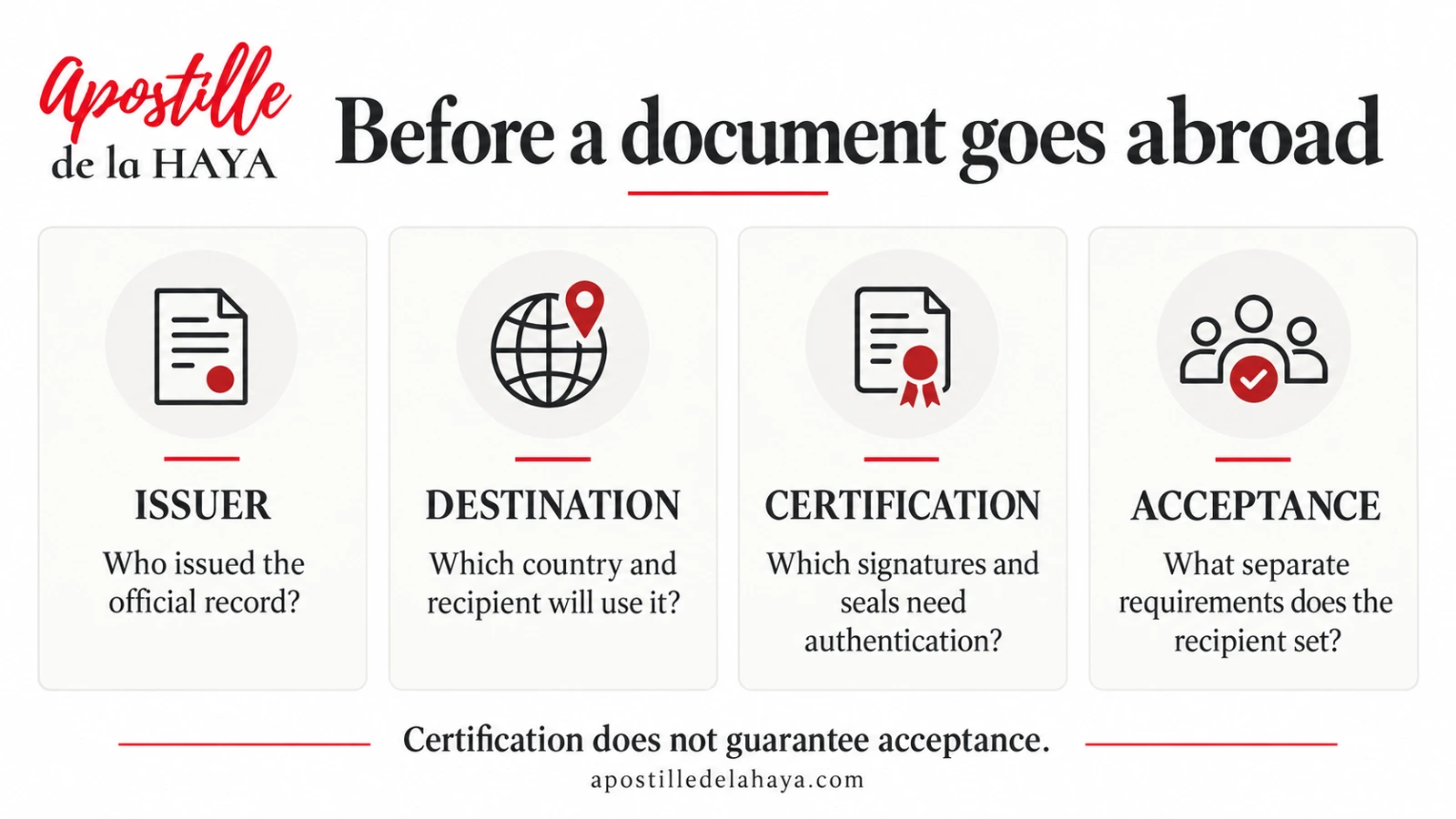
The route follows the document’s official origin and how it will be used. A state record, a federal certification and a private notarized instrument each start with a different official act. Before you submit, find out which signature the next authority will recognize. Don’t add an extra notarization just because it appears on a service menu.
If an apostille is appropriate under the applicable Convention relationship, consular legalization is not a premium version of the same certificate. And if the case calls for authentication followed by consular legalization, an apostille prepared for a different destination will not complete it. The related comparison of legalization and apostille gives more background on that difference.
When a foreign mission is involved, confirm its jurisdiction and its current document rules. The embassy with the most convenient address is not automatically the one authorized to handle your file. Some destinations use designated submission channels or requirements that change by document category. Check the country-specific instructions before you ship a record you cannot replace.
Frame the review with the relevant destination service, such as preparation for Egypt or preparation for the UAE. These pages link the destination with the documentary assistance on offer. They do not promise that every document is eligible, or that every later decision by the recipient is included.
Translation can be a separate reason for rejection
Knowing both languages yourself does not tell you which translation the recipient will accept. Ask whether a translation is required, which language or languages it must be in, and what translator certification or other formalities apply. Let the destination’s requirements define the job before you order the translation.
Check the scope as well as the language. A translated main page may leave out certification attachments, a note on the back or a relevant seal. Those gaps can make the translated file incomplete for the recipient’s purpose. Find out whether the translation should cover only the original record or the complete certified set at the right stage.
Be especially careful with names. A passport spelling, a transliteration and an older name on a public record may differ without the record being false. What matters is how the recipient wants those identities connected. Don’t fix it by quietly changing the translated name to whatever seems most convenient. Ask the recipient for instructions and gather any supporting evidence it requires.
A document legalization review before shipping
Put the document, the issuer, the destination and the recipient into one description of the case. Add the format you have and any certifications already on it. If there are several records, list them separately. A degree and a marriage certificate in the same package may need different preparation, even with the same destination and delivery address.
Note the required language, the intended use and any deadline that affects planning. Keep an official submission deadline apart from a date you would simply prefer. If the request depends on another office issuing a new copy, count that dependency before you estimate the remaining work. A file is not ready just because the courier label is printed.
Check the delivery plan both for sending the file out and for the completed file. The person requesting the service may be outside the United States while a relative or an institution holds the documents. Identify who has authority to release them and where they should go next. Clear handling instructions lower the risk that a correctly completed record ends up at an address where nobody can use it.
Keep copies of the request and the shipping references for tracking, while the actual document stays in the form required for submission. A courier delivery, an intake acknowledgment, a completed certification and acceptance by the final recipient are four different milestones. Any status report should describe only the milestone the available evidence actually shows.
What to do when a file has already been returned
Read the stated reason for the return before you order the whole service again. A rejection over the document version calls for a different response from one over a missing prior certification, an incomplete application or the wrong jurisdiction. Sending the same package again with a different courier will not fix the underlying issue.
Keep the return notice and the full set of documents. The notice may name the exact item that stopped processing. If its wording is unclear, ask the office for clarification through the proper channel. Don’t remove certificates or swap pages to make the file look newly prepared. The reviewer needs to see what was actually submitted and returned.
If the receiving institution rejected the completed file, separate documentary objections from substantive ones. The institution may object to an incomplete translation, or it may need a different document altogether. A certification provider cannot decide a legal eligibility question for that institution. Apostille de la Haya can help organize the documentary review and point out which question has to go back to the recipient.
Document legalization: assess the remaining work and timing
Meeting the recipient’s requirement may involve obtaining an eligible record, translation, official certification and delivery. Review each task against the actual request. Do not add a stage merely because a generic package lists it. The document’s issuer, existing certifications and intended use determine which preparation remains necessary.
Once the file is identified, consult Apostille de la Haya directly about the service conditions. Mention existing certifications and any return notice so the assessment covers the unresolved work. Conditions may vary with the nature, complexity and requirements of the case. Confirm the scope and the final delivery point before proceeding.
Timing also depends on the state of the file. The processing periods authorities publish may leave out issuing or correcting the record, shipping, and the recipient’s later review. A realistic plan takes those dependencies into account. When the deadline is close, the useful answer is what can actually be prepared and submitted in time. Administrative urgency does not change the recipient’s standards.
How Apostille de la Haya reviews documentary issues
Through the document legalization service, Apostille de la Haya can review the record you have and where it is going, explain the documentary preparation and define the assistance included. The aim is to settle questions before the record travels, instead of discovering them at each office along the way.
A clear review shows both the preparation already done and the decisions still pending. If a question about the legal content, a clarification from the recipient or a personal appearance is still needed, the review should say so plainly. That way you can choose the right help without mistaking document handling for a guarantee of acceptance, recognition or an immigration outcome.
Frequently Asked Questions
Why can a genuine document be rejected for document legalization?
A genuine record can be submitted in the wrong version, lack a required prior certification or be sent to an office that has no authority over it. The exact reason matters. Share the return notice and the complete file with Apostille de la Haya so the review deals with the documented problem instead of repeating the same submission.
Should I get a new copy before contacting a service?
Not necessarily. First identify the copy you have and what the recipient requires. Your copy may already work, or the issuing authority may need to provide a different certified version. Apostille de la Haya can review those details before you order another record, so you don’t replace a document without knowing which format you need.
Can legalization fix a spelling or date error?
No. Certification does not amend the underlying record. Errors go to the issuer, and questions about a private legal instrument go to the appropriate professional or to the recipient. Once the issue is identified, contact Apostille de la Haya so the documentary preparation can be planned around the correct record, not an altered copy.
Is translation always included in legalization?
No. Translation is a separate service, and the form it must take depends on the recipient. The scope has to say what needs translating and whether the translator’s declaration needs further treatment. Apostille de la Haya can review the stated requirement and explain the relevant assistance, without assuming that any bilingual copy will be accepted.
What information helps prevent another return?
Send the full document, the existing certifications, the recipient’s written requirement, the destination and any rejection notice. Include your deadline and delivery needs. With those details, Apostille de la Haya can tell an issuer problem apart from a certification or presentation problem and explain which part of the file needs attention before you submit it again.
Have your file reviewed before it travels again
Contact Apostille de la Haya with the U.S. document you hold and the foreign recipient’s requirements. We can review the preparation, clarify the scope of our assistance and help you avoid repeating a documentary mistake that was never resolved.
Contact Apostille de la Haya by phone or WhatsApp: +1 305 500 0185.