Birth certificate authentication starts with two things: the certified record you actually have and the foreign authority that is asking for it. A U.S. birth certificate is not authenticated because it has a raised seal, because it was accepted for a passport or because someone photocopied it in front of a notary. The issuer, the official signature, the version you hold and the destination decide how it should be prepared. The following review applies to an existing U.S.-issued birth record intended for use abroad.
The focus is whether the record is ready for international use. That covers whether the copy is suitable, which authority is responsible for its signature, how the destination changes the route and what translation or presentation requirements are left. Apostille de la Haya can review the complete record and the receiving authority’s instructions before explaining what the service covers. This avoids sending an unsuitable copy through several offices. It also avoids confusing the authentication of the certificate with approval of the foreign procedure.
Birth certificate authentication depends on the issuing record
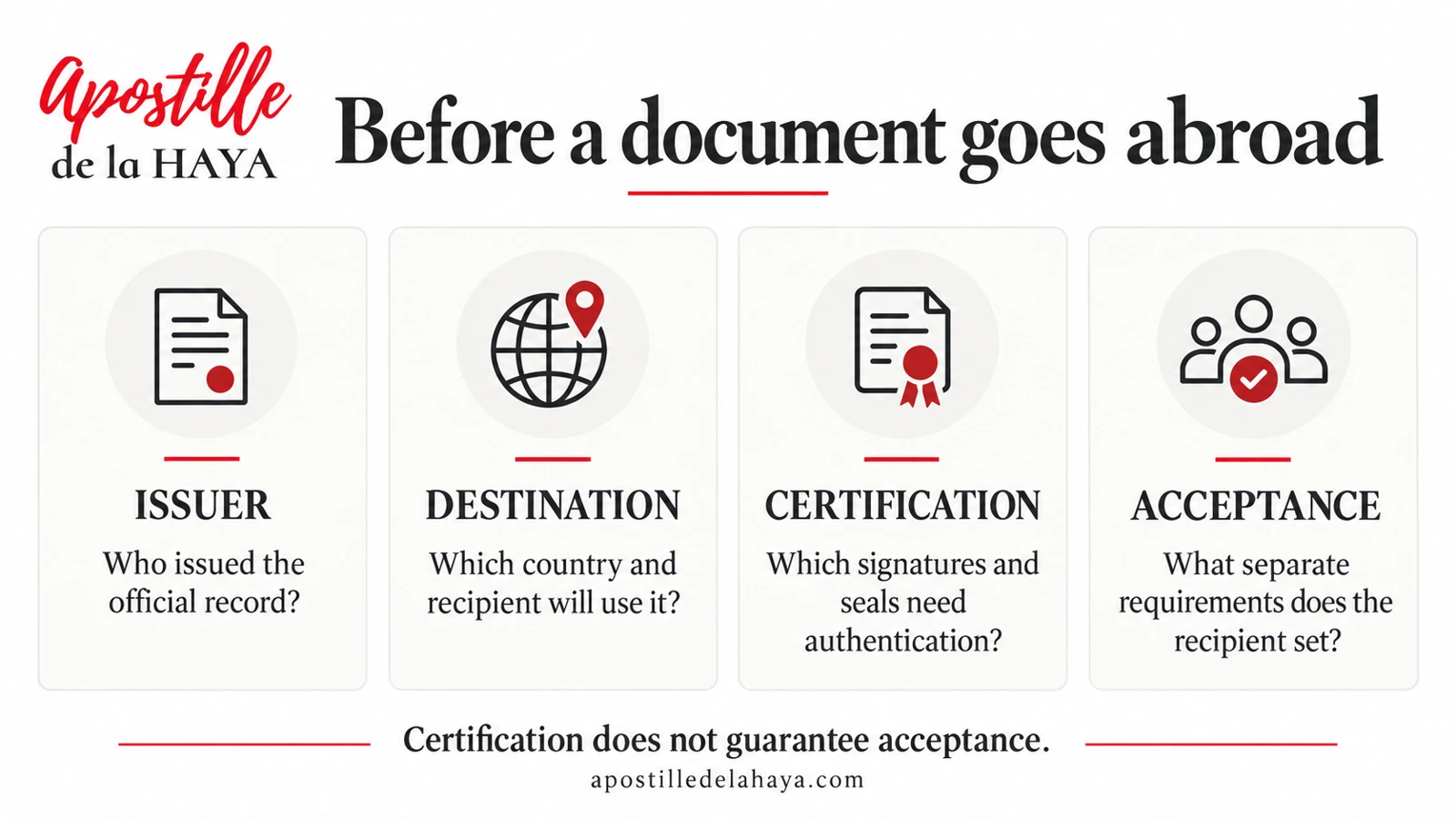
Find the public office named on the certificate. A state or local vital records authority may issue the certified copy, and the official signature on it can change what preparation is needed. Where the applicant lives now does not replace the issuing jurisdiction. Someone living in one state may hold a birth record that has to be reviewed under another state’s rules.
The CDC’s vital records directory is organized by the state or area where the birth took place. It helps you find the right issuing system. The directory itself is not an office that issues every American birth certificate. When you describe the file, use the actual issuer printed on your record. Calling it a “federal” or “American” certificate is not enough.
Also keep a state-issued birth record separate from a Consular Report of Birth Abroad or a foreign birth certificate held by a U.S. citizen. Those documents have different issuers. Citizenship and the origin of a record are two different facts. What this article says about state records should not be applied to a foreign or consular record without first identifying the responsible authority.
Confirm the purpose before choosing a certificate
The receiving authority decides what evidence its procedure needs. A foreign civil registry may want something different from a school or an employer. Ask for the name of the required record, the accepted format, the language and any condition on the issue date. The word “authenticated” on its own may not tell you which certification is expected.
Your destination then helps show whether an apostille applies or a different authentication and legalization route. The U.S. government’s overview of document authentication explains how this depends on the destination. A route that works for one country should not be assumed to satisfy another country’s request just because the birth record itself has not changed.
This review does not decide the merits of the foreign application. Certifying the issuing signature does not settle citizenship, immigration eligibility, school admission or recognition of a family relationship under foreign law. The appropriate authorities decide those questions. The documentary service should explain what it prepares and should not promise a separate legal outcome.
Check whether your copy is admissible
An official certified copy is different from an ordinary photocopy, a scanned image or a hospital keepsake. The information on them may overlap, but the official act attached to the record is not necessarily the same. Before you order authentication, find out which version you have and whether the authority involved accepts it for the route you need.
Read the certification statement, the issuer, the signature, the seal and any restrictions. Include the back of the document and any attached pages. If the record is marked for informational use or carries another limitation, another stamp will not remove it. Ask the issuer or the relevant authority which certified version you need.
Florida’s guidance on accepted documents shows why you need to identify the official record and an eligible signature. It also separates public records from copies a Florida notary can attest. A notarized copy is not a universal substitute for a certified vital record supplied by its custodian.
If you need a new copy, confirm the required format before you order it. “Long form” and “short form” are not labels that work the same way in every issuing jurisdiction or for every recipient. What matters is whether the official version contains the information and certification the procedure requires. Replacing a copy without answering that question can lead to the same problem again.
State-specific details can change the preparation
Two certificates with the same birth details can carry different official signatures. Some state procedures treat records signed by particular state officials differently from records issued at the local level. That can decide whether an extra local certification is needed before the state authority acts.
New York’s apostille and authentication guidance describes how qualifying state-issued vital records differ from locally issued ones, and it identifies situations that involve county clerk certification. So inspect the issuer and the signature. Do not push every New York birth certificate through one assumed sequence.
The same principle holds in other states, although New York’s rules are not national rules. Do not copy one issuing state’s instructions onto a record from another state. A first review should identify the actual record and then check the relevant authority’s current guidance. The discussion of certifying a birth certificate gives related background on how a certified copy differs from later international certification.
When a federal authentication stage may apply
A birth certificate issued by a state is not a federal document. If the destination’s route requires federal authentication after the appropriate state certification, that is a later stage in the file. Don’t confuse it with the state office that issues the birth record or recognizes its official signature.
The article on Department of State birth certificate authentication deals with that narrower question. It helps you tell a required federal stage apart from the assumption that every U.S. birth record has to go straight to Washington. Establish the destination and the certificate route that applies first.
If a foreign mission has to be involved, confirm the country and its current instructions. Finishing the federal stage does not automatically mean every consular or destination-side requirement is done. The proposed service should state which stages it includes and in what condition the finished document will be delivered.
Translation needs its own scope
Ask the recipient whether a translation is required and what form it accepts. The language, the translator’s qualifications or declaration and how the certifications are handled can all depend on the procedure. A translation that helps you understand the record may not meet the receiving institution’s formal presentation requirements.
Find out whether the relevant certification pages and any annotations on the back need to be included. If the translation is ordered before certification is finished, later attachments may change what the recipient needs translated. Clarify the scope. Translating only the main page of the birth record does not always meet the language requirement.
Handle names and dates with care. If the certificate and your current identity documents differ because of a name change, find out which supporting evidence the recipient wants. Do not quietly rewrite the record or the translated name to match another document. Errors made by the issuer are corrected through the issuer, and legal questions go to the relevant professional or authority.
Common birth certificate authentication mistakes that delay a file
One mistake is assuming that a record accepted at home is ready for international use. A certificate that worked for a U.S. passport or a school enrollment may still need a specific certification for the foreign procedure. Domestic acceptance and foreign authentication answer different questions.
A second mistake is notarizing an ordinary photocopy to avoid getting the proper official copy. A notary’s act does not recreate the registrar’s certification. If the route requires an official certified vital record, identify the correct issuing source before adding a different act that may not meet the requirement.
A third is taking the destination from an earlier application. A record prepared for one foreign country may need a new assessment for another. Keep the existing certificates attached and show the complete file. Removing the earlier apostille or authentication in the hope that a clean record will be easier to process is a mistake too.
Another avoidable problem is treating every birth record as if it expired after a set period. A recipient may require a recently issued copy, but that is a specific presentation condition you need to verify. Ask which date and which period matter. The age of the event, the age of the paper and the date of certification are not interchangeable.
Organize delivery around the actual requirement
Work out where the certificate is now, who can release it and where the finished file has to go. An applicant abroad may have a relative in the United States holding the record. Describe that arrangement clearly so the service can separate collecting the document, certification, return delivery and any final submission to the recipient.
Tracking should say which stage it proves. Delivery to an office does not necessarily mean a complete application was accepted. A return shipment does not show that a foreign institution has approved the document for its intended use. Keep the request details and shipping references together so any status inquiry is about the right file.
If the deadline is close, explain what has to happen by then and whether the record is already in an admissible form. Getting a replacement, correcting an error, translation and official processing each affect the plan in different ways. Apostille de la Haya can assess the documentary work, but urgency does not remove any authority’s requirements, and we will not promise that it does.
How Apostille de la Haya reviews a birth certificate
Through the birth certificate authentication service, Apostille de la Haya can review the issuing authority, the copy you have, any existing certifications and the destination’s request. The goal is to see whether the record is ready and explain the right help before it moves to the next stage.
For a route tied to a specific destination, the country service page, such as UAE document preparation, connects the birth record with the receiving country’s requirements. The service scope should separate documentary handling from any later decision on the application or any personal action the applicant has to take.
Describe the complete file and ask which work remains: obtaining an eligible record, preparing a translation, securing the applicable certifications or arranging delivery. Conditions may vary with the nature, complexity and requirements of the case. Consult Apostille de la Haya directly so the proposed assistance matches the actual document.
Frequently Asked Questions
Is my birth certificate automatically a federal document?
No. A birth record issued by a state or local vital records authority belongs to that issuing system. A federal stage may be relevant under a particular destination’s route, but that does not change who issued the record. Apostille de la Haya can review the certificate and separate the issuing authority from the later stages of birth certificate authentication.
Can I use a hospital birth certificate?
Don’t assume a hospital record or keepsake is the certified civil record needed for international use. Identify the issuer and what the recipient asked for. Apostille de la Haya can review what you have and tell you whether you need to get the proper official certified copy before authentication is arranged.
Do all states require the same preparation?
No. The issuer, the official signature and the state procedure that applies can all change the requirements. One state’s instructions should not be applied to another state’s record. Share the complete certificate with Apostille de la Haya so the review follows the rules of the relevant issuing authority and not a general national checklist.
Does authentication correct an error on the certificate?
No. Errors in the underlying record are for the issuing authority to fix. Certification concerns an official act and does not change names, dates or other facts. Contact Apostille de la Haya and describe the problem, so birth certificate authentication can be planned around the right record once any needed correction is made.
What information is needed for a review?
Send the certificate’s issuer, the version you have, the destination, the receiving authority’s instructions, any existing certifications and your deadline. Include all relevant pages through the intake channel we agree on. With those details, Apostille de la Haya can evaluate the documentary preparation and explain the service scope for the U.S. record you actually hold.
Review your certified birth record before sending it abroad
Contact Apostille de la Haya with your U.S. birth certificate and the recipient’s requirements. We can review the copy, the issuing authority, the destination route and the documentary help that fits how you plan to use the record.
Contact Apostille de la Haya by phone or WhatsApp: +1 305 500 0185.