Marriage certificate attestation UAE preparation starts with one question: where was the marriage record issued? This guide covers a certified U.S. marriage record that you plan to present to a UAE institution. It shows how to review the copy you have, line up the American certifications, use the current U.S. intake channel, and check names and translation before anything is sent.
You may need the certificate for a family application, an employer’s records or another administrative purpose. Attestation does not guarantee residence approval, and it does not register the marriage in every UAE system. Apostille de la Haya can assess how the document is prepared. The receiving authority sets the requirements for the wider procedure and decides its outcome.
Marriage certificate attestation UAE starts with a U.S. certified copy
First, identify the public office that issued the certificate and the state or jurisdiction where the marriage was recorded. The spouses’ nationality and where they live now do not tell you where the document comes from. If an American citizen holds a foreign marriage certificate, that record is not a U.S. state record. Don’t apply this American route to it until you have checked who actually issued it.
Look at the certification statement, the official signature, the seal and whether the document is complete. A ceremonial keepsake or an ordinary photocopy is not the same as a record certified by the custodian. Some jurisdictions issue a completed license-and-return form, so judge the record and its certification as they are. The heading printed at the top can mislead you.
USA.gov’s marriage certificate guidance is a reasonable place to start when you need to find the right official source. If you need a replacement, get it from the lawful custodian or from an authorized ordering channel that supplies the custodian’s record. When you ask which certified version is available, say that it will be used abroad. That way you can ask for a version that works for later authentication.
Get the UAE recipient’s requirements in writing
Find out which institution is asking for the certificate and for what exact purpose. An employer’s benefits file may have different rules from a government family application. Ask the institution for its current document requirements instead of relying only on a message passed along by a relative or a relocation contact. This also helps you keep the certificate’s preparation apart from any separate question about registration, sponsorship or proof of identity.
Confirm whether the recipient wants a recently issued copy, a particular language, all attached certifications or several completed copies. There is no universal expiry period for U.S. marriage records, so don’t assume one. If a recipient does have a recent-issuance rule, get it in writing and plan around it. The date of the marriage itself is a separate fact.
Ask whether the record is needed for a preliminary review or for the final filing. A scan may be accepted for an initial assessment and still fall short for the certification authorities or the final recipient. Settle who will receive the completed packet and in what form. Then you won’t send an original overseas before its U.S. preparation has been checked.
Check what the state can certify on your actual copy
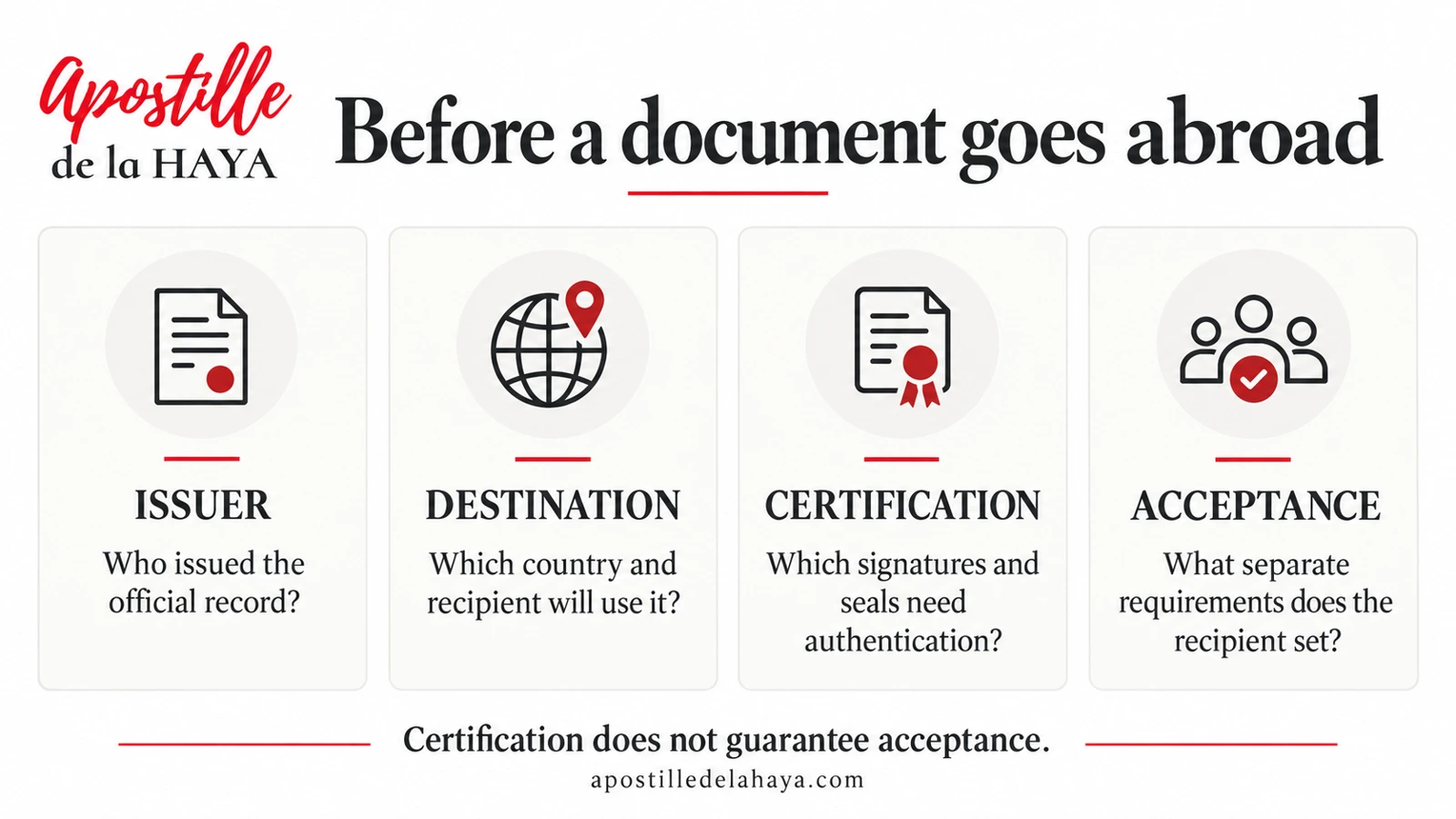
The relevant U.S. state authority has to be able to certify the official signature on the record. Where either spouse lives today does not decide which state can act on a certificate issued somewhere else. Identify the issuing office and the official who signed, then read the marriage record instructions of the competent jurisdiction.
Florida is one example. Its accepted-document instructions list which marriage records and official signatures qualify. Those rules don’t replace another state’s rules, though. The practical lesson is simple: look at the certification already on the copy before you add a new act or order a replacement.
A private notarization does not stand in for the public custodian’s certification in every case. A spouse can’t turn an ordinary photocopy into an eligible document by signing a statement about it. If the record you have is not suitable, work out whether you need a different official copy or additional official preparation. Sort that out before you arrange the later stages.
Complete the federal step on the U.S. route
The UAE embassy’s guidance on personal documents requires U.S. Department of State authentication before submission through the current handling channel. For marriage certificate attestation UAE files, check the Department of State’s authentication requirements to see what prior preparation the state-issued record needs.
A spouse’s U.S. passport does not make a marriage certificate a federal document. The issuer and the official signature still decide the earlier certification question. If you send an unprepared state record straight to the federal office, you don’t skip a required state act, and you don’t fix an incomplete certified copy either.
The record may already carry an apostille or an authentication for another country. If so, send the whole packet for review. Don’t remove the attachment, and don’t assume it meets the UAE requirement. Our marriage certificate apostille guide explains that other framework. The current UAE requirement still has to be checked against your actual file and its intended use.
Use the current VFS channel named by the Washington embassy
The embassy in Washington says in its personal and educational document guidance that VFS handling took effect on August 21, 2025. Before you ship anything, check the VFS U.S. UAE attestation portal for the submission requirements in force. Confirm the current submission address; an older checklist or the embassy’s general contact address may not identify the correct intake location.
Go through the required application information, supporting materials, handling of originals and return arrangements. The document category you choose should match the actual marriage record. Don’t borrow a process for commercial documents, or instructions from a UAE mission in another country, just because that service is also called attestation.
Keep the application reference and a full copy of the packet you sent. Leave official certificates attached as they were issued. If you get a replacement record after a preliminary review, ask whether its signature or format changes the preparation. The version you submit should match the one described in the application and in any translation.
Compare the spouses’ names and dates carefully
Compare both names as recorded at the time of marriage with current identity documents and the recipient’s forms. A former surname can be historically correct. Often the real question is what evidence links the certificate to a current passport, and the certificate may not need to be amended at all. Ask the receiving authority what explanation or supporting record it accepts.
Some differences are legitimate and some are genuine errors. If the issuer recorded a name or date wrongly, ask about its correction procedure. Attestation certifies the relevant official act, but it does not correct the underlying record. Never edit a scan or ask a translator to put in a preferred spelling to hide the discrepancy.
Read the dates in context. A file can show the marriage date, the recording date and the date the certified copy was issued, and each one serves a different purpose. Make sure the application and the translation label them correctly. If a numeric date format is ambiguous, have it shown clearly and faithfully instead of guessing which event or month the source meant.
Plan the translation for the recipient and the certification channel
Find out whether the English certificate is accepted for your procedure or whether you need a legally certified translation. Check who is allowed to translate it and whether the translation or the translator’s declaration needs its own certification. The attestation channel and the final recipient may set language requirements for different stages of the file.
Ask whether the translation must cover the full packet, including the state, federal and UAE certification pages. If you translate too early, later attachments may be left out. On the other hand, if the translation itself needs certification, leaving it until every other stage is done can also cause a delay. Base the order on the actual requirement.
The translator should keep the meaning of the source, including names, office titles, seals and dates where required. A translation does not authenticate the marriage record. Likewise, attesting the record does not automatically certify that the translation is accurate. Keep the original, the official attachments, the translation and any declaration clearly identified as related but separate items.
Check for any remaining UAE step before final delivery
Read the MOFA attestation service information for foreign-issued documents and check what the selected service covers. Work out which UAE certification acts are included and whether anything is still pending before the recipient can use the file. Look at the completed output. Don’t assume every application needs a separate, identical local step.
Don’t use a digital process built for UAE-issued records on a U.S. marriage certificate until you have confirmed it is eligible. Applying online does not always remove the need for physical documents. If you receive a digital result, keep the original electronic file and its verification details, and ask the recipient which format it accepts for final presentation.
Be clear about where the service ends. Returning the documents to a family member is different from filing them with the UAE authority handling the wider application. Decide who will do that final handoff and which reference or supporting forms they need. In marriage certificate attestation UAE cases, finishing attestation and getting the larger family application accepted are two separate milestones.
Avoid returns and repeat handling you can prevent
Before dispatch, check the issuer, the copy format, the required certifications, the application details, the document count and the return arrangements. Make sure the source record is legible and that no official attachment has been separated. If the original is laminated or altered, ask for advice about an acceptable replacement. Don’t try to repair it yourself for submission.
Track the courier and the application separately. A delivery confirmation is not a certification decision. Link each reference number to the right stage so you can look into a delay properly. If a document comes back, keep the stated reason. Then work out whether the problem lies in the copy, a prior certification, the application, translation or a recipient requirement.
When a problem turns up, allow time for corrections by the issuer or for replacement copies. Faster shipping won’t fix a wrong official record or supply a missing certification. A preparation review helps most before a fixed family filing deadline makes each extra shipment harder. If you have a deadline, mention it when you ask for help, but don’t count on a guaranteed official completion date.
Marriage certificate attestation UAE: frequently asked questions
Can I use a U.S. marriage certificate that already has an apostille?
Have the full record and the apostille reviewed against current UAE requirements. Don’t assume the earlier certificate completes this route, and don’t remove it before the assessment. The earlier destination, the document version and the existing certifications all matter. A review can show which preparation still fits the new recipient and the intended use.
Do I have to replace an older certified copy?
Not automatically. Check that the copy is an eligible official record, that it is intact and legible, and that it meets the recipient’s requirements. If the UAE institution asks for a recently issued copy, get that requirement and plan for it. How long ago the marriage took place is a different matter from a rule about when the certified copy was issued.
Does attestation guarantee family residence approval?
No. Attestation supports the document’s certification status. It does not decide sponsorship eligibility, proof of identity or any other condition of a residence application. The responsible authority reviews the complete application. Keep document preparation separate from any legal or immigration assessment of the family’s situation and the likely outcome.
Can I submit the English certificate without an Arabic translation?
Confirm the requirement with the actual recipient and the attestation service. English may be fine at one stage while another stage calls for a specific translation. Ask who may translate, which pages must be covered and whether a separate certification applies. Don’t buy a translation, or skip one, based only on what another applicant went through.
What should I send for a document review?
Send the complete certified copy, the issuing state and office, any existing attachments, where the original is now and the UAE recipient’s instructions. Mention any name difference, any translation you already have, any earlier return notice and your deadline. With those details, the review can point to the real next step instead of guessing at a missing stamp.
Arrange a review of your U.S. marriage record
Our UAE embassy attestation service deals with the preparation this destination requires. The marriage certificate legalization service starts from the document itself. Looking at both the record and the recipient’s instructions shows which route applies and what help you need.
Contact Apostille de la Haya on WhatsApp +1 305 500 0185 to talk about your certificate. Tell us whether U.S. authentication has already started and where the document must end up. A clear assessment separates copy readiness, certification, translation and final presentation, without promising a decision that belongs to the receiving authority.