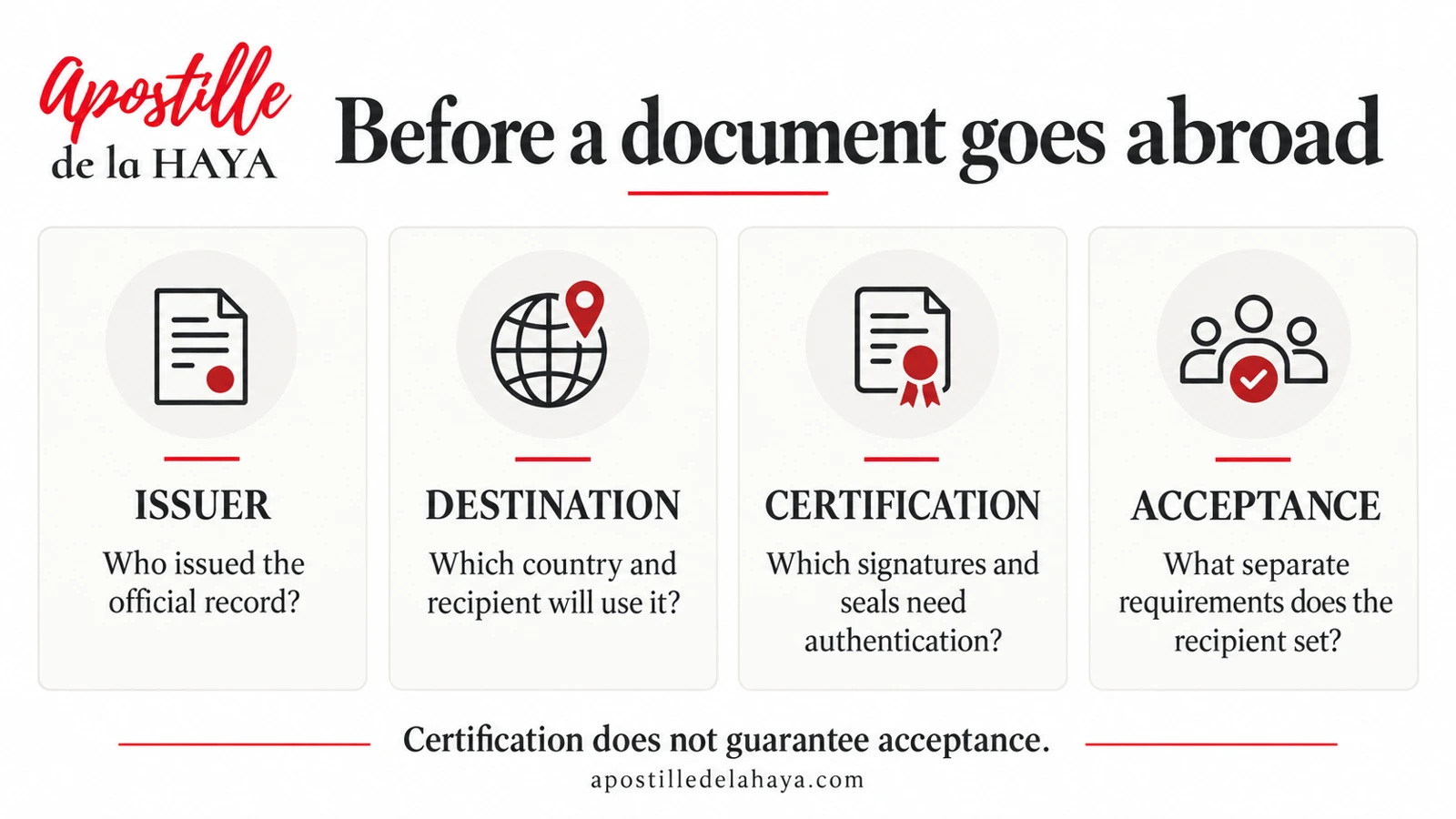
Plan Kuwait embassy legalization around two things: the specific U.S. document and the institution in Kuwait that will receive it. Academic credentials, personal civil records and commercial instruments raise different preparation questions. Before you arrange certifications or send an original to a mission, identify the issuer, the document format, the relevant signatures and the purpose of the request.
This guide covers documents that originate in the United States and will be used in Kuwait. It explains the review that shows which route fits, so you don’t borrow a checklist meant for another country or another type of document. Once the current mission and recipient requirements are known, Apostille de la Haya can assess your existing file and discuss how it can help with preparation. The document legalization service explains the wider certification assistance; the destination and document category still need their own review.
Kuwait embassy legalization begins with the recipient and the issuer
Ask the receiving institution to put its requirement in writing. An employer, a university, a government department, a bank or a registry may each want different evidence, even for a document with the same name. Find out whether the request is about certifying signatures, academic verification, translation or a separate recognition or registration process.
Next, identify the authority that actually issued the record. A document is not American just because its owner is a U.S. citizen, it is written in English or it is kept in the United States. A foreign certificate held by an American applicant may need to be prepared in its country of origin. Settle that point before choosing American state or federal services.
Describe the version you have accurately: an official certified copy, a signed original, an electronic original, a photocopy or a scan. These forms can serve different purposes, and an authority may not accept one in place of another. A scan can support a preliminary review, but that doesn’t mean the next authority will accept it for the final submission.
Confirm the competent Kuwaiti authority and its current intake rules
Use official Kuwaiti government and mission channels to find the office responsible for the service. Kuwait’s Ministry of Foreign Affairs offers government and diplomatic information through its official channels. A privately run website with “embassy” in its name does not necessarily issue official instructions or speak for the mission.
Before dispatch, confirm what the mission in the U.S. currently requires for your exact document category. That means prior certifications, the application, whether it takes an original or a copy, supporting papers and return arrangements. Confirm the current submission arrangements for the exact service and document.
Don’t rely on instructions from a Kuwaiti mission in another country. Its local certification authorities and accepted formats may differ from the U.S. route. In the same way, a cultural office’s process for authenticating student documents is not automatically the general consular legalization process for every personal, commercial or employment document.
Review personal civil records through their lawful custodians
For a birth or marriage certificate, find the state or local office that issued the certified copy and note the official signature on it. A ceremonial certificate or an ordinary photocopy is not automatically fit for international authentication. If you need a replacement, get the eligible official record from the custodian. Adding a private notarization to an unsuitable copy won’t fix it.
The relevant U.S. certification authority depends on where the record comes from and which official act it carries. Living in one state does not make that state competent to certify a public official from another state. USA.gov’s overview of document authentication gives background on what states and the federal government each handle. Apply the specific rules of the relevant jurisdiction to the copy you actually have.
Check names and dates against what the recipient’s application requires. A legitimate name change may need supporting evidence, and a genuine error in the record may need correcting by the issuer. Legalization does not correct historical facts or decide family eligibility. Settle those issues with the right authority before completing certifications on a version you might have to replace.
Treat academic credentials as a separate file
Identify the awarding institution, the qualification, the campus and the academic records the recipient wants. A diploma and a transcript answer different questions, and direct verification by the institution may be a separate requirement. Notarizing a diploma does not prove the whole academic history, and it does not satisfy a request for official transcripts sent by the school.
The Kuwait Cultural Office’s information on authentication and placement describes academic services meant for specific audiences and purposes. Read its student-related procedures with that in mind. Check whether the applicant’s nationality, study status, qualification and intended use bring the file within the relevant cultural-office service.
An expatriate professional looking for work in Kuwait shouldn’t automatically be told to supply everything on a Kuwaiti scholarship student’s checklist. Ask the recipient and the competent academic or consular authority which review applies. Certifying document signatures, verifying education, recognizing studies and professional licensing are separate matters, even when a file needs more than one of them.
Assess commercial instruments by content and authority
For a company record or agreement, decide whether it is a public registry document or a privately signed instrument. An official certificate of incorporation and a declaration by a company representative come from different sources. Prepare each one according to the actual record and signature, instead of following a generic instruction to notarize every business page.
Confirm that the signer has the authority the transaction needs and that the instrument contains the required terms. Legalization won’t add missing corporate authority or clear up an ambiguous contract. It also doesn’t guarantee that a Kuwaiti registry or counterparty will accept the document. Deal with substantive legal questions before the final version is signed and certified.
For background on one category, see our articles of incorporation certification guide. It helps separate official corporate records from other business documents, but it does not set Kuwait’s specific route. Ask the competent mission how your commercial category, and any annexes or supporting certificates, must be handled.
Match state and federal steps to the Kuwait embassy legalization route
Where that route applies, a document issued or notarized in a state may need the appropriate state certification before federal authentication. A genuine federal document comes from a different source and follows the relevant federal rules. A private document does not become federal because it mentions a passport, a tax number or a federal agency.
For the federal stage, check the U.S. Department of State’s authentication requirements. Combine them with the Kuwaiti category requirements once those are confirmed. The federal office certifies the relevant official signatures. It does not decide whether the content of the document meets the Kuwaiti recipient’s legal or administrative needs.
Don’t order an apostille just because the word is familiar. Check which certification framework applies using the Hague Conference (HCCH) information on the Apostille Convention and the competent authorities. If a packet already carries an apostille for another destination, have it reviewed intact. Don’t assume it completes the route or that an unrelated stamp can convert it.
Check what may remain after the Kuwaiti mission in the United States acts
Ask the recipient whether another Kuwaiti attestation, a translation, a registration or an academic review is needed after the U.S. preparation and the mission’s act. Kuwait’s official information on consular services says the ministry examines official seals and signatures and coordinates certain academic matters. Confirm the actual next step for your document and its use.
Delivery to Kuwait and final acceptance are two different events. A finished packet may still have to be presented to the requesting institution with an application or a reference number. Decide who will make that final submission, and ask whether the recipient needs the original, an accepted digital form or extra copies.
Keep the wider decisions separate. A legalized marriage record doesn’t guarantee a residence outcome. An authenticated degree doesn’t automatically grant permission to practice a profession, and a commercial certificate doesn’t complete a business deal. Kuwait embassy legalization supports those processes, but the responsible authority still makes the substantive decision.
Plan the translation around the final packet
Confirm the accepted language and the translation rules with the recipient and the relevant service. Find out whether a certified translation is required, who may prepare it and whether the translator’s declaration needs its own certification. A translation prepared for another country or institution may not meet the current Kuwaiti requirement.
Ask whether the official attachments must be translated too. If you translate only the original before later certificates are added, the final packet may be incomplete. On the other hand, a translation that needs its own certification can change the earlier order of steps. Fix the timing before you order work, so you don’t need a second translation or resubmit without need.
Check names, dates, qualification titles, company details and references across every version. A translation should reflect the source faithfully, without quietly correcting or improving it. If the record itself is wrong, use the issuer’s correction process. If the difference is legitimate, ask what evidence or explanation the recipient accepts.
Do a final review before originals leave your hands
Make an inventory that lists each item with its issuer, available format, existing certifications, intended recipient and any requirement still pending. Add where the original is now and the final delivery address. This helps a lot when a family member, a school, an employer and a service provider are each handling part of the same file.
Keep official attachments in place and hold on to a complete legible copy. Confirm the current application, packaging and return instructions with each authority separately. A carrier that one office accepts may be the wrong choice for another. Instructions written for another country’s embassy do not necessarily apply to the Kuwaiti mission.
Track delivery and processing as separate events. If a file comes back, read the actual reason and work out which stage it concerns. A missing issuer certification, a problem with academic verification, a translation requirement and an administrative issue each need a different fix. Sending the same packet again without solving the problem can add more delay.
Frequently asked questions
Do all U.S. documents follow one Kuwait checklist?
No. The document’s origin, category and signature, together with the recipient, set the preparation questions. Academic, personal and commercial records can call for different supporting evidence and different authorities. Confirm the mission’s current requirements for each item. Documents that travel in the same envelope don’t necessarily have the same certification needs.
Is the cultural office the same as the consular legalization office?
They do different jobs. A cultural office may handle academic verification or authentication of student documents within its stated remit. That does not automatically replace a consular act, and it does not set the procedure for every foreign professional. Ask which authority handles the academic and certification requirements for your actual file.
Can I use a document already certified for another country?
Have the whole packet reviewed against the Kuwaiti recipient’s requirements. Existing certifications may be relevant, but acceptance somewhere else does not mean the file is ready for Kuwait. Keep attachments in place while the route is assessed. Don’t remove a certificate or order more work until you know what the next act is for.
Does legalization confirm the legal content of a power or agreement?
No. Kuwait embassy legalization is not legal advice, and it does not approve every substantive term. The instrument itself must contain the right authority and wording for its intended use. Settle those questions with the recipient and a qualified professional before signing and certification, especially where property, banking or company obligations are involved.
What do you need for a first case review?
Send the complete document, the issuer, the document category, any existing certifications, the recipient’s instructions and your deadline. Say where the original is and whether translation, direct academic verification or another separate process has been requested. Include any return notice, so the review can deal with the actual issue instead of an assumed generic requirement.
Ask for a review based on your document category
Our Kuwait embassy legalization service can help assess the U.S. preparation your actual file needs. Contact Apostille de la Haya on WhatsApp +1 305 500 0185 and send the complete copy with the recipient’s instructions. The service scope should list the confirmed certification stages, the help that is permitted, where delivery ends and any separate requirement that stays with the applicant or the receiving authority.