Marriage certificate attestation Kuwait work starts with two things: the official U.S. record and the institution that asked for it. The search phrase alone says nothing about which country issued the certificate, which certification chain applies or why the document is being filed. This guide covers a marriage certificate issued in the United States for use in Kuwait. It looks at the copy, the names on it, translation and the final handoff.
Once the origin and the recipient’s requirements are clear, Apostille de la Haya can review the document preparation that remains. Keep attestation apart from marriage registration, family sponsorship and any immigration decision. Those belong to the authority running the wider procedure. That authority decides what evidence it needs and whether the application meets its substantive rules.
Marriage certificate attestation Kuwait begins with the actual record
Look closely at the copy you actually hold. Find the issuing office and the certification statement. Then note the state or jurisdiction, the official who signed, the seal and any certificates attached. Don’t assume a ceremonial keepsake or an ordinary photocopy has the same status as a certified copy from the lawful custodian of the marriage record.
The spouses’ citizenship and current address do not decide where the record comes from. Suppose an American holds a marriage certificate issued abroad. That document does not automatically follow a U.S. state authentication route. The reverse also holds: a U.S. record stays tied to its American issuer after the couple moves to Kuwait. Settle the origin before you ask anyone for a new certification.
USA.gov publishes marriage certificate guidance that helps you find the right official source for a U.S. record. States use different terms and formats, so judge the completed document itself, not just its title. Some records include a completed license and return. An unused license belongs to a different stage and serves a different purpose.
Find out what the Kuwaiti recipient needs
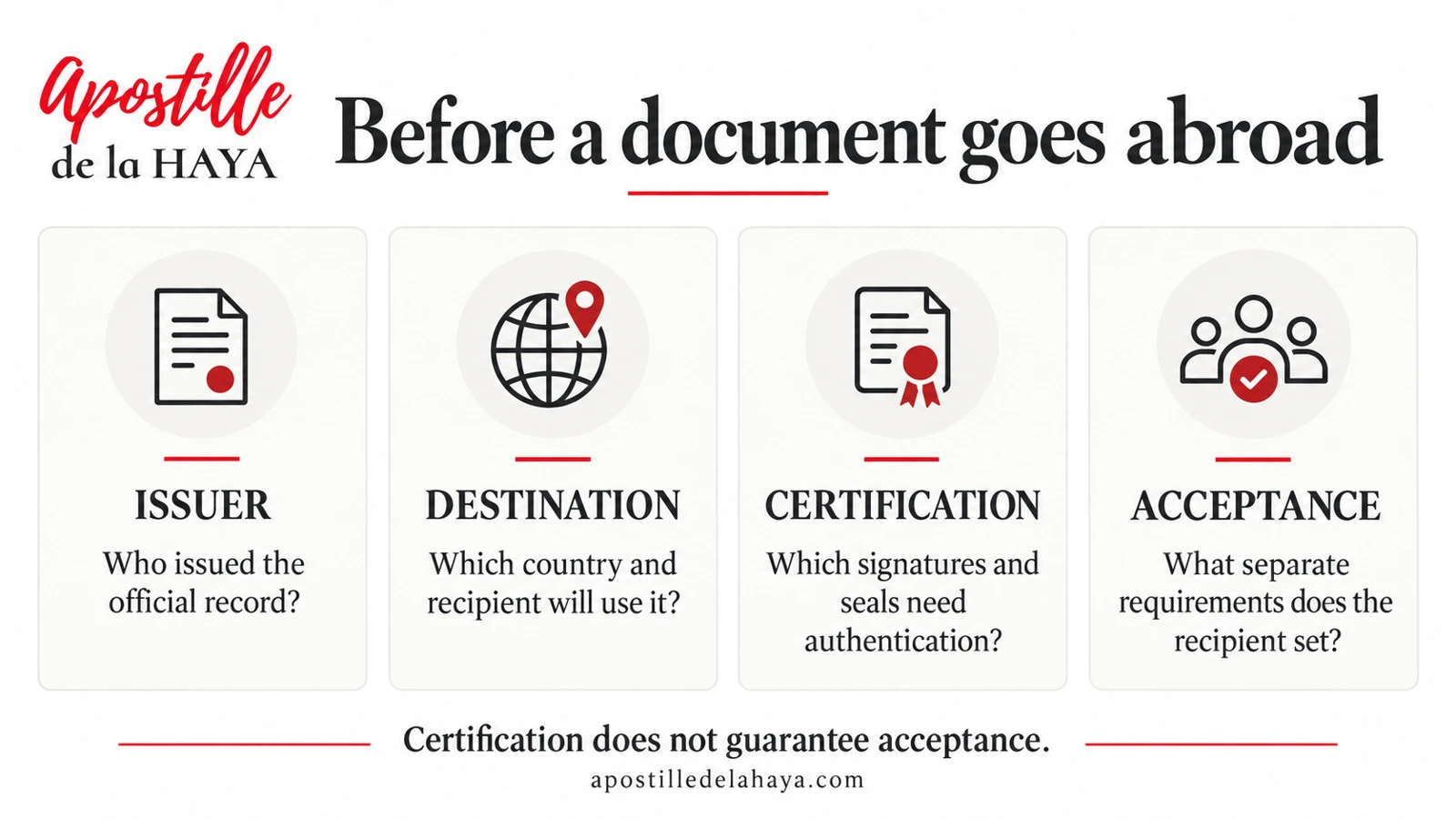
Start by naming the institution that wants the certificate. It could be a government office, an employer, a benefits administrator or another organization. Then get its current written requirement for the procedure you are actually in. A short message passed along by an intermediary may leave things out. For example, it may not say whether the recipient wants an original, a recently issued certified copy, a translation, particular certifications or more supporting evidence.
Ask whether the certificate is going into a family file or whether a separate registration or recognition procedure applies. The answer shapes the wider application, and the competent authority is the one that should answer it. Attesting the document does not by itself record the marriage in every local system. It also does not guarantee that the couple qualifies for a benefit or a residence status.
Identify the deadline and the stage at which the document will be used. A scan that works for a preliminary review may fall short at final presentation or at a certification office. Find out who receives the finished packet and in what form. Then you can plan the U.S. preparation and the international delivery around a real requirement based on the certification the recipient actually requests.
Review the certified copy before ordering a replacement
Check whether your copy is complete, legible, undamaged and officially certified. Look at the back and at any attachments as well as the front. A missing certification page or an unclear official signature can hold the file up. If the copy won’t work, ask the lawful custodian which version it can issue for the international use you have in mind.
An older certified copy doesn’t automatically need replacing. Whether it works depends on its official format, its condition, the authentication requirements and any recipient rule about recent issuance. Keep in mind that the date of the marriage and the date the copy was issued are two different facts. If a recipient sets its own rule on issue dates, record it as that recipient’s rule. Don’t describe it as a universal expiration period for American marriage records.
For background on the official-copy question, see the certified-copy marriage certificate guide. It is written for apostille use, so it does not set Kuwait’s route. It does show how a custodian-certified record differs from a private photocopy. Get the right starting document before you spend time on later certifications.
Match the American certifications to the issuer
As a rule, the state tied to the public record and its official signature determines which authority handles the first certification. Your current address does not give another state’s office the power to authenticate a record issued somewhere else. Read the issuing state’s instructions for your exact copy and signer. One state’s rules don’t apply nationwide.
A public marriage record should not be handled by default as a private document that needs a notarized declaration from one spouse. A spouse’s private statement about a copy and the custodian’s certification are different acts. If more preparation turns out to be necessary, find out what the competent authority actually accepts. Don’t assume any notarial seal will fix the problem.
If the verified route includes federal authentication, check the U.S. Department of State’s requirements and confirm which state-level steps must come first. A state marriage certificate does not become a federal original because one spouse holds a U.S. passport. Applying to a foreign government doesn’t change that either.
Marriage certificate attestation Kuwait: check the mission's current rules
Confirm the right service for a U.S. record through official Kuwaiti government or mission channels. The Kuwait Ministry of Foreign Affairs is an official place to start for government and diplomatic information. A commercial website with an embassy-sounding name is not the mission, so don’t treat it as one.
Before you send any originals, confirm the document category, the prior certifications, the application, the accepted format, supporting papers and the return method. A Kuwaiti mission in another country may rely on different local authorities. Its instructions were written for that setting. Don’t carry that route over to a U.S. submission just because the document there was also a marriage certificate.
If your copy already carries an apostille or another certification from an earlier use, send the whole packet for assessment. Check the applicable framework against the HCCH’s Apostille Convention information and with the competent authorities. Leave the attachments where they are. Adding more certificates will not automatically make a packet prepared for another destination suitable for Kuwait.
Use evidence to explain name differences
Compare both spouses’ names on the record with the names on the recipient’s forms and on current identification. The certificate may correctly show the name used at the time of the marriage, while a passport shows a surname adopted later. Ask the recipient what evidence it accepts to connect those identities. A legitimate difference is not necessarily a reason to amend the historical marriage record.
A genuine error by the issuer is a separate situation. If the official record is wrong, ask the custodian how its correction process works. Attestation deals with the relevant official act; it does not correct the facts underneath. Never alter a scan or cover a field. And don’t ask a translator to hide the discrepancy in the translated version.
Watch transliteration and date formats. A name written in another alphabet can be spelled more than one way, and numeric dates can be ambiguous. The translator should render the source faithfully. The recipient, in turn, should say whether it needs a supporting explanation. If the certificate doesn’t contain what a field asks for, don’t invent it.
Confirm translation requirements and timing
Ask whether the recipient accepts the certificate in English or needs a particular certified translation. Find out who may prepare it and whether a declaration, notarization or further certification is required. A translation done for another institution may not meet this recipient’s rules, even when the underlying text is the same.
Check whether the translation has to cover the full certification packet. If the recipient wants the later authentication pages translated too, translating before those pages exist can leave the file incomplete. However, if the translation itself has to go through a certification process, you may need it earlier. Build the sequence from the verified requirement.
Keep the source record, its attachments, the translation and any translator declaration easy to tell apart. The translation conveys what the record says. Attestation supports the relevant signatures and seals. Neither one automatically does the other’s job. Anyone reading the finished file should see which official act relates to the original certificate and which, if any, relates to the translator’s statement.
Identify the steps in Kuwait without promising an outcome
Ask the recipient whether another local attestation or administrative step follows the U.S. preparation and the mission stage. Kuwait’s official consular-services information describes the ministry’s role in reviewing official seals and signatures. In marriage certificate attestation Kuwait cases, confirm which service and presentation requirements apply to this particular record. Don’t infer one local sequence that fits everyone.
Keep the document task apart from the family’s eligibility. A complete certificate may be one item in a larger application with its own identity, sponsorship or legal requirements. Finishing the certifications does not let a preparation service decide those outcomes. Take questions about eligibility or legal recognition to the responsible authority or a qualified professional.
If the recipient asks for other civil records, assess each one on its own. A birth certificate, a divorce decree or another supporting document can have a different issuer and a different preparation route. Include those records only when the recipient requires them. A single marriage-certificate request shouldn’t grow into a pile of sensitive family documents with no defined purpose.
Plan delivery and keep the packet intact
Work out who holds the certified original, who submits it at each required stage and who receives it at the end. A relative in the United States and an applicant in Kuwait may be handling different parts of the job. A clear record of each handoff keeps the wrong copy or an unfinished translation from reaching the final recipient.
Keep a full, legible copy for yourself and leave the official attachments as they are. Don’t remove fasteners, separate certificates or swap pages between copies to save time. Before shipping anything, confirm each office’s current application and return-delivery instructions. A shipping method that suits one stage may not be acceptable to every other authority.
Track the courier delivery and the application status separately. If the file comes back, keep the notice. Then work out whether the problem lies with the issuer, the copy, a certification, the translation, the application or the submission details. Fix the actual cause before you resubmit. Faster shipping won’t cure a record error or a missing official act.
Frequently Asked Questions
Does this route apply to a marriage certificate issued outside the U.S.?
Not automatically. The country that actually issued the record decides the origin preparation question. A U.S. passport, an American address or an English translation does not make a foreign marriage record a U.S. public document. Identify the issuer and ask the relevant authorities which route applies before you request any American state or federal certification.
Is a notarized photocopy enough?
Don’t assume it is. A private statement about a photocopy is different from a certified record issued by the lawful custodian. Confirm which official format the U.S. certification authorities and the Kuwaiti recipient accept. If you need a replacement certified copy, sort that out before arranging later stages or translation.
Does the certificate have to show my current surname?
It depends on the record and on what the recipient requires. The name used at the time of the marriage may be historically correct. Ask what evidence links it to your current identification instead of automatically changing the certificate or the translation. Genuine errors go through the issuer’s formal correction process.
Does attestation guarantee family residence in Kuwait?
No. Attestation deals with the document’s certification and preparation. The responsible authority evaluates the wider application and any eligibility requirements. A correctly prepared marriage certificate can support that file, but it does not decide the result. Keep legal, immigration and registration questions separate from the document-handling service.
What should I send for a preliminary review?
Send the complete certified copy, the issuer and state, any existing attachments, the Kuwaiti recipient’s instructions and your deadline. Say where the original is and whether anyone has asked for a translation or additional evidence. If an earlier submission came back with a return notice, include it. That way the review deals with the specific problem and not with a missing stamp someone assumed.
Get the record and the destination reviewed together
The Kuwait embassy legalization service handles the destination side, and the marriage certificate legalization service covers the civil record. For marriage certificate attestation Kuwait requests, contact Apostille de la Haya on WhatsApp +1 305 500 0185 and send the complete document with the written requirement. A focused assessment can show whether the copy is ready, which certification route is verified, what translation is needed and how far the final delivery goes.