Qatar embassy attestation for a U.S. document starts with three questions: where the document comes from, what kind of document it is and who will receive it. A degree, a marriage certificate, a commercial agreement and a federal record can each need different American preparation and different supporting evidence. Before you arrange a consular submission, find out which Qatari mission can take the file and what its current instructions say.
This guide deals only with documents that originate in the United States and will be used in Qatar. It covers the preparation decisions, the checks to run before submission and the difference between the mission stage and any later requirement inside Qatar. Apostille de la Haya can review the packet you already have and discuss help based on the actual document and the recipient’s instructions. The document legalization service explains the wider certification assistance; the destination and document category still need their own review.
Qatar embassy attestation starts with the correct Qatari mission in the United States
The consular-services page of the Qatar embassy in Washington is a good official starting point. It lists service categories and contact details. Qatar also has consular offices in the United States, so confirm which office is competent for your document and your situation. Only then treat that mission’s instructions as the rules for your submission, and don’t apply them nationwide by default.
The New York consulate shows why the specific office matters, because it publishes its own information on legalizing U.S. documents. A Qatari embassy in another country may work with that country’s authorities arrangements. Don’t carry its requirements over to an American file without checking them.
Before you send originals, identify the active application channel, the document category, the prior certifications required, the accepted format, supporting materials and the return arrangement. A general contact address on a government website is not always a full mailing instruction for the service. Ask the responsible mission to clarify any missing submission details.
Identify the record's origin and available format
Read the name of the issuing office or institution and any certification statement. The owner’s nationality, address or language does not decide where a document comes from. A foreign certificate kept in the United States may need a route through its own country of origin. And a U.S. record stays tied to its issuer even after the owner moves to Qatar.
Describe exactly what you have. It might be a certified public record, a signed private instrument, an official academic document, a federal original, an electronic record or an ordinary copy. These formats are not interchangeable. A scan can support a preliminary assessment, but it may not meet the final submission requirements of every office involved in authentication.
If the record already carries official attachments, include them in the review. An apostille issued for an earlier destination, a state authentication and a federal certificate each play a different role. Keep the whole packet together while the current route is assessed. Don’t detach certificates, and don’t order a new act just because someone calls an existing stamp by a different name.
Sort personal, academic and commercial documents
Personal civil records go through their lawful custodians. A U.S. marriage or birth certificate may need an eligible certified copy signed by the appropriate public official. Don’t assume a keepsake or a privately notarized photocopy can stand in for the official record that the competent state authority and the Qatari recipient require.
An academic file can include a diploma, a transcript and evidence sent directly by the institution. For its academic certificate service, Qatar MOFA specifically requires a transcript along with a foreign-issued bachelor’s degree. Check with the Qatari mission in the United States and the receiving institution how your actual qualification and supporting records should be prepared.
Commercial documents need their own classification. An official corporate record, a private contract, a commercial power and an invoice may carry different requirements. What the document says and what it does legally both matter. A business instrument is not personal just because an individual signed it. Assess each commercial document against its own requirements.
Confirm the recipient's purpose before certification
Ask the Qatari institution for its requirements in writing. An employer, a university, a licensing body, a bank, a court or a government department may use the same document to decide very different things. Find out whether it needs only an attested record or also a translation, direct verification, registration or some other substantive review.
Check whether the request is for preliminary screening or for final presentation. A recipient may take a scan at first and later ask for the completed official packet. That early flexibility does not remove the certification authorities’ requirement for original documents. Settle the final format and the delivery point before an original goes overseas.
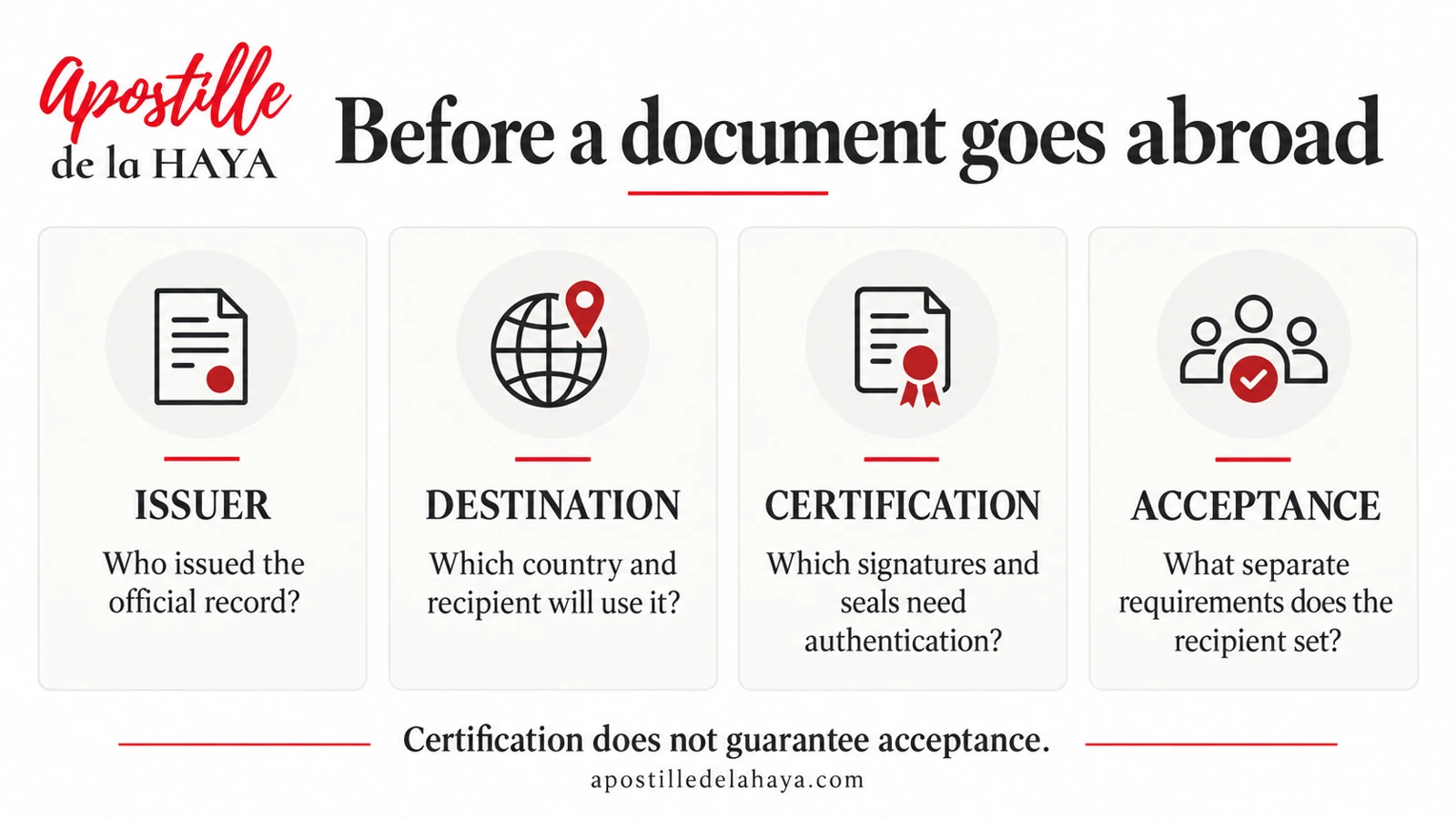
Keep acceptance decisions separate from document certification. Attestation does not guarantee a job, academic equivalency, residence approval or the success of a legal transaction. What it does is support the documentary file. The responsible recipient decides whether the underlying qualification, relationship or instrument meets the rules of the wider procedure.
Prepare the American certifications according to the signature
For a state public record or an instrument notarized in a state, identify the relevant state authority and its preparation rules. You can’t pick a state office at will based on where you live now. A certificate issued in one jurisdiction has to be assessed by the authority competent for its official signature or act.
If the verified route calls for federal authentication, review the U.S. Department of State’s authentication requirements. Handle any prior state certification first where it applies. A federal office does not make up for missing state preparation, and it cannot turn a private photocopy into an eligible official record.
Genuine federal documents are assessed under their own requirements. Private notarization should not be added to a federal original as a routine step. A packet that holds both a federal record and a state civil certificate may need different American preparation for each item. Sharing a destination does not give them the same origin or the same signature chain.
Qatar embassy attestation and an existing apostille
An apostille and consular legalization are two different mechanisms. To see which framework applies to your document, consult the HCCH’s Apostille Convention information and the competent authorities. Don’t assume the Convention applies just because a country takes part in other Hague organizations or conventions.
If a document was prepared for another destination, have the whole packet checked against the current Qatar requirement. What matters is whether the existing certifications fit the verified route. How official the paper looks is beside the point. Earlier acceptance by another country or institution is useful history, but it does not show that the document is ready now.
For background on American certification, see the U.S. Department of State guide. For current federal application and delivery details, rely on the relevant official U.S. instructions. A mission page may still carry older references to an American office. Check each authority’s operating requirements at its own current source.
Plan translation and keep identities consistent
Confirm which languages both the attestation channel and the final recipient accept. For the service it describes, Qatar MOFA’s FAQ covers originals in Arabic or English, or originals with a certified translation. That general information won’t answer every recipient’s own translation rule. Find out the actual rule before you order a translation or decide to skip one.
Compare names, dates, institutional details and document references across the source and the application. A legitimate name change may call for evidence that links the two names. A genuine issuer error may call for a correction. Don’t alter a scan, and don’t ask a translator to hide differences. The translation should follow the source faithfully, including any points that need explaining.
Ask whether attached authentication pages must be translated too, and whether the translator’s declaration needs its own certification. Both answers affect the order of the steps. If you translate before later certificates are attached, the final recipient may find the translation incomplete. On the other hand, a translation that needs its own certification can’t always wait until the very end.
Identify the local Qatar stage and any completion service
Work out what is left after the Qatari mission in the United States acts. Qatar MOFA offers local attestation channels and an application process, which its official FAQ describes. Review the completed packet and the recipient’s instructions to see what comes next. A courier delivering the file to Qatar is not proof that local attestation or the final filing is done.
MOFA also publishes a service for completing attestation outside Qatar, meant for foreign documents that still need work in their country of origin. It is a separate service. It is no promise that missing American preparation can be skipped. Before you count on it, confirm eligibility, handling and scope for your actual record.
Digital eligibility and online application are two separate questions. Uploading a copy for review does not necessarily replace the handling of originals that the service describes. If the result is electronic, keep the original file and the verification details, and confirm which format the recipient accepts. A digital process built for records issued in Qatar doesn’t automatically extend to every U.S. certificate.
Run a final check before dispatch and handoff
Make an inventory that lists each document with its issuer, existing certifications, translation status, intended recipient and required delivery form. Note who holds the original and who is responsible for each remaining stage. This helps when a school, a family member, an employer and a document service are each handling part of the file.
Before dispatch, confirm the mission’s current instructions on the application, copies, packaging and return. Keep official attachments intact and hold on to a full, legible copy. If the packet mixes several categories, check how each one is counted and handled. One list of supporting documents may not cover the whole envelope.
Track the application status separately from the courier’s tracking. If an office asks for a correction, identify the reason and the stage responsible before you resubmit. A missing transcript, an ineligible public-record copy, an incomplete earlier certification and an application problem each need a different fix. Correcting the actual problem is more useful than adding an unrelated stamp.
Frequently Asked Questions
Can I use instructions from any Qatar embassy?
Don’t assume they apply to a U.S. document. A mission in another country may rely on different local certification authorities, accepted formats and procedures. For Qatar embassy attestation of a U.S. document, confirm the competent Qatari mission in the United States and its current requirements for your document category. General service descriptions are useful background. They don’t replace the actual submission instructions.
Does a transcript matter for degree attestation?
Yes. Qatar MOFA’s academic service specifically lists a transcript requirement for foreign-issued bachelor’s degrees. Confirm with the responsible mission and the recipient how the actual diploma and transcript should be handled and certified. Other qualifications may have their own supporting-record rules, so don’t apply one degree category to every academic file.
Does an online application remove the need for originals?
Not necessarily. An upload may be used for preliminary review while the service still requires the physical documents. Confirm eligibility, accepted format and delivery requirements for your actual record. Digital services described for particular Qatari issuers don’t automatically cover an ordinary scan of a U.S. document.
What if my document is already in Qatar without all its certifications?
Have the existing packet assessed before you decide how to complete it. MOFA describes an overseas-completion service, but whether it applies and what it covers must be confirmed. Missing work in the country of origin is still a preparation issue. A local appointment doesn’t automatically take the place of every American or mission certification the route requires.
What should I send for a review?
Send the complete document and tell us the issuer, the category, any existing attachments, the recipient’s instructions, your deadline and where the original is. Mention any translation, academic verification or other separate requirement the recipient has already asked for. Include any return notice too, so the assessment focuses on the item that is actually missing and not on a standard sequence someone assumed.
Request a review of your Qatar embassy attestation file
The Qatar embassy attestation service can help you assess the preparation your document and destination actually need. Contact Apostille de la Haya on WhatsApp +1 305 500 0185 and send the complete packet with the written requirement. The review should identify the competent authorities, the required document format, the scope of the service and any separate decision the recipient still has to make after attestation.