To discuss Qatar embassy attestation fees, first identify the documentary assistance your case requires. Conditions can vary with the nature, complexity, scope and particular requirements of the case. Consult Apostille de la Haya directly about your file. Before that conversation, identify the U.S. document, the Qatari recipient and the work already completed. Those facts establish which preparation still needs attention.
This guide explains how to define the assignment for U.S.-issued documents intended for Qatar. It covers document categories, existing certifications, academic evidence, translation and the distinction between mission processing and a service inside Qatar. Documentary attestation should not be confused with approval of a residence, employment, registration or academic application.
Qatar embassy attestation fees: begin with the actual record
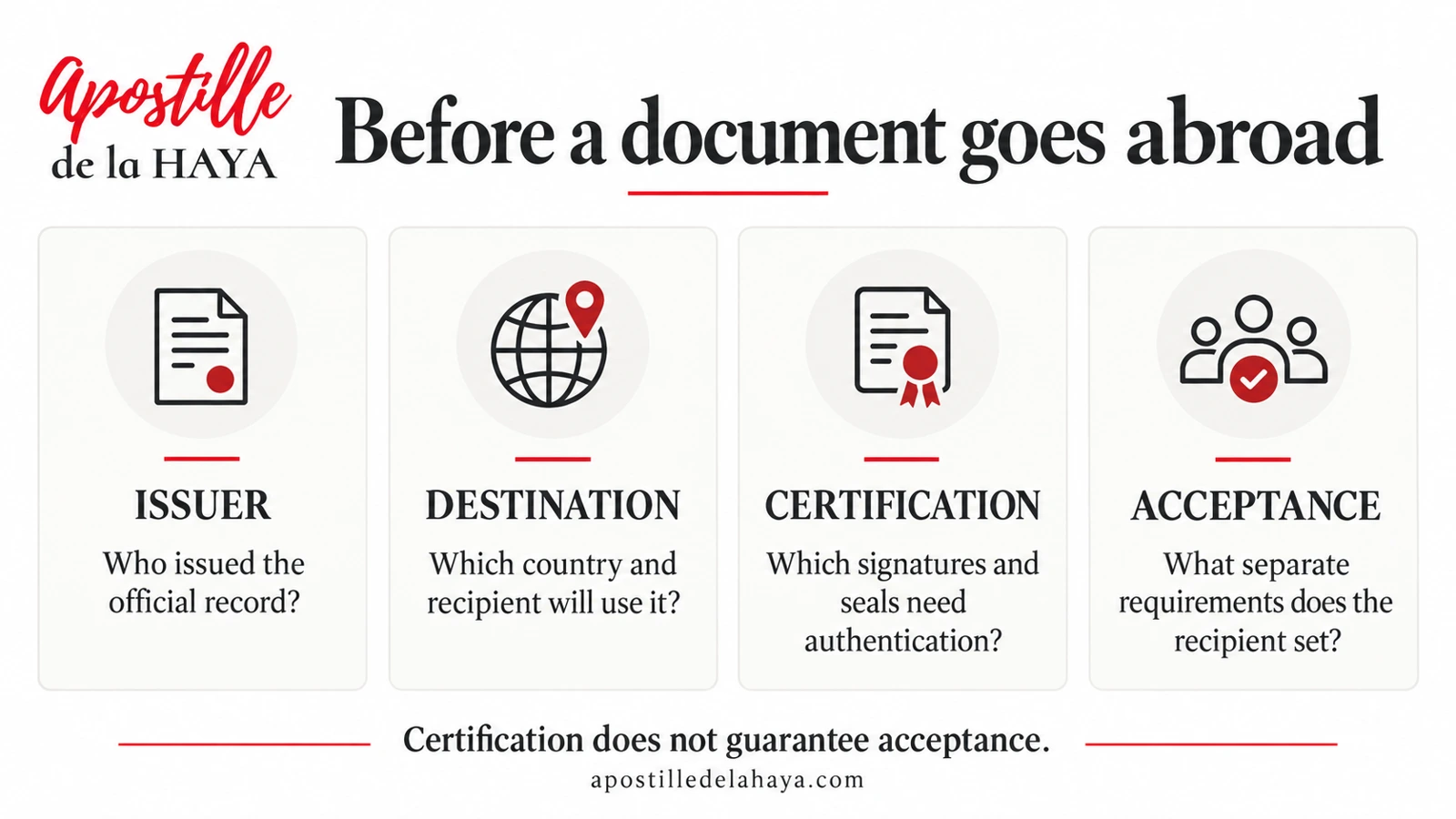
Describe the record before choosing a service category. A marriage certificate, a diploma, a company agreement and a judicial record do different jobs. Identify the issuer and what the document establishes. An individual signing on behalf of a company does not necessarily make the instrument personal. The category should reflect the document and the competent authority’s instructions for the intended use.
Then establish the available version. You may hold a certified public record, a signed private instrument, an original electronic document or only a scan. These formats are not automatically interchangeable. A complete preliminary copy helps a reviewer understand the file, but the authority performing the attestation and the final recipient determine the forms acceptable for their respective stages.
Define the Qatar recipient's requirement
Name the institution requesting the document and the procedure involved. An employer, a university and a government office may have different requirements even when they all request a diploma. Obtain the written request where possible. Ask which record is needed, what language is accepted and whether supporting evidence or a separate recognition procedure forms part of the application.
The request also establishes the intended endpoint. Delivering an attested record to you is different from presenting it to the institution. Acceptance into a file is different from approval of the wider application. Keep those events separate when discussing assistance. A document service should explain the work it performs without suggesting that it controls the recipient’s legal or administrative decision.
Confirm the competent Qatari mission
The Qatar Embassy in Washington publishes consular information for document categories. That information is a starting point for reviewing a U.S. file, but the competent mission and current submission requirements still need confirmation. A general embassy address does not establish the correct intake arrangement for every service. Identify the applicable category and service before sending the original record.
The Qatar embassy attestation service can help frame the review of U.S. preparation and permitted documentary assistance. Explain where the document was issued and where it is now. Instructions for a Qatari mission in another country should not be treated as a universal procedure for American records, even when the service uses a similar name.
Establish which U.S. authority can act
The relevant authority follows the official signature and the document’s origin. The applicant’s current address does not give a state authority over a record issued elsewhere. A state marriage certificate remains a state record even if the spouses live in Qatar. A document issued by a federal agency raises a different preparation question from a privately notarized instrument.
Where federal authentication belongs in the confirmed route, the prior preparation required by the U.S. Department of State must be satisfied. The federal certification guide explains the office’s role and the distinction between certificate routes. Adding a federal act does not correct an unsuitable source record or replace the destination’s requirements. The actual issuer and intended use remain central.
Review civil records against their official source
A marriage certificate should be identified through its public issuer and certification. A ceremonial keepsake, unused license or ordinary photocopy is not necessarily the official record required for foreign use. Some jurisdictions use a completed license-and-return format, so the title alone does not decide suitability. Review the record’s actual content, official signature and certification statement.
The certified marriage copy guide explains why the underlying version matters, using the apostille context. A Qatar file requires its own subsequent route review. If a replacement is needed, establish the required version first. Do not assume every older copy must be replaced, or that every newly issued copy automatically satisfies the receiving institution.
Give academic records their own scope
Identify the awarding institution, qualification and documents requested by the recipient. A diploma and a transcript support different information and should remain distinguishable in the file. Qatar MOFA’s academic certificate guidance requires a transcript with a foreign bachelor’s degree. Review that condition for the relevant service; do not turn it into an identical rule for every award or academic document.
Attestation and academic equivalence are separate matters. The recipient may require institutional verification, recognition or another academic review for the intended purpose. Establish that requirement before assuming that the requested service ends with a certified diploma. A documentary certificate does not guarantee a professional license, a particular employment classification or recognition of a qualification under a separate education procedure.
Identify every instrument in a company file
A company packet can contain a commercial agreement, a certificate of origin, an invoice and a power of attorney. Treat each as an identifiable document with a defined purpose. Annexes may belong to an instrument, while a separately issued record can require its own consideration. The complete set should be reviewed before its classification or preparation is assumed.
A company’s name on the front page is not enough to establish who issued or signed each item. Distinguish public registry records from private statements and contracts. Also establish whether the signer’s authority needs supporting evidence for the intended transaction. Signature certification should not be presented as a decision that the company has met every commercial, customs or contractual requirement at destination.
Read existing certificates as evidence of completed work
Ask what an earlier service actually completed and examine the official attachments. A delivery receipt shows transport, while a certificate records a particular official act. A broad description such as “legalization completed” may not identify every stage. Keep a short record of the authority responsible for each attachment and the destination for which it was prepared.
An apostille or mission certificate obtained for another country may not fit the Qatar requirement. Leave it attached while the file is assessed. Do not move certificates to another copy, change a destination reference or swap pages inside a signed document. If a corrected or replacement record is required, its preparation needs review based on that version rather than an earlier packet.
Distinguish local attestation from missing overseas work
A local Qatar MOFA service and an act by a Qatari mission abroad have different places in a document’s history. Identify the service selected and the actual output. An online application is not, by itself, evidence that the underlying document has completed every required certification. Review the full set before deciding what remains to be done inside Qatar.
MOFA also describes a separate service for completing attestation outside Qatar. It concerns foreign documents that still require work abroad. This is different from presenting a fully prepared packet for a routine local act. Confirm the applicable scope for the record involved. Being physically in Qatar does not remove a missing certification associated with the U.S. issuer or earlier official signature.
Plan language and translation requirements
Qatar MOFA’s general attestation FAQ describes originals in Arabic or English, or originals accompanied by a certified translation, for the service addressed there. The final recipient may impose its own requirements. Confirm the relevant document category, language and accepted form before deciding that a translation is unnecessary or arranging one without a defined purpose.
The translation scope may include official attachments and relevant annotations as well as the main record. Ask who may prepare it and whether a translator’s declaration needs separate certification. Names, dates and office titles should accurately reflect the source. A translator should not hide a discrepancy by changing the original meaning. Genuine record errors belong with the issuer or appropriate professional.
Define delivery, custody and remaining responsibilities
Record where the original is held and who can authorize its release. The applicant may be abroad while a relative or institution holds the document in the United States. Identify the person receiving the completed set and the destination address. This establishes the handling scope without assuming that the document must return to the place from which it was sent.
Maintain a complete copy for reference and leave official attachments intact. Keep shipment and application references tied to the correct record. When several documents concern one family or company, their origins and outstanding requirements may still differ. A clear inventory makes it possible to identify a missing item without treating the whole packet as if every document had the same history.
Discuss Qatar embassy attestation fees through a case review
Consult Apostille de la Haya directly about service conditions once the actual assignment is known. Conditions may vary with the nature, complexity, scope and requirements of the case. Explain which records are ready, which certifications exist and what the recipient has requested. A general description of attestation cannot establish the conditions applicable to a partly completed academic, personal or commercial file.
The proposed scope should name the documentary work included and the remaining responsibilities. Identify translation, delivery and any further destination service separately when they apply. If a document category or recipient instruction is uncertain, resolve that question before treating the assignment as settled. The applicant should be able to understand what the service will deliver and what decisions remain with other authorities.
Handle deadlines and returned documents carefully
Explain what the deadline represents: an appointment, delivery to a recipient or another filing event. Issuing a replacement, correcting a record, official examination and transport can affect different parts of the plan. A processing estimate for one authority does not establish the final completion date for all of them. Urgency does not remove an unresolved documentary requirement.
If a submission has been returned, preserve the notice and the complete packet. Identify whether the issue concerns the source copy, a missing official act, translation, application information or a separate recipient requirement. The correction should address the stated issue. Arranging an unrelated certificate does not resolve a misspelled name or establish eligibility for the wider procedure the document is intended to support.
Frequently Asked Questions
How do I obtain conditions for my Qatar document service?
Contact Apostille de la Haya with the document type, issuer, available version, existing certifications and recipient’s instructions. Add the document’s location and your deadline. Conditions may vary with the nature, complexity and requirements of the case. A review should establish the remaining documentary work before the service scope and conditions are discussed for that particular file.
Does a mission attestation complete every Qatar requirement?
Not automatically. Review the mission’s act, any applicable local ministry service and the final recipient’s requirements separately. The assistance should identify its endpoint and any remaining task. A completed certificate does not decide a residence, academic or commercial application. The relevant institution retains responsibility for its own acceptance and substantive eligibility decisions.
Is the diploma enough for an academic file?
It depends on the qualification, service and recipient. Qatar MOFA’s guidance for foreign bachelor’s degrees requires a transcript with the degree. Other document categories need their own review. Identify the actual academic request and distinguish certification from recognition or institutional verification. Do not assume that one certified diploma supplies every record needed for the intended purpose.
Can missing U.S. certifications always be completed through a local appointment?
Do not assume a routine local service replaces work that must occur abroad. MOFA describes an overseas-completion service with a separate scope. Have the existing packet reviewed to identify the missing act and the appropriate service. An unsuitable source copy may also need attention from its U.S. issuer before further certification can proceed.
Can urgent handling guarantee my preferred completion date?
No documentary service controls every official examination or the final recipient’s decision. Faster transport does not establish faster government processing. Have the file assessed and explain the event behind the deadline. The review should identify outstanding records, corrections and required official acts, so any timing estimate accounts for the work and authorities involved.
Request a review of the remaining preparation
Contact Apostille de la Haya on WhatsApp +1 305 500 0185 with the complete file and the Qatar recipient’s written requirements. We can assess the U.S. preparation and explain the available documentary assistance. For Qatar embassy attestation fees and other service conditions, consult Apostille de la Haya directly about the nature, complexity and particular requirements of your case.