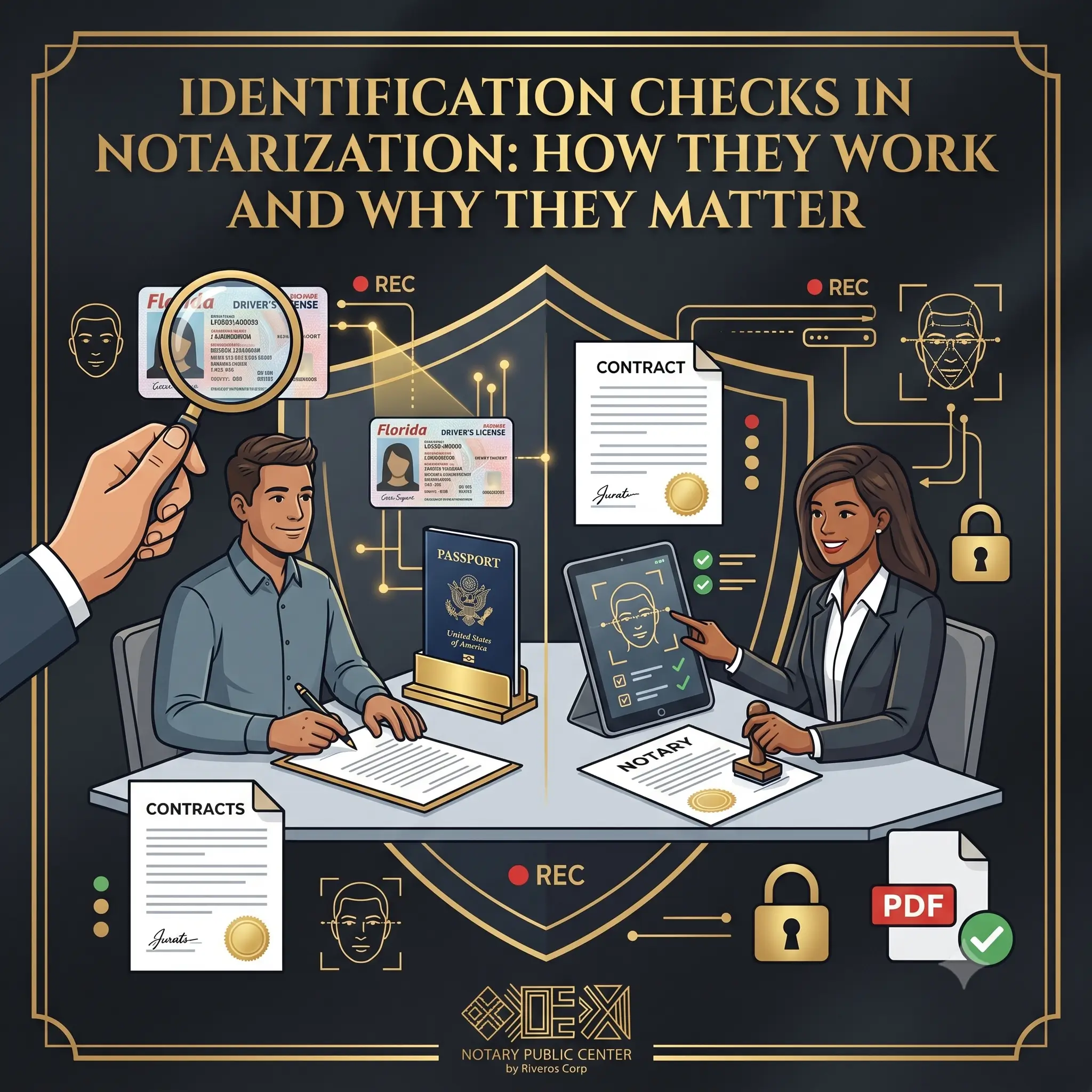

The stamp of notary public identifies the notary who performed a notarial act. On a Florida paper document, the official seal includes the notary’s name, commission details and state designation. However, the impression alone does not establish that every requirement was met or that the document’s statements are true.
A complete notarization involves the applicable act, the required appearance and identification, and a completed certificate. The seal belongs within that process. A bank, court or foreign authority may also have requirements for the underlying document and its delivery.
Notary Public Center can review the requested notarial service and discuss paper or remote options. This guide explains Florida’s stamp rules, the difference between physical and electronic seals, and issues to resolve before submitting a document.
What does the stamp of notary public show?
The seal supplies information about the commissioned notary. It helps the recipient identify whose official act appears on the document. Read it together with the certificate, which describes what the notary did and when.
For example, an acknowledgment and a jurat serve different purposes. An acknowledgment involves the signer’s acknowledgment of execution. A jurat involves an oath or affirmation and signing as required for that act. A stamp cannot replace either process.
Nor does a seal establish that a contract is enforceable, an affidavit is factually correct or an application will succeed. Those questions may require evidence or legal review beyond the notary’s role.
Read the certificate as well as the impression
The certificate identifies matters such as the act, date, signer and manner of appearance. It also includes the notary’s signature and required identifying information. A clear stamp beside an incomplete certificate can still leave an issue to resolve.
If a form has no notarial wording, ask the receiving party or your legal adviser which act is needed. A notary who is not an attorney cannot select legal provisions for you or advise which act will protect your interests.
Florida requirements for a paper notary seal
Florida Statutes section 117.05 requires the official rubber-stamp seal on notarized paper documents. It must use black ink that reproduces photographically. Florida’s rule should not be treated as a statement of every state’s law.
The seal contains the words “Notary Public-State of Florida,” the notary’s name, commission number and commission expiration date. The notary must also print, type or stamp the name exactly as commissioned below the signature.
These details help connect the certificate to the notary’s authority. Still, copying the required words onto a page does not create a lawful notarization. The person performing the act must have the necessary authority and comply with the applicable requirements.
Why legibility matters
The seal must remain readable when the document is copied or scanned. Smudging or overlapping text can obscure information that the recipient needs. Therefore, a problem with the impression deserves attention before the document is submitted.
Do not alter the seal yourself or paste a clearer image over it. Describe the issue to the notary and receiving institution. The appropriate response depends on the completed act, applicable law and intended use.
Inked stamp and embosser: different tools
An inked stamp leaves a visible impression on the paper. An embosser creates a raised impression. Florida permits an impression-type seal in addition to the rubber-stamp seal, but it cannot replace the required official rubber stamp.
A decorative raised seal may look formal without supplying the necessary inked information. Conversely, the absence of an optional embosser does not by itself mean a Florida paper notarization is defective.
Ask which jurisdiction’s requirements govern the act before comparing documents from different states. Shape, layout or decorative details alone are not a reliable way to decide whether a notarization is valid.
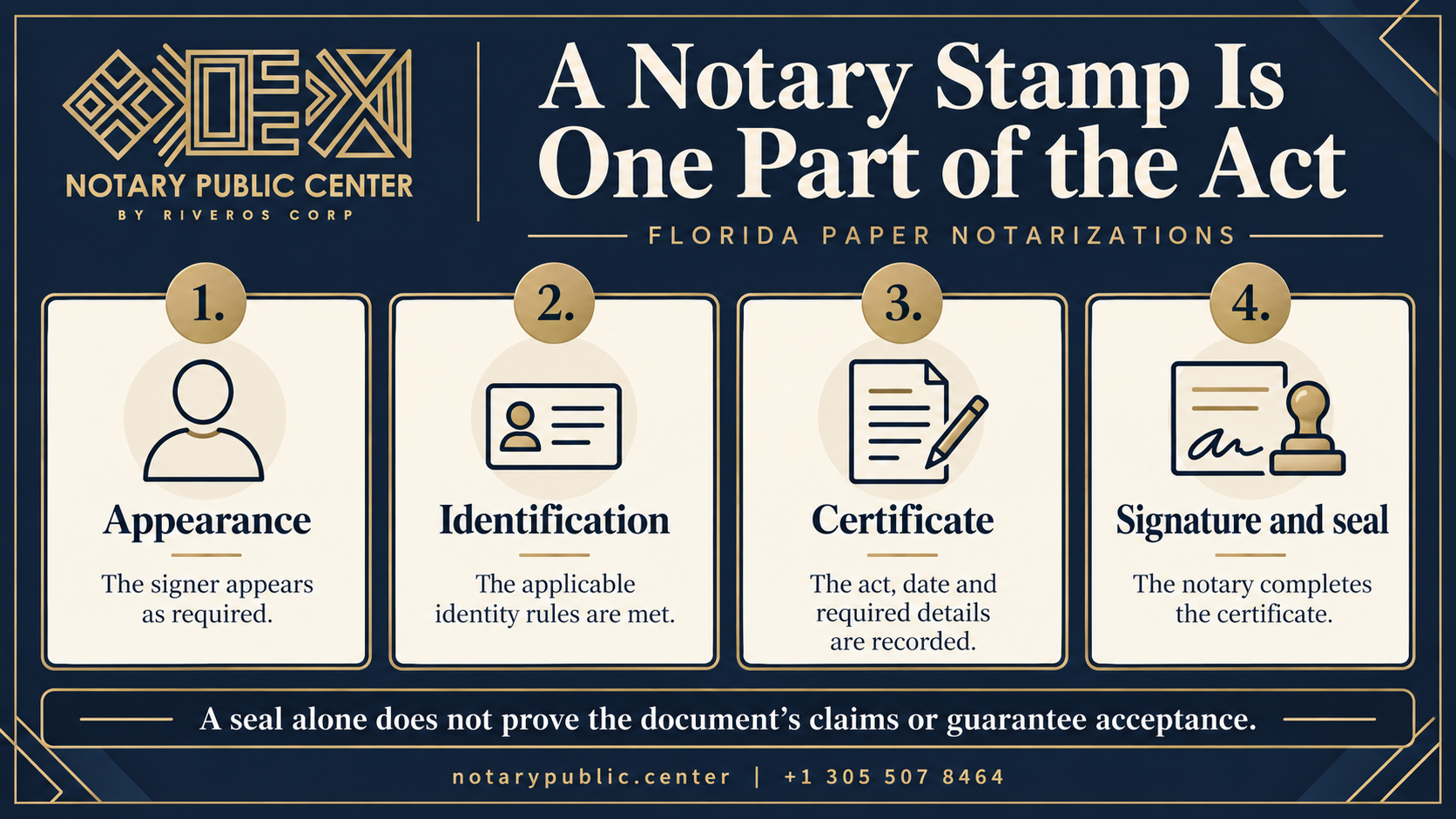
The stamp is part of a complete notarial act
For a signature notarization, the signer must appear as required by law. Florida recognizes physical appearance and qualifying online appearance. Sending someone a signed document by email, without the required appearance, does not complete that requirement.
The notary must also establish identity under the applicable rules. In-person identification can involve personal knowledge or legally sufficient evidence. It is inaccurate to assume that every valid notarization necessarily involved the same government ID check.
Finally, the certificate records the act and carries the notary’s signature and seal. Our guide to a notarized application explains other preparation questions, including instructions, signing capacity and delivery.
A prior signature does not answer every question
Some documents call for an acknowledgment of a signature already made. Others require signing and an oath or affirmation in the notary’s presence. Therefore, tell the provider whether the document has already been signed.
Also identify any separate witnesses required for the transaction. A notary’s seal does not replace those witnesses. The document’s legal requirements and the notarial act must both receive attention.
What is an electronic notary seal?
An electronic notarization uses an electronic record and the required electronic signature and seal information. Under Florida section 117.021, the notary’s electronic signature must meet specific verification, control and alteration-detection requirements.
Consequently, a picture of a rubber stamp pasted into a PDF is not enough. The electronic act must use the required process and technology. A recipient may need the original electronic file to evaluate its signatures and integrity.
Electronic notarization and remote appearance are related but distinct concepts. The electronic format describes the record and signature. Remote online notarization also involves the authorized audiovisual interaction and other requirements for participants.
Remote notarization still requires an actual session
Florida’s online-notarization rules require the Florida online notary to be physically in the state. The signer may be elsewhere, subject to the applicable conditions. Identity checks and a recorded audiovisual session form part of the process.
However, online service may not fit every document or intended use. Before booking, confirm whether the recipient accepts the proposed format. Our article Can a document be notarized online? discusses that review.
Commission dates and older documents
The expiration date on a seal concerns the notary’s commission. Compare it with the date of the act, rather than only with today’s date. A commission that expires later does not, by that fact alone, undo a notarization lawfully performed while it was active.
By contrast, a person must not knowingly act as a Florida notary after the commission has expired. If the certificate date falls outside the apparent commission period, ask for clarification. Avoid assuming that an old stamp, a renewal or a clerical mismatch all have the same legal effect.
A recipient may separately require a recently executed document. That is a different issue from the notary’s commission expiration. Obtain the institution’s current requirement before paying to repeat an otherwise usable document.
Problems that need review before submission
| Issue noticed | Why it matters | What needs review |
|---|---|---|
| Faint or smudged impression | Commission details may be unreadable | The original and the recipient's requirements |
| Seal overlaps writing | It may obscure the document or certificate | Legibility and the completed notarial act |
| Date appears inconsistent | The notary's authority needs clarification | The act date and relevant commission record |
| Certificate or signature is missing | The stamp alone does not complete the certificate | What act was performed and whether a new appointment is needed |
| Only a pasted seal image appears | An image does not establish electronic compliance | The original electronic record and verification method |
These issues can cause questions, delay or rejection. Their legal consequences depend on the circumstances. It is too broad to say every imperfect impression automatically invalidates the entire transaction.
Do not repair a completed certificate yourself
Florida section 117.107 restricts changes after signing and prohibits a notary from amending a completed notarial certificate. A correction request therefore needs careful review.
Keep the document as received and explain the problem to the provider. Do not change a date, copy a signature or add a seal from another page. A new notarial act may be necessary, depending on the issue.
Stamp of notary public and apostille requirements
An apostille is a separate certificate issued by the competent authority. It concerns the origin of a public document, including the relevant official signature, capacity and seal. It does not certify the truth of the document’s contents or guarantee the underlying transaction’s acceptance.
The HCCH Apostille Convention establishes the international framework. Whether an apostille is needed depends on the document, destination and applicable requirements. Foreign use alone does not make every document require notarization and an apostille.
For a document notarized by a Florida notary, the Florida Department of State reviews the relevant state authentication request. Federal documents and documents issued or notarized in other states follow their appropriate authorities.
Birth certificates follow a different document route
A Florida notary cannot turn a photocopy of a birth certificate into an official certified vital record. The issuing authority’s certified copy serves that purpose. Adding a notary stamp to a photocopy does not replace it.
Similarly, an apostille for an official record does not always require a preliminary notarization. Our guide to Florida birth-certificate apostilles explains the distinction. Identify the document’s issuing authority before choosing a service.
Who controls the notary's seal?
Florida law places the official seal under the notary’s direct and exclusive control. It remains the notary’s property even if an employer paid for it. The notary must not surrender it to the employer when employment ends.
The seal also cannot be used to notarize the notary’s own signature. Florida has additional restrictions involving specified relatives and interests in the transaction. An employment relationship alone does not necessarily prohibit notarizing an employer’s document.
Explain relevant relationships and signing roles when arranging the appointment. The provider can assess the permitted service, while legal questions about the transaction should go to qualified counsel. A seal should never be lent to someone else for convenience.
Frequently asked questions about notary stamps
What color must a Florida paper notary stamp use?
Florida requires photographically reproducible black ink for the official rubber-stamp seal on paper. Other states have their own requirements. Check the law governing the notarial act instead of relying on a general recommendation about ink colors.
Can a raised embosser replace the rubber stamp?
Not for a Florida paper notarization. Florida permits an impression-type seal as an addition, but the official rubber-stamp seal remains required. The presence or absence of decorative embossing does not answer whether the rest of the act was properly completed.
Does a later commission expiration invalidate my document?
Not by itself. The relevant question is whether the notary had authority when performing the act. A recipient may have a separate requirement for a recent document. Distinguish that requirement from the expiration printed on an older, lawfully completed notarization.
Is a digital picture of the stamp enough?
No. An electronic notarization must meet the applicable requirements for the act, electronic signature and seal information. Florida also requires technology that makes later alterations evident. Pasting a stamp image into a PDF does not establish compliance.
Can a notary stamp their own signature?
No. Florida prohibits notarizing one’s own signature. Other restrictions can apply to relatives or interests in a transaction. Tell the provider who is signing and in what capacity so the proposed act can be assessed before the appointment.
Discuss your document with Notary Public Center
Contact Notary Public Center with the document type, receiving institution and intended country of use. Mention whether you need a paper original, an electronic record or related apostille coordination.
Request information by WhatsApp at +1 305 507 8464. The team can discuss the notarial appointment and service scope. The receiving institution and competent authorities determine their own requirements and decisions.
This article provides general information and does not constitute legal advice. Reading it does not create an attorney-client relationship. Consult a qualified attorney about your document, transaction or the legal effect of a defect.