
When founders look for an articles of incorporation form, they usually want one specific thing: the actual document they need to fill in and file to create their corporation. It sounds like a simple hunt for the right PDF. But there is more to it than downloading a file. This form you use depends on your state and your entity type, and completing the form correctly depends on decisions the form itself will never explain. Getting the right form is the easy part. Using it correctly is where corporations are made or unmade.
This guide explains where the articles of incorporation form comes from, the difference between a PDF and a fillable version, the fields that carry real legal weight, and why the form is only half the job. It is written for founders who want to understand the document before they rely on it. Also, it ends with how Riveros Corp completes and files the correct form for your situation so nothing is missing, mismatched, or misworded.
Where the Articles of Incorporation Form Comes From
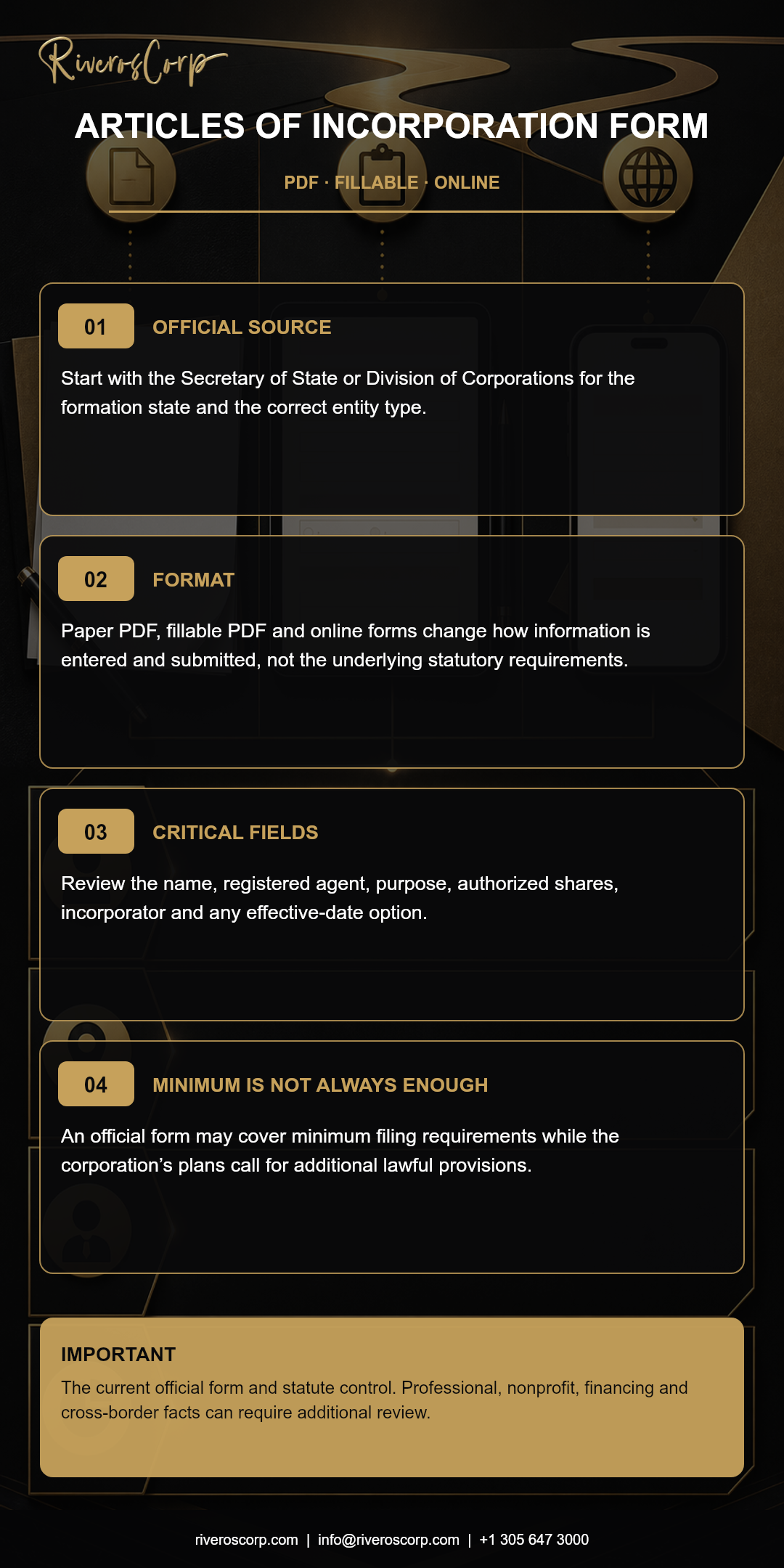
The authoritative articles of incorporation form comes from the state where you incorporate, specifically its Secretary of State or Division of Corporations. In Florida, that is the Department of State, Division of Corporations, which provides forms for a for-profit corporation, a nonprofit corporation, and an LLC (the LLC form is technically articles of organization, not incorporation). Each state publishes its own version. Also, each entity type has its own form. That is the first place founders go wrong: they grab a form that is either for the wrong state or the wrong entity. Also, the filing bounces.
You will also find third-party versions of the form on legal-document websites. Some mirror the state form faithfully. Others are generic and may not match your state’s exact requirements. The safest source is always the state itself. This is because that form is designed around the state’s current minimum filing requirements. But even the correct official form does not tell you how to answer it well, it simply provides the blanks. For the wider context on the document, see our overview of what articles of incorporation are.
PDF vs. Fillable vs. Online Form
Founders often ask whether they need a PDF, a fillable PDF, or the online form. The distinction is about how you complete and submit the document, not about its legal effect. A plain PDF is meant to be printed and completed by hand or typed and mailed. A fillable PDF lets you type directly into the fields before printing or submitting. The online form is completed and filed electronically through the state’s portal, in Florida, through Sunbiz. Also, uses the state’s electronic submission channel.
All three produce the same result: a validly formed corporation, if completed correctly. And all three share the same limitation: they check that fields are filled, not that your answers are sound. A fillable PDF does not know your name is too close to an existing entity, and the online form does not know your share structure will hamper your next investment round. The format affects convenience and speed. It does nothing for correctness. We usually file electronically for speed. However, we treat the substance the same regardless of the medium.
The Fields That Actually Matter
Most of the form is straightforward identification, name, address, incorporator. A handful of fields, though, are where the real decisions live, and where a wrong entry has consequences that outlast the filing:
- Corporate name. Must be distinguishable in your state and carry a proper suffix. The name must satisfy the formation state’s distinguishability rules.
- Registered agent. Requires a real person or company with a physical in-state address and their acceptance. A placeholder here is a defect that surfaces when a legal notice goes unreceived.
- Purpose. State law may permit broad lawful-purpose language for a for-profit. A nonprofit seeking section 501(c)(3) recognition must satisfy the federal organizational test.
- Authorized shares. Drives control and future fundraising. A careless number means amending later.
- Effective date. An optional field that, used well, can keep you out of an unnecessary extra annual-report cycle.
These few fields are why the form is not the whole job. The blanks are identical for everyone. The right answers are specific to you.
What the Form Will Never Do for You
A form is a container. It holds the information you supply. However, it supplies no judgment of its own. From completing these forms for founders across the U.S. and abroad, here is what the document quietly leaves to you. Also, what founders most often get wrong. The form will not confirm your name is truly clear under your state’s “distinguishable” standard, only that it is not an exact duplicate. Nor does it verify that your registered agent has agreed to serve or that the address satisfies current rules.
The fields do not tell you whether a corporation or an LLC fits your goals, even though the forms may appear near each other. They also do not determine whether a nonprofit provision satisfies the federal organizational test. After submission, the form provides no planning guidance, no reminder about the EIN, bylaws, share issuance, or annual report that turn a filed form into a functioning corporation.
We deliberately stop short of a field-by-field walkthrough. This is because the answers that make a filing succeed depend on your entity, your state, your ownership, and whether you are filing from inside or outside the U.S. That is the judgment we bring, the part the form cannot.
The Cost of Filing the Wrong or Incomplete Form
Using the wrong form, or completing the right one carelessly, produces the same expensive pattern: a rejected filing that must be redone at a fresh fee, a defect that surfaces at the bank when you can least afford it, or a nonprofit that must amend the organizing document during federal review. Because the articles are the legal foundation of the corporation, a flaw at this layer ripples into taxation, ownership, banking, and compliance.
And since the filed form becomes a public record, a sloppy version is visible to everyone who later evaluates your company. The form is free to download. The consequences of using it wrong are not.
Choosing the Right Form Is a Decision, Not a Download
The single most common form mistake is treating “find the form” as the whole task, when choosing the correct form is itself a decision with real stakes. Before you can pick a form, you have to know your entity type and your state. Also, those are exactly the questions founders have not always settled. A person who assumes they want to “incorporate” may actually be better served by an LLC, whose form is articles of organization, not incorporation.
A founder who grabs a Delaware form because they heard Delaware is the default may have no business reason to incorporate there and would be simpler off in the state where they actually operate. The form follows these decisions. It cannot make them.
Match the Articles of Incorporation Form to the Entity
There is also the question of which version of the correct form to trust. State portals sometimes offer multiple forms, a basic profit-corporation form, a professional-corporation variant, a nonprofit form. Also, the differences are not cosmetic. A professional corporation for licensed practitioners has requirements an ordinary for-profit does not. A nonprofit form addresses a different entity. However, the filer must still compare its provisions with the intended federal classification. Downloading the wrong variant produces a filing that is either rejected or valid-but-wrong for your purpose.
And third-party form sites add another layer of risk. This is because a generic form may quietly omit an element your state requires. Therefore, the filing looks complete to you and incomplete to the state.
All of this is why we describe the form as the last step, not the first. By the time we complete a form, the consequential choices, entity, state, name, structure, have already been made correctly, and filling in the blanks is genuinely the easy part. Founders who start with the form and work backward are solving the problem in the wrong order, and the wrong order is where the expensive mistakes hide. Getting the sequence right, decisions first, document second, is a large part of what you are actually paying for when you have it handled.
The official form usually reflects minimum filing requirements rather than every provision a corporation may lawfully include. Florida’s own instructions state that additional items may apply and recommend legal review before submission. A founder should therefore distinguish between a form that can be accepted and a charter that supports the planned ownership, governance, financing and regulatory context.
Founders can also review Riveros Corp’s company formation service before selecting the state, entity and filing package.
How Riveros Corp Completes and Files Your Form
At Riveros Corp we complete and file the correct articles of incorporation form for entrepreneurs inside and outside the United States, including foreign founders with no Social Security Number. We start from the right state and entity form, then supply everything the form cannot: a corporate name reviewed against the state’s current distinguishability rules, a proper registered agent with a valid acceptance, a purpose clause that fits your entity, a sensible share structure, and an EIN lined up so the corporation is operational from day one.
You can avoid searching among multiple forms, decode its fields, or wonder whether an instant confirmation hides a defect. We manage the entire filing and keep your corporation in good standing afterward, including annual-report coordination. If you are an international founder, our guide on whether a foreigner can register a business in the USA is a helpful companion, and after filing you will want your proof of EIN.
Need help reviewing articles of incorporation form for your planned entity? Contact Riveros Corp, call +1 305-647-3000, or use WhatsApp. We can coordinate the formation filing and identify questions that require licensed legal or tax advice.
Frequently Asked Questions
Where do I get the official articles of incorporation form?
From the state where you incorporate, its Secretary of State or Division of Corporations. In Florida, the Department of State provides forms for for-profit and nonprofit corporations. The state form is the safest source because it matches that state’s requirements. We use the correct form and complete it for you.
Is there one articles of incorporation form for every state?
No. Each state publishes its own form with its own required elements. Also, each entity type has a separate form. Using a form from the wrong state or for the wrong entity is a common reason filings are rejected. We make sure you are using the right one.
What is the difference between a PDF and a fillable form?
A plain PDF is printed and completed by hand or typed and mailed. A fillable PDF lets you type into the fields on screen. The online form is completed and filed electronically. All produce the same legal result. The format affects convenience, not correctness. This is where our work matters.
Can I file the articles of incorporation form myself?
You can. However, the form only checks that fields are filled, not that your answers are sound, the name, agent, purpose, and share choices are left to you, and errors there are costly. Nonprofit, financing and cross-border facts often justify professional legal or tax review before filing.
Does the form work for an LLC?
No. An LLC uses a different form, articles of organization, not articles of incorporation. They sit near each other on state portals, which causes frequent mix-ups. If you are unsure which entity you need, we help you decide and file the correct document.
What do I do after completing the form?
File it with the state, then handle what the form does not mention: obtaining an EIN, adopting bylaws, issuing shares, and filing your annual report to stay in good standing. The form ends at submission. A working corporation needs all of it. We manage the full sequence.