Knowing how to change a registered agent in Florida starts with two separate arrangements: the new agent must accept the appointment, and the entity’s state record must reflect the change through an authorized filing. Hiring a new provider privately does not by itself update the Division of Corporations record.
Florida law permits a statement of change and, in appropriate circumstances, changes through an annual report or other authorized filing. The applicable provisions depend on whether the entity is an LLC, a corporation or another form of organization.
Keep the appointment and notice handling continuous. The business needs a reliable registered agent and registered office while the transition occurs, along with a clear process for forwarding legal notices. A change should not leave the owner unsure which provider is responsible or whether an important document arrived at the former address.
Keep the state filing confirmation with the service agreement and the notices already received. They show when the appointment changed and which documents still require a response after the handoff.
How to change a registered agent in Florida: confirm the entity
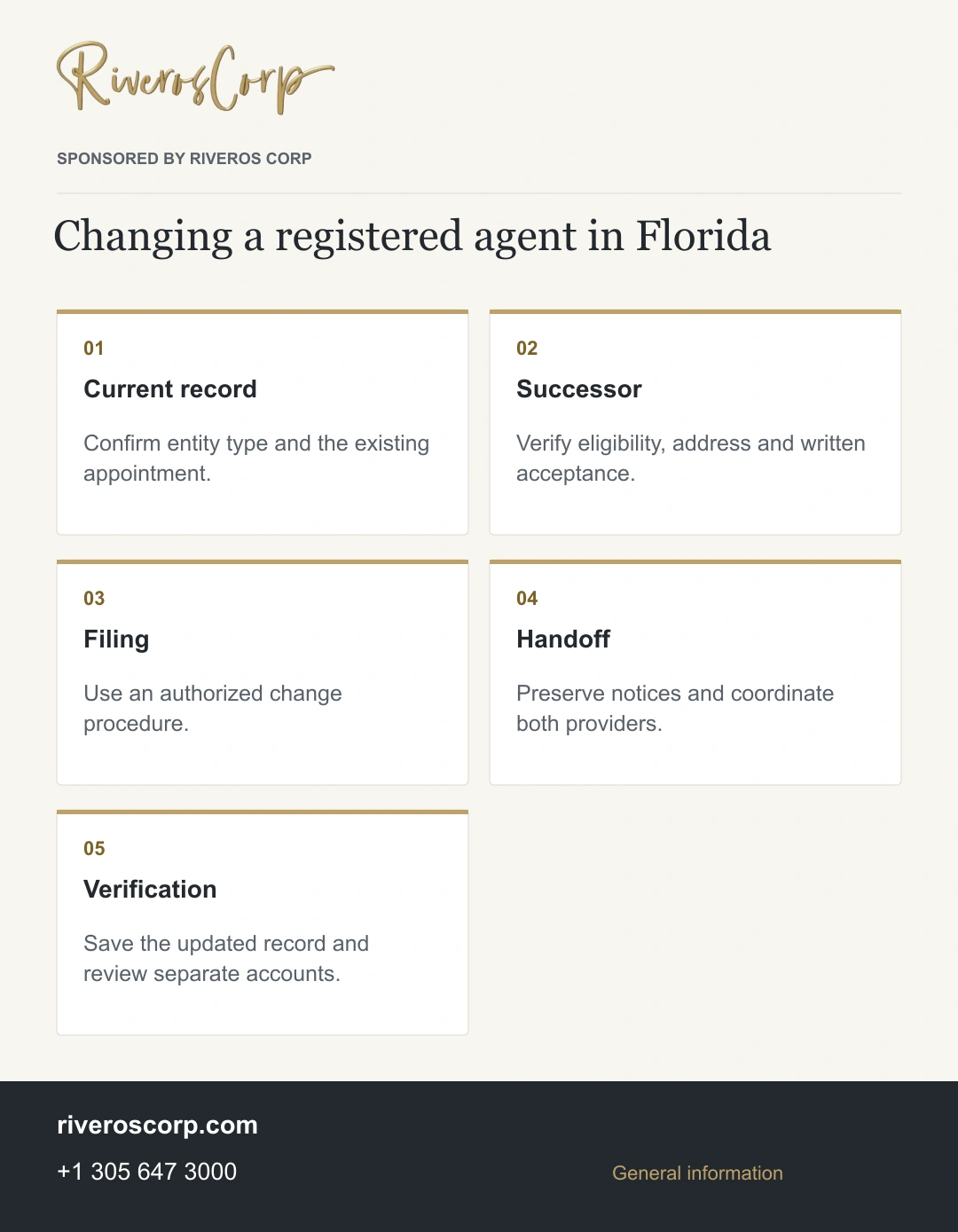
Start with the entity’s current Division of Corporations record. Confirm the exact legal name, document number, entity type and registered agent information. Similar business names can lead to a change being prepared for the wrong entity if the record is not checked carefully.
An LLC and a corporation have different statutory provisions, even though their registered agent changes share several features. A foreign entity authorized in Florida also needs attention to the Florida registration, rather than assuming a change in its formation state automatically updates Florida.
Keep the current record with the formation documents. Our explanation of Florida articles of incorporation provides context for corporate records. The original articles show the initial arrangement, but later filings may have changed it. Use the current record to understand the appointment that needs updating.
The registered office must meet Florida requirements
A registered agent serves a defined statutory role connected with receiving service of process and other required notices. Florida requires a registered office in the state and an eligible agent under the applicable entity statute. A mailing address alone does not establish that the requirements are satisfied.
For an LLC, the agent can be an individual who resides in Florida or an eligible domestic or authorized foreign entity. The agent’s business address must match the registered office, which must have a Florida street address. An owner should not substitute an overseas address or a post office box merely because it is convenient for ordinary mail.
The registered office is also distinct from the company’s principal business or mailing address. Those addresses can serve different purposes in the state record. Confirm which information is changing so the filing accurately reflects the intended arrangement.
Obtain the new agent’s acceptance before relying on the change
Florida’s change provisions require the successor registered agent’s written acceptance with the appropriate change filing. This establishes more than a private plan to hire someone. The proposed agent must actually agree to serve in the statutory role.
Confirm the exact agent name and registered office address that should appear in the record. A service provider may operate under a brand different from the legal entity designated as agent. The filing should use the supported information, not an informal name copied from an email signature.
Also clarify the service arrangement: how notices reach the business, which contact receives them and how changes in contact details are handled. Written acceptance and a functioning notice process address different needs. The appointment can appear correctly on the state record while an outdated owner email still prevents timely attention to a delivered document.
A statement of change can update the appointment
For LLCs, Florida law authorizes a statement of change containing the required current and replacement agent or office information. The successor’s written acceptance must accompany or form part of the statement when the agent changes.
The corporation statute provides a comparable statement-of-change mechanism with its own requirements. Use the procedure appropriate to the entity rather than copying an LLC filing into a corporate matter without review. The effective change depends on the applicable filing rules, not merely on the date the owner signs a service agreement.
For a business corporation, the statement becomes effective when the department files it. An LLC’s statement is effective upon filing or as otherwise authorized under its statutory effective-date rules. Keep the accepted document and confirmation with the company records; the signature date alone does not establish when the change took effect.
An annual report may also carry the change
Florida law permits registered agent and registered office changes through an entity’s annual report in the circumstances described by the applicable statute. Other authorized filings may also provide a route, including specified reinstatement or amendment documents.
The availability of an annual report route does not mean the business should wait if the present agent is leaving or the registered office is no longer reliable. Timing should reflect the need for continuous coverage and the actual filing situation.
Confirm whether the annual report has already been filed and what change procedure is appropriate now. Our guide to Florida LLC processing time explains why a submission and a completed state filing should be distinguished. If a filing is returned for correction, keep the response and arrange the correction promptly. Supplying information to a provider does not establish that the department has filed it.
Coordinate the handoff with the former agent
Before ending the old service arrangement, establish when the successor appointment will appear in the state record and how any remaining notices will be handled. A private cancellation email does not by itself establish the legal effective date of the state change.
Ask the former provider to identify any documents it has already received and the applicable delivery history. Keep copies of those records. A notice delivered before the transition may still require action after the new agent takes over.
Contract terms and statutory responsibilities are different issues. A completed state change does not necessarily resolve every contractual question with the former provider. Review the service agreement and obtain legal advice if a dispute exists, rather than assuming the registered agent filing automatically settles payment, record access or notice-handling disagreements.
A resignation creates a separate timing issue
For a Florida LLC, the statute provides that an agent’s resignation becomes effective at the earlier of the thirty-first day after the department files the resignation or the filing of a record appointing a new agent. The rule concerns the statutory resignation process, not an informal statement that a provider plans to stop service.
Once the resignation takes effect, the former agent ceases responsibility for matters later tendered to it in that role. The statute also preserves contractual rights between the company and agent. Those details make prompt review important when an LLC receives a resignation notice.
Do not treat the period as permission to leave the company without a working agent arrangement. Confirm the entity type, filed resignation and successor appointment. Corporation resignations and other entity forms should be checked under their own provisions instead of assuming every Florida organization uses the LLC rule.
Changing the agent does not update every account
A registered agent change updates the relevant state entity record. It does not automatically update the IRS, banks, licensing authorities, contractual notice addresses or every other organization that holds the company’s information.
Determine whether the business is also changing its principal office, mailing address or responsible party. Those are different facts and may trigger separate procedures. A registered agent’s address should not be substituted everywhere unless it is appropriate for the particular record and service arrangement.
Our guide to an EIN proof document explains why federal identification records belong in the company’s document file. Keep the IRS information and state records consistent where they concern the same facts, while preserving legitimate differences between a registered office and a business or tax mailing address.
Verify the filed result and the notice process
After the change is filed, review the state record for the successor’s correct name and registered office address. Save the filing confirmation and a copy of the updated record with the company’s governance documents. A draft or submission receipt alone may not show the final accepted information.
Then confirm the operational details with the new agent. The company should know how it will receive a notice, which owner or manager monitors the contact channel and what happens if that person is unavailable. If the provider accepts backup contacts, keep them current too.
A registered agent receives and forwards specified documents; it does not automatically provide legal representation in the matter described by a notice. If a lawsuit or other legal document arrives, the business must obtain appropriate professional assistance. Changing agents does not extend a response deadline or resolve the underlying dispute.
What Riveros Corp’s registered agent service includes
Riveros Corp’s Florida registered agent service includes checking the existing public record, accepting the appointment in writing and filing the designation or change. It provides a physical Florida registered office and arranges whom to notify when a process, notice or demand is received for the company.
Before the change, confirm the legal entity name that will appear as agent and the registered office address. Also confirm the company contact and forwarding channel. The filing records the appointment. The forwarding arrangement tells the agent whom to contact when a document arrives.
A registered agent engagement does not include every corporate task. Tax returns, legal representation and ordinary business-address services need their own arrangements. If the company also needs annual-report or other corporate-record work, identify it separately so the scope is clear before the service begins.
Frequently asked questions
Can I change my registered agent in an annual report?
Florida law permits that route for LLCs and corporations under the applicable provisions. The appropriate procedure depends on the entity and current filing situation. If the existing agent is resigning or the office is no longer reliable, review timing rather than assuming the company can wait for its next routine report.
Does hiring a new provider automatically change the state record?
No. The successor must accept the appointment, and the change must reach the Division of Corporations through an authorized filing. Keep evidence of the completed filing and review the updated record. A private service contract alone does not establish that the public appointment has changed.
Can the registered office be a post office box?
The registered office must satisfy Florida’s statutory requirements for a street address and the agent’s location. A post office box alone does not meet that role. Distinguish the registered office from an ordinary mailing address and confirm the proposed address with the successor before filing.
Does the change update my IRS address?
No. Federal tax account information follows separate procedures. Review whether the business mailing address, location or responsible party also changed and determine the appropriate updates. Do not assume that a state registered agent filing notifies every agency or financial institution holding the company’s information.
Does a new agent handle notices received before the change?
The answer depends on when the document arrived, the statutory appointment and the service arrangements. Coordinate the transfer of existing records with the former and new providers. A change does not erase an earlier notice or extend its deadline, so unresolved legal documents need prompt professional review.
Coordinate your Florida registered agent change
Contact Riveros Corp at +1 305 647 3000 or through WhatsApp about changing your Florida registered agent. Share the company’s legal name and current record so the team can review the appointment, prepare the filing and agree on how notices will reach the designated contact.
By Zulma E Bourelly. General information only. Individual legal and tax questions require advice from an appropriately qualified professional.