A W-9 form gives a requester a U.S. taxpayer’s name, identification number and specified tax certifications. A customer, bank or other organization may need those details for reporting or withholding. The taxpayer gives the form to the requester; it is not an annual return sent to the IRS.
Whether W-9 is appropriate depends on the taxpayer’s status. Foreign citizenship does not automatically rule it out: a foreign citizen can be a U.S. resident for federal income tax purposes. Conversely, a U.S. bank account or an EIN does not make a foreign person a U.S. taxpayer for this certification.
For an LLC, identify who the tax rules require the payer to document. A disregarded single-member LLC generally points to its owner for this purpose. A domestic corporation has a separate classification. That distinction matters before a client copies the name and number into its reporting records. Income-tax reporting and employment-tax identification can follow different rules for the same LLC.
What a W-9 form tells the requester
The form’s full name is Request for Taxpayer Identification Number and Certification. It identifies a taxpayer and provides information such as a name, federal tax classification, address and taxpayer identification number. Certain exemptions and certifications apply only to taxpayers who meet their conditions.
The requester needs those details to identify the payee correctly. Depending on the transaction, it may later prepare an information return showing payments or another reportable event. Requesting a W-9 does not establish that the payer will report every payment on the same form.
A W-9 is not an invoice, a business license or an annual income tax return. It does not calculate the recipient’s final tax liability. Providing one also does not establish that the income is exempt from tax. Those questions depend on facts and rules beyond the certificate itself.
Keep the request and the submitted version in the relevant business records. If a later information return contains a different name or number, those records help identify where the discrepancy arose. You can check the actual submission instead of trying to remember what you sent several months earlier.
Who is a U.S. person for this purpose?
Form W-9 generally documents a U.S. person. That term includes U.S. citizens and resident aliens, as well as certain domestic entities. It is a tax classification, not a general description of nationality, immigration history or where a business finds its customers.
An individual with foreign citizenship can be a U.S. resident for federal income tax purposes. The green card test, substantial presence test and applicable exceptions or elections may affect the analysis. Conversely, having a U.S. mailing address does not establish tax residence by itself.
A U.S. citizen living outside the country is not automatically a foreign person for this certificate. The same caution applies to someone who describes themselves as an expatriate. Everyday descriptions of residence can differ from the categories used in federal tax documentation.
When residence is uncertain, have a qualified professional review the facts before selecting a certificate. Dates, immigration documents and treaty questions may be relevant. Obtaining a new taxpayer number cannot resolve an underlying classification issue; the number identifies a taxpayer rather than deciding the taxpayer’s status.
A foreign-owned U.S. LLC does not always provide W-9
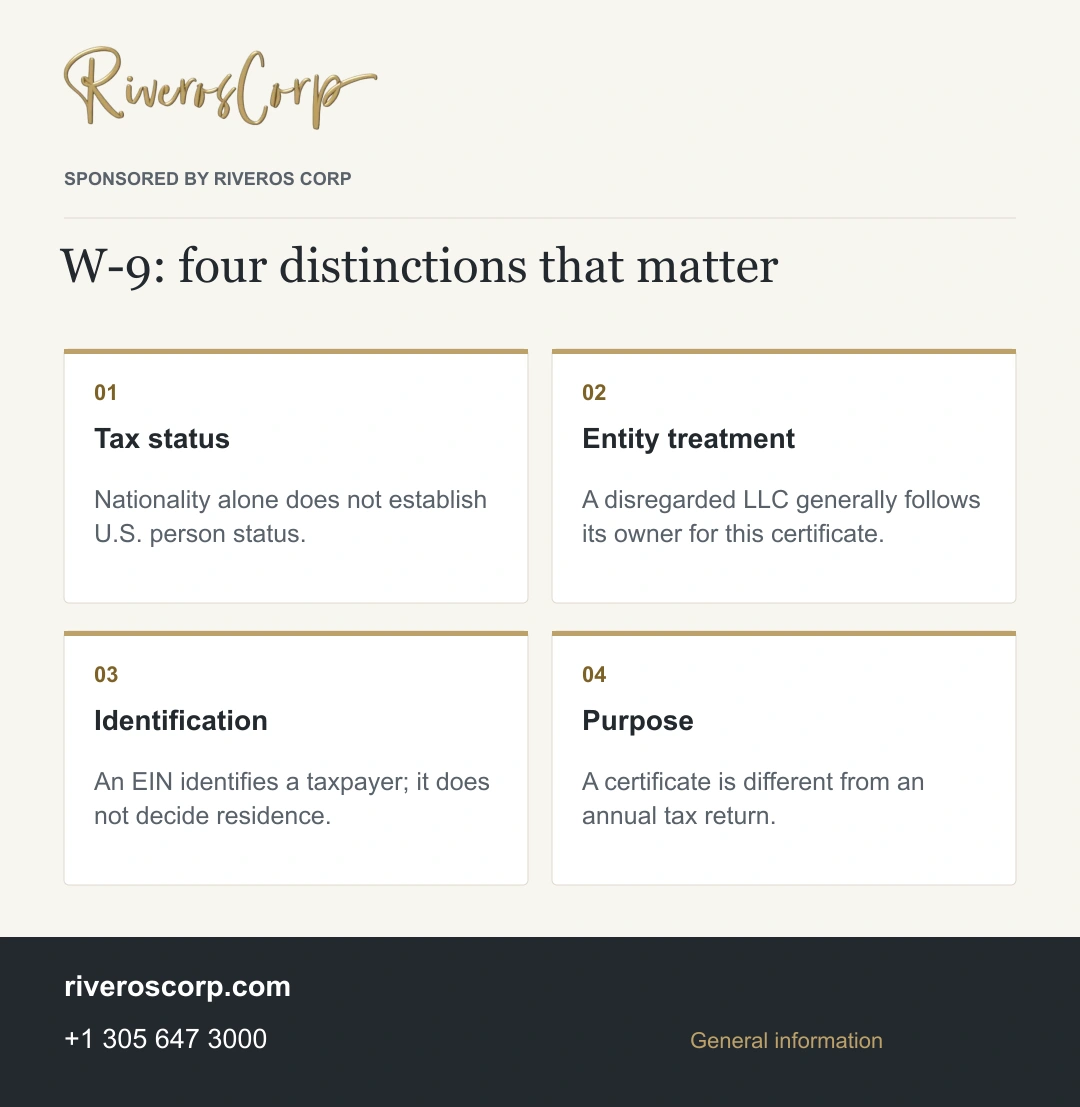
A domestic single-member LLC is generally disregarded as separate from its owner for federal income tax unless it makes a valid corporate election or another applicable rule changes the result. The LLC still exists under state law. “Disregarded” describes the tax treatment, not the disappearance of the business.
The IRS instructions expressly say that a foreign owner of a disregarded entity must complete the appropriate W-8 instead of W-9, even if the owner has a U.S. taxpayer identification number. The owner is the person documented in this situation. The LLC’s U.S. address and separate EIN do not replace that requirement.
When a disregarded LLC has a U.S. owner, that owner generally provides W-9 documentation under the applicable instructions. The owner’s name, classification and taxpayer number must fit together. The LLC’s name can identify the disregarded business without making it a separate income-tax payee for this certificate.
A domestic corporation can be a U.S. person even when all its shareholders are foreign. A domestic LLC that validly elects corporate treatment can therefore have a different documentation result from an otherwise similar disregarded LLC. In the corporate case, do not substitute the shareholder’s foreign status for the corporation’s status.
A domestic LLC with several members generally defaults to partnership treatment unless it elects corporate classification. A change in ownership can therefore affect the documentation that follows. Our article on foreign ownership of a U.S. LLC explains the ownership question. The tax review also needs the number of members, classification and effective elections.
How W-8 documentation differs
A foreign individual may use Form W-8BEN for the purposes described in its instructions. Certain foreign entities use W-8BEN-E. Other certificates address different circumstances, including effectively connected income and intermediary arrangements. Being foreign does not make every member of the W-8 family interchangeable.
A certificate can document foreign status without establishing entitlement to a treaty benefit. Treaty residence, beneficial ownership, the type of income and any applicable limitations require separate attention. A payer’s request for a form does not promise that no withholding will occur.
A foreign-owned disregarded LLC can add another layer because the person documented may be its owner. The relevant certificate follows the tax rules for that relationship. The name on the account or the state formation certificate cannot determine that choice alone.
If a payment platform only displays a W-9 option, contact the requester about its process for foreign payees. A limited software menu does not change a person’s tax status. Making an inaccurate certification to complete onboarding can create problems in the reporting that follows.
The name and taxpayer number need to match
The name and taxpayer number must identify the same taxpayer. For a disregarded entity that properly uses W-9, the instructions look to its owner. If the direct owner is itself disregarded, they look further up the chain to the first owner that is not disregarded for federal tax purposes. A company name alone may hide that distinction.
A disregarded LLC may have its own EIN for employment taxes, certain excise taxes or another permitted purpose. That does not mean its separate EIN belongs on this income-tax certificate. The IRS’s single-member LLC guidance distinguishes those obligations from reporting that uses the owner’s identification.
An individual’s appropriate identifier may be an SSN or ITIN, while business taxpayers may have EINs. The applicable instructions determine which identifier belongs with the name being documented. A number is not suitable merely because it is available or because a payment portal accepts its format.
An EIN assignment letter helps confirm the taxpayer associated with that EIN. It does not prove a corporate tax election or establish an individual’s residence. Our explanation of EIN proof documents describes what the assignment evidence establishes and why other records remain necessary.
Keep the submitted form when a name, classification or other certification changes. Identify when the replacement reached the requester. If an information return later uses the earlier name, the two versions help explain the discrepancy without changing the original record or guessing which details the payer received.
What the certification means
The form contains certifications concerning the taxpayer number, U.S. person status and other matters, including backup withholding where applicable. Signature requirements and particular certifications vary in specified situations. Read the relevant instructions rather than assuming every request requires an identical response.
Backup withholding may arise when required identification is missing or incorrect, or when other specified conditions apply. It is not the same as withholding on certain payments to foreign persons. The two systems involve different documentation. Foreign ownership alone does not resolve either analysis.
Exemption codes require an actual basis. A corporation is not necessarily exempt for every type of payment, and an individual cannot simply borrow a code from a company’s completed form. Review both the payer’s reporting duties and the recipient’s status.
If a mismatch notice arrives, review the stated issue and the records behind it. Sending the same information again without checking the name-number combination can leave the problem unresolved. A qualified tax professional can help determine whether the certificate or another record needs correction.
Why a customer or bank might ask for W-9
A customer may collect W-9 during vendor setup so its records identify the taxpayer before it prepares an information return. Banks also collect tax documentation for account reporting. The request therefore does not necessarily mean that the recipient is a freelancer or that the payment will be reported as nonemployee compensation.
Match the request to the relationship. If the contract names an LLC but the tax documentation identifies its owner, that can be consistent with disregarded treatment. If a corporation is the taxpayer instead, the owner’s personal certificate may describe the wrong recipient. Clarify the classification rather than treating every name difference as an error.
A request for an unfamiliar taxpayer number deserves a check through an established contact. Use the institution’s normal secure channel and ask what documentation it needs. You can describe the classification issue without first sending passports, account passwords or an entire personal tax return.
Electronic W-9 systems are permitted when they satisfy IRS requirements. These include preserving the submitted information, supporting identification of the person submitting it and being able to produce a copy. When a signature is required, the electronic process must also support the required certification. A casual message containing a number is not automatically the same as a compliant electronic certificate.
If a requester returns the form, ask which name, number or certification caused the problem. Compare its explanation with the version actually submitted. Changing a valid classification simply to satisfy a software field can carry the inconsistency into later reports; the record should be corrected to match the facts.
W-9 is different from a 1099 or W-2
A W-9 gathers information about the taxpayer whom it identifies. Forms in the 1099 series report various kinds of payments or transactions. The appropriate reporting form depends on the transaction; the series covers more than independent contractor compensation.
Form W-2 reports wages and related employment information. Providing a W-9 does not decide whether a worker is an employee or an independent contractor. That classification depends on the relationship and applicable law, not simply on the document a business prefers to collect.
A payer may prepare an information return using details from a W-9, but the documents do not replace one another. Nor does receiving a 1099 settle every question about an annual tax return. The reviewer needs to consider the reporting documents alongside the underlying activity.
When a document appears inconsistent with the records, keep the original and contact the issuer about the discrepancy. Do not change the copy and treat it as though the issuer corrected its filing. The professional reviewing the annual return needs to know which version the issuer actually sent.
Documents to discuss before responding
Useful records include the requester’s message, the relevant account or contract, identification records and any documents establishing the business’s tax classification. When the entity has made a tax election, its effective date matters. A draft election or an unconfirmed intention to change treatment is not the same as an effective classification.
The distinction between corporations and LLCs helps frame that conversation. An entity’s legal structure and federal tax treatment can overlap without being identical. Keep both descriptions available so the reviewer does not have to infer one from the other.
Riveros Corp’s page on U.S. taxes for foreigners and nonresidents, provides a starting point for discussing documentation support. Confirm the scope of assistance for the particular request. Classification decisions and treaty claims require an accurate review of the taxpayer’s circumstances.
Describe the issue before sending records that may not be relevant. Explain who requested the form, who earns the income and which classification is uncertain. That gives the reviewer a concrete question while reducing unnecessary disclosure of sensitive information.
Frequently asked questions
What is a W-9 form used for?
It gives a requester taxpayer identification information and specified certifications for reporting and withholding purposes. The requester normally retains it. It does not calculate the recipient’s annual tax liability or serve as an annual income tax return.
Why would someone ask me for a W-9?
They may need to document a payee for an information return or another reporting obligation. Ask which taxpayer and transaction the request concerns. A legitimate request still requires the correct form for the recipient’s actual tax status.
Is a W-9 the same as a 1099?
No. W-9 collects identification and certifications. A form in the 1099 series reports a particular payment or transaction. Providing a W-9 does not mean the payer will report every payment on a 1099. Neither document replaces an annual tax return.
Can I refuse to provide a W-9?
If you are not the person who should provide W-9, explain that and identify the appropriate documentation with professional help. When a valid request requires taxpayer information, failing to provide it can have withholding or reporting consequences. Confirm the request before disclosing sensitive data.
Can my foreign-owned LLC use its EIN on W-9?
Not automatically. If the LLC is disregarded and its owner is foreign for U.S. tax purposes, the owner must provide the appropriate W-8. A domestic corporation can have a different result. An EIN identifies a taxpayer; it does not decide whose status the payer must document.
Discuss the tax documentation your client requested
Tell Riveros Corp whether the request concerns you personally, a disregarded LLC or a corporation. The company can confirm what documentation support it offers for that request. Tax residence and entity classification need factual support before any certificate is signed. Phone and WhatsApp: +1 305 647 3000.
General information, not legal or tax advice for individual circumstances.
By Zulma E Bourelly.