W-8BEN-E instructions address several different questions about a foreign entity: what kind of entity it is for U.S. tax purposes, which FATCA status applies and whether it qualifies for any claimed treaty treatment. Resolve those questions before selecting boxes or signing the certification.
The form is not automatically appropriate for every company with a foreign owner. A U.S.-organized corporation, a disregarded LLC and a foreign corporation can require different documentation. The person or entity treated as the beneficial owner also matters.
A bank or customer may request the form as part of its own documentation process. That request does not establish the company’s classification or make every part of the form applicable. A qualified tax professional should evaluate uncertain classifications and treaty claims, while the company supplies reliable ownership, activity and organizational records.
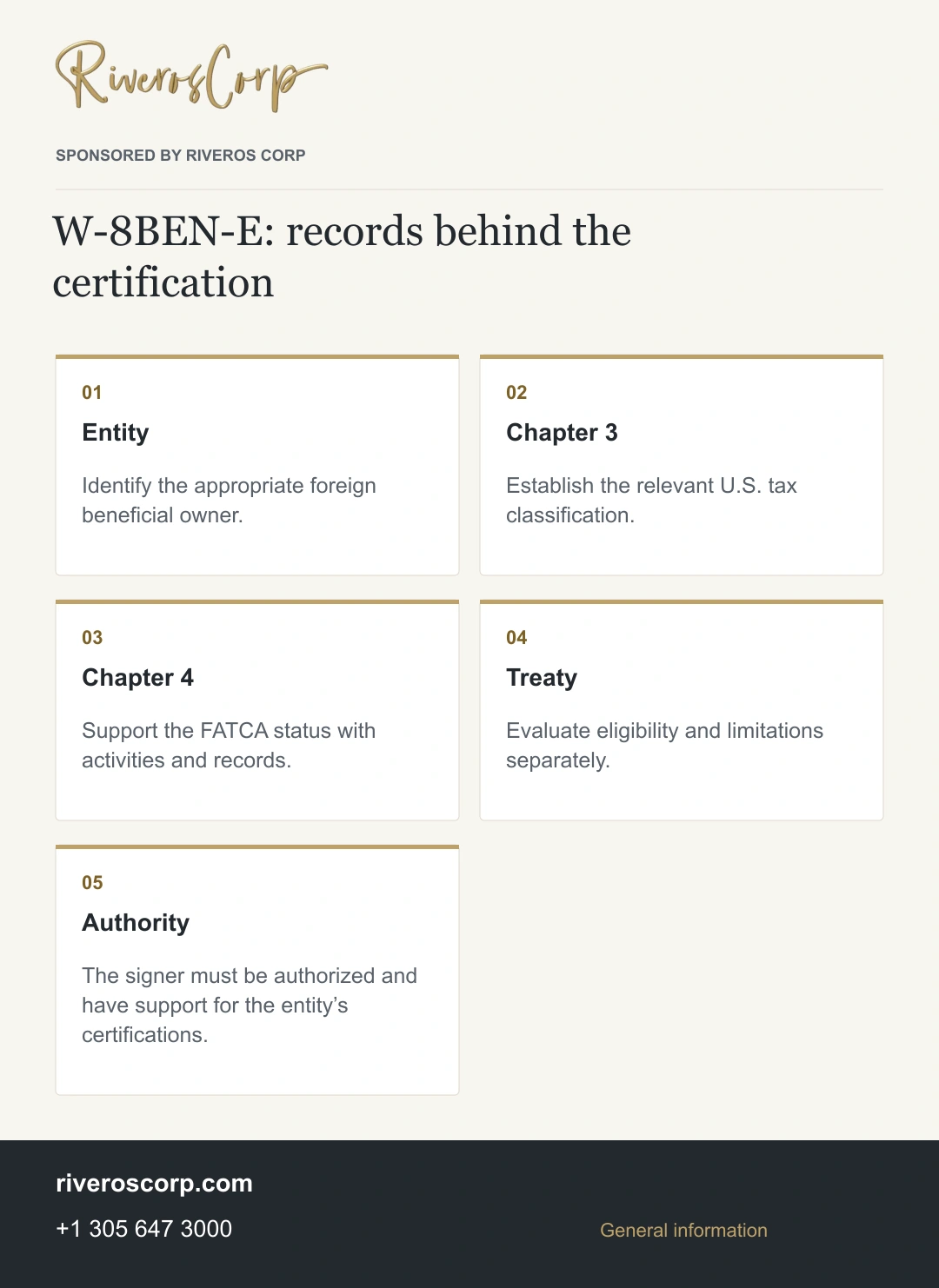
Each record answers a different question. Formation documents establish legal identity; financial statements support the activity review. Ownership records help explain who controls or benefits from the entity. A signature certifies the resulting answers.
W-8BEN-E instructions begin with the right entity
Form W-8BEN-E generally documents specified foreign entities for U.S. withholding and reporting purposes, including the rules commonly called chapter 3 and chapter 4. The entity identified on the form must be the appropriate person under the applicable tax rules.
Start with the place of organization, legal form and tax classification. A foreign mailing address does not turn a domestic corporation into a foreign corporation. Nor does a U.S. mailing address necessarily determine a foreign entity’s status. The records need to establish the underlying facts.
Our discussion of whether a foreigner can register a U.S. business explains why owner nationality and entity formation should be separated. For the certification, the tax analysis must go further and identify who receives the income or holds the account for the relevant purpose.
Separate chapter 3 classification from chapter 4 status
Chapter 3 concerns specified withholding on payments to foreign persons. Chapter 4 relates to FATCA’s documentation, reporting and withholding framework. W-8BEN-E asks about both, but an answer to one does not automatically determine the other.
An entity may have a particular U.S. tax classification and a separate FATCA status. Describing a company as a corporation, for example, does not by itself establish whether it is a financial institution, an active nonfinancial foreign entity or another chapter 4 category.
The person preparing the form should explain the basis for each relevant classification. A certificate of incorporation may support the entity’s legal identity, while financial information and activities support other conclusions. Do not select the same familiar label everywhere simply because the company uses that label in ordinary business correspondence.
Review foreign-owned U.S. LLCs individually
A domestic LLC’s federal tax classification depends on its ownership and elections. A single-member LLC may be disregarded as separate from its owner. In that situation, the owner generally supplies the appropriate tax documentation, with exceptions for particular FATCA and treaty circumstances.
A foreign individual owner may need W-8BEN, while a foreign corporate owner may need W-8BEN-E. A U.S. owner generally uses U.S.-person documentation. An LLC classified as a U.S. corporation does not become foreign merely because a shareholder lives abroad. Its EIN identifies it; the number does not decide any of these classifications.
Our explanation of foreign ownership of a U.S. LLC provides the organizational background. For the certification, bring the ownership records, any tax election and the account request together. Those documents let the tax adviser identify the appropriate owner or entity and explain how the payment should be documented.
Financial institution status requires more than a business name
FATCA’s financial institution definition includes depository and custodial institutions, certain investment entities and specified insurance businesses. The entity’s activities and the applicable definitions need review. A company should not assume it is nonfinancial merely because its name lacks the words bank, fund or investment.
Conversely, ordinary business language about investments does not automatically establish a particular financial institution status. Consider the relevant rules, including an applicable intergovernmental agreement. Different categories carry different certification and registration consequences.
Gather a clear description of what the entity does, how it holds assets and who manages it. Where investment activity or professional asset management is involved, identify those facts accurately. A tax professional can then determine which definition applies rather than relying on a marketing description written for customers.
Active and passive NFFE are technical classifications
NFFE means nonfinancial foreign entity. Active and passive NFFE classifications involve defined conditions; they do not simply mean that a company is open for business or has stopped operating. A functioning company can still require careful review of its income and assets.
The active NFFE certification examines passive income and the assets that produce it or are held to produce it. Dividends, interest, rents, royalties and annuities can fall within passive income, subject to exceptions. Review the financial statements and asset holdings; a website, employees or recent invoices do not answer those tests. Other excepted categories may also be relevant.
A passive NFFE classification can involve information about substantial U.S. owners or relevant controlling persons under an applicable agreement. Support the ownership review with records. Do not choose a disclosure by guessing which answer will cause the bank to ask fewer questions.
A GIIN is required for certain statuses, not every company
A Global Intermediary Identification Number, or GIIN, is associated with specified FATCA registration and reporting statuses. The form’s GIIN field does not mean every foreign business must register for one before it can provide valid documentation.
Participating and registered deemed-compliant foreign financial institutions are among the categories requiring a GIIN. Direct reporting and sponsored direct reporting NFFEs also use one. For covered statuses, the requester verifies the number against the IRS list. An EIN or a foreign business registration number serves a different purpose and cannot replace a GIIN.
If a requester asks for a GIIN, confirm the classification underlying the request. A qualified professional should determine whether the entity needs that registration or whether the request reflects an incorrect assumption. Never invent a number, substitute another entity’s identifier or select an inaccurate status to bypass the issue.
Treaty claims require a separate eligibility review
An entity claiming treaty benefits must satisfy the relevant treaty provisions and documentation requirements. Tax residence, beneficial ownership, income type and limitation-on-benefits provisions can be relevant. The existence of a treaty with the country of incorporation is not sufficient by itself.
The entity should have records supporting the particular claim. Corporate ownership and activity may matter when applying treaty limitations. Do not copy a provision relevant to one payment into another income category without review.
A limitation-on-benefits provision may require facts about ownership, payments or business activity beyond proof of treaty residence. The adviser should identify which treaty condition the entity satisfies and the records supporting it. Keep that conclusion with the payment documents so the signer can understand what is being certified.
The signer must have authority and understand the certification
W-8BEN-E includes a certification under penalties of perjury. The person signing needs the appropriate authority to act for the entity. Being the employee who received a bank’s email does not automatically establish authority to make the certification.
Keep the corporate records supporting the signer’s role. When an agent signs under a power of attorney, the IRS instructions require a proper authorization or copy specifically covering the making, execution and presentation of the form. An electronic signature must show that an authorized person signed electronically; a typed name alone is insufficient.
Our guide to articles of incorporation versus bylaws explains why different corporate records serve different purposes. Those records can help establish organizational identity and authority, but the signer still needs support for the tax and FATCA statements contained in the certification.
Give the form to the requester and retain the supporting file
The form generally goes to the withholding agent or financial institution requesting it. Entities ordinarily do not send it directly to the IRS as a standalone annual return. Different recipients may need their own documentation for the payments or accounts they administer.
Keep the signed form, the request and the records supporting classification and any treaty claim. The recipient may ask for clarification or additional evidence when information conflicts. Keep the explanation for the selected status alongside the completed form.
The institution may use a permitted electronic or substitute form. Review the actual certification rather than assuming that a shorter online questionnaire has no legal significance. If the questions do not fit the entity’s structure, clarify the issue with the requester and the professional advising on classification before signing.
Changes and expiration require a current review
Generally, W-8BEN-E remains valid through the last day of the third succeeding calendar year after signing, unless a change makes its information incorrect. Certain conditions permit indefinite validity until a change in circumstances. The institution’s renewal request is an opportunity to check the current facts rather than copy an old certification.
The IRS instructions require notification within 30 days when changed facts make information incorrect for chapter 3 or chapter 4 purposes. Ownership changes, new activities, a tax election or changed facts behind a treaty claim may require review. Keep the relevant transaction or organizational records with the replacement documentation.
Riveros Corp’s English overview for foreign and nonresident taxpayers offers related background. Its business services include corporate records, secretary services and EIN assistance. Those services can address the underlying company documents; a qualified tax adviser must resolve the tax classifications and treaty position used in W-8BEN-E.
Errors that can misstate the entity’s status
Using the entity form for an individual or treating every foreign-owned domestic company as foreign can misstate the taxpayer’s identity. Other possible errors include confusing a tax identification number with a GIIN or selecting active NFFE without reviewing the required tests. The same facts need review even when the requester supplies a prefilled template.
Another problem is treating a bank’s acceptance as a binding tax determination. The bank decides whether its documentation requirements are satisfied; that does not resolve every tax consequence for the entity. Annual returns, information reporting and other obligations still require their own review.
Before seeking assistance, identify the unresolved question clearly. Is it the entity’s tax classification, FATCA status, treaty eligibility or authority to sign? Separating those questions allows the relevant records and professional advice to address the actual issue instead of repeatedly changing boxes without understanding their meaning.
Frequently asked questions
Does every company owned by a foreign person use W-8BEN-E?
No. The correct documentation depends on the entity’s organization, tax classification and the person treated as owner or payee. A domestic corporation does not become foreign because of its shareholder. Disregarded entities require particular attention to the owner and the relevant payment or account.
Is active NFFE the same as an operating business?
No. Active NFFE is a technical FATCA classification with specified conditions, including income and asset tests. A company’s ordinary description as active or operating does not establish that it meets those conditions. Review the financial facts and applicable definitions before making the certification.
Must every foreign entity obtain a GIIN?
No. A GIIN is required for specified statuses, not every foreign company. The need depends on the entity’s classification and applicable registration rules. An EIN or foreign tax number is not a substitute. Obtain professional review if the institution’s request conflicts with the entity’s understood status.
Can the person handling bank paperwork sign automatically?
No. The signer needs appropriate authority and support for the certifications. Administrative responsibility for an account does not alone establish authority to certify the entity’s tax status. Confirm the signer’s role and any required authorization before submitting the form.
Does an accepted W-8BEN-E replace the company’s tax return?
No. The form documents specified withholding and reporting facts for the requester. It does not replace federal or foreign returns, information reports or other obligations that apply to the entity. A tax professional should evaluate those duties separately from the institution’s documentation process.
Organize the records for your entity certification
Contact Riveros Corp at +1 305 647 3000 or through WhatsApp about corporate records or EIN assistance needed for your company file. Describe the bank’s request and the records you need. Have the qualified tax adviser establish the entity’s classifications and treaty position before the authorized signer certifies them.
By Zulma E Bourelly. General information only. Individual legal and tax questions require advice from an appropriately qualified professional.