
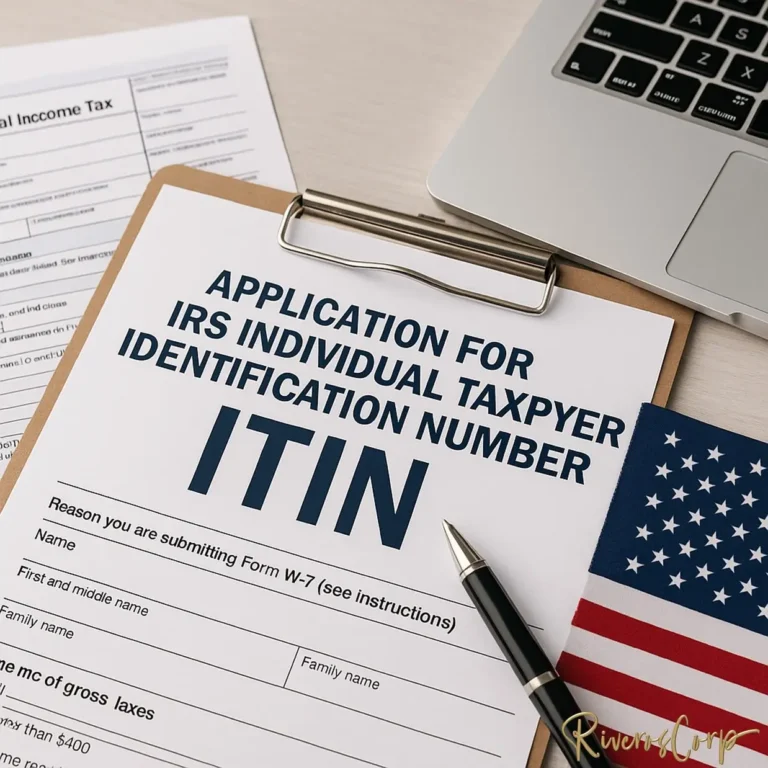
Securing an itin tax id is the Individual Taxpayer Identification Number, or ITIN., yet frustrating, hurdles for foreign nationals doing business in the United States. If you are a non-resident alien launching a U.S. LLC, opening a corporate bank account, or complying with federal tax withholdings, the Internal Revenue Service (IRS) requires you to have this specific nine-digit number.
However, obtaining it is far from a simple online application. The IRS mandates strict identity verification, and applying on your own often requires mailing your original, physical passport to a federal processing center for months. A single formatting error on your Form W-7 will result in an outright rejection, severely delaying your business operations. At Riveros Corp, our corporate compliance experts eliminate these risks. We manage the entire application process, ensuring your paperwork is flawless and your vital identity documents remain safe, so you can focus on growing your company.
Demystifying the ITIN Tax ID: More Than Just a Number
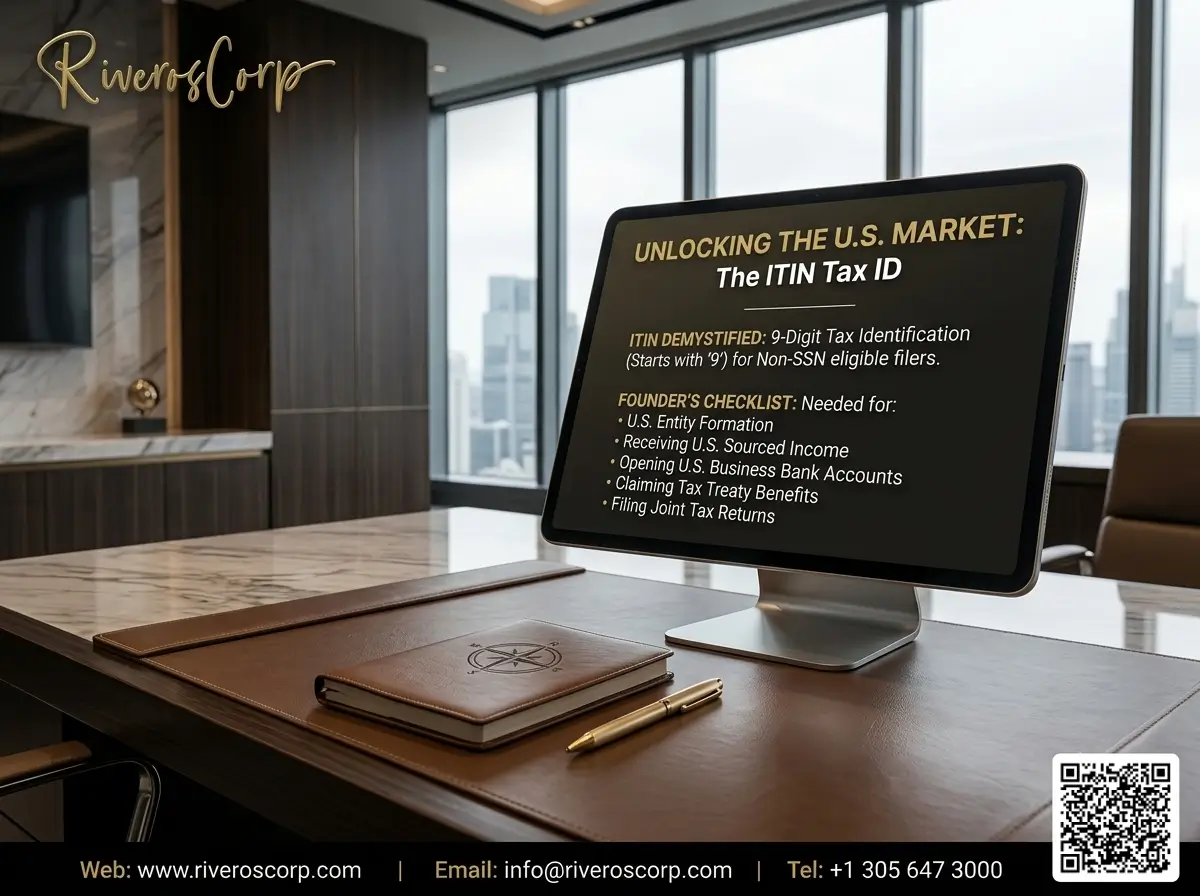
An Individual Taxpayer Identification Number (ITIN) is a nine-digit tax processing number issued by the Internal Revenue Service (IRS). Its structure is similar to a Social Security Number (SSN), formatted as XXX-XX-XXXX, but it is easily identifiable because it always begins with the number 9.
The primary purpose of an ITIN is to facilitate federal tax reporting and compliance for individuals who are required to file a U.S. tax return but are not eligible to obtain an SSN. This category includes many nonresident and resident aliens, their spouses, and dependents. The ITIN system was created in 1996 to ensure that foreign nationals could comply with U.S. tax laws, contributing billions of dollars in tax revenue annually.
What an ITIN Is NOT: Crucial Limitations
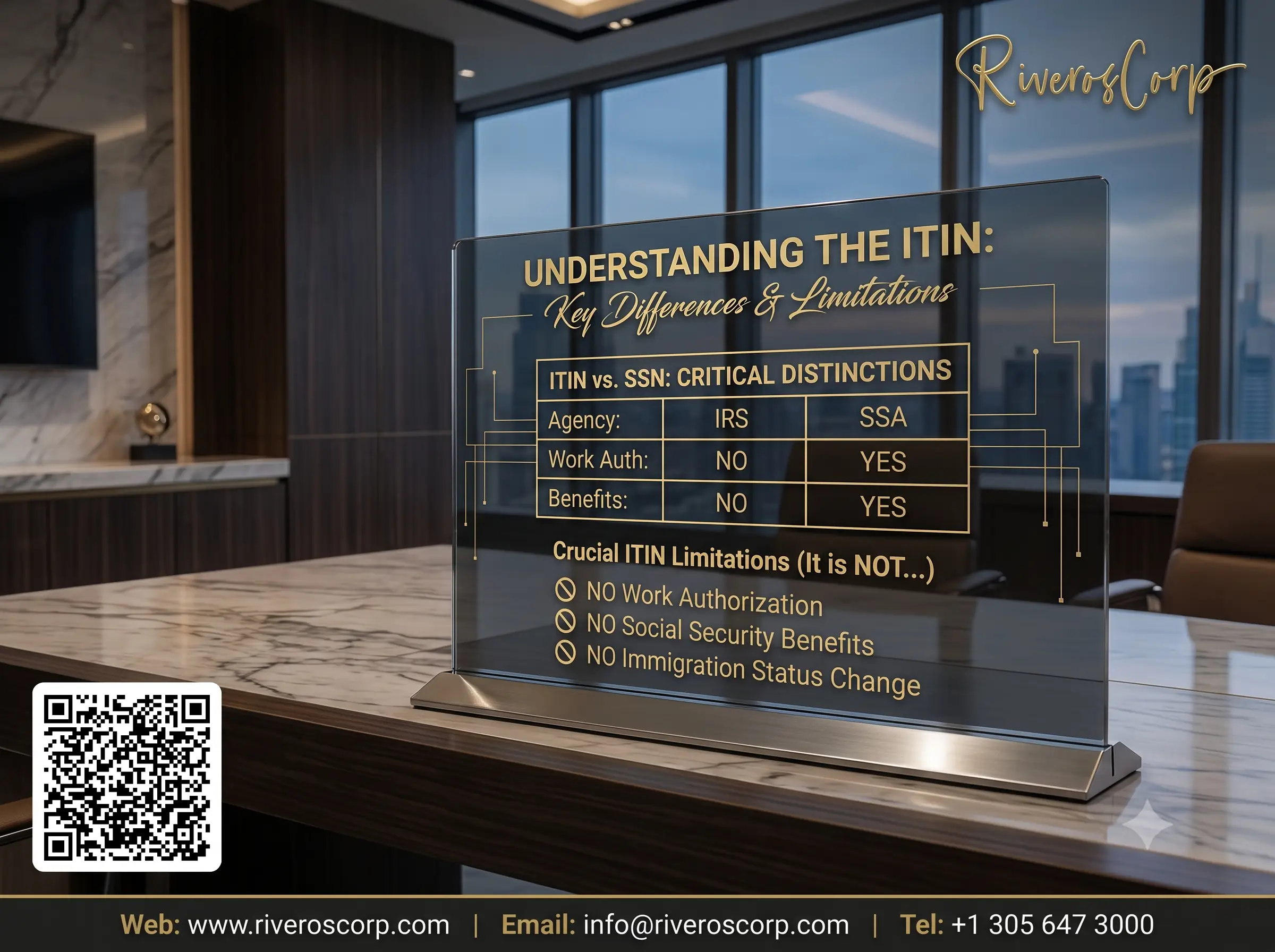
Understanding an ITIN’s limitations is as important as knowing its purpose. An ITIN is strictly for federal tax administration and should not be misconstrued as having other functions. Specifically, an ITIN does not:
• Authorize work in the United States. An ITIN cannot be used for employment purposes.
• Provide eligibility for Social Security benefits. These benefits are tied exclusively to the SSN system.
• Qualify an individual for the Earned Income Tax Credit (EITC). This credit requires a valid SSN.
• Change or confer immigration status. The IRS emphasizes that the ITIN program is separate from immigration enforcement, and federal law protects taxpayer privacy in this regard.
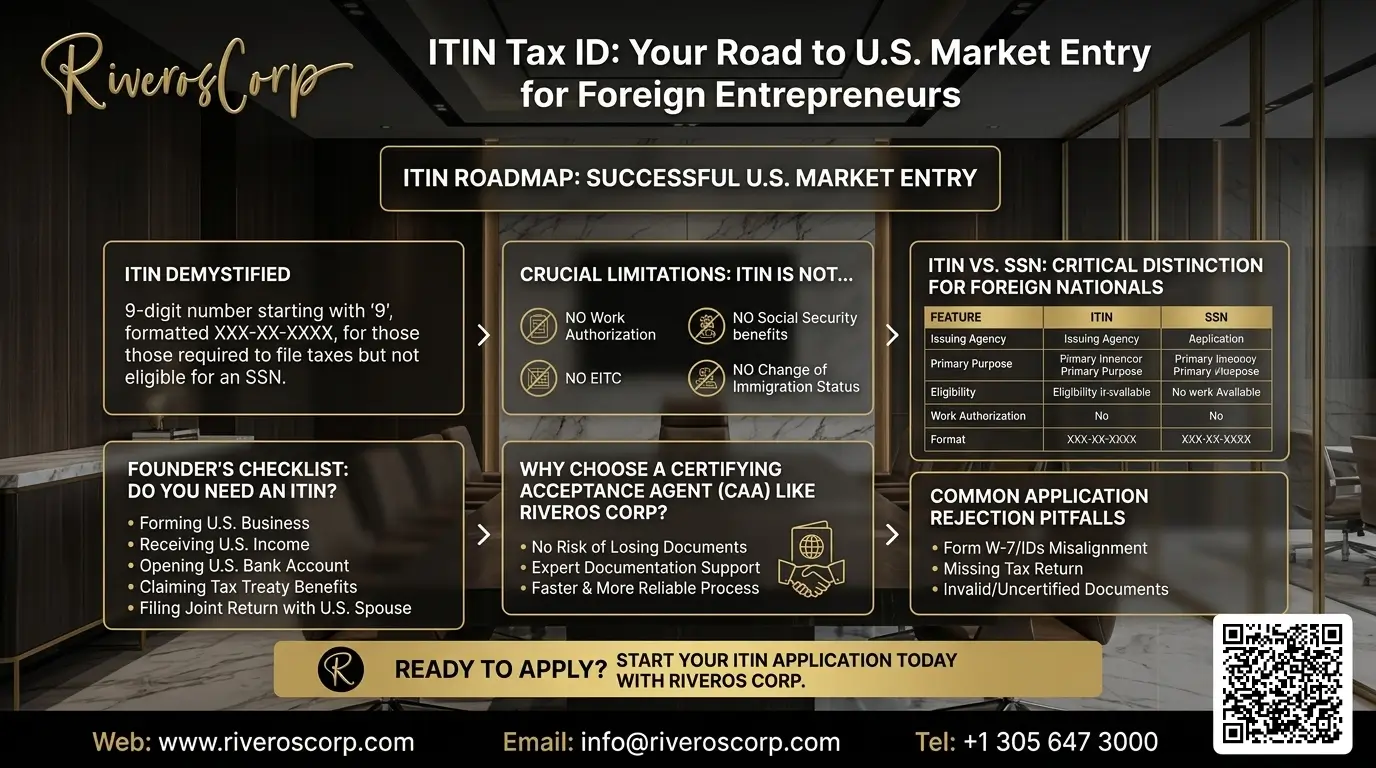
ITIN Tax ID vs. SSN: A Critical Distinction for Foreign Nationals
This comparison has been validated by our team of business formation consultants at Riveros Corp. A common point of confusion for foreign individuals is the difference between an ITIN Tax ID and an SSN. While both are nine-digit Taxpayer Identification Numbers (TINs) used by the IRS, they serve distinct populations and purposes. The Social Security Administration (SSA) issues SSNs to U.S. citizens, permanent residents (Green Card holders), and certain noncitizens who are authorized to work in the U.S. In contrast, the IRS issues ITINs to individuals who have a U.S. tax filing obligation but do not qualify for an SSN. By law, an individual cannot have both an ITIN and an SSN.
The following table provides a clear, at-a-glance comparison:
| Feature | Individual Taxpayer Identification Number (ITIN) | Social Security Number (SSN) |
|---|---|---|
| Issuing Agency | Internal Revenue Service (IRS) | Social Security Administration (SSA) |
| Primary Purpose | Federal tax reporting and compliance | Employment, retirement benefits, and tax reporting |
| Eligibility | Non-SSN-eligible foreign nationals with a U.S. tax filing requirement | U.S. citizens, permanent residents, and work-authorized noncitizens |
| Work Authorization | No | Yes |
| Format | 9-digit number always beginning with a «9» | 9-digit number, format does not have a designated starting digit |
A Founder’s Checklist: Do You Need an ITIN Tax ID?
If any of the following applies to you, we strongly recommend contacting Riveros Corp to evaluate your specific situation and determine the most effective way to proceed. For a foreign entrepreneur, the need for an ITIN Tax ID is typically triggered by specific business and financial activities in the United States. You will likely need to apply for an ITIN if you are: • Forming a U.S. Business Entity: As a foreign owner of a U.S. LLC or C-Corporation, you will have a federal tax filing requirement.
- Receiving U.S. Sourced Income: If you earn income from U.S. sources, you are required to file a U.S. tax return, such as the Form 1040-NR.
- Opening a U.S. Business Bank Account: While not a strict legal requirement for an ITIN, many U.S. financial institutions require some form of taxpayer identification number to open an interest-bearing account.
- Claiming Tax Treaty Benefits: To claim a reduction in tax withholding under a treaty between your country of residence and the U.S., you must have a taxpayer identification number.
- Filing a Joint Tax Return: If you are the nonresident alien spouse of a U.S. citizen or resident and elect to file a joint tax return, you will need an ITIN.
The ITIN Tax ID Application Roadmap: Navigating Form W-7 and Documentation
While it’s useful to understand the ITIN Tax ID process, we advise against trying to complete it alone. For a deeper, step-by-step breakdown of the paperwork, see our ultimate guide to the ITIN application. At Riveros Corp, we handle this documentation on your behalf to prevent errors, delays, or rejected applications.
Complete Form W-7: This is the official IRS application. You must provide your legal name, foreign and mailing addresses, country of citizenship, date of birth, and the specific reason you need an ITIN.
Prepare a U.S. Federal Tax Return: In most cases, a completed Form W-7 must be attached to the front of a valid federal income tax return (e.g., Form 1040-NR). The application package is then mailed to a dedicated IRS processing center in Austin, Texas. The first return filed with a W-7 cannot be submitted electronically.
Gather Supporting Documentation: You must submit documents that prove both your identity and your foreign status. The IRS accepts 13 types of documents. A valid, unexpired passport is the only stand-alone document that proves both identity and foreign status. If you do not submit a passport, you must provide a combination of at least two other documents from the approved list.
How to Apply for an ITIN Tax ID (The W-7 Process)
Filing for an ITIN requires submitting IRS Form W-7. However, you cannot usually submit this form by itself. It must be attached to a valid U.S. federal income tax return, unless you qualify for a specific «Exception» (such as Exception 1(a) for third-party withholding on passive income or royalties).
The Nightmare of Mailing Original Documents
To prove your identity and foreign status, the IRS requires you to submit specific documentation. The most comprehensive document is an unexpired foreign passport.
If you apply via the standard DIY mail-in process, the IRS strictly demands that you send your original passport or a copy certified directly by the issuing foreign agency (which is logistically impossible in many countries). Mailing your actual passport means you cannot travel internationally for 10 to 14 weeks while the IRS processes your application. Furthermore, thousands of passports are delayed or lost in federal mail rooms every year.
The Solution: Certified Processing
You do not have to surrender your passport to the mail system. By working with specialized corporate consultants, you can navigate the application using IRS-approved certification methods, ensuring your original documents never leave your hands while satisfying all federal identity requirements.
The Smartest Path to Your ITIN Tax ID: Why a CAA Is the Only Sensible Choice
While there are alternative ways to apply for an ITIN, such as mailing documents directly to the IRS or visiting a Taxpayer Assistance Center (TAC), these options come with serious limitations and risks—including document loss, long wait times, and lack of personalized support.
Choosing to work with a Certifying Acceptance Agent (CAA) like Riveros Corp is not just a safer option—it’s the smartest and most efficient path. Here’s why:
No risk of losing vital documents: Your original passport and IDs remain in your possession.
Direct support from experts: We handle the complex documentation and ensure everything is submitted accurately.
Faster and more reliable process: As an authorized CAA, we have direct lines of communication with the IRS to resolve issues quickly.
If your goal is to save time, avoid mistakes, and ensure peace of mind, partnering with Riveros Corp is the only way to go.

The ITIN vs. EIN: Understanding the Difference
Many foreign founders confuse the ITIN with an EIN (Employer Identification Number). Understanding the difference is crucial for your corporate structure:
EIN (Employer Identification Number): This is the tax ID for your business entity (your LLC or Corporation). It is used to hire employees, file corporate taxes, and is the primary number banks use to open a business account.
ITIN Tax ID: This is your personal tax number. While the business uses an EIN, major U.S. banks, payment gateways (like Stripe or PayPal), and the IRS will require the foreign owner’s personal ITIN to verify who is ultimately behind the company and to process personal income tax returns generated from the business.
Why Foreign Founders Choose Riveros Corp
Applying for an itin tax id should not paralyze your ability to travel or delay your startup’s launch.
At Riveros Corp, we specialize in shielding foreign entrepreneurs from bureaucratic nightmares. Our compliance team will evaluate your U.S. business structure, determine if you qualify for an IRS Exception to apply without a tax return, and prepare your Form W-7 with absolute precision. We guide you through secure document verification protocols, drastically reducing the risk of IRS rejection and keeping your original passport safe.
Do not gamble with federal compliance or your vital travel documents. Contact Riveros Corp today and let our specialists manage your application from start to finish.
ITIN Tax ID Frequently Asked Questions (FAQ)
How long does it take to get an ITIN tax id?
The standard IRS processing time is 7 to 11 weeks. However, during peak tax season (January to April) or if there is a minor error on your Form W-7, this process can stretch beyond 14 weeks. Utilizing professional processing helps avoid formatting errors that cause massive delays.
Can I open a U.S. business bank account without an ITIN?
It is becoming increasingly difficult. While a few fintech startups might open an account with just an EIN and a foreign passport, all major traditional U.S. banks (like Chase, Bank of America, or Wells Fargo) require the foreign owner to provide a personal ITIN to comply with strict KYC (Know Your Customer) banking regulations.
Does an ITIN tax id expire?
Yes. If your ITIN has not been used on a federal tax return at least once in the last three consecutive tax years, it will expire. Additionally, the IRS periodically expires older ITINs based on their middle digits. If yours expires, you must submit a new Form W-7 to renew it.
Can I just use a regular notary to copy my passport for the IRS?
No. The IRS expressly states that they do not accept standard notarized copies of passports from a public notary. You must provide the original, a copy certified by the issuing government agency, or utilize an IRS-authorized certifying process.
Is my ITIN tax id public information?
No. Just like a Social Security Number, your ITIN is strictly confidential. It is used exclusively by the IRS for tax administration and by financial institutions for required identity verification.
Legal Disclaimer
This article is provided for informational purposes only and does not constitute legal advice. The content herein is not intended to substitute professional legal consultation. For specific guidance regarding your individual circumstances, please consult directly with a qualified attorney licensed to practice in your jurisdiction.