Marriage certificate authentication requires an eligible official signature on the copy being submitted. If a U.S. marriage record is going to be used abroad, start by identifying the public office that issued the copy and the official who certified it. The issuing office and certifying official determine which signature can be authenticated. Paper color or either spouse’s current residence does not establish that authority.
This guide is about checking the issuer. That means finding the custodian of the record, assessing the copy you already have, and working out which certification authority can act on it. Authentication is a separate matter from translating the record or registering the marriage overseas. Apostille de la Haya can review your certificate and the destination’s instructions before explaining which preparation service fits.
Marriage certificate authentication follows the record’s origin
A marriage certificate reflects an event recorded by a competent authority. The marriage certificate apostille guide explains the certification option when the Convention applies. A certified copy comes from that official record and carries the required certification. Where the copy came from still matters if both spouses have moved, changed citizenship, or left the United States. Moving does not transfer the historical record to another state’s authentication office.
USA.gov’s guidance on marriage records points people looking for U.S. records to the relevant state vital-records resources. State and local arrangements vary. Which office keeps the record may depend on where the marriage was recorded and when. Use official issuer information to find the right custodian. Don’t assume every record sits in one national database.
If the marriage took place outside the United States, a U.S. state-record route doesn’t apply just because one spouse is American. A foreign certificate and a U.S. record come from different places, so identify the actual issuing authority first. An English translation, a U.S. mailing address, or later use inside the country does not change who issued the underlying foreign record.
Look at what the copy actually contains
Go through the whole document, including the back and any attached certification. Look for the name of the office, the certifying official’s title, the signature, the seal, and wording that says the copy is certified. A decorative certificate signed by the officiant may commemorate the day and still not be the custodian-certified record needed for international use.
The title alone doesn’t settle it. Some official record formats refer to a marriage license and include the completed return or record of the ceremony. Other documents are only an unused authorization to marry. Work out whether yours is the completed official record, and whether your copy has the certification the state and the foreign recipient require.
Photocopies and scans are useful for an initial review, but they may not be acceptable for final certification. In the same way, a private declaration that a copy is accurate may not replace certification by the official custodian. Before you ask a notary to add anything, find out what the authentication office accepts for this public record.
Use the state’s signature requirements to check readiness
State authentication offices certify official acts within their competence. Before they can act, they may need a particular official’s signature or an extra certification. Read their requirements for marriage records in particular. Instructions written for a privately notarized affidavit or a birth certificate may not answer the question your marriage certificate raises.
Pennsylvania is a concrete example. Its official guidance on document certification names the register of wills or the clerk of the orphans’ court as the relevant signers for marriage certificates, instead of relying only on the officiant’s signature. That is specific to Pennsylvania. What it shows is that you should check the official title on your copy against the issuing jurisdiction’s instructions.
In New York, Department of State guidance separates qualifying records from the state Department of Health and records issued locally. That doesn’t mean adding a county certification in every case. What you need to find out is whether your specific copy already meets the state’s requirements or needs another official act before submission.
Decide whether you need a replacement
A replacement may make sense when the copy you have isn’t certified, is damaged, lacks a required signature, or doesn’t meet the format the recipient asked for. Don’t order one automatically just because the marriage took place many years ago. The date of the event and the date the custodian issued your current copy are two different dates.
If a foreign recipient wants a recently issued record, get that requirement in writing and find out the period it has in mind. A rule set by one recipient does not mean all U.S. certificates expire after a fixed number of months. When you ask the issuer which certified version will work for later authentication, explain how the record will be used abroad.
The certified-copy marriage certificate guide gives more background on preparing an official copy for an apostille. If your destination uses a different route, the first question about the lawful issuer still matters, but the later certifications need their own assessment. A replacement is only worth ordering if it is then prepared for the right destination.
Link the issuer review to the destination route
Once you know which copy you have, identify the country and the institution that will use it. The HCCH materials on the Apostille Convention explain how an apostille can replace a legalization chain for covered public documents. Whether that framework applies depends on the jurisdictions and the document involved. The certificate must match those requirements.
Where a separate authentication and consular process applies, confirm which state, federal, and foreign mission stages are really required. U.S. Department of State guidance on authentication covers preparation before the federal stage. For marriage certificate authentication, a state marriage record should not be treated as a federal original just because it is going to Washington.
Don’t send the record to several offices “just in case.” Every certificate should have a defined role in the route. If a prior apostille was issued for another destination, have it reviewed before asking for anything else. Keep the existing attachments in place and compare them with the new recipient’s requirements. Old and new certificates are not interchangeable labels.
Keep identity questions apart from authenticity review
Marriage certificate authentication supports the relevant official signature and capacity. It does not investigate the history of the relationship, decide eligibility for a family benefit, or resolve every difference between the names on a certificate and on a passport. Those matters may need separate evidence or a decision by the receiving authority.
Compare the names as recorded at the time of the marriage with current identity documents. A former surname, a longer middle name, or a different transliteration may need explaining. Ask the recipient what evidence it accepts. Not every difference is an error in the marriage record, and the certifying office cannot fix one with an authentication stamp.
If the issuer’s record contains a genuine error, use the issuer’s official correction process. Altering a digital image or asking a translator to swap in a different name produces a misleading file. Fix the source record or the supporting evidence through the proper channel. Then reassess certification and translation for the version that will actually be presented.
Marriage certificate authentication, translation and registration are separate steps
Authentication, translation, and registration each meet a different need. Authentication deals with official signatures and the related certification. Translation makes the record readable in an accepted language. Registration may mean entering the marriage in a foreign system or completing some other administrative procedure. Finishing one does not automatically finish the others.
Ask whether the receiving office wants a translation of the certificate alone or of the whole packet, authentication pages included. Confirm who may translate and whether a declaration, notarization, or separate certification applies. The translation’s own certification route can affect timing, so settle it before the original document has finished every other stage.
For a family application, find out whether other records are requested and why. Don’t add a spouse’s passport, birth record, or other evidence just because it showed up in someone else’s application. Let the recipient’s actual requirements shape the supporting file. A properly authenticated marriage certificate is still one piece of evidence in that larger process, and it does not guarantee immigration or benefits approval.
Write a short handoff record centered on the issuer
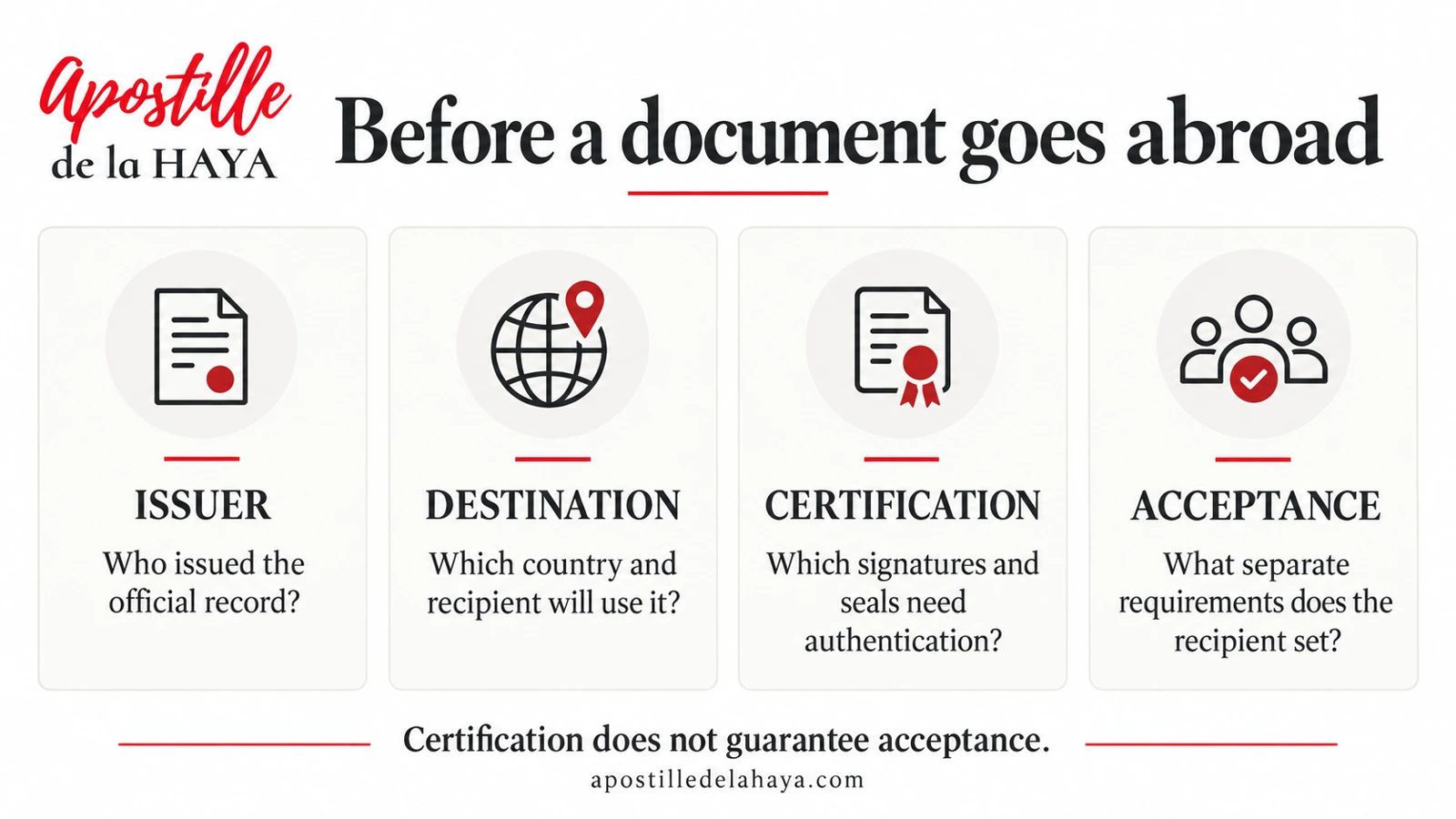
Before anyone sends the certificate on, note the issuing jurisdiction, the public office, the official signer, the format you have, and any existing certificates. Add the destination, recipient, intended use, and deadline. With that short record, a service provider or family member can understand the file without guessing from an envelope marked only “marriage papers.”
Keep a legible copy of the whole packet and leave the certified original intact. Don’t remove official attachments or move pages between copies. If you get a replacement, mark which version is meant for submission. When several copies look alike, it’s easy to send the old one while the translation or application refers to the new one.
Before dispatch, confirm each office’s submission requirements and return arrangements. Keep the delivery and application references, and remember that receipt is different from a completed review. If a document comes back, read the stated reason. Work out whether it concerns the issuer, the signature, the copy format, the destination, the application, or the submission details. Sorting it that way lets you fix the real problem instead of repeating the same failed submission.
Frequently Asked Questions
Which office issued my marriage certificate?
Look for the public office named in the certification statement. Where the ceremony took place is only part of the picture. Depending on the jurisdiction, a state or local custodian may issue the official record. If it’s unclear, use official state vital-records guidance to identify the custodian, and ask which certified version is available for foreign use.
Can the authentication office correct a misspelled name?
No. Authentication is not how records get corrected. A genuine error goes to the issuing authority under its own procedure. A legitimate difference caused by a name change may call for supporting evidence the recipient accepts. Figure out which situation you are in before you replace the certificate or ask for more certification.
Does a seal prove that my copy is acceptable?
A seal matters, but it isn’t enough on its own. The office, the official signature, the certification statement, the document format, and the destination’s requirements all count. A decorative or incomplete record can look official and still not be the certified copy you need. Check the whole document against the competent authority’s instructions before you submit it.
Do I need authentication to use the certificate within the United States?
International authentication services are for use abroad. A domestic recipient may ask for a certified marriage record without needing an international apostille or legalization process. If a domestic institution uses the word “authentication,” ask what it means. Only order an international certificate when the intended use and the applicable requirement call for it.
What should I send for a preliminary review?
Send a complete, legible copy that shows the issuing office, the official signature, the seal, the back of the document, and any attachments. Include the country of use and the receiving institution’s written instructions. Tell us whether you hold the certified original and whether anyone has already flagged a problem. Keep the original intact until the right submission requirements are confirmed.
Have your copy assessed before ordering more work
The marriage certificate legalization service can help assess the U.S. record you already have. A useful review starts with the actual issuer and signature and then ties that copy to the destination’s route. It should show whether your next step for marriage certificate authentication is getting an eligible copy, completing a certification, arranging a translation, or clarifying what the recipient asked for.
Contact Apostille de la Haya on WhatsApp +1 305 500 0185 to talk about your certificate. Say where it was issued and where it will be used. If a document was already returned to you, include the notice, so the review can deal with that problem and you can avoid repeat submissions you don’t need.