
What is a registered agent? It is the person or eligible business your company designates to receive service of process and certain official notices at its registered office. In Florida, both a domestic LLC and an LLC authorized to operate as a foreign entity must continuously maintain that appointment. Corporations have a related obligation under their own statute.
For an owner who lives abroad, the role solves a specific problem: the company needs a dependable point of contact in Florida even when the owner is elsewhere. It does not give the agent ownership, management power or general authority to act for the business.
Choosing an agent therefore means checking more than an address. Someone must accept the appointment, receive the documents and forward them to the right person. The company must also keep its own contact details current so forwarded documents reach someone who will read them. The contact should know who handles litigation and send legal notices to that person promptly.
What is a registered agent responsible for?
Service of process is the formal delivery of legal papers through a method the law allows. A registered agent gives the company a designated recipient for those papers. Receiving a summons or complaint can start a response deadline, so the agent’s forwarding arrangements matter even when the owner works elsewhere.
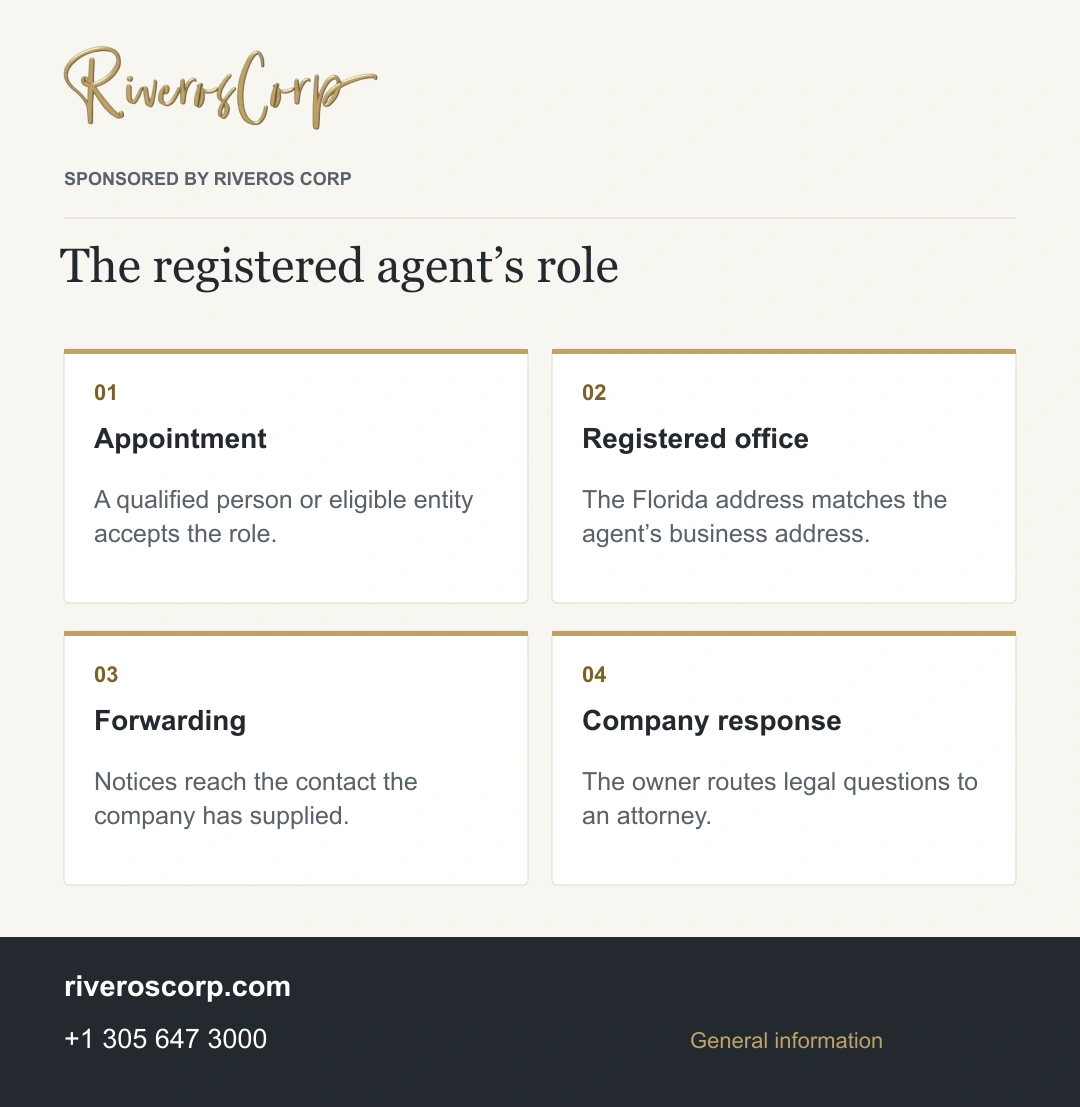
Florida Statutes section 605.0113 requires an LLC’s registered agent to forward a process, notice or demand concerning the company to the address the company most recently supplied. That creates an obligation for the agent, but it also leaves a practical responsibility with the owner: the contact address on file with the agent must work.
Consider a company whose founder changes email accounts after formation. The registered office may remain fully staffed and the public record may remain correct. Yet the founder could miss a forwarded notice if nobody updates the private delivery instructions. A reliable arrangement includes both the public appointment and an internal contact who checks incoming messages.
The registered agent does not decide whether a claim has merit or prepare the company’s defense merely by accepting the role. Legal papers should reach the company’s attorney promptly. Administrative delivery and legal representation have different purposes, and each should have a clearly assigned person.
Who can serve in Florida?
For a Florida LLC, an individual agent must reside in Florida. An entity can serve if it belongs to an eligible category and meets the statute’s requirements: a corporation for profit, an LLC, a limited liability partnership or a limited partnership. A foreign entity must also be authorized to transact business in Florida. In each case, the agent’s business address must match the registered office.
The initial agent and a successor agent must accept the appointment in writing in the manner prescribed by the Department of State. The acceptance confirms familiarity with the obligations of the position. Putting a friend’s name on a filing without that person’s agreement does not create a sound arrangement.
A person who lives outside Florida cannot qualify as the individual agent merely because the company is a Florida LLC. Likewise, owning a vacation property in the state does not by itself establish the required residence or an appropriate registered office. Company ownership and eligibility to serve as an agent are separate questions.
An eligible business that provides registered agent services offers another route. Its actual designation, address and authority still need to be correct. The arrangement should identify which entity is accepting the role, rather than relying only on the trading name shown on a website.
Can I be my own registered agent?
An owner may serve individually if the owner satisfies Florida’s requirements. There is no separate rule making every owner eligible. Residence, the registered office and acceptance of the role still matter. Owners who travel frequently should consider how someone will handle legal papers during absences.
One practical issue is the public address. The registered agent and registered office appear in the state record. An owner who uses a home address should understand that this is a public business filing. A professional agent may provide a different registered office, but that does not automatically remove every personal address from every other filing or database.
Another issue is continuity. A business address can change, a staff member can leave and an owner can move out of state. Any of those changes may require a review of the appointment. The arrangement that worked on formation day may no longer meet the company’s needs a year later.
Serving as your own agent also means recognizing legal papers among routine mail. Decide who receives them when you are away and who sends them to counsel. Keep the envelope and the documents together so the recipient has the available delivery information. These everyday arrangements matter as much as having the correct name on the public record.
Registered agent, owner, manager and CPA
An owner holds an interest in the company. A manager, director or officer may have authority over business decisions, depending on the entity and its governing documents. A registered agent receives designated communications. One person can hold several roles, but the roles do not become interchangeable.
For example, naming a service company as registered agent does not make it a member of the LLC. It does not grant the service company access to a bank account or permission to sign commercial contracts. Those powers depend on separate authority and the applicable documents.
A CPA may also offer registered agent services if the legal requirements are satisfied. However, an accounting engagement alone does not designate the CPA as the registered agent. Nor does the agent appointment include bookkeeping, return preparation or tax representation unless those services are separately agreed and properly authorized.
The distinction also matters for tax correspondence. The IRS uses its own records and procedures. A state registered agent appointment does not automatically redirect all federal tax mail or make the agent the company’s IRS representative. Review the company’s mailing address, responsible contacts and professional authorizations separately.
For owners comparing business structures, our explanation of corporations and LLCs describes how ownership and management differ. That choice affects the governing documents, even though both structures need a reliable way to receive legal notices.
The registered office and other business addresses
A registered office serves the purpose assigned by state law. It may coincide with the company’s place of business, but the two addresses answer different questions. A company can operate elsewhere while maintaining an appropriate registered office in Florida.
Do not assume a registered agent service includes a general mailing address, a virtual office, storage of business records or a place to meet customers. Each use depends on the service agreement and the recipient’s requirements. A bank may ask for the operating address even when it already has the registered office.
Keeping address labels clear reduces confusion. The principal office describes the company’s business location. A mailing address indicates where routine correspondence should go. The registered office identifies the location linked to the agent’s statutory role. A tax agency may hold another mailing address in its own records.
When an owner lives abroad, it helps to explain the actual operating arrangement accurately. Using an agent’s address does not establish a physical operating business there. The broader planning issues appear in our article on forming a U.S. LLC as a foreign owner, including the difference between company ownership and personal immigration matters.
What happens if the appointment stops working?
Failure to appoint and maintain a registered agent can be a ground for administrative dissolution of a Florida LLC. Changes to an agent’s name or address also require attention under the applicable filing rules. The Department’s process depends on the particular ground and the entity involved.
Distinguish an outdated contact from an actual dissolution. An unanswered email to a service provider does not establish the company’s legal status. The current state record, notices and appointment documents need to be reviewed together.
Administrative dissolution does not mean every obligation disappears. It also does not automatically prevent service of process. Florida’s LLC statute expressly preserves the registered agent’s authority for service after administrative dissolution. An owner should not ignore a legal notice because the company has become inactive on the register.
If the agent resigns, the company needs to examine the resignation and arrange a qualified replacement within the applicable rules. Avoid an informal handover where the outgoing provider stops forwarding mail before the replacement is properly designated. Questions about an existing lawsuit, missed response or disputed service require legal advice from an attorney.
Keeping the appointment current
The registered agent is one part of maintaining a company. Annual reports, internal records, tax filings and professional licensing can involve different deadlines and different people. Hiring an agent does not transfer every obligation to that provider.
The company should identify who checks the public record, who confirms the agent’s appointment, who receives forwarded notices and who contacts counsel when legal papers arrive. It should also identify a backup contact. That backup can matter when the primary owner is traveling or no longer works with the business.
Review the arrangement when the company moves, appoints new managers, changes ownership or expands into another state. A Florida appointment does not automatically satisfy another state’s requirements. An LLC formed elsewhere may also need Florida registration before conducting activities that require it.
Keep the latest appointment, service agreement and forwarding details with the company’s records. Those documents should be available to the person responsible for compliance. An invoice alone may show that a service was ordered, but it does not replace checking the actual designation on the state record.
How Riveros Corp can help organize the appointment
Riveros Corp provides registered agent services in Florida. Its service includes receiving and forwarding notices and handling an agent change with written acceptance. The company name, formation jurisdiction and current public record help identify whether you need an initial appointment, a replacement or an update to an existing designation.
Before the arrangement starts, the company should confirm which legal entity will serve, the registered office and the agreed notice channel. It should also clarify what services are included and which matters remain with the owner, accountant or attorney.
If legal papers have already arrived, give the attorney handling the response the complete document and delivery details. Riveros can address the registered agent arrangement, while the attorney deals with the claim. For a routine appointment, keep the accepted designation and forwarding instructions where the company’s designated contact can find them.
Frequently asked questions
Why would a company need a registered agent?
Florida law requires covered LLCs and corporations to maintain an agent and registered office. The appointment gives the company a designated recipient for service of process and certain notices. The company still needs someone who reads forwarded papers and acts on them.
Is a registered agent the same as an owner?
No. The appointment does not grant an ownership interest or general management authority. An owner can sometimes serve as agent, but must meet the requirements for that separate role.
Can an owner outside Florida serve as the individual agent?
An individual agent for a Florida LLC must reside in Florida and have the required business address. An owner living elsewhere should examine a qualified individual or eligible entity appointment rather than assume ownership is enough.
What are the risks of being your own registered agent?
Consider whether you want a home address in the public record and who will receive legal papers when you are away. The owner must also keep the appointment current after a move or other change. The best choice depends on the actual operating arrangement.
Does hiring a CPA satisfy the registered agent requirement?
Only if the CPA or eligible entity is separately designated, qualifies and accepts the role. Tax preparation and registered agent work are different engagements. Confirm both the public appointment and the services included.
Review your Florida registered agent arrangement
Contact Riveros Corp at +1 305 647 3000 for help appointing or changing a Florida registered agent. Have the company name and current designation available so the team can identify the work needed.
General information, not legal or tax advice for a particular situation. By Zulma E Bourelly.