Embassy legalization usually comes up after a U.S. document has already been through one or more certification stages. Before arranging delivery, check whether any certification or submission requirement remains. A mission, however, may require a specific version of the document, a prior certification, a particular application channel or a certain jurisdiction. This article covers the embassy submission stage for documents issued in the United States and meant for use abroad, including the review that can reduce avoidable returns.
The destination embassy represents the foreign government. It is a different institution from a U.S. embassy located overseas, and its document service is not automatically available for every record. Apostille de la Haya can review the U.S. file and explain what documentary help makes sense for the destination. The best place to start is the complete record plus the receiving authority’s written request. That way the service is built around the real requirement and not around an assumed final stamp.
Embassy legalization requires a named mission and service
“Embassy” names a type of institution. It is not a complete filing destination. Establish which country’s mission is involved, where the relevant service is handled and whether a consulate or a designated provider is responsible. The general address of a mission may not be the correct submission channel for document legalization.
Identify the document category too. Personal certificates, educational records, private powers of attorney and commercial documents may each have their own instructions. Do not apply one category’s form or prior-certification rule to every document in a package. If a file holds several records, list them one by one so each set of requirements can be checked on its own.
If an applicable apostille route meets the international certification requirement, embassy legalization may have no place in the process at all. The Convention status reference helps establish that framework. If the recipient’s wording is unclear, ask what certificate or official act it expects before you decide an embassy submission is needed.
Check the current channel before relying on an address
Submission channels change. An older article may describe, accurately, a procedure that is no longer used for your document. Read the mission’s instructions for the specific service instead of relying on a general contact page, a map listing or an outdated courier checklist.
The UAE is a concrete example. Its Washington embassy instructions for personal and educational documents state that VFS handles document attestation from August 21, 2025. They also call for prior U.S. Department of State authentication for those categories. A request built on the older assumption that documents go straight to the embassy needs a review before anything is shipped.
Don’t generalize that example to other destinations. A designated channel for UAE documents says nothing about the procedure for Egypt, Kuwait or Qatar. Use the UAE service page for that destination, and look up the other country’s own service when the recipient is somewhere else.
Read the existing certification chain as a complete set
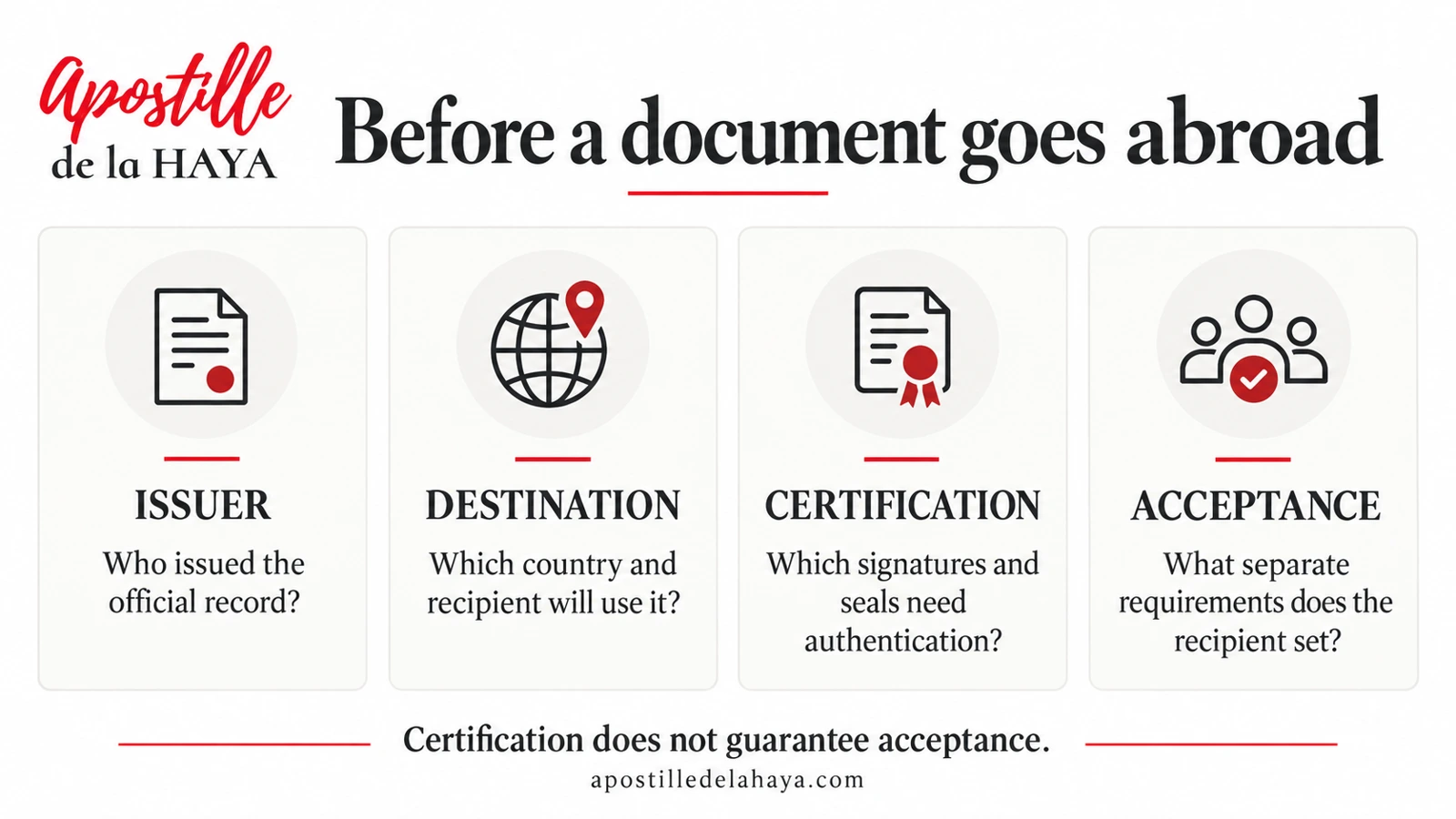
Before the embassy stage, look at the underlying document and every certificate attached to it. The official signature that matters may be on an attachment and not on the first page of the record. Seeing the whole set lets you tell what has already been certified and what the mission is being asked to recognize.
Keep the issuer separate from each authority that certified the document later. A registrar may certify a public record, a state authority may recognize the registrar’s signature and another authority may carry out a further act. A privately notarized document starts from a different relationship. Listing the offices in order only helps if each act really belongs to that document.
Do not detach or rearrange certificates to make the file look simpler. If an attachment is damaged, or it is unclear how it relates to the record, flag it for review. Swapping a page for a photocopy or moving a certificate from one document to another does not preserve the original official act. Assess the full file as it stands before making any changes.
For background on a possible federal stage, see the Department of State document discussion. That stage involves a different authority from the foreign mission. Finishing it should not be reported as finishing embassy legalization, unless the embassy stage has actually happened and is part of the applicable route.
Jurisdiction can decide whether the file is accepted
A mission’s jurisdiction may depend on the issuing state, the applicant’s residence or the service requested. Those are different facts. Check which criterion applies to the service. Living near a mission does not make it competent to process every document you own.
Egypt’s guidance on signature legalization shows why jurisdiction and document-specific instructions matter. It separates records from signature services, deals with prior certifications and points applicants to the relevant consular coverage. Apply an instruction from that mission to the facts it actually describes. It is not a rule for all U.S. documents.
The Egypt service page is a starting point for discussing preparation for that destination. When a consular act requires the applicant to take part directly, that requirement stays with the applicant. Help with preparing a record should not be described as a substitute for personal identity verification or a required consular signature.
Review forms, copies, translation together
The application should name the service requested and match the document supplied. If the mission asks for supporting copies or a cover request, make sure they refer to the records actually in the package. A form copied from an earlier application may name a different person, category or delivery address, and that causes confusion even when the certifications are correct.
Work out the translation requirements for both the recipient and the mission’s process. Depending on the required scope, the translation may have to cover relevant seals or certification pages. A translation into the destination language is not automatically an officially acceptable translation. Confirm the formal requirements instead of choosing a format because it looks right.
The service scope should match the document category and the acts requested. A personal certificate, a commercial instrument and a translation may require separate handling. Identify each item before arranging assistance. Conditions may vary with the nature, complexity and specific requirements of the file; consult Apostille de la Haya directly.
Submission instructions can vary by channel and may change. Confirm the accepted document format, the correct receiving office and the return arrangements before dispatch. An online application does not mean every stage is digital. Resolve these administrative details while the packet is still available for review, rather than after it has reached the wrong office.
Common reasons an embassy legalization file needs correction
One problem is a missing prerequisite. A document reaches the mission without the official certification its category requires. The applicant sees several stamps and assumes the chain is complete, but the required signature is not there. The fix is to identify the missing act, not to add notarizations that have nothing to do with it.
Another is the wrong version of the record. A scan or an ordinary copy may show the same words as an eligible certified record without carrying the same official act. The mission’s requirement is about the admissible document, not just whether it can be read. If you need a new certified copy, get it before repeating the embassy submission.
Errors about jurisdiction or the submission channel cause a different kind of return. The record may be fine in principle but sent to an office or channel that does not handle the service requested. A faster courier cannot fix that mismatch. Check the current service instructions and the jurisdiction before you book transport.
Finally, a substantive problem may sit outside certification altogether. A power of attorney may leave out authority it needs, or an academic record may not meet a recognition requirement. A mission’s certification is not legal advice and does not guarantee the recipient’s decision. Take those questions to the receiving institution or the appropriate professional before you present the document as ready for its intended transaction.
Tracking should separate delivery from completion
Keep the application details, the document list and the shipping references together. A courier’s “delivered” status shows that a transport event happened. It does not necessarily show intake, acceptance of a complete application, certification or return dispatch. Status reports should describe only the milestone the available evidence supports.
When a response or a return notice arrives, compare it with the original request. Work out which record it concerns and whether the issue affects the whole file or one document. A package with several records may not move forward evenly if one of them needs more preparation. An update about one item does not confirm that every item is done.
If the deadline matters, explain what has to happen by that date. Return to the applicant, delivery overseas and formal acceptance by a recipient are separate events. Official processing, transport and later presentation each need their own planning. A private service should not promise a complete outcome based only on how long one embassy stage takes.
What happens after the mission certifies the document
Compare the finished file with the destination requirement. A foreign affairs service in the destination country, a translation requirement or a submission to the recipient may still be pending. Those stages belong in the service scope from the start. The applicant should not find out about them after the document comes back.
If the document will be used in more than one country, review each use. A mission’s certification for one destination does not automatically meet another destination’s requirements. Keep the finished records intact and ask for a new assessment before using them for something else. The general legalization service can help organize that review.
How Apostille de la Haya helps prepare an embassy submission
Apostille de la Haya can review the U.S. document, the existing certifications, the destination and the recipient’s instructions, then explain what documentary work is included. A clear scope sets out the preparation, the handling and any actions that have to stay with the applicant or a competent authority. It should also make clear where the embassy service ends and a wider end-to-end requirement begins.
If a file has already been returned, send the notice and the complete document set so the review can address the recorded problem. Once the category and remaining work are clear, consult Apostille de la Haya directly about the service conditions. These depend on the nature, complexity and requirements of the particular case.
Frequently Asked Questions
Can I mail my document to any embassy office?
No. Confirm which mission is competent for the destination and the current submission channel for the service you need. General addresses and older instructions may not point to the correct intake office. Apostille de la Haya can review the document and destination details before helping you define the right preparation and handling.
Does federal authentication complete embassy legalization?
Not on its own when a separate mission certification is required. Federal authentication and a foreign mission’s act involve different authorities, and whether your route needs both depends on the document and the destination. Apostille de la Haya can help you separate the stages already done from the work that still remains under the recipient’s requirement.
Can I send a scanned copy instead of the certified record?
Only if the service in question expressly accepts that format. A scan, an original digital record and a certified paper copy are not automatically equivalent. Keep the full record and its attachments for review. Apostille de la Haya can help identify which version the mission requires before the file is sent.
What does an embassy stamp guarantee?
Don’t treat it as a guarantee of every legal or administrative outcome. Certifying an official signature or seal does not necessarily approve what the document says or meet every recipient requirement. Apostille de la Haya can explain the documentary scope and point out issues that belong with the receiving institution or a qualified professional.
How should I respond to a returned submission?
Keep the notice and the document set together, then find the specific reason given. A missing certification, the wrong channel and an unsuitable record each need a different correction. Contact Apostille de la Haya with that evidence so the review deals with the actual problem before another shipment is arranged.
Review your embassy legalization file before dispatch
Contact Apostille de la Haya with your U.S. record, the existing certifications and the destination’s request. We can check whether the file is ready and explain the documentary help that fits before the next submission.
Contact Apostille de la Haya by phone or WhatsApp: +1 305 500 0185.