Form 5472 instructions deserve attention even when a foreign-owned U.S. LLC has no employees, no sales and no tax payable on its ordinary operations. For a domestic single-member LLC treated as disregarded and wholly owned by a foreign person, transactions with its owner can create an information reporting obligation.
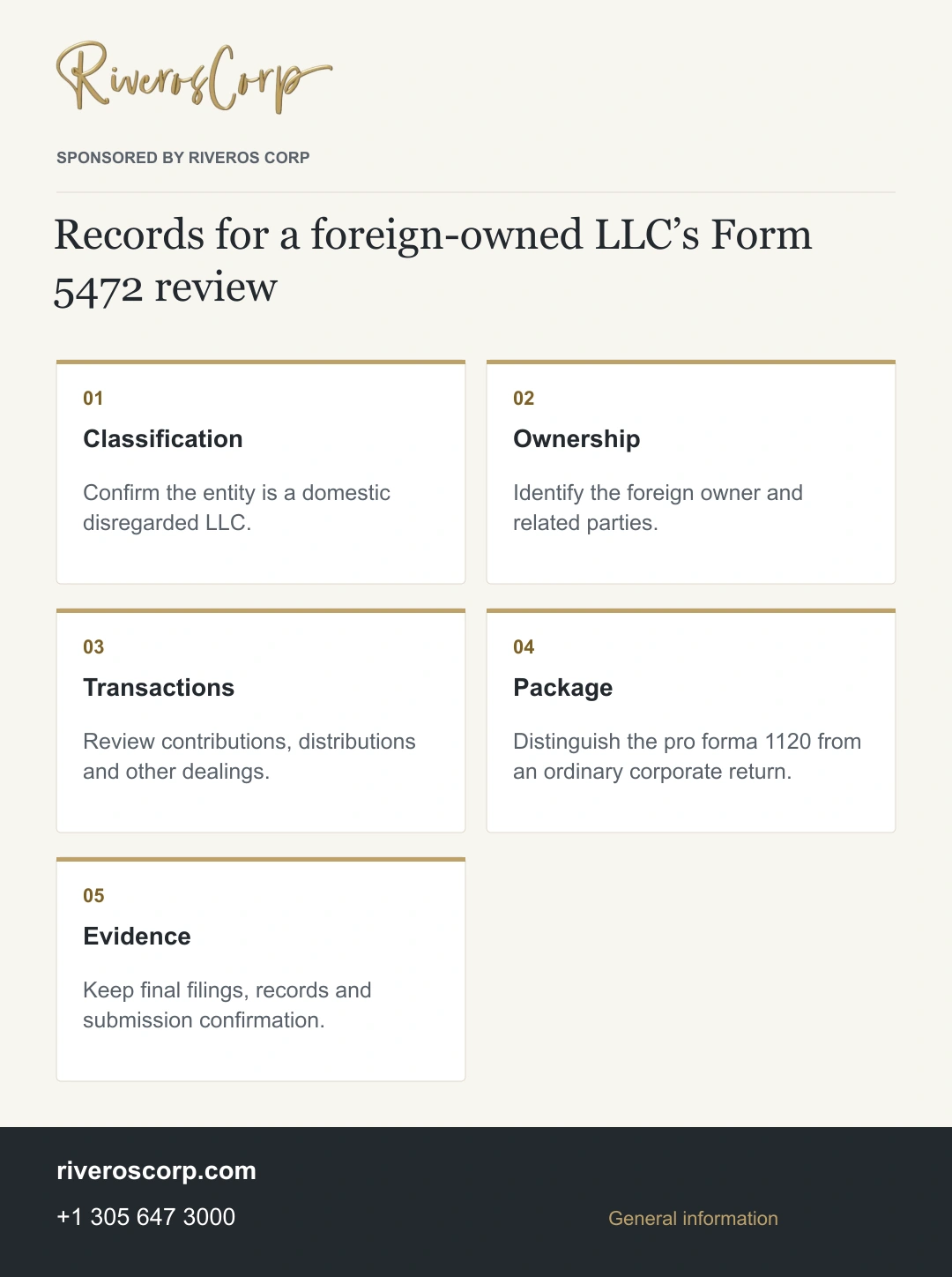
An owner’s contribution, a distribution or a transaction connected with forming the company may matter. Describing the company as “inactive” does not answer whether reportable transactions occurred. The first review should examine the entity’s tax classification, ownership and actual transactions during the year.
An incomplete or incorrectly submitted information return can carry consequences even when no income tax is due. Review the reporting duty separately from whether the business made a profit.
Form 5472 reports specified transactions with related parties. For this type of LLC, it accompanies a limited, pro forma Form 1120 rather than making the entity a corporation for every tax purpose.
Form 5472 instructions treat certain disregarded LLCs specially
A domestic entity wholly owned by a foreign person and otherwise disregarded for federal income tax purposes is treated as a separate corporation for the limited information reporting requirements covered by section 6038A. That treatment explains why an LLC may need Form 5472 even though its owner ordinarily reports its income under other rules.
This limited reporting treatment does not elect C corporation taxation for the LLC. Confusing those two ideas can lead an owner to file the wrong income tax return or assume that a corporate tax election has occurred.
Begin by confirming the actual classification and ownership for the relevant year. Our discussion of foreign ownership of a U.S. LLC provides formation context, but the annual tax analysis requires the company’s current facts, including any ownership changes or elections.
Foreign ownership and reportable transactions are separate questions
Form 5472 covers more than single-member LLCs. The reporting framework also includes U.S. corporations with a qualifying foreign shareholder and foreign corporations engaged in a U.S. trade or business. This article focuses on a domestic disregarded entity wholly owned by a foreign person, because that category has additional transaction rules.
For an individual owner, foreign citizenship alone is insufficient: the instructions distinguish a foreign person from a U.S. citizen or tax resident. An owner’s mailing address is therefore not conclusive. For an entity owner, organization, classification and ownership records establish which rules apply. Preserve any election documents and ownership changes affecting the year under review.
The next question is whether reportable related-party transactions occurred. The instructions contain a no-reportable-transactions exception, which also requires checking the additional transactions applicable to foreign-owned U.S. disregarded entities. Other exceptions available to some corporations do not apply to that category. The review must address the particular exception rather than assume all reporting corporations have identical rules.
Contributions and distributions can matter without sales
For a foreign-owned domestic disregarded entity, the instructions address additional reportable transactions, including contributions to and distributions from the entity. Transactions associated with formation, dissolution, acquisition or disposition can also require attention.
Saying “the LLC earned nothing” does not resolve the filing question. An owner may have transferred funds into the company, paid expenses on its behalf or received property from it. Those events need to be identified and classified even if the business never issued an invoice to a customer.
Use complete records rather than only the business bank statement. An owner may have paid a formation expense directly from a personal account, for example. Whether and how that transaction is reported requires professional review, but omitting it from the records prevents that review from happening. Label uncertainty honestly instead of treating every transfer as ordinary revenue.
Related-party dealings need consistent records
The form concerns specified transactions with related parties. A business may have more than one relevant related party, and the instructions generally call for a separate Form 5472 for each related party with which reportable transactions occurred.
Keep the identity and relationship of each party clear. A transfer from the owner, a payment to another company the owner controls and a payment to an unrelated vendor are not automatically the same reporting category. The bookkeeping should preserve those distinctions so a tax professional can apply the relevant definitions.
Written agreements and transaction descriptions also matter. If a transfer is described as a loan, retain the documents supporting that characterization. If it is an owner contribution, record that consistently. Changing labels after year-end merely to fit a preferred filing position can create contradictions between the books, bank records and tax documents.
The pro forma Form 1120 serves a specific reporting purpose
Under the instructions, a foreign-owned U.S. disregarded entity generally submits Form 5472 attached to a pro forma Form 1120. The pro forma return serves the information reporting process described in the instructions. It should not be confused with a full corporate income tax return prepared on the assumption that the LLC elected C corporation treatment.
This distinction is particularly important for owners who hear only that “an LLC must file Form 1120.” That statement omits the reason for the filing and can conceal other obligations of the owner or entity. The appropriate return package depends on the actual tax classification and applicable reporting rules.
Have the preparer explain the capacity in which each document is filed. Keep the final package, the supporting transaction schedule and evidence of submission together. A copy of Form 5472 by itself may not show whether the required accompanying return and submission requirements were satisfied.
The foreign-owned disregarded entity package has special filing rules
The current instructions require foreign-owned U.S. disregarded entities to submit the pro forma Form 1120 and Form 5472 package by the specified fax or mail process. They cannot electronically file Form 5472. The dedicated mailing address differs from the ordinary Form 1120 addresses.
The extension procedure also has special instructions for this category. A preparer who normally handles ordinary corporate returns needs to distinguish this package from those returns. Completing the forms in tax software does not establish that the accepted submission method, accompanying documents or correct destination have been used.
Keep the final signed package, related-party schedules and evidence of submission together. A record of the submission date and method allows the owner to answer a later inquiry without relying on a screenshot showing only that a form was prepared. If a correction is needed, retain both versions with an explanation of the change.
The tax year and deadline require advance attention
The reporting year for a foreign-owned U.S. disregarded entity follows the rules in the instructions, including reference to the owner’s U.S. tax year when applicable and the calendar year otherwise. The filing deadline is tied to the relevant Form 1120 timing, including a properly obtained extension.
Do not assume the owner’s foreign tax calendar automatically controls the U.S. filing. Similarly, waiting for bookkeeping, a bank account or an EIN does not by itself create an extension. The professional responsible for the filing should establish the applicable year and deadline early enough to address missing records.
Form 7004 is relevant to requesting an extension under the applicable rules. An extension should be documented and timely; it is not established by an informal agreement with a preparer. Keep responsibility for requesting and confirming it clear, particularly when different providers handle formation and tax work.
Penalties can apply when no ordinary income tax is owed
Form 5472 is an information reporting obligation. Failure to file, substantially incomplete reporting and failure to maintain required records can lead to penalties. Additional consequences may apply when a failure continues after IRS notification.
A lack of sales or taxable income does not remove a reporting obligation that otherwise applies. A company might owe no ordinary income tax under one analysis while still having a reporting failure under another. Those are separate legal questions.
If a prior filing may be missing or incorrect, obtain a qualified review before assuming that simply submitting the current year resolves everything. The professional should examine each relevant year, the available records and the applicable correction or response procedures. Bring the relevant notices and earlier filings so the reviewer can assess the omitted year and any response that is due.
Assemble records that explain the transactions
A useful review file includes formation and ownership documents, the EIN confirmation, tax election records if any, bank statements, accounting records and evidence of owner-related transactions. Include transactions conducted outside the business account when they relate to the company.
The records should allow a preparer to trace a transaction from its source to the books. For example, an owner-paid expense may require the vendor document, payment evidence and explanation of how the company recorded the transaction. A spreadsheet total alone may not establish those facts.
Our guides to an EIN proof document and an LLC operating agreement explain records that help identify the entity and its ownership arrangements. Those documents support the review but do not replace transaction evidence or determine every tax reporting conclusion.
Prepare the company records for the tax review
Riveros Corp’s overview of U.S. taxes for foreign owners introduces the wider reporting context. For Form 5472, the decisive facts are the entity’s classification, the owner’s status and the transactions. The tax preparer needs those facts for each year being reviewed, including a formation or dissolution year.
Riveros Corp can assist with the company’s organizational and EIN records. Its EIN service addresses the application and confirmation documents that identify the entity. Determining whether Form 5472 is required and classifying the reportable transactions belong to the professional handling the tax return.
Before the filing, establish who will review the related-party schedule, who will submit the return package and how the owner will receive a complete copy. Provide any previous filing or IRS notice as well as the current records. The preparer needs the history to distinguish an annual filing from a correction of an earlier omission.
Frequently asked questions
Does a foreign-owned LLC need Form 5472 if it had no income?
It may. For a foreign-owned domestic disregarded entity, owner contributions, distributions and other reportable transactions can matter even without customer revenue. A professional should review the transactions and applicable exceptions. “No income” and “no reportable transactions” are not interchangeable conclusions.
Does filing a pro forma Form 1120 make my LLC a C corporation?
No. The special reporting treatment for a foreign-owned domestic disregarded entity is limited to the applicable information reporting rules. It does not itself establish a general corporate tax election. The entity’s income tax classification and the owner’s obligations require their own review.
Is one Form 5472 enough for every related party?
Not necessarily. The instructions generally require a separate form for each related party with which the reporting corporation had reportable transactions. Identify each party and its relationship accurately. Combining all owner-related activity into one unexplained total can conceal facts needed for the filing analysis.
Can I ignore transactions paid from the owner’s personal account?
No. A transaction may relate to the company even when it never passed through the company bank account. Preserve the payment record and explain the business purpose. A tax professional should decide whether and how the transaction is reportable and how it belongs in the books.
Does closing the LLC remove its reporting obligations?
No. Dissolution does not automatically eliminate obligations for the final year or earlier years. Transactions associated with dissolution may themselves need review. Coordinate the legal closure, final transaction records and tax filings rather than assuming that a state dissolution filing completes every federal requirement.
Organize your foreign-owned LLC records
Contact Riveros Corp at +1 305 647 3000 or through WhatsApp for the formation, ownership and EIN records supporting your company file. Have the tax professional preparing Form 5472 review the related-party transactions, filing obligation and any earlier omissions.
By Zulma E Bourelly. General information only. Individual legal and tax questions require advice from an appropriately qualified professional.