Corporate minutes are the company’s written record of what happened at a meeting of its shareholders, directors or an authorized committee. They identify the meeting and document the actions taken. They should reflect actual events, not create a meeting history after the fact.
For a Florida corporation, recordkeeping is a legal obligation. Section 607.1601 requires minutes of meetings and records of actions taken without a meeting, along with other corporate records. A small company does not become exempt from that framework merely because its shareholders know each other.
The minute book is the organized collection that helps the company retrieve these records. It may include minutes, written consents, governing documents and related corporate information. A paper binder or secure electronic system can work if the records stay accurate, current and accessible. Minutes also help incoming directors understand earlier decisions without relying on one person’s memory. The record needs enough context to identify the action and authority, without transcribing every comment.
What corporate minutes should establish
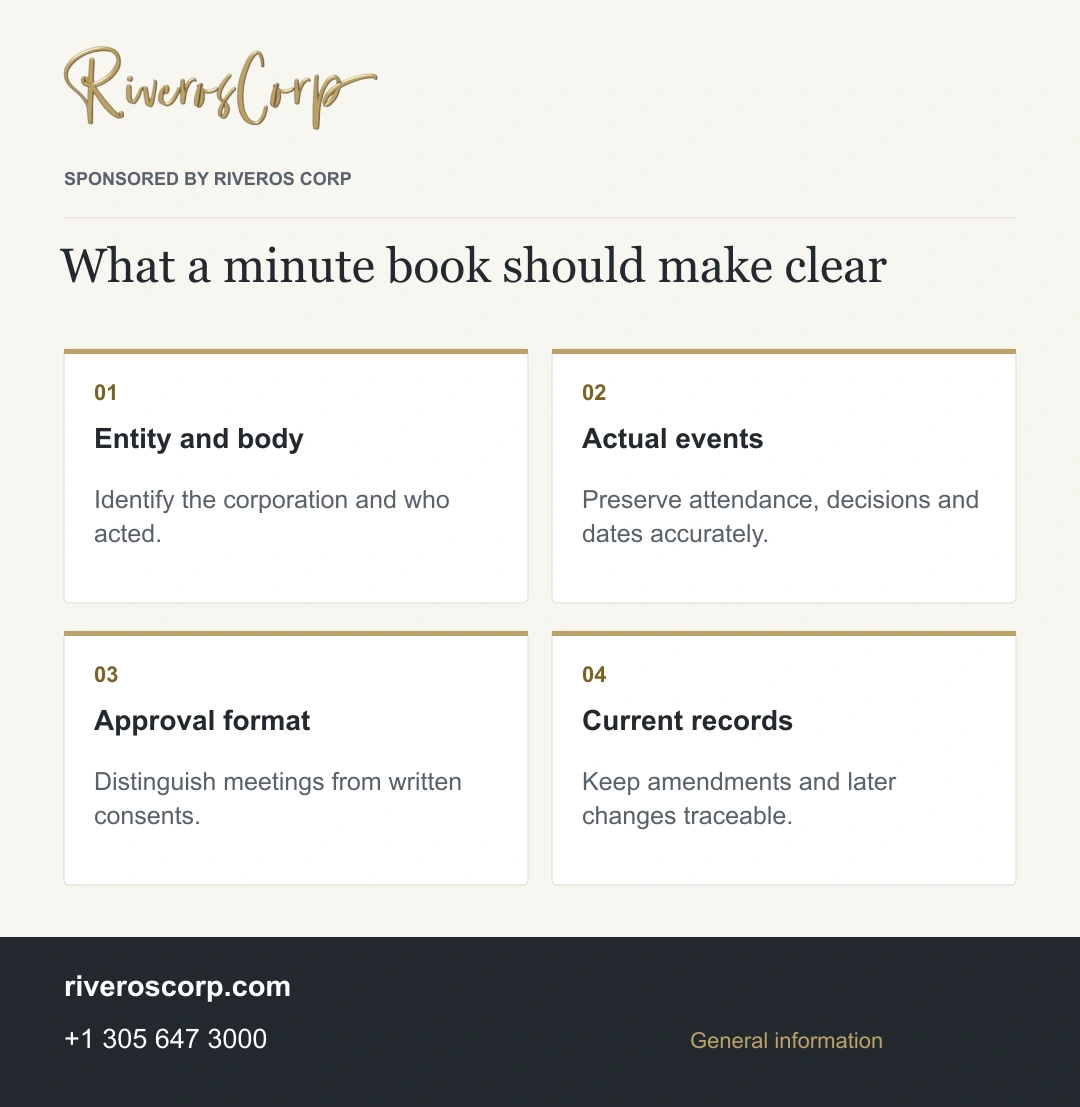
A reader should be able to identify which company and decision-making body met, when the meeting took place and what actions resulted. The record should distinguish a board meeting from a shareholder meeting, even when the same people participated in both roles.
Attendance shows who participated; a quorum establishes whether enough directors or shareholders were present to conduct the relevant business. For a Florida corporate board, section 607.0824 sets a default majority quorum, subject to permitted changes in the governing documents and other statutory rules. The minutes should reflect the rule that applied and the vote actually taken.
Minutes generally summarize proceedings and decisions rather than reproduce every word spoken. A useful record captures the substance needed to understand the action without turning ordinary discussion into a transcript. The appropriate level of detail depends on the subject and any legal issues involved.
Do not describe a proposal as adopted when participants only discussed it. A question left for later review should remain unresolved in the record. Clear distinctions between discussion, authorization and implementation help prevent a later reader from assuming more was approved than actually occurred.
Florida's corporate recordkeeping requirements
Section 607.1601 lists the records a Florida corporation must maintain. They include current articles and bylaws, minutes and written actions, current director and officer information, and the most recent annual report. It also covers specified shareholder communications, financial statements, accounting records and a current shareholder list. Minutes belong in that larger collection, even when they are stored in their own folder.
Florida law assigns responsibility for preparing minutes and authenticating corporate records to an officer through the bylaws or board. The person doing the clerical work may receive help, but the company should know who is responsible for the official record.
An annual report filed with the Department of State does not replace internal minutes. It updates specified public information. A report showing an officer’s name does not, by itself, document how the officer was appointed or whether a particular transaction was approved.
Our comparison of articles of incorporation and bylaws explains the documents that supply much of the governance framework. The minutes should be read alongside the versions in effect when the decision was made, including any relevant amendments.
Meetings, resolutions and written consents
A resolution is a statement of an approved decision. Minutes can record its adoption at a meeting. A written consent records action taken through a permitted process without a meeting. These documents have related purposes, but they should not be labeled as though the events were identical.
For Florida board action without a meeting, section 607.0821 ordinarily requires each director to sign a written consent describing the action and deliver it to the corporation, unless the articles or bylaws provide otherwise. The action is ordinarily effective when the last director signs and delivers the consent, unless it specifies a different effective date. Shareholder consent has separate voting and notice conditions.
If participants used written consent, preserve the consent and describe it accurately. Do not create minutes claiming a meeting occurred when it did not. The law may allow action without a meeting, so inventing a meeting narrative is both unnecessary and misleading.
Similarly, a draft resolution circulated for comment is not automatically an approved consent. The required approvals, signatures and delivery need to be evaluated. The company’s record should identify the completed action and retain supporting documents that establish what was actually authorized.
What belongs in a corporate minute book?
A practical minute book groups governing documents and decision records so the company can locate them. Current articles and bylaws should be distinguishable from superseded versions. Minutes and written consents should identify the relevant meeting or action date, rather than sit in a folder with ambiguous filenames.
Officer and director records help explain who held which role at a particular time. Shareholder records and share-related documents may also be part of the broader corporate records. They should be maintained consistently with the company’s legal and accounting arrangements.
Supporting materials can include the version of an agreement approved by the board or a report considered for a decision. The record should make the relationship clear. An undated document placed beside minutes may not establish that it was the version participants reviewed.
Set access permissions according to the type of document. Meeting minutes, personal identification records and confidential legal advice need not be kept in the same shared folder. At the same time, the corporation must keep statutory records available for inspection within a reasonable time. An inspection request should go to the responsible officer, with counsel handling any question about privilege or the scope of disclosure.
How much detail is useful?
The record should be sufficient to explain the decision and the process used to reach it. Routine matters may need a concise account. A conflict of interest, a significant transaction or a disputed action may require more careful legal review and a more developed record.
Avoid adding praise, motives or conclusions that nobody expressed or approved. A sentence saying that directors “carefully considered all risks” should not be inserted merely because it sounds formal. The record should identify the actual materials and actions where those details are relevant.
The same caution applies to dissent and abstention. Record the facts accurately rather than smoothing out disagreement to make the minutes look unanimous. An accurate account is more useful than a polished narrative that changes the substance of the meeting.
Minutes should also separate a decision from later implementation. If the board authorized an officer to negotiate an agreement subject to further approval, the record should not say the final agreement was approved. That distinction can matter when a third party asks what authority the officer held.
Reviewing and correcting the record
The review should identify factual errors while the events are still clear. Participants can confirm names, dates, decisions and the relevant supporting documents. The company should follow its governing rules for approving the official minutes and preserving the approved version.
If an error is discovered later, do not quietly replace the historical record with a different account. Preserve the original and document the correction through an appropriate process. The method may depend on the nature of the mistake and whether it affects a corporate action.
For an older decision with missing minutes, gather the evidence that still exists: meeting notices, correspondence, signed agreements and records showing what was done. That material may establish some facts while leaving others uncertain. Counsel can assess whether a later record, a new approval or a corrective action is appropriate. The file should identify when the new document was prepared and what evidence supports it.
Where a third party requests minutes, confirm which document is needed and who may provide it. A certified extract, a resolution or the full record may serve different purposes. The officer authenticating a document should understand what the certification states and have authority to make it.
Can software or AI help with corporate minutes?
Software can organize notes, propose a draft and make records easier to search. It cannot verify from a title alone whether the meeting had a quorum or whether the right body approved an action. Those facts must come from the actual events and governing documents.
An AI-generated summary may omit a condition, confuse speakers or describe a discussion as a decision. Treat the output as a draft to compare against reliable notes and approved materials. Never allow invented attendance, votes or dates to become part of the official record.
Confidentiality also matters. Before placing meeting recordings, personal information or legal discussions in any tool, the company should consider its policies, permissions and professional advice. A convenient transcription feature does not decide whether the information should be shared.
The person responsible for the minutes should review the complete draft, not only its spelling. Confirm that each approval has the correct scope, that open issues remain open and that the document uses the right corporate roles. The officer responsible for the minutes remains responsible for that factual review.
Do LLCs need the same minute book?
An LLC follows a different statutory and contractual framework. Its operating agreement determines many aspects of management, member relations and approval procedures, subject to nonwaivable law. It should not adopt corporate meeting rules by accident simply because a bank uses the phrase “corporate minutes.”
Documenting important LLC decisions can still be useful, and the agreement may require records for particular actions. The appropriate form depends on whether members or managers hold the relevant authority. A record should identify that authority instead of inventing a board the LLC does not have.
Our article on the purpose of an LLC operating agreement describes how that document guides company decisions. Compare a requested resolution or consent with the agreement before deciding who needs to approve it.
The broader comparison of corporations and LLCs also helps explain why the structures use different terminology. Both need reliable records, but a useful recordkeeping system fits the actual entity and its governing rules.
Organizing the records with Riveros Corp
Riveros Corp’s corporate secretary service includes organizing the record book, preparing minutes and resolutions, maintaining document versions and tracking agreed deadlines. A review starts by separating approved records from drafts and identifying gaps. The work should preserve the history that exists, including the dates when later corrections or amendments were made.
Begin with the company’s legal name, formation jurisdiction, current governing documents and the purpose of the review. A bank request, an ownership change or preparation for a transaction can call for different records. Explain that purpose so the work addresses the actual need.
For a complete meeting record, provide the notices, participant information, decisions and supporting documents available to the company. If accounts of the vote conflict, flag that conflict for legal review. The secretary service can organize the material and prepare a factual draft; the company must establish what was approved before the draft becomes its official record.
Frequently asked questions
Are corporations required to keep minutes in Florida?
Yes. Florida Statutes section 607.1601 requires minutes of meetings and records of actions taken without a meeting by the listed corporate bodies. Other corporate records are also required. The company should maintain a system that preserves and retrieves them.
Are corporate minutes a word-for-word transcript?
Usually they are a record of proceedings and actions rather than a transcript. The necessary detail depends on the subject, governing documents and legal requirements. A concise account should still accurately preserve decisions, conditions and relevant participation.
Can ChatGPT write meeting minutes?
It can help prepare a draft from accurate source material, but the company must verify the result. Do not accept invented facts or treat software output as proof of valid corporate action. Review confidentiality before sharing meeting materials with any service.
Is a minute book always a paper binder?
No particular binder creates the legal validity of the record. The company needs an appropriate system that preserves required records and makes them available as applicable law requires. Electronic storage should address access, integrity and retention.
What if a company has no minutes for an old decision?
Do not invent a meeting or backdate a record. Gather the available evidence and seek advice about the appropriate response. Depending on the facts, the company may need a correction, a new approval or another legally permitted action.
Make the company record easier to verify
Contact Riveros Corp at +1 305 647 3000 to discuss corporate record organization. Bring the current governing documents and explain which meeting records or authorizations are needed.
General information, not legal or tax advice for a particular situation. By Zulma E Bourelly.