
An online notary USA search can lead to services that follow different state laws and platform rules. For a Florida remote online notarization, the notary must have the required authority and perform the act while physically in Florida. The signer may be elsewhere, provided the applicable requirements are met.
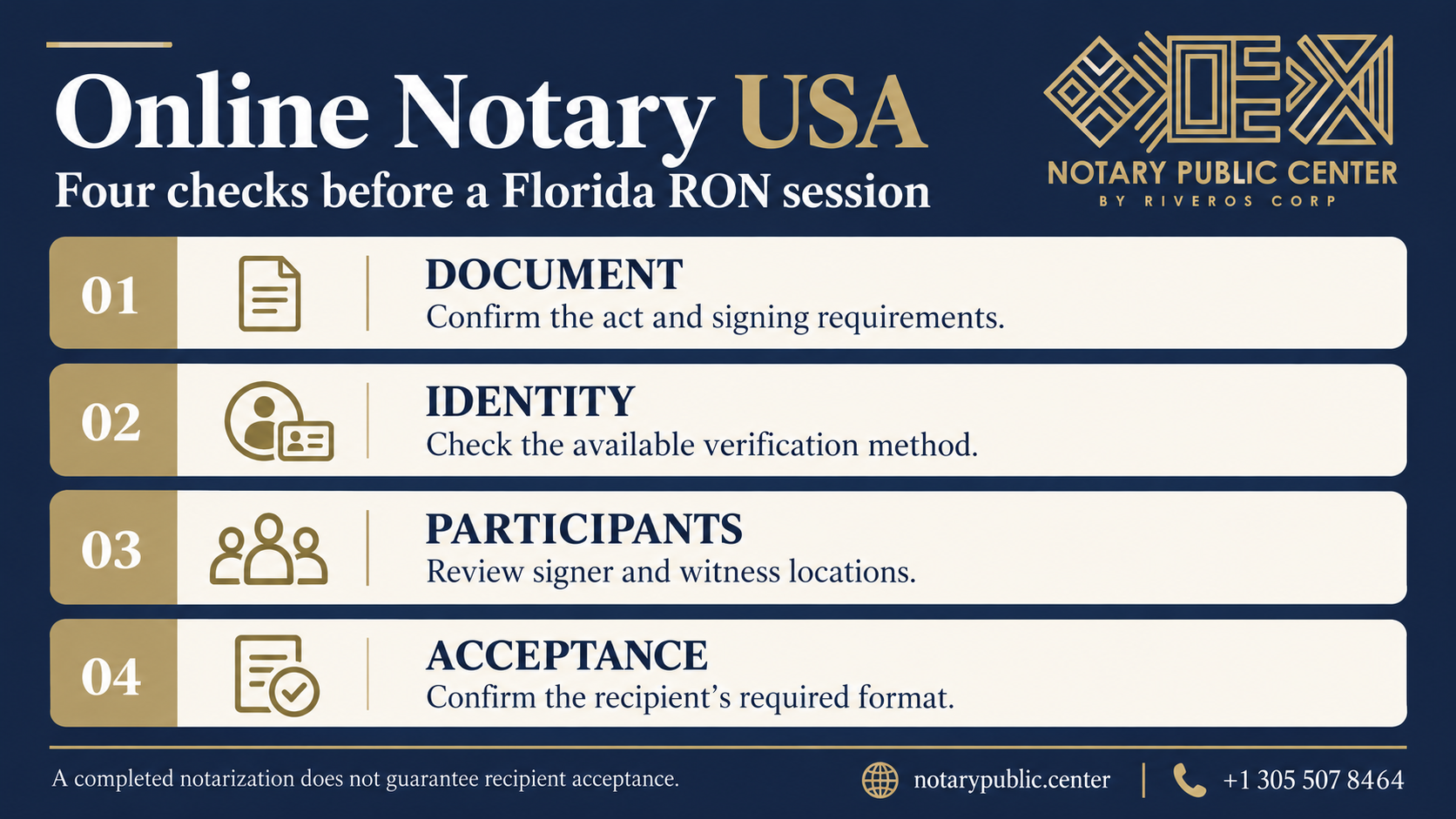
Before booking, confirm that your document qualifies and that the recipient will accept the completed format. Identity checks, witnesses and international use can affect the arrangement. Notary Public Center can review the signing requirements for its Florida notarial services and explain the options available for your document.
What does an online notary do?
Remote Online Notarization, often called RON, allows the signer and notary to appear through qualifying live audio-video technology. The notary performs a specific notarial act, such as taking an acknowledgment or administering an oath. Uploading a file or adding an electronic signature alone does not complete that act.
Florida permits online notarization under Chapter 117 and requires the notary to complete the relevant registration requirements. Therefore, an ordinary notary commission does not, by itself, establish authority to offer RON. The service also needs technology that meets the applicable standards.
If you are unfamiliar with the notary’s role, our guide to notary public services in the United States explains the basic distinction. A notarization does not mean that the notary has approved every statement in the document or advised you about its legal effect.
Online notary USA: Florida location rules
A Florida online notary must be physically located in Florida when performing the act. However, the signer does not have to be in the same room or necessarily in the same state. Florida law allows qualifying online notarizations regardless of whether the principal or witnesses are physically in Florida.
This does not make every proposed session eligible. The document, the participants and the required act still need review. In addition, a signer outside Florida must confirm the desire to have the act performed by a Florida notary under Florida law, as the statute requires.
It is therefore misleading to treat the phrase “Florida document” as a complete legal test. A document’s destination and governing law may matter, but they are separate from the notary’s location and authority. Describe your document and its intended use when asking whether the service can handle it.
Signing from another country
A signer abroad may be able to use Florida RON when the applicable requirements can be satisfied. Still, access to a video connection does not establish eligibility. The identification method, any witness arrangements and the recipient’s requirements need to work for that particular signing.
Also consider the rules that may apply where you are located or where the document will be used. If the transaction raises a legal question, seek advice from a lawyer qualified to address it. A notarial appointment cannot determine the legal effect of a document in every jurisdiction.
Identity verification before the notarial act
The online notary must establish the signer’s identity through a method Florida law permits. Personal knowledge is one statutory route. Otherwise, the process involves presentation of a government-issued credential, credential analysis and qualifying identity proofing, subject to the applicable standards.
Knowledge-Based Authentication, or KBA, is one form of identity proofing. It commonly uses questions drawn from records associated with the person. However, it should not be described as the only possible method in every Florida online notarization. The available method must comply with the law and the service’s approved arrangements.
A passport or another identification document does not guarantee that a platform can complete the required checks. For example, insufficient information in the relevant records can prevent authentication. If the notary cannot satisfy the required identity process, the online act cannot proceed through that route.
Citizenship and access are different questions
U.S. citizenship is not a general requirement for a signer to receive a Florida notarization. Even so, a person must satisfy the identification and other requirements of the particular service. Nationality alone does not tell you whether a remote appointment will work.
Before paying for a session, explain what identification you hold and where you will be located. The provider can assess the available process without promising that every foreign credential or record history will pass. If the remote option cannot be completed, another arrangement may need consideration.
What to expect from an online notary USA service
A RON service usually includes a review of the proposed document and participants before the live appointment. During the session, the notary confirms the required information and performs the appropriate act. Florida requires a recording of the audio-video session and an electronic journal of online notarizations.
The exact signing requirements depend on the notarial act and the document. For that reason, follow the appointment instructions before adding signatures or changing the file. A general statement that every document must always be signed in exactly the same way can create confusion.
| Part of the service | What it addresses | What to confirm |
|---|---|---|
| Document review | The requested act and apparent signing requirements. | Whether the service can handle this document. |
| Identity checks | The signer’s identity under the permitted method. | Available credentials and verification options. |
| Live session | Appearance and performance of the notarial act. | Participants, technology and witness arrangements. |
| Completed record | The electronic document and notarial certificate. | Delivery format and recipient requirements. |
| Later formalities | Any separate certification or translation. | Requirements for the intended destination. |
A clear appointment plan also identifies who will attend and whether each participant has the necessary technology. If a required person cannot join or the connection is inadequate, the session may need another arrangement. A booking confirmation is not a guarantee that the act will be completed.
Documents and witnesses need separate review
People seek online notarization for affidavits, business records, consent letters and certain real estate or power of attorney documents. Those labels do not establish that every version qualifies. The document’s execution rules and the recipient’s requirements still govern what is needed.
For instance, an affidavit or sworn statement may involve an oath or affirmation. A power of attorney raises different questions about the authority granted and any required witnesses. The notary’s certificate does not replace the document’s substantive legal requirements.
If you need a power of attorney in Florida, confirm the execution requirements before arranging a remote signing. Certain powers and documents have additional rules. A general online appointment should not be treated as a substitute for reviewing those conditions.
Remote witnesses are not interchangeable with signers
Florida has specific rules for supervised electronic witnessing. A witness appearing remotely must meet the applicable identity requirements and confirm residence and physical presence in the United States or a U.S. territory. That rule differs from the general location rule for the principal signer.
Some estate planning, health care and power of attorney instruments also trigger special witnessing protections. These can include restrictions involving vulnerable adults and circumstances requiring witnesses to be physically present. Therefore, do not assume that adding another person to a video call satisfies every witness requirement.
Technology and preparation for the appointment
You need a device and connection that allow clear live communication with the notary. A working camera and microphone are part of that requirement. In addition, the chosen platform may have its own device, browser or access conditions that should be checked before the appointment.
Have the document available in the requested format and review the instructions for your identification. Also tell the provider about required witnesses, language needs or accessibility considerations in advance. These details can affect whether the service can complete the proposed act.
The signer must understand the nature and effect of the document to the extent required by the applicable notarial rules. A relative or helper cannot simply answer on the signer’s behalf. If understanding, willingness or identity cannot be established as required, the notary may be unable to proceed.
Online notarization and recipient acceptance
Florida law authorizes compliant online notarizations, but that does not support a promise that every recipient will accept every electronic document. A court, recorder, lender, government agency or foreign institution may have specific filing and format requirements. Confirm those conditions before choosing the signing method.
In particular, recognition of a notarial act and acceptance of an electronic file are related but different questions. A recipient might require a particular form of submission or additional documentation. Asking about those details early can help avoid arranging a session that does not meet the intended purpose.
For a broader explanation of what the act does, read our guide to the meaning of a notarized document. Notarization does not approve a transaction, establish every fact in a statement or guarantee that the underlying agreement is enforceable.
International use and apostille
If the completed document will be used abroad, confirm whether it needs an apostille, another authentication process or a translation. The applicable route depends on the document and destination. These are separate services and should not be assumed to be included in the notarial appointment.
Also confirm the form in which the recipient needs the completed document. An electronic record, a printed copy and a document prepared for further certification may raise different requirements. Review the full intended use before deciding that a remote signing will meet every part of the request.
Security, records and confidentiality
Florida’s RON framework includes identity checks, recording requirements and safeguards for electronic records. The notary must keep a secure electronic journal, and the required records generally must be retained for at least ten years. Certain documents can have additional custody requirements.
These safeguards do not make every device or connection immune to risk. The signer still needs to use the service’s designated channels and protect access to personal documents. If a message asks for identification or a file through an unexpected route, verify it with the provider before sending anything.
A recording documents the notarial session, but it does not turn the notary into a legal adviser. Nor does it guarantee that no dispute will arise later. The service’s role remains the performance and documentation of the authorized notarial act.
Choosing between online and in-person notarization
Online notarization may be useful when travel is difficult or participants are in different locations. However, an in-person arrangement may be more suitable when the remote identity process is unavailable, physical witnesses are required or the recipient needs a different format.
Compare the options against your document’s requirements rather than speed alone. A convenient session has little value if it cannot produce what the recipient needs. Likewise, a tight deadline does not remove the notary’s duties or permit missing identification and witness requirements.
Fees, availability and delivery
Ask Notary Public Center for the scope and cost of the proposed service before booking. The number of acts, participants and any separate document services can affect the arrangement. A quote should make clear what is included and what requires a separate review.
Also confirm appointment availability and how the completed file will be delivered. Do not assume immediate completion or same-day delivery before the required checks are complete. If your transaction has a deadline, explain it when requesting the service so that practical limits can be discussed.
Frequently asked questions about online notary USA
What is a Florida online notary?
A Florida online notary has the required authority to perform qualifying notarial acts through live audio-video technology. The notary must be physically in Florida when performing the act.
Can I sign while outside Florida?
You may be able to, subject to the applicable requirements. Your identity, document, location and any witness arrangements need review, along with the recipient’s acceptance conditions.
Do I have to be a U.S. citizen?
Citizenship is not a general signer requirement. However, you must satisfy the permitted identity process and other conditions. A passport alone does not guarantee successful remote verification.
Will every institution accept the completed document?
No universal acceptance promise is appropriate. Confirm the recipient’s electronic format and filing requirements before booking, especially when witnesses, international use or later certification are involved.
Does an electronic signature complete the notarization?
No. The notary must perform the required act through the authorized process. Signing a file or uploading identification without that process does not establish a completed notarization.
Coordinate your signing with Notary Public Center
Contact Notary Public Center to review the requirements for a Florida remote or in-person notarial service. Explain what document you have, where each participant will be located and who will receive it.
You can reach the team through WhatsApp at +1 305 507 8464. Confirm availability, identification options, witnesses and the expected delivery format before booking. The service does not guarantee that a recipient will approve the document or the underlying transaction.
This article provides general information, not legal advice. Notarial requirements and recipient policies can change. Consult a qualified attorney about document validity, legal rights or execution requirements that depend on your particular circumstances.