
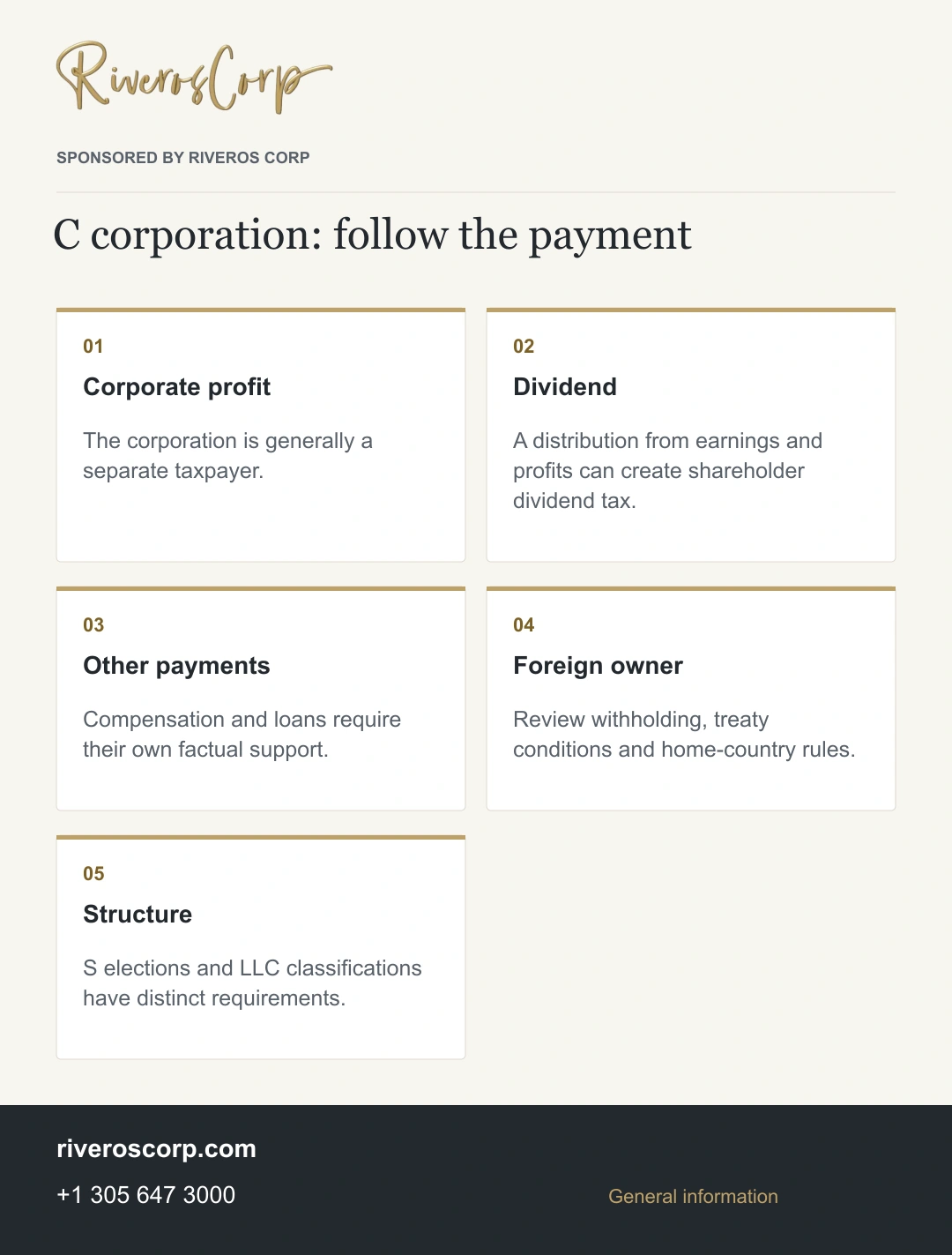
C corp double taxation describes two potential tax levels: the corporation pays tax on its taxable income, and shareholders may pay tax when the corporation distributes earnings as dividends. The corporation and its owners are separate taxpayers.
That does not mean every dollar moving out of a corporation is automatically a dividend, or that every profitable year immediately produces shareholder dividend tax. The nature of a payment matters. Retained earnings, compensation, loans and distributions require different analysis and accurate records.
For a foreign owner, the review may also involve U.S. withholding, treaty eligibility and the owner’s home-country rules. A corporate structure should therefore be evaluated with a qualified tax professional before an owner assumes that incorporation creates a particular tax saving or that a familiar label describes every payment correctly.
The company’s accounts should identify what each payment represents and preserve the supporting documents. With those records, the adviser can assess corporate deductions alongside the shareholder’s tax treatment.
C corp double taxation begins with a separate taxpayer
A C corporation generally calculates and pays its own federal income tax. Its profit is not automatically treated as each shareholder’s current business income in the way owners often associate with pass-through structures. The corporation’s return and the shareholder’s return concern different taxpayers.
When the corporation distributes earnings as dividends, the shareholder may have a separate tax consequence. The corporation generally does not deduct the dividend payment in calculating its taxable income. That combination produces the two-level treatment commonly called double taxation.
Our discussion of corporations versus LLCs explains why the legal structure and tax classification should be considered together. An LLC can elect corporate tax treatment, while a state-law corporation’s federal treatment depends on the applicable rules and any valid election. The business name alone is insufficient.
How a distribution becomes a dividend
A distribution is generally a dividend to the extent it comes from the corporation’s current or accumulated earnings and profits. The remaining portion generally reduces the shareholder’s adjusted stock basis; an amount beyond that basis can create gain. Those rules explain why the tax treatment cannot be decided from the word “withdrawal” on a bank statement.
Earnings and profits is a tax measure. It can differ from the retained earnings balance in the books or the cash available in the bank. Earlier returns, adjustments and distribution history may be needed to establish the relevant amount for the year. The current account balance alone does not supply that history.
Payments for services and genuine loan transactions follow different rules from shareholder distributions. A compensation record should describe the services. A loan should have facts supporting repayment. Use the underlying documents to explain why funds moved rather than changing the bookkeeping label to fit a desired tax result after the payment occurred.
What happens when the corporation keeps its earnings?
If the corporation retains earnings rather than distributing them, a profitable year generally does not by itself create an ordinary shareholder dividend. The corporation remains responsible for its own income tax. The retained funds remain corporate assets until the company uses or distributes them.
Keeping funds for planned operations or investment can serve a business purpose. Federal rules can nevertheless impose an accumulated earnings tax where earnings are accumulated beyond the reasonable needs of the business to avoid shareholder income tax. Retention is therefore a fact to analyze, not a permanent exemption from the second level of tax.
Keep records of the company’s plans and decisions, particularly when substantial earnings remain undistributed over time. If a shareholder later receives a payment or uses corporate property personally, review that event on its own facts. A decision to keep profit in the business does not authorize personal withdrawals without recording their tax character.
Compensation requires actual services
A shareholder who works for the company may also be an employee. Pay for those services needs the appropriate employment, payroll and tax records. A salary and a dividend have different tax treatment, but the label selected by the owner does not settle which one occurred.
The IRS explains that an unreasonably high salary paid to a shareholder-employee can be treated in part as a distribution. The services actually performed and the reasonableness of the compensation matter. A transfer cannot become a deductible expense merely because the company describes it as a year-end bonus.
Keep the service arrangement, payroll entries and payment records consistent. For reimbursements, keep the expense documents and the business purpose. The tax professional reviewing the return can then distinguish compensation, reimbursed business costs and shareholder distributions instead of trying to reconstruct them from one total for payments to the owner.
Loans between a corporation and shareholder need substance
Corporate and shareholder loans may have legitimate business purposes, but the records need to support a real debtor-creditor relationship. A casual transfer described as a loan does not necessarily receive loan treatment when repayment terms and conduct do not support that description.
The review may consider written terms, repayment activity, interest and the surrounding facts. Different rules can apply when the corporation lends to the shareholder and when the shareholder lends to the corporation. Neither direction should be treated as a simple substitute for a properly classified distribution or contribution.
If prior transfers have unclear labels, bring the full history to a tax professional. Rewriting the ledger without examining the underlying transactions can create contradictions. The review should establish what each transfer represented and whether an earlier record or return needs correction.
Foreign shareholders add withholding and treaty questions
A U.S. corporation can have foreign shareholders, but payments to those shareholders may carry withholding and reporting responsibilities. The owner’s location and tax status, the type of payment and any applicable treaty provisions all need review.
A treaty benefit is not automatic because a shareholder holds a passport from a treaty country. Eligibility depends on the applicable treaty and supported facts, including residence and other relevant conditions. Required documentation should be evaluated before the corporation assumes a reduced withholding treatment.
The shareholder’s country of residence may also tax the income or provide relief under its own rules. Coordination between advisers may be necessary. A statement that corporate tax was paid in the United States does not establish how another jurisdiction treats the shareholder’s dividend or whether a particular credit is available.
S corporation status is not available to every owner
An eligible corporation may elect S corporation treatment, which generally passes specified tax items through to shareholders. That is a separate tax regime with eligibility conditions and exceptions. It should not be presented as a universally available way to avoid corporate-level tax.
The IRS prohibits nonresident alien shareholders in an S corporation. This is a tax-status distinction, not a blanket rule that every person with foreign citizenship is ineligible. A shareholder’s status must be determined correctly, along with the other ownership and stock requirements.
Our guide to articles of incorporation for C and S corporations explains why filing articles and making an S election are different actions. A company should not describe itself as an S corporation based only on an owner’s intention or a label used in an operating document.
LLCs can have different tax classifications
Owners sometimes compare “C corporation tax” with “LLC tax” as though every LLC has one fixed treatment. A domestic LLC may be disregarded, taxed as a partnership or taxed as a corporation, depending on ownership and valid elections.
Each treatment raises different reporting questions. A foreign-owned single-member disregarded LLC can have specialized federal information reporting even when it has no ordinary sales. A partnership can have obligations connected with foreign partners. Selecting an LLC does not remove the need for a cross-border tax review.
The comparison should include the owners, intended activity, financing and expected use of earnings. A formation service can help with organizational documents, but the decision requires tax analysis based on actual plans. Do not assume that a structure suitable for a domestic owner is automatically suitable for a nonresident owner.
Stock sales and asset sales have different tax consequences
Owners often focus on annual dividends and overlook what happens when the business or its assets are sold. A corporate asset sale and a shareholder’s sale of stock are different transactions. Their tax effects should not be treated as interchangeable.
The buyer’s proposed structure, the corporation’s assets and the owner’s tax circumstances can affect the analysis. Distributing proceeds after a corporate transaction can raise another set of questions. A general explanation of double taxation cannot determine the result of a particular sale or liquidation.
Discuss possible exit plans before committing to a restructuring or transaction. Keep formation, ownership and capitalization records complete so advisers can evaluate the history. Review the tax consequences while the sale terms can still be negotiated.
Keep corporate decisions and personal finances distinct
The company’s books should distinguish business income and expenses from shareholder contributions, loans and distributions. Record the recipient and purpose of each payment. Consistent records allow the corporation’s return, shareholder information and any withholding reports to describe the same transaction.
Our explanation of articles of incorporation versus bylaws describes the company’s formation and governance records. These help establish who can approve a transaction and what the corporation decided. The accounting and tax records then explain the payment’s treatment.
Riveros Corp’s corporation formation service includes preparation and filing of articles, initial organizational documents and related company records. The owners make the structural decisions with the appropriate legal and tax advice. Before an election, distribution or restructuring, the tax review should cover both the corporation and its shareholders, including foreign-owner withholding when relevant.
Frequently asked questions
Does every C corporation payment get taxed twice?
No. Double taxation commonly describes corporate income tax followed by shareholder tax on dividends. Other payments may have different treatment depending on their substance and applicable rules. Compensation, loan repayments and distributions should not be grouped together merely because money leaves the corporate account.
Are shareholders taxed on dividends the corporation never paid?
Corporate profit alone generally does not create an ordinary dividend to the shareholder when earnings remain in the corporation. The corporation may still owe tax. Later payments, personal use of corporate assets and other applicable tax rules require separate review, so retained funds should not be treated as personal tax-free money.
Can a corporation deduct a dividend paid to its owner?
The IRS explains that a corporation generally does not deduct dividends paid to shareholders. That is part of the two-level tax framework. Calling the same payment compensation or a loan does not change the result unless the underlying facts support the different treatment under the applicable rules.
Can a nonresident alien shareholder choose S corporation treatment?
No. An S corporation cannot have a nonresident alien shareholder. Other eligibility conditions also apply. Foreign citizenship and nonresident alien tax status are different concepts, so a qualified professional should determine the shareholder’s actual tax status rather than deciding from a passport alone.
Does a tax treaty eliminate double taxation automatically?
No. Treaty provisions and domestic relief rules have eligibility conditions and limitations. They may affect withholding or other aspects of a particular payment, but the result depends on the relevant treaty and taxpayer facts. Obtain coordinated advice before assuming a dividend will be exempt or fully credited elsewhere.
Review the documents for your corporate structure
Contact Riveros Corp at +1 305 647 3000 or through WhatsApp for corporation formation, bylaws and organizational records. Bring the proposed ownership structure and any existing entity documents. Coordinate tax elections and the treatment of shareholder payments with the tax professional advising the corporation.
By Zulma E Bourelly. General information only. Individual legal and tax questions require advice from an appropriately qualified professional.