
Understanding how to file articles of incorporation in Florida starts with the company you plan to create. The filing establishes a corporation under state law. It does not settle every question about ownership, taxes, banking or permission to conduct a particular business.
Florida’s Division of Corporations accepts formation documents through Sunbiz and by mail. Before submission, the founders need to settle the required information and any provisions specific to their situation. A completed form is only part of that preparation.
Riveros Corp can coordinate the administrative filing and related services within an agreed scope. Legal and tax decisions should involve appropriately licensed professionals. The state controls filing acceptance, while banks and licensing authorities apply their own requirements.
How to file articles of incorporation: define the entity first
Articles of incorporation generally form a corporation. A Florida limited liability company uses Articles of Organization instead. Choosing between them requires attention to ownership, management, investment plans and tax treatment.
An S corporation election is a federal tax matter; it is not a substitute for the state formation document. Likewise, adding “Inc.” to a proposed name does not create an entity. The required filing and its effective date matter.
For an overview, read what articles of incorporation are. If you are still comparing structures, our explanation of which businesses need articles of incorporation provides additional context for a professional consultation.
What Florida requires in the articles
Florida Statutes section 607.0202 sets out the required contents. These include the corporate name, office addresses, authorized shares, registered office and agent information, and each incorporator’s name and address.
The document may also contain permitted provisions beyond those minimum items. For example, the proposed ownership arrangement may call for legal review of share rights or governance terms. The basic filing process does not supply that judgment.
Therefore, gather the relevant decisions before preparing the document. If the founders disagree about control or investment rights, filing a short form will not resolve the disagreement. Address those issues with counsel before committing to terms.
The corporate name and business identity
The corporate name must satisfy Florida’s distinguishability and naming requirements. Sunbiz’s profit-corporation instructions explain the permitted designators and related filing conditions. A preliminary search is useful, but approval depends on the filing review.
Moreover, state name availability and trademark protection are separate questions. A name that can appear in state records may still create a conflict in the marketplace. Consider the intended products, services and geographic reach when obtaining trademark advice.
Keep the chosen legal name consistent across the formation record and later business documents. Differences can create avoidable questions during an EIN application or account review. A trade name, if used, should remain distinguishable from the corporation’s legal name.
Registered agent, office and mailing address
A Florida corporation needs a registered agent and a registered office in the state. The registered office requires a physical street address. A mailing address serves another purpose and should not be substituted where a street address is required.
The agent must accept the appointment. Simply entering another person’s name does not establish consent. Confirm the arrangement, contact details and responsibility for receiving legal documents before including them in a filing.
Also discuss how notices will reach the corporation after delivery to the agent. A missed communication can have consequences beyond an administrative inconvenience. Keep the agent arrangement and the corporation’s contact records current as the business changes.
Public information and address choices
Formation documents become part of the state record. Before submission, review which addresses and names belong in the required fields. Do not assume that using a registered-agent service makes every part of the filing private.
The principal office, mailing address and registered office may serve different functions. Choose accurate information that meets the relevant requirement. A convenient mailing service does not automatically satisfy every address request from a bank or government office.
Authorized shares and actual ownership
The number of authorized shares states how many shares the corporation may issue under its articles. It does not, by itself, show who owns the company or how many shares have actually been issued.
Share issuance requires appropriate corporate action and records. Section 607.0621 addresses issuance and consideration. Founders should obtain advice about the proposed ownership arrangement, including any investment or securities-law issues.
For example, a plan to bring in an investor may affect voting rights or future issuances. Those decisions should align with the articles and internal documents. A generic share number is not a complete ownership plan.
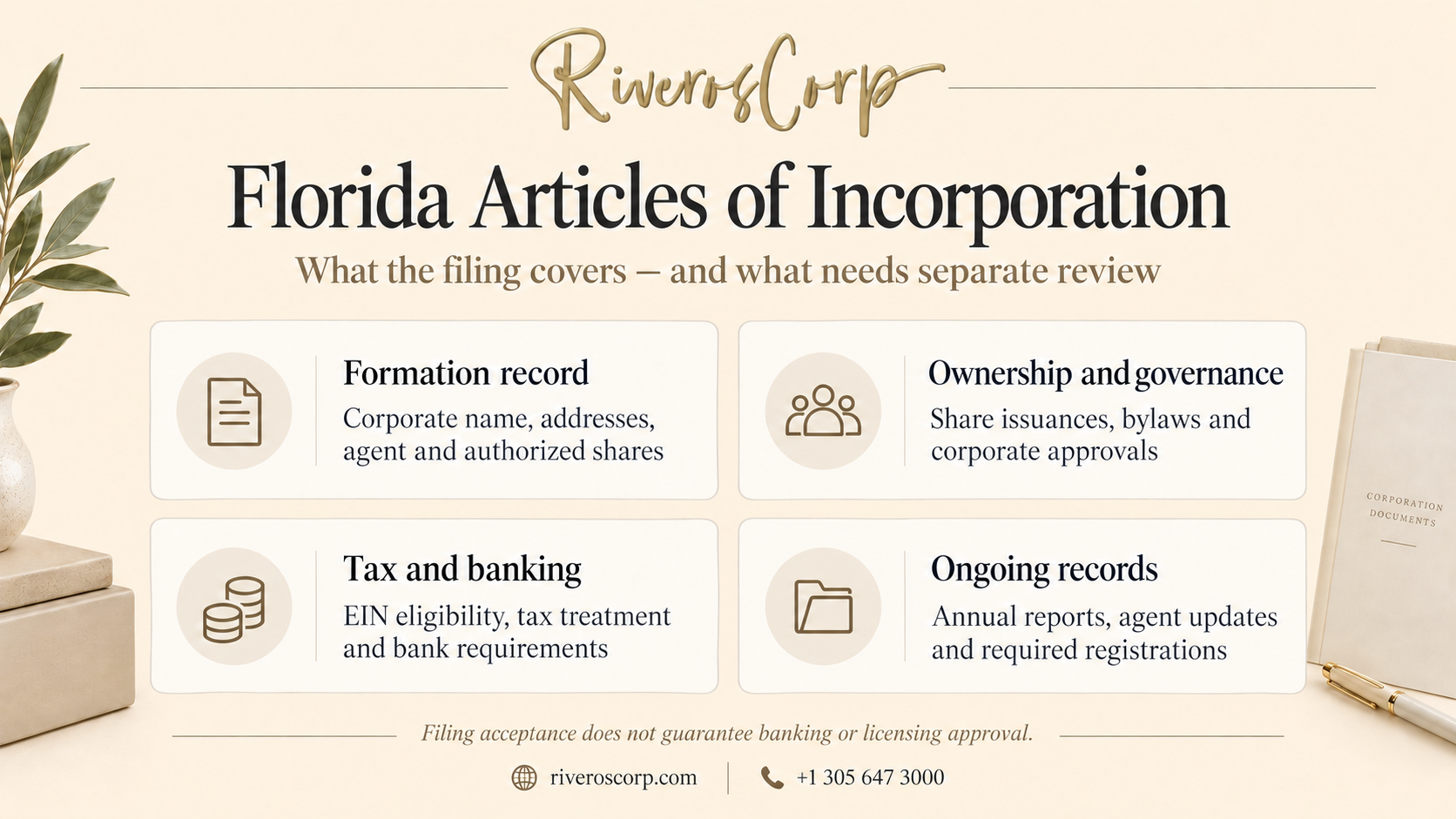
Documents and decisions to distinguish
| Item | Main purpose | Separate question to review |
|---|---|---|
| Articles of Incorporation | State formation record | Whether the provisions fit the intended corporation |
| Registered-agent appointment | Receipt of legal documents | Consent, eligible address and reliable communication |
| Bylaws and corporate actions | Internal governance | Management authority and required approvals |
| Share records | Evidence of issuances and ownership | Rights, consideration and transfer restrictions |
| EIN confirmation | Federal tax identification | Tax classification and filing obligations |
| Bank account review | Institutional onboarding | Identity, ownership and authorized signers |
These records are related, but one does not replace all the others. A bank may ask for several documents to understand the corporation and the person acting for it. Confirm its requirements before assuming that the filed articles are sufficient.
Online filing and mailed filing
Florida permits electronic and mailed submissions. Both require accurate information and the applicable state charges. The filing channel does not determine whether the chosen entity or ownership arrangement suits the founders.
Sunbiz publishes current document-processing dates. Review the queue for the relevant filing type and channel. Those dates change with workload and should not be treated as a promised completion date for a particular submission.
A payment receipt or delivery confirmation shows a different event from acceptance. Keep the state correspondence and review any request for correction. If an error appears after filing, the appropriate response depends on the document and the issue.
When does the corporation begin to exist?
Under section 607.0203, corporate existence generally begins when the articles are filed, subject to an allowable different effective date. A delayed effective date means existence starts later than the filing event.
That distinction matters when planning contracts, tax registrations and other commitments. Do not describe the company as already existing solely because someone submitted a filing. Review the accepted record and its effective date.
Timing near the end of the year can also affect the first annual-report cycle. However, selecting an effective date requires more than comparing administrative convenience. Consider when the corporation must actually exist and obtain legal or tax advice where necessary.
Organizing the corporation after formation
After incorporation, the appropriate participants complete the corporate organization. This includes matters such as appointing officers and adopting bylaws. The process depends in part on whether the articles named the initial directors.
Section 607.0205 allows the relevant organizational actions through a meeting or qualifying written consents. Therefore, it is inaccurate to describe an in-person organizational meeting as the only possible method.
Keep records of the actions actually taken. Bylaws, share records and approvals should reflect the corporation’s arrangements. Administrative assistance with collecting documents does not replace legal advice about their content or effect.
Coordinating the EIN
An employer identification number identifies the corporation for federal tax purposes. The IRS directs founders to form the entity through the state before applying for its EIN. An EIN does not create the corporation or select its tax treatment.
The available application method depends on eligibility. The IRS EIN guidance addresses the online tool and alternatives. Relevant factors include the principal place of business and the responsible party’s taxpayer identification information.
Applicants who cannot use the online tool may need another permitted route. A service provider should assess that route rather than promise immediate issuance. Once assigned, retain the IRS confirmation with the corporation’s records.
Foreign founders and S corporation eligibility
Non-U.S. persons can generally own shares in a Florida profit corporation, subject to restrictions that may apply to particular activities. Ownership does not itself provide immigration status or permission to work physically in the United States.
Federal tax eligibility is a separate review. The IRS requirements for S corporations exclude nonresident alien shareholders. Other limits also apply, including eligible shareholders and the permitted stock structure.
A foreign nationality does not alone resolve a person’s U.S. tax residency. Accordingly, ask a qualified tax professional to assess the actual owners and planned activity. Do not select a tax election solely from the word “foreign” in a service inquiry.
Banking, licensing and operational readiness
Incorporation gives the business a state-law entity, but it does not guarantee a bank account. The bank reviews identity, ownership, business activity and authority to act. Its requirements may include records beyond the filed articles and EIN confirmation.
Likewise, the corporation may need licenses or registrations for its location, profession or business activity. Operating in another state can raise additional registration questions. These issues depend on what the company will actually do.
For international ownership, our guide on registering a U.S. business as a foreigner provides related context. Use it to prepare questions for the appropriate advisers and institutions.
Annual reports and BOI are different obligations
Florida’s annual report maintains or updates information in the state record. The Division’s annual-report guidance explains the filing period and consequences of missing the requirement. This report is not a corporate income-tax return.
Missing required filings can lead to administrative dissolution. However, a filing error does not always require dissolving and recreating a corporation. Correction, amendment or reinstatement may be relevant, depending on the facts and applicable rules.
Federal beneficial-ownership reporting is separate. Under FinCEN’s current BOI rule, U.S.-created companies are exempt from BOI reporting. Foreign ownership alone does not turn a Florida-created corporation into a foreign-created reporting company.
That exemption does not eliminate state reporting, tax returns or a bank’s ownership review. Keep a compliance calendar that reflects the actual entity and activities. Also verify current requirements when the business changes.
Discuss scope and charges before filing
A service proposal should distinguish state charges from professional or administrative service charges. It should also identify optional records and ongoing services. A certified copy of the articles and a Certificate of Status serve different purposes.
Confirm which documents a lender, investor or other recipient needs before ordering them. An optional certificate should not be presented as universally mandatory. Likewise, formation assistance does not automatically include every later report or renewal.
Riveros Corp can coordinate the agreed administrative work and identify questions for legal or tax counsel. The scope should state who handles the filing, how correspondence is delivered and what assistance continues after formation.
Frequently asked questions about incorporation filings
Where do I file articles of incorporation in Florida?
File with the Florida Department of State, Division of Corporations, through an available electronic or mailed submission. Review the requirements for the intended entity and any provisions that need legal advice before the document is submitted.
Can online filing guarantee a faster approval?
No. Processing depends on the state’s queue and review of the submission. Consult current processing dates, distinguish receipt from acceptance, and allow for any necessary corrections. A service provider cannot guarantee the Division’s completion date.
Does authorizing shares establish who owns the company?
No. Authorized shares establish the number the corporation may issue under its articles. Actual ownership depends on valid issuances, transactions and supporting records. Review the proposed share arrangement with qualified counsel.
Do I need to hold an organizational meeting in person?
Not necessarily. Florida law permits qualifying written consents for organizational actions that would otherwise occur at a meeting. The correct participants and documentation depend on the corporation’s circumstances and whether initial directors were named.
Can a foreign founder form a Florida corporation?
Generally, yes, subject to any applicable ownership or activity restrictions. Formation does not grant U.S. work authorization. EIN eligibility, bank review and tax treatment require separate attention, including the restrictions on nonresident alien S corporation shareholders.
Discuss your corporation with Riveros Corp
If you need help reviewing how to file articles of incorporation, contact Riveros Corp’s company formation team. Share the planned activity, ownership and timing so the proposed administrative service addresses your situation.
Request information on WhatsApp at +1 305 647 3000. Confirm the filing scope, records and ongoing support before proceeding. Legal and tax decisions should remain with the appropriately licensed professionals.
This article provides general information and is not legal or tax advice. Reading it does not create an attorney-client relationship. Consult qualified advisers about your corporation’s structure, obligations and particular circumstances.