Before you start UAE embassy attestation for a U.S.-issued document, check what kind of document it is, which certifications it already carries in the United States and where it has to be submitted now. A marriage certificate, a university diploma and a commercial instrument each need their own checklist. Find out what the UAE recipient is asking for and which authority issued or certified the document. Use that information to identify the next required certification.
This guide covers only documents issued in the United States for use in the UAE. It explains how to organize the preparation, how guidance from the embassy in Washington differs from MOFA services, and how to avoid relying on outdated mailing instructions. Apostille de la Haya can review the file and explain what kind of help fits once its origin, purpose and existing certifications are clear. The document legalization service explains the wider certification assistance; the destination and document category still need their own review.
Where UAE embassy attestation is handled in the U.S. today
According to the UAE embassy in Washington, attestation of personal and educational documents moved to VFS Global effective August 21, 2025. The embassy’s official page for personal and educational documents also requires U.S. Department of State authentication before those documents go to VFS. These instructions were checked on September 25, 2026.
This matters if you saved an old embassy address or are working from another applicant’s checklist. An address on a government website may be the mission’s general address and not the current intake point for your service. Before you send anything, confirm which channel handles your document category. Check the application reference, the delivery arrangements and any supporting materials as well.
Reach the VFS U.S. UAE attestation portal through the relevant official guidance, and check the current service details for the file you are preparing. VFS intake, government certification and private document assistance each play a different role. Don’t describe them as interchangeable offices, and don’t assume they review the same things.
Classify the document before you plan the route
With a personal civil record, start by identifying the lawful custodian and the certified copy. A birth or marriage certificate may be a state or local public record, and how you prepare it depends on whose signature it carries. A photocopy with a private notarial statement is not automatically equivalent to the custodian’s certified record. Find out which format the U.S. certification authority and the UAE recipient will accept.
With an educational document, identify the awarding institution, the campus, the qualification and the type of record. A diploma, a transcript and a verification letter are different items, so work out which one the recipient and the current attestation channel actually require. Whether the institution is accredited is a separate question from whether a notary witnessed a signature. Review accreditation before the academic packet goes out.
Commercial instruments need their own classification. A company power of attorney, an agreement, an invoice and a certificate of origin can involve different requirements or submission channels. Don’t apply the embassy’s instructions for personal documents to a commercial file until you have verified the relevant service. What the instrument says and what it will be used for matter more than its length or whether an individual signed it.
Confirm what the UAE recipient actually needs
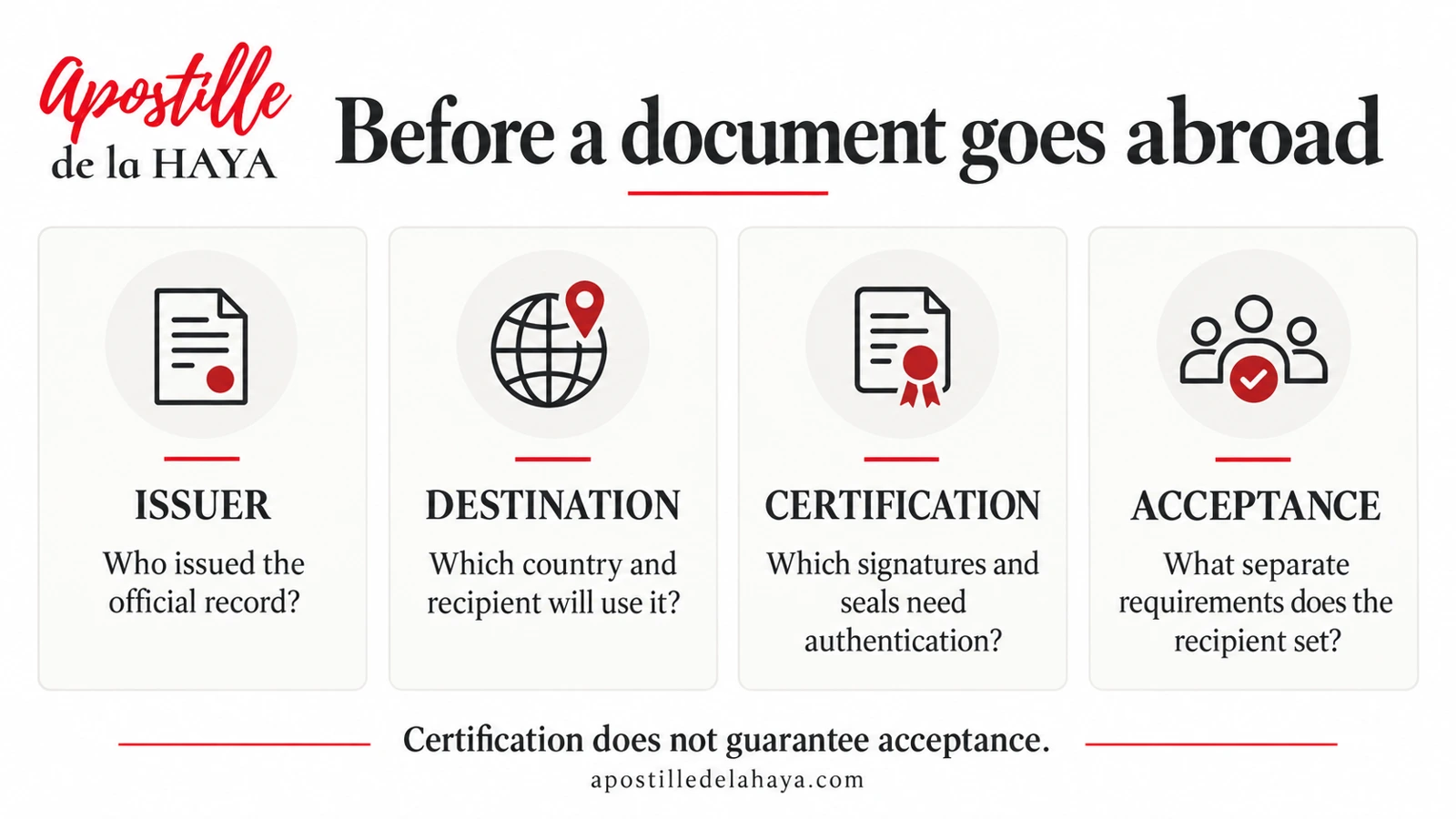
Identify who is asking for the document. It may be an employer, a school, a licensing body, a government department or some other recipient. Ask them for their current requirements in writing. When a request comes through a recruiter or relocation contact, details about originals, translations, supporting records or separate recognition procedures can get lost along the way. Get the underlying requirement before you assume attestation alone completes the file.
Ask whether the document is for a preliminary review or for the final submission. A recipient may look at a scan first and ask for the completed official packet later. That doesn’t mean every authority along the certification route will take a scanned version. For each stage, establish the format needed and who has to receive the completed original or an eligible digital output.
With a university qualification, find out whether the request also involves academic recognition or professional licensing. For a family record, keep attestation apart from residence eligibility or marriage registration. Certification supports the paperwork. The authority handling the wider application decides whether to accept it and whether other conditions apply, and no service provider can guarantee those outcomes by handling the documents.
Prepare the U.S. side based on who issued the document
State-issued public records and privately notarized documents go through the relevant state authority. Where the applicant lives now doesn’t decide which state can certify an official signature from another jurisdiction. Read the certification already on the document and check the instructions of the appropriate state. A document that looks American is not necessarily ready for federal authentication.
The U.S. Department of State publishes authentication requirements that describe the preparation expected at the federal stage. If a state certification is needed first, take care of it first. Sending an unprepared document straight to the federal office doesn’t skip that step. It also doesn’t turn a private copy into an eligible public record.
Federal documents come from a different source, so assess them on that basis. Adding a private notarization to a federal original is not a routine shortcut. If your packet holds several types of documents, review each one on its own. A federal background record and a state marriage certificate may end up in the same UAE application and still need different preparation in the United States.
Check degree eligibility for UAE embassy attestation before ordering certificates
The Washington embassy’s guidance on educational documents looks closely at the U.S. institution and its accreditation. Review the current official criteria and the supporting evidence for your particular school. Don’t assume that every institution with “university” in its name, every foreign branch of a U.S. brand or every online credential automatically meets the same conditions.
Ask the registrar which official academic documents it can issue for international use, and whether it can provide the required signature or statement. Find out whether transcripts or other evidence have to go directly to a recipient. A printout from the student portal can be useful for reference, but it may not be the official academic record the relevant office requires.
The UAE Ministry of Higher Education and Scientific Research runs its own qualification recognition process. Check whether it applies to your intended use. UAE embassy attestation does not replace a recognition decision, a professional license or an employer’s review of the qualification.
What MOFA does and what your chosen service covers
MOFA is the UAE Ministry of Foreign Affairs. Its services cover documents from different origins, used in different directions. Guidance written for a certificate issued in the UAE and headed to another country shouldn’t be applied unchanged to a U.S. certificate coming into the UAE. Start with who issued the document and which certifications it already has.
The official MOFA FAQ treats foreign-issued documents separately and explains the attestation channels. For your file, find out which UAE certification steps the service you choose will complete, and whether anything will still need to be done in the UAE. Look at the actual scope and the finished output before you order another attestation that might repeat work already included.
Applying online doesn’t necessarily mean an ordinary scan replaces the physical original. Digital services can be limited by issuer, by document type or by the verification method available. Confirm that the route offered fits your particular record. For example, a digital process described for UAE-issued school or civil records doesn’t mean a U.S. diploma or marriage certificate can skip preparation in its country of origin.
Get translations, names and supporting records in order
Ask the recipient and the attestation channel which language they accept. Find out whether you need a translation, who may prepare it, and whether the translator’s declaration needs its own certification. Timing matters too, because later authentication pages may also need translating. Don’t order a translation of the first page only when the final recipient needs the complete certified packet.
Compare personal names and institutional details across the source record, your current ID, the application and the translation. A legitimate name change may call for supporting evidence; the certificate itself should not be altered. If the record contains a genuine error, take it up with the issuer. Neither a translator nor an attestation service should quietly rewrite official information so the documents look consistent.
Include supporting records because they are required. The fact that another applicant once submitted them is no reason to add them. Evidence of academic accreditation, identity information or a commercial authorization may matter for one category and be irrelevant to another. A clear inventory of your documents keeps you from disclosing more than necessary, and it helps the reviewer see which item supports which requirement.
Send, track and get your documents back
Before you send originals, confirm the current intake instructions for your document category and channel. Check the application, reference number, packaging and return method. Keep official attachments intact and keep a complete, legible copy. The document you mail should be the same version that was reviewed and described in the application.
Track the physical delivery and the service application separately. The carrier’s confirmation proves delivery, while the application status shows intake or processing. Neither one means the final UAE recipient has approved anything. If an office asks for more information, identify the specific requirement and answer through the approved channel. Don’t resubmit the whole packet before you understand the issue.
Plan your schedule around the full sequence: any replacement record, U.S. certification, intake, UAE attestation, translation and final delivery. An estimate from one office doesn’t cover all of those stages. Mention the recipient’s deadline when you ask for assistance. However, a preferred date is not a guaranteed completion date, and it can’t be treated as one before the file and the official processing conditions have been reviewed.
Frequently Asked Questions
Can I mail personal documents directly using old embassy instructions?
Don’t rely on an older checklist. The Washington embassy’s current guidance for personal and educational documents points to VFS. Confirm the active submission channel and the requirements for your category right before you send anything. A general embassy mailing address does not show that it is the right intake address for the service you need.
Do all U.S. documents need the same state preparation?
No. Preparation depends on where the document came from, whose official signature it carries and what type of document it is. A state civil record, a privately notarized instrument and a federal document can each need different treatment. Before federal authentication, check each item against the instructions of the competent U.S. authority. Putting them in one UAE application doesn’t make their U.S. certification requirements the same.
Does attestation mean my degree is recognized for employment?
Not automatically. Document attestation, academic recognition, professional licensing and hiring decisions are separate functions. Ask the employer or the responsible authority which processes apply to you. Completing one certification route does not guarantee that your qualification meets every requirement of a particular job, profession or further study program.
Can I do everything by uploading a scanned certificate?
It depends on the current service and on whether your document is eligible. An online application may still require the physical original or a certified format that is specifically accepted. Digital attestation offered for certain issuers doesn’t extend to every U.S. document. Confirm the exact submission and delivery requirements before you rely on a scan alone.
What information do you need for an initial review?
Send the document type, the issuing jurisdiction or institution, a complete copy, any existing certificates, the intended UAE recipient and your deadline. Include the recipient’s written instructions and say whether anyone has asked for a translation or for academic recognition. Also say where the original is, so the preparation and delivery options can be assessed realistically.
Get help with UAE embassy attestation for your U.S. document
The UAE embassy attestation service can assess your file against the preparation route that applies to it. Send the complete document and the recipient’s current instructions. A description of the stamp you think is missing is not enough. With the full file, the review can separate U.S. preparation, intake, UAE certification and any separate requirement from the recipient.
To discuss your documents, contact Apostille de la Haya on WhatsApp +1 305 500 0185. For background on the wider certification process, see the U.S. Department of State apostille and authentication discussion. The right service depends on the verified origin and destination of your actual file.