MOFA UAE attestation depends on the document’s issuer and the country where you intend to use it. If your certificate comes from the United States and is going to a recipient in the UAE, start with the route for foreign-issued documents. Instructions for sending a UAE-issued digital certificate abroad concern documents issued in the UAE for use in another country. Don’t apply them to your U.S. record.
An existing certification does not always complete the required process. Review the whole packet to identify the acts already completed, any outstanding MOFA requirement and the appropriate submission channel. Apostille de la Haya can review the U.S. preparation and explain the help available for your actual file and the destination’s requirements.
MOFA UAE attestation starts with origin and direction
MOFA is the UAE Ministry of Foreign Affairs. Its document services deal with signatures and seals on records. They do not decide the wider application that the records support. First, identify whether a UAE or foreign authority issued the document. The applicant’s current address does not establish its origin.
A U.S. marriage certificate is still U.S.-issued when you carry it to Dubai. A diploma from a U.S. institution doesn’t become a UAE public record because the graduate works in Abu Dhabi. In the same way, a UAE-issued certificate doesn’t become American because its owner moves to Florida. Identify the authority that created or officially certified the record before you pick a service category.
Next, state the direction of use. In this guide, that is U.S. origin to a UAE recipient. This distinction prevents confusion between the service for UAE digital records going abroad and the preparation of foreign certificates for the UAE. The MOFA document attestation service page separates these situations, and the issuer and the document type both affect which service fits.
Review the certifications already attached
Go through the complete document and every attachment. Identify the issuing office, any state certification, any U.S. Department of State certificate and any certificate from a UAE mission or MOFA. Write down which authority issued each attachment and which document it refers to. A handwritten note saying “MOFA done” doesn’t replace a look at the actual completed output.
If a previous service handled the file, get its scope and its completion record. Did it cover only U.S. preparation, or also mission attestation, an integrated service, delivery or further work at the destination? Don’t order a stage twice just because people use different names for the same act. And don’t assume a courier’s delivery receipt proves the certification was completed.
Keep all official attachments intact while you review. Don’t remove an older certificate or detach pages to make the file look simpler. Work already done may still count even if another step is needed. With a complete copy, the reviewer can follow the sequence and spot the gap without touching the original packet too early.
Understand the U.S. preparation that comes first
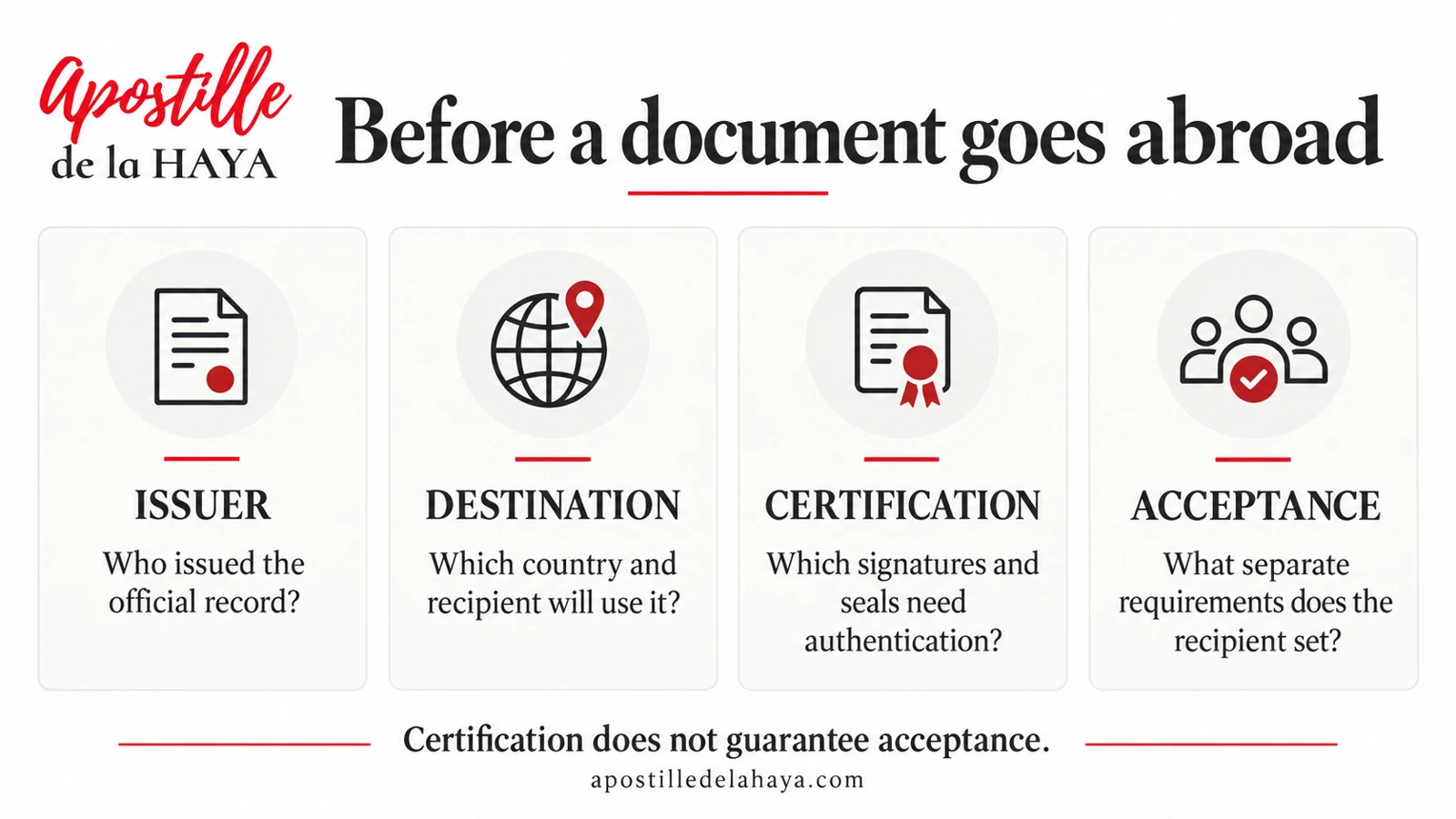
A state civil record usually requires review of the official signature on its certified copy. For marriage records, our guide to custodian-certified marriage copies explains the starting document; its apostille discussion does not establish the UAE route. Privately notarized instruments follow the jurisdiction where the notarial act took place. A federal public document has a different origin. These differences still matter when all the records will end up in one UAE application.
The U.S. Department of State sets out what is required before federal authentication. Where a state certification is necessary, the federal office doesn’t waive it. A foreign attestation request doesn’t turn an ordinary photocopy into the official record the issuing jurisdiction requires, either.
The UAE embassy in Washington publishes guidance for personal and educational documents. It names VFS as the handler and requires Department of State authentication before submission for those categories. Read that U.S.-specific guidance together with the ministry’s general information. A generic description of MOFA services shouldn’t override the current intake instructions for the mission and category involved.
Use the channel that fits the actual document
MOFA’s service page separates documents issued abroad from those issued in the UAE, and it tells applicants to confirm availability through the relevant mission. For a U.S. personal or educational file, the current Washington instructions and the VFS U.S. attestation portal are what matter when you assess the submission. Check the active requirements before you ship the original.
If someone is already in the UAE with a U.S. document, find out whether the required preparation in the country of origin has been completed. Being in the UAE doesn’t, on its own, fix a missing U.S. certification. Ask the competent channel how to handle the current packet. Don’t just pick the nearest office and assume it can perform every earlier act.
For commercial documents, confirm the right service category on its own terms. A corporate agreement, a commercial power, an invoice or a certificate of origin may not fit the personal-document process. The document’s purpose can affect the applicable preparation requirements. A company instrument is not an individual document just because a natural person signed it.
A digital application and a digital original are different things
An online application is a way of requesting a service. An original digital document is a record that the competent authority issued in electronic form. A scan is an image of another document. Having an upload field on a form doesn’t mean every scanned U.S. record qualifies for a fully digital attestation route.
According to MOFA’s current service description, digital attestation is for eligible UAE-issued digital records that will be used abroad. Don’t read that as a blanket waiver of the origin-country requirements for American documents. Check the exact issuer, the document type and the service offered for your file. If the route calls for physical delivery, plan for the original or an accepted certified form.
When you receive a digital result, keep the original electronic file and its verification information. A screenshot or printout may not preserve the original file’s electronic verification features. Ask the recipient which form it accepts, because a printed copy of a digitally signed record may lose some of the verification features of the electronic original. Agree on the format before the final presentation.
Confirm delivery and any MOFA UAE attestation work left to do
The service you choose may decide how documents are collected and returned. Check whether the process needs an approved courier, a particular intake office or delivery of a digital output. Give accurate contact and delivery details, and only through the proper application channel. A wrong phone number or return address can hold things up even when the document itself is prepared correctly.
Before you order another local attestation, identify the certificates included in the service you chose and look at the completed packet. The MOFA FAQ gives background on foreign-issued records and the channels available. Rely on current, service-specific instructions to see whether a step at the destination is still outstanding. Don’t assume every file needs the same separate visit.
Ask who is responsible for the final handoff to the UAE recipient. A service may end by returning the documents to you, without submitting them to an employer, university or government department. The scope should make that clear. Finishing MOFA UAE attestation doesn’t automatically mean the recipient has received or accepted the file.
Attestation, academic recognition and acceptance
An attested academic record may still need a separate recognition assessment or a professional licensing review. The UAE’s qualification recognition service belongs to the education authority and follows its own process. Ask the employer or other recipient what the intended use requires. Not every educational request is simply a call for another MOFA stamp.
A family record raises a similar distinction. Attestation can support the document’s authenticity, but it doesn’t decide marriage registration, sponsorship eligibility or a residence application. If the receiving authority needs supporting records or more evidence, those requirements stay separate. A document service shouldn’t promise an outcome that another institution controls.
With a commercial instrument, legal effect and business authorization also need their own attention. Certification doesn’t fill in missing contract terms, give an agent powers beyond those in the instrument or approve a transaction. Settle questions about wording and authority before you certify a version that may have to be replaced later.
Sort out names, translations and corrections before you resubmit
Compare the document with the details in the recipient’s application and note any legitimate differences in names. A former surname or a different transliteration may call for supporting evidence. A genuine error by the issuer may need an official correction. Work out which situation you are in. Don’t alter the original, and don’t ask a translator to hide a discrepancy so an online form looks consistent.
Confirm whether English is accepted or a translation is required, who may prepare it and which attached pages need translating. A translation may need its own declaration or certification. Time it to fit the actual route, so later certificates aren’t left out of a packet the recipient expects to be complete.
If an application is rejected or returned, keep the notice and identify the exact reason. An upload problem, missing origin certification, ineligible document type or concern from the recipient each calls for a different response. Identify the stated reason before opening another request. Sending the same submission again without a correction is unlikely to solve the underlying problem.
Frequently Asked Questions
Can MOFA replace a missing U.S. state authentication?
Don’t assume it can. The U.S. document has to meet the preparation requirements of the route that applies, including earlier certifications where they are required. Identify the issuer and the existing attachments before you choose a MOFA-related service. Being in the UAE doesn’t automatically remove an earlier certification requirement that attaches to a U.S. record.
Is the digital service for UAE records suitable for my U.S. diploma?
Not automatically. Eligibility depends on the issuer, the document type and the direction of use. MOFA’s process for UAE-issued digital documents shouldn’t be stretched to cover an American diploma. Review the Washington mission’s guidance and the current U.S. channel, and confirm whether your file needs physical submission or another accepted format.
How do I know whether MOFA UAE attestation is already included?
Look at the written service scope, the completion record and the certificates actually delivered. Ask the handling channel which acts it has completed and whether any requirement at the destination is still open. A generic line on an invoice or a courier receipt is not enough. Hold off on ordering a stage again until someone has checked the existing packet against the recipient’s current instructions.
Once attestation is complete, does my employer have to accept the document?
No. The employer or the responsible authority may have additional documentary, academic or professional requirements. Attestation deals with the relevant signatures and seals. It doesn’t replace a separate decision on qualification recognition, licensing or employment. Find out the recipient’s full requirement before you treat certification as the last milestone in the process.
What information helps most at the start of a review?
Send the U.S. issuer, the document type, a complete copy, the existing certifications, where the original is now and the UAE recipient’s instructions. Include the scope of any earlier service or any return notice. With that, the reviewer can tell work already done from the next required act, and assess delivery and translation needs realistically.
Review the U.S. file before choosing a MOFA UAE attestation service
The UAE embassy attestation service can help you see how your American document fits the UAE preparation route. The review should identify where the record came from, its existing certifications, the right submission channel and any requirement the recipient still has. It should also state clearly what the assistance covers, including where document handling ends.
Contact Apostille de la Haya on WhatsApp +1 305 500 0185 to discuss your packet. For a broader explanation of the American certification authorities, see the U.S. Department of State document guide. Bring the complete history of the document, so the next step follows the file’s actual status and not a guess about a missing stamp.