If you are asking about UAE embassy attestation fees, begin with the documents you need to present in the Emirates. Before discussing service conditions, however, the file needs a clear scope. The document may still need an eligible certified copy, an official authentication, a translation or another required act. Conditions can vary with the nature, complexity and requirements of the case. Consult Apostille de la Haya directly about your documents.
This article explains what information makes that conversation useful. It covers U.S.-issued documents and distinguishes preparation in the United States from the UAE recipient’s requirements. An attestation confirms the relevant signatures or seals; it does not guarantee employment, residence, academic recognition or approval of the underlying application. Understanding those limits helps you define the assistance you actually need.
UAE embassy attestation fees: define the document first
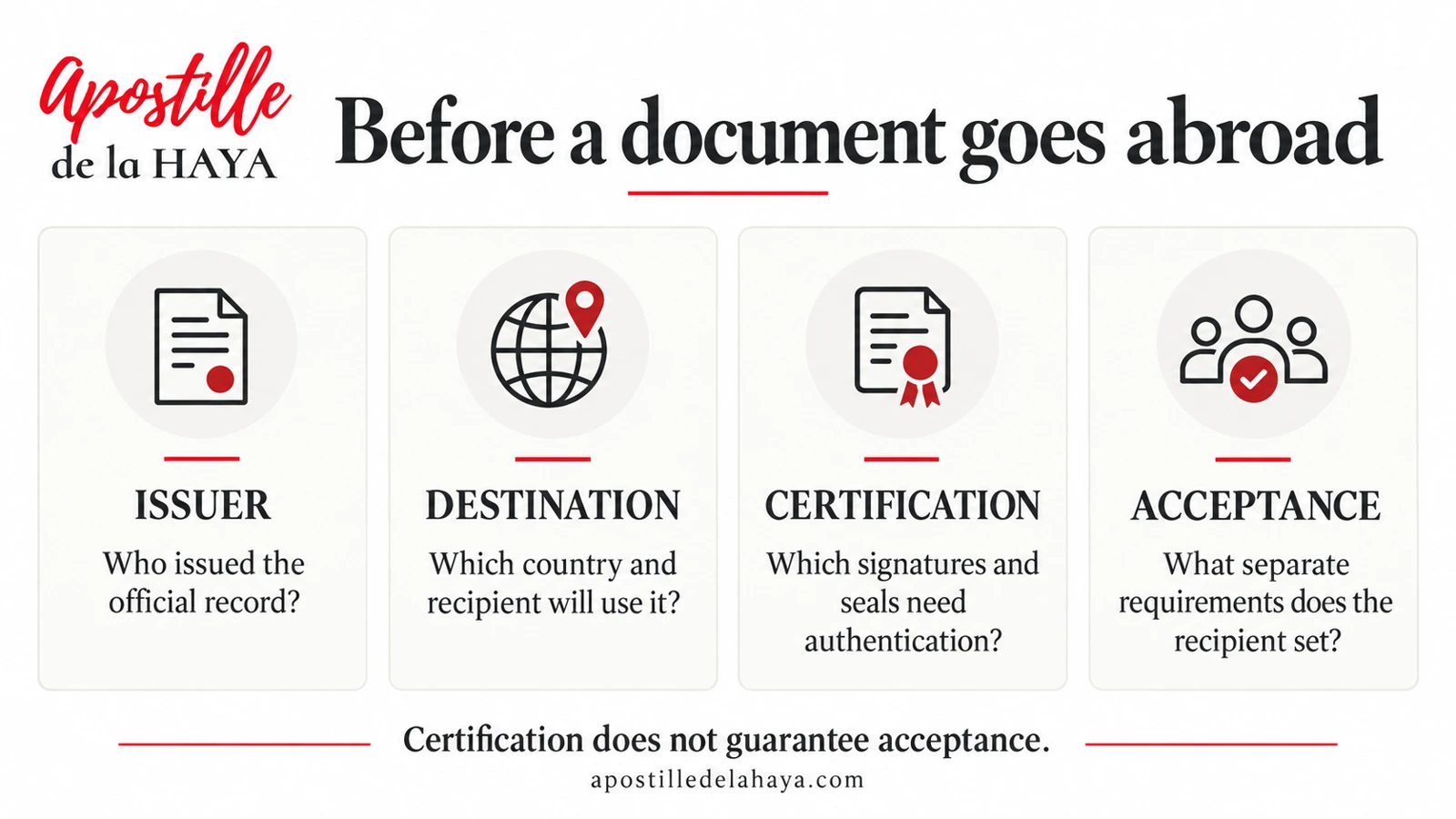
The document category matters before a service can be defined. A birth record, a university diploma and a company agreement serve different purposes. Identify the actual issuer and the intended use. A business power of attorney does not become a personal record simply because an individual signs it. Likewise, several pages belonging to one instrument do not automatically constitute several independent records.
Describe the file in concrete terms. Include the document’s title, the public office or institution that issued it, and whether you hold an original, a certified copy or a scan. The reviewer also needs to know what has already been done. An existing authentication may be relevant, but its presence alone does not establish that the complete UAE route has been satisfied.
Identify who will receive the document
A country name is only the beginning. Name the government office, employer, university or other institution requesting the document. Ask for its written requirements for the particular procedure. These instructions may address the language, the accepted version of the record, supporting evidence or the date the copy was issued. A relative’s earlier application cannot establish the requirements for yours.
Keep the document request separate from the wider application. A marriage certificate may support a family filing without resolving eligibility for that filing. A degree may be authenticated without meeting every requirement for professional practice. If the recipient asks for a separate recognition, registration or licensing procedure, identify it explicitly. It should not be treated as an automatic result of attestation.
Check the current U.S. submission channel
The UAE Embassy in Washington’s guidance for personal and educational documents identifies VFS as the handling channel, effective August 21, 2025. It calls for prior U.S. Department of State authentication for the documents covered by that guidance. This is a specific route for the categories described. Confirm its application to the actual file before arranging a submission.
An older checklist may describe a channel that no longer handles the same service. Equally, instructions for a UAE mission in another country should not be copied into a U.S. file. The UAE embassy attestation service provides a point of contact for reviewing the current preparation. Explain the document’s origin and category so the assessment starts with the appropriate mission guidance.
Review the copy before planning later certification
A civil record needs the certification accepted by the relevant authorities. A hospital keepsake, a ceremonial marriage certificate or an ordinary photocopy may contain familiar information without carrying the required official act. Review the issuer, signature, seal and certification statement. A private notarization does not automatically replace a certified vital record from its lawful custodian.
The certified marriage copy guide explains the underlying copy question in an apostille context. For UAE use, the subsequent certification route needs its own review. If the available version is unsuitable, identify the correct replacement before ordering it. A new copy is useful only if its form and official signature address the requirement that was missing.
Separate state preparation from federal authentication
The competent authority follows the relevant official signature. Your present address does not give your current state authority over a record issued elsewhere. A state or local public record also does not become a federal original because you intend to use it overseas. Establish the issuer and the applicable state preparation before assessing any federal stage.
The U.S. Department of State certification guide provides background on the federal office and the distinction between certificate routes. For authentication, the office’s current preparation requirements must be met. A federal certificate has its own function; it does not amend an inaccurate record, supply a missing translation or complete every requirement imposed by the receiving institution.
Treat academic records as an identifiable set
For an academic file, name the awarding institution, the qualification and the documents available. A diploma, transcript and registrar statement can support different facts. Ask which records the recipient requires rather than assuming the diploma alone is enough. If a school issues a replacement or an accompanying statement, the version used for certification should remain clearly identifiable throughout the file.
The embassy’s educational guidance includes an institutional accreditation requirement. Academic recognition remains a separate question for the relevant UAE authority and intended use. Attestation should not be described as automatic recognition of the qualification or permission to practice a regulated profession. If recognition is requested, distinguish that process from documentary certification and establish what institutional verification or further evidence it requires.
Clarify translations before work begins
Find out whether the recipient accepts the English document or requires a translation. It may also specify who may translate and how the translation must be certified. A translation prepared for another institution can be useful background, but it is not automatically acceptable for the new procedure. The required language and form should come from the actual recipient’s instructions.
Decide which parts of the completed file need translating. Official attachments, relevant annotations and the reverse side of a record may matter. A translator should preserve names, dates and the meaning of official titles without quietly correcting the source. If the source contains an error, address it through the issuer or the appropriate professional before relying on a translated version.
Read existing certifications before requesting more
Keep the complete certified set intact. Show every attached certificate and explain the destination for which it was prepared, if known. An apostille obtained for a previous use is not automatically an early stage of the UAE route. The assessment must identify what the existing act proves and whether it is relevant to the new requirement.
Do not detach official certificates, move them to another copy or replace pages inside a signed instrument. Those changes can obscure the relationship between the document and the act certified. If a replacement document is needed, it should be reviewed as its own record. Reusing a scan of an earlier certification does not transfer that certification to the new version.
Identify any remaining requirement in the UAE
The file may involve a mission service and a requirement connected with UAE MOFA. Review the actual service selected and the evidence of completion. A broad description such as “fully attested” is not enough to establish which official acts were performed. The proposed assistance should name its endpoint and any further action that remains with the applicant or recipient.
Digital services also require a specific eligibility review. A scan of paper is not necessarily an original electronic document, and an online application does not mean every stage is paperless. Confirm the accepted format for the document and channel involved. Keep the original record available until the applicable requirements are settled, rather than assuming an uploaded image completes the official process.
Plan delivery around the document's actual location
The applicant, the original document and the recipient can be in different places. State where the record is held, who may release it and where the completed set should go. That information defines the handling assignment. It also prevents a return to an address where nobody is available to receive a document needed for a filing elsewhere.
Delivery and processing are separate events. A carrier’s confirmation shows that a package reached a location; it does not establish that an authority accepted or completed the request. Keep the relevant references with the document inventory. If a file is returned, preserve the notice so the next review addresses the recorded problem rather than repeating the same submission without a correction.
UAE embassy attestation fees and case-specific conditions
Service conditions should be discussed directly with Apostille de la Haya after the document and the remaining work are identified. They may vary according to the nature, complexity, scope and particular requirements of the case. A general search term cannot establish the terms applicable to a particular document set.
The useful outcome of the review is a clear description of the assignment. It should identify the record, the certifications included, any translation, the delivery point and the actions that remain outside the service. If a category or a recipient requirement is unresolved, record that question before proceeding. Clear responsibilities help the applicant understand what completion will actually mean.
Explain the deadline without assuming a guaranteed result
State what must happen by the deadline. The document reaching you, reaching the receiving institution and being accepted into its procedure are different milestones. Issuance of a replacement, correction of an error, official examination and transport may each affect the plan. A published processing estimate for one office does not establish the completion date for the whole assignment.
A close deadline does not remove documentary requirements. A private service can coordinate the assistance within its permitted scope, but the competent authorities retain their decisions. If a material issue is unresolved, identify it early and clarify who must act. The service discussion should distinguish what is ready from what depends on the issuer, a government office or the final recipient.
Frequently Asked Questions
How can I obtain conditions for my UAE document?
Contact Apostille de la Haya with the complete document, its issuer, existing certifications and the recipient’s instructions. Conditions may vary with the nature, complexity and requirements of your case. The review should first establish the assistance needed. Include the document’s location and your deadline so the proposed scope can address the actual handling and delivery arrangements.
Does federal authentication complete UAE attestation?
It completes the federal office’s act when that stage applies. It does not, by itself, prove that the mission’s requirements or the UAE recipient’s requirements have been met. Review the complete route and the service endpoint. State preparation, translation and a remaining destination requirement should be identified separately where the actual file calls for them.
Can I use a checklist from a UAE mission in another country?
Do not assume it applies to a U.S.-issued document. The origin, mission, document category and current channel all matter. Use the competent mission’s instructions for the file being submitted. A similar service name does not establish identical requirements. Apostille de la Haya can assess the U.S. preparation against the document and destination involved.
Does attestation guarantee recognition of my degree?
No. Academic recognition and professional eligibility can involve separate requirements and authorities. Attestation addresses the relevant signatures or seals and should not be presented as an academic or licensing decision. Share the recipient’s request so the review can distinguish document certification from any recognition process or additional institutional evidence that the intended use requires.
Can a faster delivery service guarantee acceptance by my deadline?
No. Transport does not control government examination or the recipient’s decision. Explain the deadline and the event it relates to, and have the document’s readiness assessed. Any timing discussion must account for unresolved preparation and the required official stages. A completed certification is also different from approval of the wider application for which the record is needed.
Request a review of your U.S. document
Contact Apostille de la Haya on WhatsApp +1 305 500 0185 with the issuer, document category, current certifications and UAE recipient’s instructions. We can review the preparation and explain the available assistance. For UAE embassy attestation fees or other service conditions, consult Apostille de la Haya directly about the nature, complexity and requirements of your particular case.