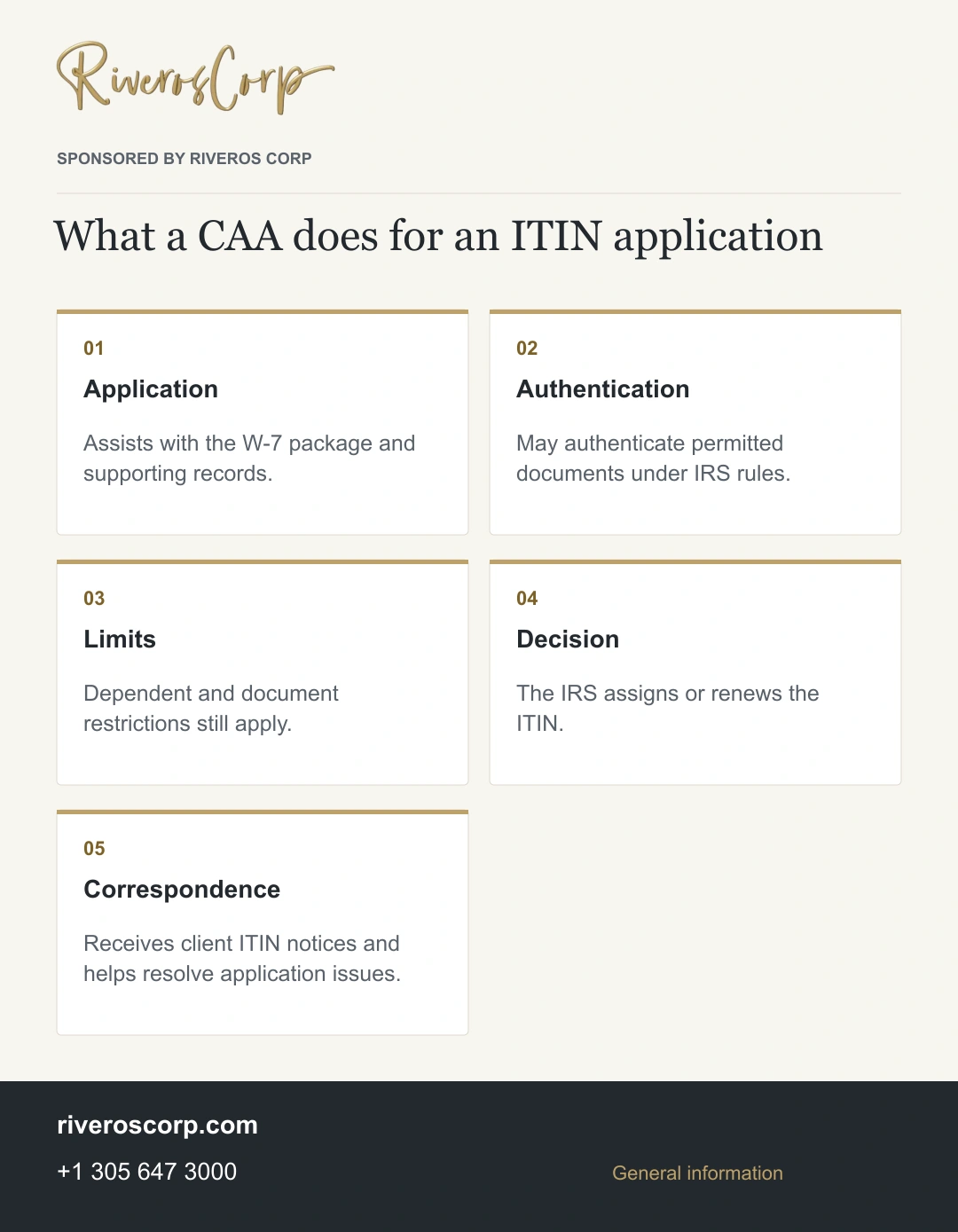
What is a Certifying Acceptance Agent? A Certifying Acceptance Agent, usually called a CAA, is a person or organization authorized under an IRS agreement to help with Individual Taxpayer Identification Number applications and authenticate certain supporting documents. The CAA prepares the applicable certification for the IRS; the IRS decides whether to assign or renew the ITIN.
A CAA can help you establish which documents support identity and foreign status. It can also affect whether particular original documents must be sent to the IRS. The answer depends on the applicant and the document, because a CAA’s authentication authority has limits.
A CAA is not an IRS employee, an immigration authority or automatically a tax adviser for every issue. Understanding the role before engaging a provider helps you ask practical questions about authorization, document handling and the exact service offered.
A regular Acceptance Agent can also help prepare an application. Its role differs because it cannot authenticate supporting documents in the same way as a CAA.
What is a Certifying Acceptance Agent authorized to do?
The IRS acceptance agent program allows approved providers to help applicants prepare Form W-7 and the required ITIN documents. A CAA can also authenticate permitted identity and foreign-status documents. It records that examination on Form W-7 (COA), the Certificate of Accuracy, which accompanies the application.
The CAA checks whether the documents support the applicant’s identity and foreign status and whether the application includes the required information. Its certificate describes that review. The IRS still evaluates the application, may request more evidence and decides whether to assign or renew the number.
You can check the provider’s listing in the IRS directory. The IRS marks ordinary Acceptance Agents with an asterisk; unmarked entries are Certifying Acceptance Agents. Riveros International Business Corp is an unmarked entry in the Florida directory. This confirms the relevant program role rather than relying on a business name or a general claim of tax experience.
A CAA and an Acceptance Agent have different document roles
An Acceptance Agent, often abbreviated AA, can assist with the ITIN application process. An ordinary AA does not have the same authority to authenticate documents for submission with a certificate of accuracy. The IRS describes different document-handling responsibilities for the two types of provider.
That difference affects an applicant who needs to retain a passport or other identity document. Choosing an AA and assuming it can perform every CAA function may lead to an unexpected requirement to send documents to the IRS. Clarify the provider’s role before handing over originals.
Neither category guarantees an approved application. The applicant still must meet the ITIN requirements, demonstrate the applicable federal tax purpose and provide acceptable documentation. A provider’s authorization helps define how an application may be prepared; it does not make an otherwise ineligible applicant eligible.
Authentication has limits for dependents and certain documents
The IRS does not give CAAs unlimited authority to authenticate any document for any applicant. Its guidance excludes foreign military identification from the documents a CAA can authenticate. For dependent applicants, CAA authentication is limited to passports and birth certificates.
Other evidence may still be necessary. A dependent’s passport, for example, may not resolve every applicable residency or eligibility requirement. The relevant question is not simply whether the CAA can inspect the passport. It is whether the complete application contains the evidence required for that particular dependent.
Ask the provider to distinguish documents it can authenticate from documents that must be submitted in another accepted form. This avoids treating the CAA designation as a promise that no original will ever leave the applicant’s possession. Each document should have a clear purpose in the package and an agreed handling process.
What the Certificate of Accuracy records
Form W-7 (COA) identifies the CAA business and the responsible party completing the certificate, as well as the ITIN applicant. It lists the supporting documents the CAA examined and records the certification that, to the best of the reviewer’s knowledge, they are authentic, accurate and complete. The responsible party signs and dates that certification.
The certificate accompanies the applicant’s Form W-7. It is not an ITIN assignment letter, and it does not replace the federal return or exception evidence when the application requires those records. Copies of the authenticated documents also accompany the certificate under the IRS requirements.
For applicants, this explains why a document appointment involves more than showing a passport number. The CAA must examine the accepted document and connect it to the person applying. An ordinary photocopy or a local certification does not automatically meet the IRS standard. Original documents, issuing-agency-certified copies and CAA authentication have specific, different roles in the application.
Document authentication and tax preparation are separate services
A CAA may offer tax return preparation as part of its business, but the CAA designation alone does not describe every professional qualification or service. Applicants should ask whether the engagement includes a federal return, document authentication, renewal assistance, correspondence support or only some of those tasks.
The difference matters because a W-7 application generally accompanies a federal tax return unless an exception applies. Someone may need a tax professional to determine filing obligations before an agent can assemble the appropriate ITIN package. Authentication cannot answer whether a treaty claim, dependent benefit or filing position is legally correct.
Our ITIN application overview explains how the number and the application fit into the tax filing process. Check whether your engagement includes the return as well as the ITIN package; those services require different work.
Confirm that an ITIN is the correct number
An ITIN is generally for someone who needs a federal taxpayer identification number and is not eligible for a Social Security number. The need for a bank account or a convenient identity number does not automatically establish eligibility. Identify the federal tax purpose before preparing the application.
The provider should also ask whether the applicant already has an ITIN and whether circumstances have changed. An expired number, a previously rejected application and a newly assigned Social Security number each raise different questions. Treating every inquiry as a first application can create avoidable inconsistencies.
The number has limited legal significance. It does not grant immigration status, authorize employment or establish entitlement to Social Security benefits. Readers can review our guide to an ITIN tax ID for foreigners for that distinction. A provider should explain those limits without implying that authentication changes them.
Questions to ask before sharing identity documents
Ask whether the provider is acting as a CAA, an AA or a document preparer outside those roles. Then ask which services are included, which documents it can authenticate and whether any originals must be sent elsewhere. The answers should be specific to your application.
Also clarify how the provider handles IRS notices. Some issues concern a missing document; others require a substantive tax review. An engagement should explain who receives correspondence, how you receive a copy and whether responding to a later notice is included in the service.
Ask how the provider protects your records. Confirm the submission method, who has access and how the provider returns originals. Do not post a complete passport, ITIN or tax return in an unsecured public message to prove that you are ready to proceed. Share the records through an agreed process after establishing what the provider needs.
What to organize before the appointment
Gather the identity documents requested for review, any existing ITIN assignment notice and relevant IRS correspondence. If the application relates to a return, have the tax information needed to establish the filing purpose. Explain prior applications and name changes rather than leaving the provider to discover them later.
For a dependent, be ready to discuss the relationship, the claimed tax purpose and any evidence needed under the applicable instructions. A renewal review needs the existing number and relevant filing history. For a claimed exception to the return attachment requirement, identify the records supporting that exception.
This preparation gives the reviewer the facts already documented and identifies questions that still need an answer. If records conflict, preserve the source documents and explain the conflict honestly. Do not edit dates or names merely to make an application package appear consistent.
What happens after the CAA submits the application
The IRS can approve the application, request missing information or reject it. A CAA receives copies of the client’s ITIN notices and can work with the IRS to resolve application issues. Keep your own copies too, including the submitted W-7, the relevant return or exception evidence and later correspondence.
A request for another identity document differs from a disagreement about a position taken on the tax return. The CAA can handle matters within the ITIN application role; a substantive tax issue may need the return preparer or another qualified tax professional. Read the notice as a whole so the response addresses what the IRS actually requested.
If the IRS assigns or renews the ITIN, preserve the official notice with the tax records. If it does not, keep the explanation and review the missing requirement before submitting again. The CAA’s certificate proves that the agent completed the stated document review; it does not promise the IRS’s decision or give the applicant immigration status.
ITIN preparation and certification with Riveros Corp
Riveros Corp offers ITIN preparation and CAA certification through Riveros International Business Corp. Its IRS directory entry supports the CAA role described here. The service includes preparing Form W-7, reviewing the supporting documents within that authority and following up on application correspondence.
Bring an existing ITIN notice if you are renewing, or the IRS explanation if a previous application was rejected. For a new application, explain the federal tax purpose and whether you are eligible for an SSN. This gives the team the information needed to distinguish a first application from renewal or correction of an earlier package.
Riveros Corp does not provide tax planning through this service. If residency, a treaty position or a claimed dependent benefit remains unresolved, the tax professional responsible for the return needs to determine that issue. Once the tax purpose is established, the application and identity documents can be prepared to reflect it.
Frequently asked questions
Is a Certifying Acceptance Agent an IRS employee?
No. A CAA operates under an agreement with the IRS but is not an IRS employee simply because of that authorization. The agent assists with the application and permitted document authentication. The IRS retains responsibility for reviewing the application and assigning or renewing the ITIN.
Can a CAA issue my ITIN during an appointment?
No. A CAA cannot issue the number. An appointment may allow document review and preparation of the required materials, but the application still goes through the IRS process. A provider should explain submission and correspondence arrangements without promising that the number will be assigned immediately.
Can every CAA authenticate all documents for a child?
No. For dependents, the IRS limits CAA authentication to passports and birth certificates. Additional evidence may be required, and other documents may need a different accepted submission method. Ask about the complete dependent application rather than assuming that a passport review resolves every requirement.
Does using a CAA guarantee that I keep every original document?
No. The answer depends on the applicant, the document and the accepted authentication rules. A CAA can authenticate certain documents, but its authority has limits. Confirm the handling of each original before submission, particularly when the document is needed for travel or another pending matter.
Will the CAA receive a copy of my IRS ITIN notice?
The IRS states that CAAs receive copies of their clients’ ITIN notices and can help resolve issues with submitted applications. Keep the notice sent to you as well. If either copy identifies missing information, the response should address that request. Application follow-up does not by itself include representation in a separate tax dispute.
Arrange ITIN preparation and CAA certification
Contact Riveros Corp at +1 305 647 3000 or through WhatsApp for W-7 preparation and CAA document certification. Tell the team whether this is a new application, a renewal or a response to an IRS notice so it can identify the records needed for your appointment.
By Zulma E Bourelly. General information only. Individual legal and tax questions require advice from an appropriately qualified professional.