The types of power of attorney describe different features of a document: its scope, duration, starting point, and subject. These features can overlap. For example, one instrument can grant limited authority and remain effective after the principal later loses capacity.
Therefore, choosing a label is only part of the planning. The person granting authority, called the principal, needs a document that reflects the intended acts. Its wording and execution must also satisfy the applicable law.
Notary Public Center coordinates signing and notarization for eligible documents. A licensed attorney should advise on which authority to grant and how to express it. This comparison explains the main categories and the issues to resolve before the appointment.
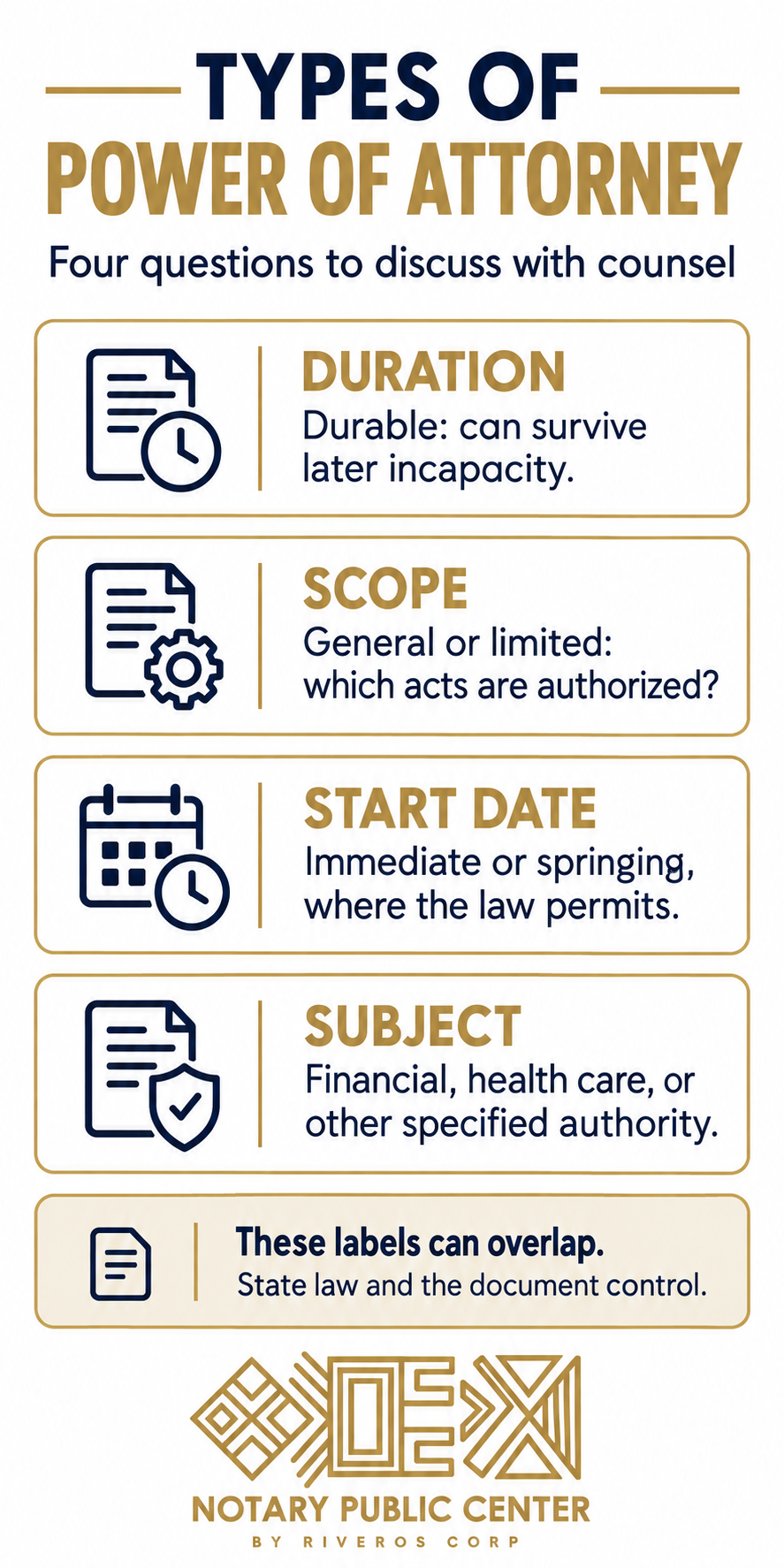
Types of power of attorney: four separate questions
First, consider scope. A general instrument usually addresses several categories of financial activity, while a limited instrument focuses on a defined matter. However, neither label substitutes for the actual grant of authority.
Next, consider duration and effectiveness. Durability concerns the effect of later incapacity. Immediate or springing terms address when the agent may begin acting. These questions are related, but they do not mean the same thing.
Finally, identify the subject. Financial decisions, health care, and a particular transaction may require different provisions or documents. State law determines which arrangements are available and how the principal must execute them.
Durable authority and later incapacity
A durable power of attorney can remain effective after the principal’s later incapacity, subject to the document and governing law. It does not last indefinitely under every circumstance. Death, revocation, court action, or another termination event can still affect authority.
Florida requires statutory durability language or similar words showing the principal’s intent to continue authority despite later incapacity. By contrast, New York’s financial-power statute generally treats a power as durable unless it expressly ends on incapacity. Consequently, the state default matters.
A document may grant broad or narrow authority and still be durable. For example, durability can matter when someone needs continuing authority over a specified account. Counsel should assess both the duration and the scope the situation requires.
General types of power of attorney
A general power of attorney commonly grants authority over multiple financial matters. These may include accounts, property, contracts, or other specified activities. The document and applicable law define the actual powers.
General does not mean unrestricted. In Florida, a blanket statement allowing the agent to do everything the principal could do does not supply every specific grant. Certain sensitive powers also require separate approval.
Therefore, a reviewer should look beyond the document’s title. Authority to manage an account may differ from authority to change its beneficiary. An agent should obtain legal advice when the proposed act goes beyond the clear grant.
Special or limited authority for a defined matter
A special or limited power of attorney focuses on a transaction, asset, or category of acts. A principal might use one for a particular property closing or another defined matter. However, the necessary scope depends on the entire transaction.
A document that mentions one signature may omit related acts the agent needs to complete. Conversely, overly broad wording may grant more authority than the principal intends. Counsel can address that balance before execution.
The instrument can also specify an ending condition where the law permits. Our discussion of a special power of attorney explains why the transaction details and receiving party’s requirements matter.
Springing types of power of attorney
A springing power begins upon a future event or condition where applicable law permits that structure. Incapacity is one possible trigger. The document should identify the event and how the agent will establish that it occurred.
Florida generally makes a power exercisable when executed and rejects future-date or future-event terms. Statutory exceptions include certain pre-October 1, 2011 instruments conditioned on incapacity and military arrangements. An attorney should assess those exceptions rather than relying on the label.
Other states may permit different terms. New York, for example, recognizes specified dates or contingencies subject to its requirements. Consequently, a springing provision that works under one state’s law may create problems elsewhere.
Evidence of the triggering event
Where springing authority is available, the receiving institution may need evidence that it has begun. The document may call for a written determination or another specified record. Ambiguous language can create uncertainty at the time of use.
This does not make every springing instrument unsuitable. It does mean that the principal and attorney should consider the trigger, evidence, and intended recipient together. The choice depends on the person’s needs and the governing law.
Compare the types of power of attorney
The following table compares features rather than mutually exclusive forms. A single instrument can combine several rows. Its title alone does not establish validity, authority, or acceptance.
| Feature | Question it answers | What to confirm |
|---|---|---|
| Durable | Can authority survive later incapacity? | Required wording, applicable default, and termination rules |
| General | Does the grant cover several categories of activity? | The specific powers actually granted and any exclusions |
| Special or limited | Does authority address a defined matter? | All necessary acts, limits, and ending conditions |
| Springing | Does authority begin after a future event? | Whether permitted and what evidence establishes the trigger |
| Health care | May the representative make medical decisions? | Express authority and applicable health care law |
Financial authority and health care decisions
A financial provision does not automatically authorize medical decisions. However, it is inaccurate to say that Florida prohibits health care authority in a durable power of attorney. Section 709.2201 permits an express grant of that authority.
Florida also provides for health care surrogate designations and other advance directives under chapter 765. These documents can address treatment and information access under their own rules. Their relationship with any existing power needs review.
Therefore, the principal should discuss the whole arrangement with counsel. Paying a hospital bill, obtaining health information, and consenting to treatment are different tasks. Clear authority helps the representatives understand which decisions each may make.
Types of power of attorney and special Florida powers
Florida section 709.2202 requires the principal to sign or initial beside specified grants of sensitive authority. Examples include making gifts, changing beneficiaries, creating survivorship rights, and certain trust actions. The law also imposes conditions on their exercise.
Consequently, a general grant may be insufficient for an intended estate-planning transaction. The principal should understand the effect of each proposed power. A notary cannot select those powers or provide the legal advice needed to evaluate them.
Separate approval does not authorize conduct that violates the agent’s duties or other applicable restrictions. The agent must also consider the document’s limits. This remains true when the agent is a close relative.
Banking and investment authority
Florida section 709.2208 offers statutory wording that grants specified banking or investment authority without listing every covered act. It provides a useful drafting mechanism. However, omitting that reference does not automatically eliminate every possible financial power.
A specifically described transaction may have another valid grant. Conversely, a document titled general power of attorney may lack the authority a particular request needs. Therefore, counsel should review the actual language against the proposed act.
The institution may also request supporting information allowed by law. Florida limits improper rejection and demands for a different form when the existing instrument grants the authority. Those protections do not make notarization a guarantee of immediate acceptance.
Signing requirements depend on the state
For a Florida execution under section 709.2105, the principal signs before two subscribing witnesses and acknowledges the instrument before a notary or other authorized officer. The applicable process also addresses a principal who cannot physically sign.
New York’s financial-power rules require an acknowledged principal signature and two qualified witnesses. The acting agent also signs with acknowledgment. A witness is not automatically required to have a separately notarized signature.
California’s general rule under Probate Code section 4121 calls for a dated instrument and required signature, with acknowledgment or two qualified witnesses. Other requirements can affect the particular use. Our guide to Florida execution requirements examines that state’s process.
Remote notarization and witnesses
Remote notarization does not make every witness arrangement valid. Florida imposes additional safeguards for specified documents and limits remote witnessing of certain powers. The principal’s circumstances and location can also affect the plan.
Therefore, disclose the proposed document and arrangements before booking. If witnesses must be physically with the principal, a remote notary appointment alone will not supply them. The team should confirm eligibility before the signing.
Capacity and voluntary execution
All types of power of attorney require attention to the principal’s ability to grant the proposed authority. Age alone does not establish incapacity. However, the ability to write a signature does not by itself establish the required understanding.
Any concern about confusion, pressure, or the effect of medication should reach the advising attorney. The notary has separate duties concerning identity, understanding, and voluntary execution. A seal cannot cure a lack of legal capacity.
Our article on a power of attorney for an elderly parent discusses related issues. If new execution is no longer possible, counsel can assess existing authority and lawful alternatives.
When authority ends or changes
Durable does not mean irrevocable. A principal may revoke authority subject to applicable capacity and legal requirements. Death also ends the power; the agent should not treat it as authority to administer the estate afterward.
In Florida, other termination or suspension events can arise from the document, completion of its purpose, changes affecting the agent, or court proceedings. Specific rules and exceptions govern those events. Therefore, an agent should seek advice when circumstances change.
Notice also matters to the people relying on the instrument. Our explanation of revoking a power of attorney addresses that issue. Preparing a replacement does not justify assuming that every prior recipient knows about it.
Common mistakes when comparing types of power of attorney
One mistake is treating general and durable as competing choices. Another is assuming that a broad financial grant necessarily covers gifts or medical decisions. The wording and applicable law must support each intended act.
Similarly, a limited instrument can fail to address related steps in a transaction. A springing provision can create an unavailable or unclear trigger. These are drafting questions to resolve with counsel before the notarial appointment.
Finally, distinguish valid execution from the receiving party’s review. The recipient may need permitted evidence of continuing authority, a translation, or another supporting record. International use can also require authentication, without guaranteeing acceptance of the underlying powers.
How Notary Public Center supports execution
Notary Public Center coordinates the notarial arrangements after the document’s legal requirements are clear. The team can discuss location, identification, witnesses, and whether an online appointment is appropriate. It can also coordinate relevant authentication needs for international use.
However, the principal must make the decision to grant authority. A licensed attorney should advise on drafting and legal consequences. No signing service can promise error-free execution under every circumstance or guarantee a receiving institution’s decision.
Provide the complete document and known destination requirements before scheduling. This allows the team to identify practical issues early. Timing depends on participant availability, eligibility, and any questions that still need resolution.
Types of power of attorney: common questions
Can a power be both general and durable?
Yes. General describes scope, while durable addresses later incapacity. A document can combine those features if its wording and execution satisfy the governing law. Neither label creates powers that the document does not grant.
What type may suit one transaction?
A special or limited power may address a defined transaction. However, counsel should consider all necessary acts and any intended limits. The title alone does not establish that the agent can complete the matter.
Are springing powers valid everywhere?
No. State law controls their availability and activation requirements. Florida generally rejects future-event terms, subject to statutory exceptions. An attorney should assess the relevant state rules and any proposed trigger.
Does general authority automatically allow gifts?
No. Florida requires separate signed or initialed grants for specified powers, including gifts and beneficiary changes. Conditions and fiduciary duties also apply. Counsel should review the planned act before the agent proceeds.
Can a durable power include medical decisions?
Florida permits an express grant of health care decision-making authority in a durable power. However, financial authority alone does not provide it. Separate advance directives may also apply and should be coordinated.
Do all types require the same notarization?
No. State law, the document, and its intended use determine execution requirements. Florida and California, for example, have different general witness and acknowledgment rules. Confirm the applicable process before arranging the appointment.
Discuss the signing your document requires
Contact Notary Public Center with the document, signing location, and intended destination. Call +1 305-507-8464 or use WhatsApp. The team can assess the notarial arrangements and explain what information is needed to schedule.
This publication provides general information, not legal advice. A licensed attorney should advise on powers, drafting, capacity, and legal disputes. Notarization does not guarantee legal sufficiency, acceptance, or a particular result.