
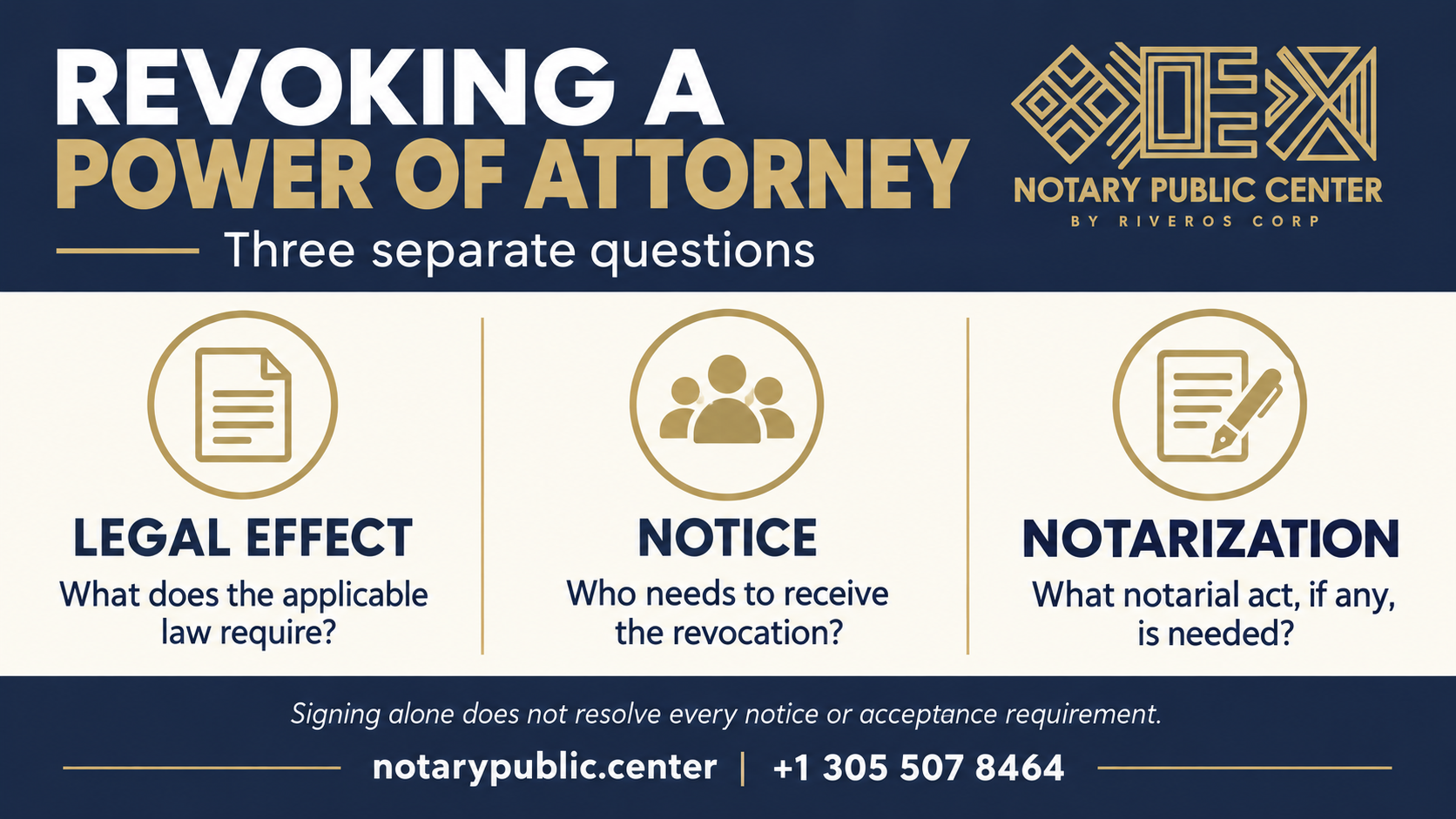
To revoke a power of attorney, a principal must consider both the legal requirements for ending the authority and the notice others need. Signing a document does not necessarily stop every institution from relying on an earlier power. However, notice is not the only issue: the governing law, the document and the principal’s capacity also matter.
This article uses Florida law to explain those distinctions. Other states and countries may apply different rules. Notary Public Center can coordinate an appropriate notarial appointment, while a licensed attorney should determine the legal language, scope of revocation and any protective action your circumstances require.
What it means to revoke a power of attorney
A power of attorney allows an agent to act for the person granting authority, known as the principal. Revocation withdraws that authority as provided by the applicable law and document. It differs from asking the agent to postpone a particular transaction.
In Florida, a principal may express revocation in a later power of attorney or in another writing signed by the principal. Importantly, simply executing a new power does not automatically revoke an earlier one. The later document must express the revocation for that statutory method to apply.
Therefore, several documents can raise questions about overlapping powers. A lawyer should review their wording rather than assume the most recent date settles everything. The principal may want to replace one agent, withdraw a particular authority or end the entire arrangement.
Our overview of types of power of attorney explains why the underlying instrument matters. A limited authorization, a durable financial power and a health care designation can involve different purposes and rules.
Capacity to revoke a power of attorney
The principal’s ability to understand and make the decision requires attention. A family member’s preference does not, by itself, authorize that person to revoke the principal’s power. Likewise, a disagreement with the agent does not establish that the principal lacks capacity.
Durability does not mean that a power is irrevocable. Instead, it concerns whether authority can continue after the principal’s incapacity, subject to applicable limits. The ability to revoke remains a separate question.
If capacity is uncertain, a lawyer should assess the available options before arranging signatures. A notarial appointment cannot resolve a contested capacity issue or replace a court order when one is necessary.
Florida also restricts notarization when the signer appears unable to understand the nature and effect of the document. Certain court findings create additional restrictions. Consequently, presenting identification and obtaining a stamp cannot overcome every legal obstacle to execution.
Notice matters when you revoke a power of attorney
Florida distinguishes termination of authority from its effect on people who lack knowledge of that termination. An agent who acts in good faith without that knowledge may receive statutory protection. That protection does not excuse conduct that is otherwise invalid or unenforceable.
Third parties also have protections when they accept and rely on a power in good faith under the statutory conditions. However, lack of a notice letter does not automatically establish good faith in every dispute. The surrounding facts and the person’s knowledge matter.
For that reason, a dated revocation and proof of relevant communications answer different questions. The first records the principal’s action. The second helps establish what a particular recipient received and when.
A lawyer can identify the parties whose reliance needs attention. Depending on the arrangement, they may include the agent, financial institutions or people handling a pending transaction. Notifying one recipient does not establish that every other recipient knows.
Florida's notice rules include an important timing distinction
Florida law calls for written notice through a suitable method likely to result in receipt. It also sets particular content and routing requirements for notice to financial institutions and broker-dealers. An informal conversation may therefore leave important questions unresolved.
The statute includes a special timing rule for financial institutions, brokerage companies and title insurance companies. Notice to those recipients does not become effective until five days after receipt, excluding Saturdays, Sundays and legal holidays.
Accordingly, it would be inaccurate to promise that a bank must treat every revocation as effective immediately upon delivery. The applicable timing and the circumstances of a disputed transaction require legal assessment.
If money or property may be at immediate risk, seek prompt legal assistance and contact the relevant institution’s appropriate department. Ask about available protective measures. A signing appointment alone should not serve as the response to suspected ongoing misuse.
Do you need notarization to revoke a power of attorney?
Florida’s general revocation provision refers to a writing signed by the principal. It does not impose notarization as a universal requirement for every separate revocation. Nevertheless, recording, a recipient’s requirements or use in another jurisdiction may raise additional issues.
When notarization is appropriate, the notary performs the specified notarial act. An acknowledgment concerns the signer’s acknowledgment of execution; it does not establish that every clause achieves the intended legal result.
Also, notarization does not provide universal acceptance. A bank, registry or foreign authority may have other requirements that the notarial certificate does not address. The legal document and the destination should therefore guide the appointment.
Our article about notarizing a power of attorney explains the notary’s role. It is useful to distinguish that role from choosing legal language, resolving disputes and deciding whether notice is legally sufficient.
When authority may end without a separate revocation
Florida law identifies events that can terminate a power or an agent’s authority. Examples include the principal’s death, completion of the power’s purpose and termination specified in the document. Incapacity can also affect authority, with important distinctions involving durability and court orders.
An agent’s death, incapacity, resignation or removal by a court can end that agent’s authority. Whether another agent may act then depends on the document and law. Thus, the end of one person’s role does not always end the entire arrangement.
For a spouse-agent, filing an action for dissolution, annulment or legal separation generally terminates authority under Florida’s provision unless the power states otherwise. This rule does not automatically remove unrelated agents named in the same instrument.
These events may affect the legal analysis before anyone signs a new document. However, relevant recipients may still need notice. A lawyer should assess both the terminating event and the communications necessary in the particular case.
Incapacity proceedings have exceptions
A pending proceeding concerning incapacity can suspend authority under Florida law. However, the rule contains exceptions for certain family-member agents and specific circumstances. It would be misleading to say that every petition suspends every power immediately.
The statute also treats health care authority separately in this context, unless the court orders otherwise. A health care directive and a financial power may therefore require different analysis.
If a proceeding is already pending, tell the attorney and notarial service before scheduling execution. The court’s orders, the agent’s relationship and the type of authority may affect what can happen next.
Family concerns deserve careful handling without assuming that age alone settles capacity. Our discussion of a power of attorney for an elderly parent addresses planning questions that can arise when relatives coordinate assistance.
Recorded powers and real estate transactions
If the original power appears in public land records, the revocation may also require attention in those records. Tell the lawyer or title professional about the recording and any pending sale, mortgage or closing.
Recording requirements differ from the general requirements for a signed revocation. In Florida, instruments concerning real property may require an acknowledgment or another legally permitted proof for recording. The appropriate form depends on the document and circumstances.
Moreover, returning the original paper does not remove copies already held by other people. It also does not erase a recorded document. A title professional should assess what the public record and transaction file need to show.
The relevant question is not simply whether the revocation carries a notarial stamp. The review must consider identification of the earlier instrument, recordability and any notice required outside the recording system. Avoid assuming that one filing answers every issue.
Revocation for use outside the United States
A foreign recipient may require a translation, notarization, apostille or another form of authentication. However, the revocation does not necessarily follow the exact certification route used for the original power. The receiving jurisdiction and the current purpose determine the requirements.
An apostille authenticates specified aspects of an official signature or seal. It does not decide whether a foreign court or registry will give the revocation the legal effect intended.
Consequently, confirm the recipient’s requirements before ordering additional services. A local attorney or the relevant authority may need to explain the substantive and filing requirements in the destination country.
Notary Public Center can discuss the requested notarial service and coordination needs. That assistance should remain separate from a promise that an overseas institution will accept the document or stop a transaction by a particular date.
Replacing an agent when you revoke a power of attorney
Some principals want to end an arrangement without appointing anyone else. Others still need help managing specified matters. Therefore, a replacement power is a planning decision, not a universal requirement of revocation.
If a replacement is appropriate, the attorney should determine how its scope and timing interact with the earlier instrument. Avoid assuming that signing both documents during one appointment automatically resolves conflicting provisions or notice obligations.
Practical arrangements also deserve attention. The new agent may need documents for the institutions involved, while the principal may want to retain direct control over particular decisions. Those preferences should guide the legal advice.
A clear division of tasks helps everyone understand what the appointment can accomplish. Legal drafting, notarization, delivery and institutional processing can occur at different times. Confirm who is responsible for each part rather than treating a completed signature as proof that the entire matter is closed.
Questions to resolve before the notarial appointment
An organized consultation helps identify issues that require legal review. The following comparison explains the purpose of common questions; it is not a substitute for a revocation drafted for your circumstances.
| Question | Why it matters |
|---|---|
| Which instrument and authority are involved? | The wording must address the intended document and scope. |
| Who currently relies on the power? | Different recipients may require separate notice and processing. |
| Is a transaction or court proceeding pending? | Timing, court orders or urgent protective measures may affect the response. |
| Was the power recorded or used abroad? | Additional recording, certification or destination requirements may apply. |
| Will another agent take over? | A replacement should reflect the principal's wishes and the applicable law. |
Keep the distinction between a service request and a legal conclusion. Knowing where a document will go helps coordinate the appointment. It does not authorize a notary to decide disputed legal rights or guarantee the recipient’s response.
Frequently asked questions about revoking a power of attorney
Does a new power automatically cancel the old one in Florida?
No. Florida’s statute distinguishes a later power that expresses revocation from one that does not. An attorney should assess overlapping documents and the intended change.
Can I revoke a durable power of attorney?
Durability does not mean irrevocability. The principal’s capacity, applicable law and circumstances still matter. If capacity is disputed, obtain legal advice before arranging execution.
Will a notary notify my bank automatically?
No. The notarial act does not automatically notify institutions or update their records. Confirm separately who will handle notice, the required method and any applicable processing rules.
Does notarization guarantee the revocation will work everywhere?
No. Notarization addresses a particular notarial act. Legal effect, notice, recording and acceptance may involve additional requirements, especially when the document will go abroad.
Must I appoint a replacement agent?
Not in every case. The decision depends on your needs and legal circumstances. Discuss whether continuing assistance is necessary and how a replacement would interact with existing documents.
Coordinate your signing with Notary Public Center
If you need to revoke a power of attorney and require notarization, contact Notary Public Center. Explain where the document will go and whether an attorney has prepared the final text. We can discuss the available appointment and the requirements for the requested notarial act.
Reach us through WhatsApp at +1 305 507 8464. Mention any relevant deadline so the scheduling discussion reflects your needs. For legal drafting, disputed authority or urgent protection, consult a licensed attorney; the notarial service does not replace that advice.
This article provides general information using Florida law as an example. It does not constitute legal advice or establish an attorney-client relationship. Other jurisdictions and individual circumstances may require a different approach.