What is Form W-8BEN? It is a U.S. tax certification generally used by a foreign individual to document beneficial ownership and foreign status for specified withholding and reporting purposes. When applicable, it can also support a claim for benefits under an income tax treaty.
The form usually goes to the bank, payer or other withholding agent requesting it. It is not an application for an ITIN, a tax return or a document granting immigration status. Signing it makes factual certifications that should match the person’s actual tax circumstances.
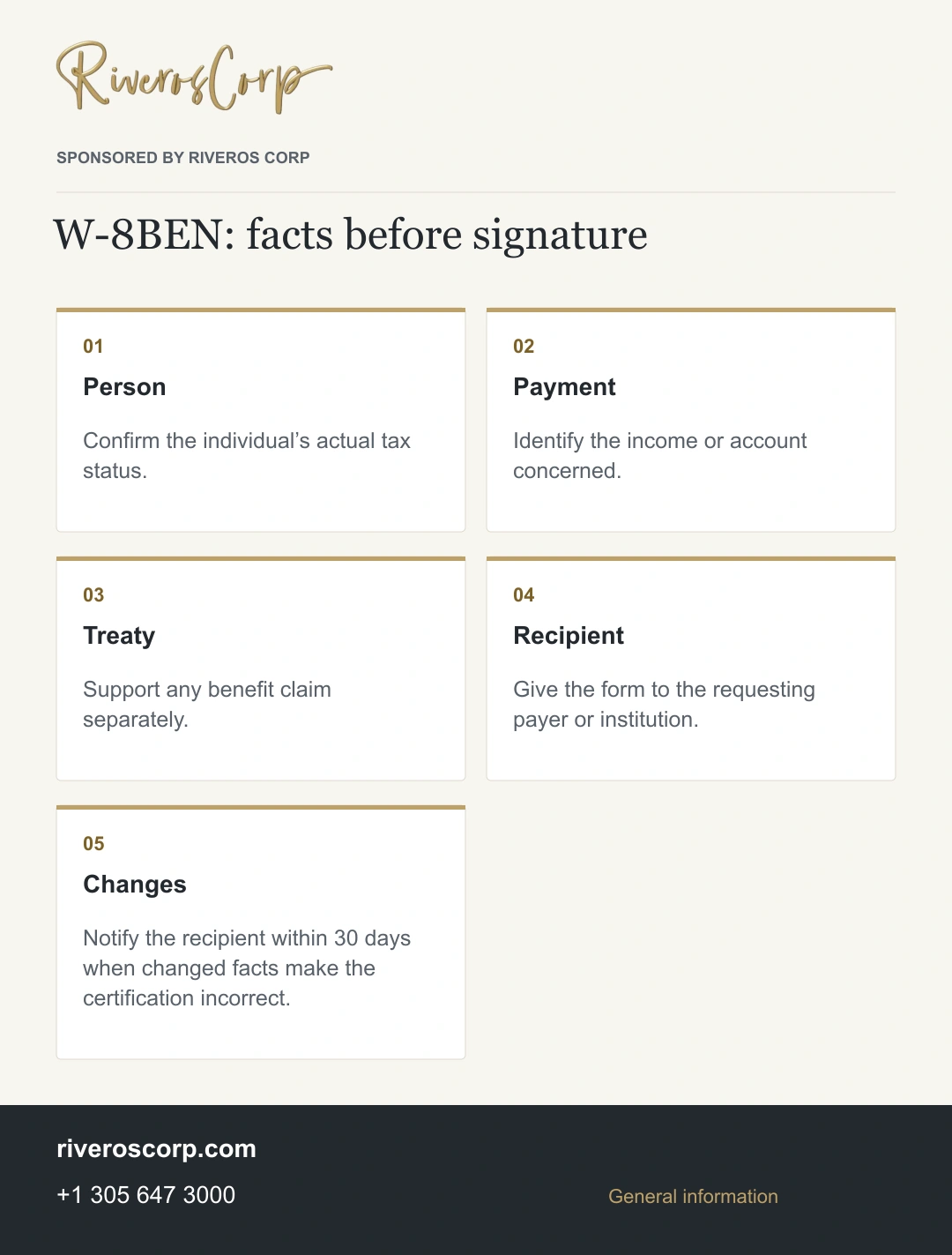
Before signing W-8BEN, check the facts behind the certification. The individual’s U.S. tax status, the nature of the income and any proposed treaty claim need review. A foreign passport alone does not establish that every certification on the form is appropriate.
The payer uses the certification to document an account or payment. It may later need a replacement if the facts change or the form expires. Keeping the request with your copy makes it easier to identify what an update needs to address.
What is Form W-8BEN intended to establish?
The form allows a foreign individual to provide information a withholding agent needs when applying relevant U.S. tax withholding and reporting rules. The certification concerns the person identified on the form and, where applicable, the income or account involved.
Foreign status and treaty eligibility require separate support. A person may properly certify foreign status while having no basis for a reduced treaty treatment on a particular payment.
Likewise, an accepted form does not decide every annual filing obligation. The individual may still need a separate review of whether a U.S. return or another report is required. The payer’s documentation process and the taxpayer’s own reporting responsibilities should be evaluated independently rather than treating one signed form as a complete tax clearance.
Tax residence determines which certification fits
W-8BEN generally applies to a nonresident alien individual for the purposes described in the instructions. U.S. citizens, including those living abroad, and other U.S. persons generally use Form W-9. A noncitizen can also be a U.S. tax resident through the green card test or the substantial presence test.
The substantial presence test considers days in the United States under a weighted three-year calculation, with exclusions and exceptions. Treaty residence can introduce additional questions. This is why the address on an account or the passport used to open it may not establish the person’s tax status.
Provide the tax professional with the relevant travel and residence history if the answer is uncertain. That classification is used for tax documentation. It grants no visa, employment authorization or other immigration benefit. An ITIN likewise identifies a taxpayer without deciding residence or immigration status.
W-8BEN is for individuals, while other forms serve other roles
Form W-8BEN-E generally serves specified foreign entities. Form W-8ECI addresses specified income connected with a U.S. trade or business, while W-8IMY covers intermediary and certain flow-through roles. The names are similar, but the certifications are not interchangeable.
A person who receives business income does not automatically need the entity form. Conversely, a corporation should not use an individual’s form merely because one person owns it. The correct documentation depends on who is treated as the beneficial owner or payee and the relevant tax classification.
For a disregarded entity, the owner generally provides the appropriate documentation. A foreign individual owner and a foreign corporate owner may therefore need different forms, subject to the applicable exceptions. Our discussion of foreign ownership of a U.S. LLC explains why formation and tax treatment differ. Before selecting a form for an LLC-related payment, have the owner, entity classification and type of income reviewed together.
Give the certification to the requesting payer or institution
The IRS instructions direct the individual to give W-8BEN to the withholding agent or payer requesting it, rather than sending it directly to the IRS as an independent filing. The institution uses the documentation to apply the rules relevant to the payment or account.
Different withholding agents may require their own documentation. A form held by one bank does not necessarily satisfy another payer’s records. An institution may also use a permitted substitute or electronic process, so the presentation can differ while still requiring the relevant certifications.
Confirm which account or income the request concerns and use the institution’s secure delivery method. Keep a copy of the signed document and submission record. If the request seems inconsistent with your status, ask for clarification and professional review rather than submitting a form you know contains an inaccurate statement.
Foreign status and treaty eligibility are separate claims
A treaty claim depends on the applicable income tax treaty and the person’s eligibility under its provisions. Residence for treaty purposes, beneficial ownership, the income category and any additional conditions may matter. Nationality alone does not establish a right to reduced withholding.
The requested treatment must fit the particular payment. A treaty provision relevant to one type of income should not be copied into an unrelated payment category. Nor should an entry used by a friend or another account holder be assumed to apply to a different person.
A treaty residence certificate, account statement and contract may each address a different part of that analysis. The adviser needs to connect the treaty provision to the income actually being paid. Keep the supporting conclusion with the account records so a later request can be answered without reconstructing the claim.
Tax identification numbers have different functions
The form can require U.S. or foreign taxpayer identification information under the applicable rules. An ITIN, an SSN and a foreign tax identification number are not interchangeable merely because each contains digits and identifies a person in some system.
Do not invent a number or use another person’s identifier to complete a field. The requirement depends on the purpose of the form and the circumstances described in the instructions. A professional should review whether an exception applies and whether the person needs a separate tax identification application.
Our guide to an ITIN tax ID for foreigners explains the limited federal tax purpose of that number. Obtaining an ITIN does not itself establish treaty eligibility or make someone a nonresident for every tax purpose. W-8BEN documents a supported status; it does not create the underlying facts.
U.S. business income and compensation can need other forms
The W-8BEN instructions generally direct an individual receiving effectively connected income to Form W-8ECI, with an exception for income allocated through a partnership. Partnership payments have their own documentation rules. Sending the money to a foreign account does not determine whether the income is connected with a U.S. business.
Compensation for personal services performed in the United States also needs separate attention. An individual claiming a withholding exemption for that compensation is directed to Form 8233 or Form W-4, as applicable. The correct form can therefore change with the nature of the payment even when the recipient is the same person.
A contract, description of the work and records showing where services were performed help the adviser analyze the payment. For investment income, the account and investment records serve a different purpose. Identify those facts before treating a bank’s general request for W-8BEN as confirmation that it fits every payment.
The usual validity period has exceptions
Generally, W-8BEN remains effective from the signing date through the last day of the third succeeding calendar year, unless a change in circumstances makes information incorrect. For example, under that general rule, a form signed in 2026 would run through December 31, 2029, if no disqualifying change occurs. Certain conditions allow the form to remain effective indefinitely until a change in circumstances.
The general rule is not simply three years from the exact signing day. It also is not permission to leave a known error uncorrected until a calendar expiration date. A form that no longer reflects the facts requires attention even if the ordinary validity period has not ended.
Keep the signing date and the requesting institution’s renewal notices with the account records. If the institution requests an updated form, review the current facts rather than automatically reproducing the previous document. A renewed signature should reflect a current certification, not an assumption that nothing could have changed.
A change in circumstances may require prompt replacement
The IRS instructions require notification to the withholding agent, payer or relevant financial institution within 30 days when a change makes the form’s information incorrect. The appropriate new documentation depends on the changed facts.
A move to the United States can affect a foreign-status certification. A move outside the country supporting a treaty claim can also matter. These examples illustrate why an address change and a tax-status review sometimes overlap, but not every foreign address change has the same consequence.
Review changes in tax residency, the income involved and any treaty position with a qualified professional. Do not wait for a bank’s routine renewal cycle when you know the existing certification is inaccurate. Keep evidence of the update so the account record and the tax position remain understandable together.
Keep tax advice and identification services separate
A useful review file identifies the person, the requesting institution and the account or payment concerned. Include relevant tax identification records, residence information and the documents behind any proposed treaty claim. Keep the dated previous certification too, if the institution is asking for an update.
Riveros Corp’s English overview of U.S. taxes for foreigners and nonresidents provides related background. If the tax review establishes that an ITIN is needed, its ITIN service covers W-7 preparation and the document certification available through its Certifying Acceptance Agent role. Obtaining that number is a separate task from determining a W-8BEN treaty claim.
Our overview of the ITIN application process explains that identification process. The qualified tax adviser resolves residence, income classification and treaty eligibility. Riveros can discuss the required ITIN documents when that service is relevant; the payer receives the supported tax certification.
Frequently asked questions
Do I send Form W-8BEN to the IRS?
Generally, no. Give it to the withholding agent, payer or institution requesting it. It is documentation for that recipient’s withholding and reporting responsibilities. Keep a copy for your records. The form does not replace any separate tax return or report you may be required to file.
Does W-8BEN prove that I owe no U.S. tax?
No. It documents specified facts for withholding and reporting purposes. Tax liability and return filing obligations depend on the applicable law and the person’s circumstances. A foreign-status certification is not a general exemption from every U.S. tax obligation or a government determination that no return is needed.
Can a foreign citizen who is a U.S. tax resident use it?
Foreign citizenship alone does not establish eligibility to certify foreign status. U.S. persons generally use W-9, and residency questions can require professional review. Do not select W-8BEN solely from the nationality shown on a passport when the person’s U.S. tax status may be different.
Does signing the form automatically secure treaty benefits?
No. A treaty claim must satisfy the relevant treaty and documentation requirements. Residence, income type and other conditions can matter. A qualified professional should establish the basis for the claim before the person signs. The form cannot create a treaty entitlement that the facts do not support.
Must I wait until the form expires to report a change?
No. A change that makes the information incorrect requires attention under the IRS instructions, including the notification requirement. The ordinary expiration period does not preserve an inaccurate certification. Ask which replacement documentation fits the new circumstances and retain evidence that the institution received the update.
Discuss an ITIN need identified in your tax review
If your tax adviser identifies a need for an ITIN, call Riveros Corp at +1 305 647 3000 or contact the team through WhatsApp about W-7 document preparation and certification. Share the purpose of the request so the team can explain the documentation its ITIN service requires.
By Zulma E Bourelly. General information only. Individual legal and tax questions require advice from an appropriately qualified professional.