An administratively dissolved LLC in Florida has lost its active status through an administrative action by the Department of State. The company still exists, but Florida law limits its activities while that status remains in place. A missed annual report is one possible cause. Failure to maintain a registered agent can also lead to dissolution.
The words on the public record can be alarming, especially when a bank, customer or business partner discovers them first. They do not tell the whole story. The date, reason and subsequent filings determine what needs to be reviewed next.
Florida permits an administratively dissolved LLC to apply for reinstatement. That process concerns the same company. Forming a new LLC is a different action and does not automatically transfer the old company’s contracts, assets or obligations. Choosing between those routes calls for more than comparing the names available on the register. Keep the Department’s notice with the filing history so the review can establish why the lapse occurred.
What administratively dissolved means in Florida
Administrative dissolution is a state corporate-record action. It differs from a member decision to dissolve, a judicial dissolution and a bankruptcy proceeding. Those processes can involve different authorities, documents and consequences. The correct route begins with identifying the status that actually appears on the LLC’s record.
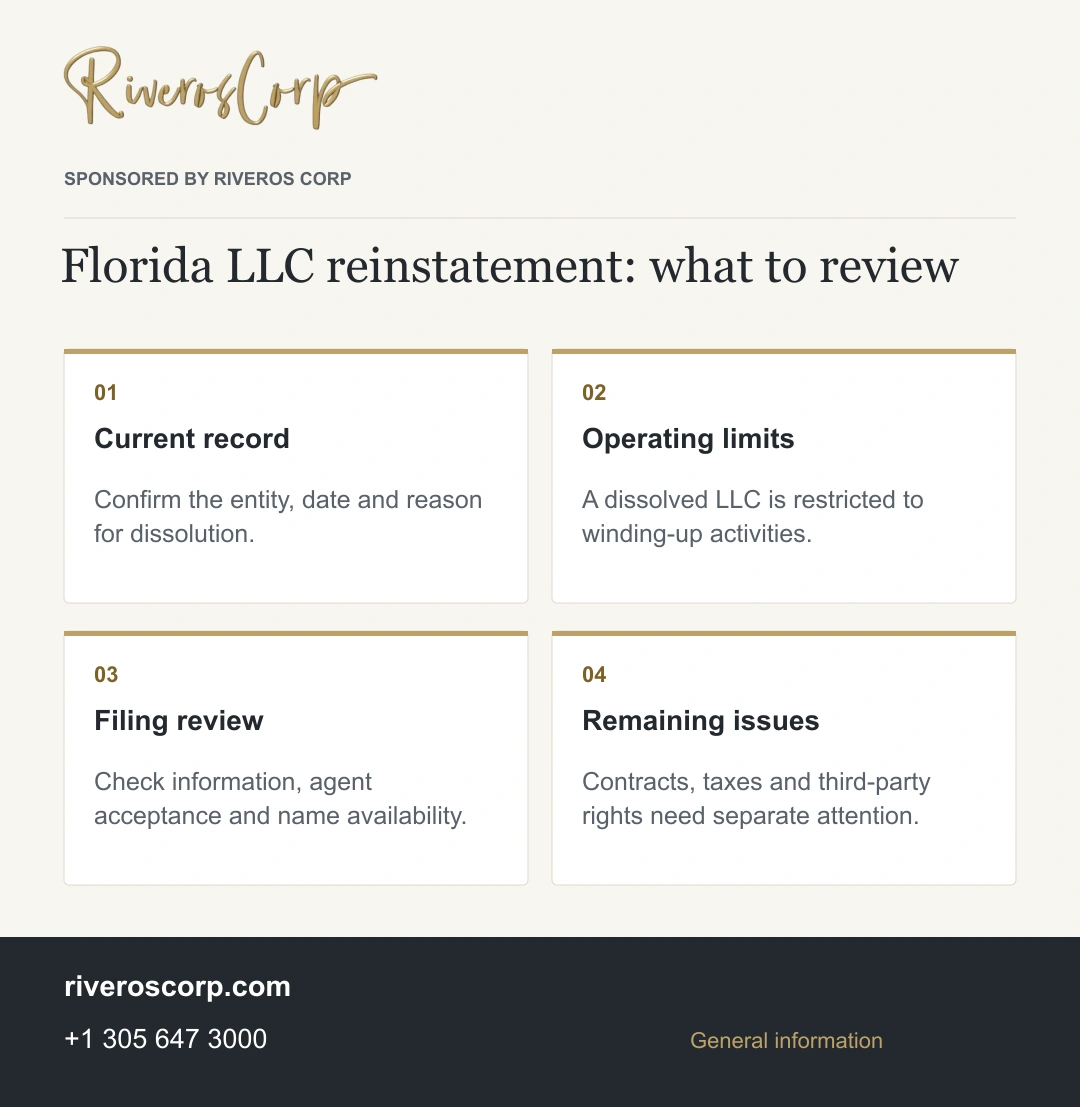
Florida Statutes section 605.0714 states that an administratively dissolved LLC continues in existence. However, it may only carry on activities needed to wind up its affairs, liquidate and distribute assets, and notify claimants under the applicable provisions. An owner should not treat continued existence as permission to carry on ordinary business without limits.
The statute also preserves the registered agent’s authority for service of process after administrative dissolution. Legal papers may therefore still reach the company. Ignoring them because the record says “inactive” can create a separate problem that a reinstatement filing will not necessarily solve.
The status entry describes the state entity record. It does not show the company’s federal tax filing history, what a contract says about active status, or the facts behind a claim against an owner. Those records need to be checked separately. For example, a lender’s request for a current certificate of status cannot be answered with an old formation document.
Reasons a Florida LLC can be administratively dissolved
The LLC statute identifies several grounds. They include failure to deliver an annual report within the statutory period, failure to satisfy obligations due to the Department under the chapter, failure to appoint and maintain a registered agent, and failure to record certain changes to the agent’s name or address.
Annual-report dissolution follows the September timetable in section 605.0714. For the other listed grounds, the Department sends a notice of intent. The LLC then has 60 days after that notice is sent to correct each ground or demonstrate that it does not exist. The notice and its sending date therefore help identify which procedure the Department used.
An old mailing address may explain why an owner did not see correspondence, but it does not establish that the Department’s action was invalid. Preserve the notices, filing acknowledgments and communications with any service provider. An attorney can assess a disputed notice or legal deadline from the actual documents.
The cause matters for reinstatement planning. If the company lost its registered agent, a new report containing the same outdated information will not resolve the underlying arrangement. If a provider submitted a report for the wrong entity, the records need to show which company actually received the filing.
Can an administratively dissolved LLC keep operating?
Florida limits an administratively dissolved LLC to activities necessary to wind up its affairs. Before accepting a new project, the company should establish whether it has been reinstated. If the status remains dissolved and the proposed work is said to be part of winding up, counsel needs the facts of that work to assess it.
Winding up may involve collecting what is owed, addressing claims and distributing remaining assets through the proper process. It should not be confused with continuing the same business indefinitely while postponing the status problem. The nature of the activity, authority to act and rights of others all matter.
An owner who discovers the lapse during a transaction should tell the attorney or other professional reviewing it. Give them the dissolution date and the documents for the proposed action. Hiding the lapse or describing the LLC as active before checking the record can make the review less reliable.
Questions about bank access, licenses and contracts should be tracked separately. A bank may have its own requirements for updated records. A licensing agency may hold different information. Restoring the state entity record does not mean every outside institution has already updated its files.
How Florida reinstatement works at a general level
Section 605.0715 allows an administratively dissolved Florida LLC to apply for reinstatement at any time after dissolution takes effect. The Department must reinstate the company when the application contains the required, correct information and the statutory payment requirements are met. The absence of a filing time limit does not resolve a separate dispute over a name, contract or company decision.
The application identifies the LLC and its principal and mailing addresses. It also addresses the organization date, federal employer identification information and at least one person with management authority. The registered agent and an authorized company representative have signing roles under the statute.
The law also provides a current annual-report route in place of the prescribed reinstatement application when its conditions are met. The appropriate submission depends on the record and current Department instructions. A professional should review the actual situation before treating one route as universally available.
The Department reviews the submission against those requirements. If it denies reinstatement, it must provide a written record explaining why. Section 605.0716 gives the LLC 30 days after service of that notice to seek judicial review in the Circuit Court of Leon County. A denial therefore needs prompt legal attention; it should not be left in a routine filing queue.
The company name may need attention
Florida protects the administratively dissolved LLC’s name from another entity’s use for one year after dissolution takes effect, unless the LLC supplies a record permitting earlier use. After that protection ends, the former name may no longer be available. The historical listing still identifies the old company, but it does not reserve the name indefinitely.
If another entity has lawfully assumed the name, the Department requires the dissolved LLC to change its name before accepting reinstatement. This can affect records held by banks, licensing bodies and contracting parties. A name change should therefore be considered alongside the administrative filing, not discovered only after it is submitted.
The entity’s identity and its current name are related but different facts. A company can retain its legal history while changing its name through the proper process. Conversely, forming a new entity with a similar name does not make that new entity the same company.
Our discussion of choosing an LLC name explains why a name review extends beyond personal preference. When reinstatement is involved, the existing record and the rights of other entities are additional parts of that review.
What reinstatement changes, and its limits
When reinstatement becomes effective under section 605.0715, it relates back to the effective date of administrative dissolution. The statute permits the LLC to resume its activities as if the dissolution had not occurred.
The same provision preserves rights arising from an act or omission in reliance on the dissolution before the person knew or had notice of reinstatement. Reinstatement does not eliminate those protected rights.
The filing also does not automatically cure unrelated tax issues, license problems or contractual defaults. These require separate analysis. A restoration of state status should be recorded alongside any remaining items rather than used to mark an entire business compliance review complete.
After acceptance, keep the reinstatement document and review the updated record. If a bank or other recipient requires a certificate of status, confirm the document it wants. Our comparison of formation documents and certificates of status explains why these records serve different purposes.
Reinstatement or a new company?
Reinstatement generally concerns continuing the existing LLC. A new formation creates a different legal entity. That distinction affects contracts, ownership records, bank accounts, licenses and the identity used on tax documents. The better choice depends on the history and intended future of the business.
A new LLC does not automatically take over assets or obligations held by the dissolved company. Transfers may require agreements, approvals or third-party consent. Some licenses and registrations may not transfer at all. The relevant professionals should review those issues before a founder assumes a new filing is a clean replacement.
Reinstatement may be relevant where the business wants to preserve the existing company’s continuity. Nevertheless, a disputed ownership change, pending lawsuit or intended closure can alter the analysis. A filing service should not choose a legal restructuring for the owner without the required advice and instructions.
Our article on Florida LLC formation timing addresses a new-company process. Its discussion should not be used as a promised reinstatement timeline. Each process has different documents, and a historical record can introduce issues that a new formation does not have.
Records to gather for a meaningful review
Start with the exact company name and Florida document number. Include the current status, the dissolution entry and any later filings. These identify the entity and help avoid confusion with similarly named companies or a business that has already been reinstated.
Keep the last accepted annual report, any Department notices and the registered agent arrangement together. Note changes to management, the principal address and the owner’s contact details. If an adviser or service provider handled a prior filing, retain the acknowledgment rather than relying only on an invoice.
Also identify the immediate reason for the review. A bank request, a planned contract or a pending legal claim may create separate document requirements. The administrative task can then be coordinated with the professional who is handling that other matter.
Riveros Corp provides Florida company reinstatement support, including the filing and updates to outstanding reports and the registered agent. Give the team the dissolution entry and prior acknowledgments. A disputed notice, denial or pending claim should also go to the attorney handling that issue so the filing work and legal response stay coordinated.
Frequently asked questions
Does administrative dissolution mean my LLC no longer exists?
No. Florida law says an administratively dissolved LLC continues in existence, with its activities limited to winding up. That is different from being active for ordinary business. Review the status and obtain legal advice before assuming a particular transaction is permitted.
Is there a maximum time to request Florida LLC reinstatement?
Section 605.0715 permits an application at any time after administrative dissolution. Other issues can still arise, including loss of the former name and rights of third parties. A long lapse deserves review rather than a promise that restoration will be simple.
Can reinstatement erase every problem caused by the lapse?
No. The statute provides a relation-back effect but preserves specified third-party rights. Tax, licensing, contract and litigation issues may also remain. Examine each issue separately after the state record is restored.
Should I form another LLC with the same name instead?
A new LLC is a different entity. It does not automatically receive the old company’s assets, contracts or registrations. The choice between reinstatement and a new formation should follow a review of the business history and the relevant legal and tax issues.
What if the Department denies reinstatement?
Request and preserve the written notice explaining the decision, and consult an attorney promptly. Florida provides a judicial review route with a limited filing period. General administrative support does not replace legal advice about challenging a denial.
Review the record before choosing a route
Contact Riveros Corp at +1 305 647 3000 about Florida LLC reinstatement support. Provide the company name, document number and any state notice so the scope of work can be identified.
General information, not legal or tax advice for a particular situation. By Zulma E Bourelly.