What is a corporate resolution? It is a formal statement of a decision made by the corporation’s authorized decision makers. It may approve a bank account, appoint an officer, authorize a contract or record another corporate action. The document records the authority and approval behind that decision.
A bank asking for a resolution usually wants evidence that the company authorized a particular action or person. The bank may need further records if the signers’ authority is unclear or the bylaws require another approval.
The correct record depends on the entity, its formation jurisdiction, its articles and bylaws, and the action being taken. Florida provides rules for corporations, while an LLC follows a different management framework. These distinctions explain why a generic “company resolution” downloaded online may need careful review before anyone signs it. For example, a draft banking resolution can name an account signer without establishing who had power to approve that appointment. The supporting record should identify the decision and who had authority to make it.
What is a corporate resolution used for?
A resolution states what the company has decided and, where relevant, who may carry it out. It should be specific enough that the people implementing it understand the authority given. A decision to open an account, for example, may need to identify the institution, authorized representatives and the scope of their authority.
The resolution can appear within meeting minutes or be part of an appropriate written consent. Those formats record corporate action in different ways. The title alone does not establish which approval procedure was followed or whether the procedure was valid.
Typical subjects include appointing officers, approving a contract, authorizing a financing arrangement or documenting an organizational decision. Some actions require additional approval or documents under the governing law. A resolution should not imply that one board vote completes every required step of a transaction.
This is also why the wording should match the actual decision. A broad authorization to do anything connected with a business activity may grant more discretion than the participants intended. The person preparing the record should identify the approved scope and refer legal drafting questions to counsel.
Board resolutions and shareholder resolutions
A corporation’s board generally directs and oversees its business under Florida law, subject to the articles and certain authorized agreements. Shareholders exercise different rights, including votes on matters reserved to them. The board and shareholders therefore cannot be treated as one interchangeable group.
The same individual may be a shareholder, director and officer in a small company. Even then, the person should identify the capacity in which an action is taken. A signature as president does not necessarily establish a shareholder vote, and a shareholder decision does not automatically appoint someone as an officer.
Some transactions require action at more than one level. The governing documents and applicable statute determine who must approve the matter and how. The company should resolve that question before drafting a paper that states the action has already been authorized.
Our article about articles of incorporation and bylaws explains the role of those underlying documents. Articles, bylaws and resolutions work together: the first two help establish the framework, while the resolution records a particular decision within it.
Meetings and written consents follow different rules
A resolution adopted at a meeting depends on the rules for calling the meeting, attendance, quorum and voting. The minutes should accurately identify the action and its result. Do not add the words “unanimously approved” if the record does not support that statement.
Florida permits board action without a meeting under section 607.0821. Unless the articles or bylaws provide otherwise, all directors must take the action, and each must sign a written consent describing it and deliver that consent to the corporation. Shareholder consent follows a different rule based on the required votes of each voting group, with additional conditions for delivery and notice.
An email exchange may contain a proposal, comments or approval, but those are different things. Identify the procedure the company used and retain the completed record. For a board consent under section 607.0821, effectiveness ordinarily depends on the last director signing and delivering the consent, unless the consent specifies a different effective date.
The date also matters. A record should distinguish the date of approval, the date of signature and any different effective date that lawfully applies. Preparing a document later does not justify pretending that a meeting occurred earlier or that someone approved an action when they did not.
Why a bank may request a banking resolution
A bank needs to identify the customer and determine who can act for it. A banking resolution can provide evidence of company approval for an account or authorized signers. The institution may supply its own form, request a certified extract or ask for other company documents.
The bank’s request should be read alongside the articles, bylaws and existing authority records. If a form assumes titles the company does not use, the response needs review. Replacing a person’s real role with a convenient title can create an inaccurate record.
A bank reviews the authorization together with its other account-opening requirements. The resolution identifies what the corporation approved; identification documents establish who the people are, and ownership records address who owns or controls the customer. Keeping those questions separate helps the company supply the document the bank actually requested instead of treating one resolution as the whole application.
Separate opening authority from ongoing operating authority. A person permitted to help submit an application may not have the same powers as someone authorized to sign transactions or change account access. The intended authority should be clear to the company and the bank before the record is submitted.
Examples that show the scope of a resolution
An officer appointment resolution records who is appointed and the role the person will hold. It should agree with the company’s bylaws and any other relevant decision. Calling someone “director” when the decision concerned an officer position would confuse two different roles.
A contract authorization can approve a defined agreement and identify who may sign it for the company. Depending on the decision, the authorized person may have discretion over limited changes or may need further approval. The record should reflect what was actually granted.
A banking resolution may authorize an account and designated signers. It should not be used to suggest that a signer owns the corporation. Ownership and authority to operate an account are separate facts, and the bank may ask about each separately.
The scope can be narrow. A decision authorizing an officer to negotiate an agreement may still require the final terms to return to the board. By contrast, a decision approving an identified final agreement may authorize that officer to sign it. The record needs to show which decision was made; the document preparer should not choose broader authority for convenience.
Does an LLC use corporate resolutions?
An LLC can document its decisions through resolutions or written consents, but its authority framework is not automatically the corporate model. Members and managers have roles determined by the LLC statute and operating agreement. An LLC should not simply replace “corporation” with “LLC” in a board form.
For example, a manager-managed LLC may have a manager who can approve some business actions, while other decisions require member approval. The operating agreement and applicable law govern the allocation. The fact that one member owns most of the company does not answer every authority question.
A recipient may use “corporate resolution” as a general label for a business authorization document. Ask what evidence the recipient actually needs, then prepare the record for the correct entity. An institution’s label should not force the company into an inaccurate description of its governance.
Our overview of the purpose of an LLC operating agreement explains the document that often supplies that framework. The decision record should be consistent with the agreement rather than create an unnoticed conflict with it.
Resolutions, minutes and the company record
Minutes describe what occurred at a meeting. A resolution states an approved decision. A written consent records action taken through an authorized process without a meeting. These records may concern the same subject, but they are not identical documents.
Florida corporations must maintain minutes of meetings and records of actions taken without a meeting by the relevant corporate bodies. Keep the approved version with the supporting materials that identify what was considered. If an agreement was approved, a clear reference to the intended version helps avoid later confusion.
The company should also retain later changes. If authority is revoked, narrowed or transferred to another officer, the record should show that development. A recipient holding an old resolution may need updated documentation under its own procedures.
Keep access controlled without treating the records as disposable. The company may need them for a bank, a transaction review or a lawful inspection request. Store the actual approved record in a place the responsible officer can retrieve, rather than leaving the only copy in a former employee’s mailbox.
Errors to resolve before signing
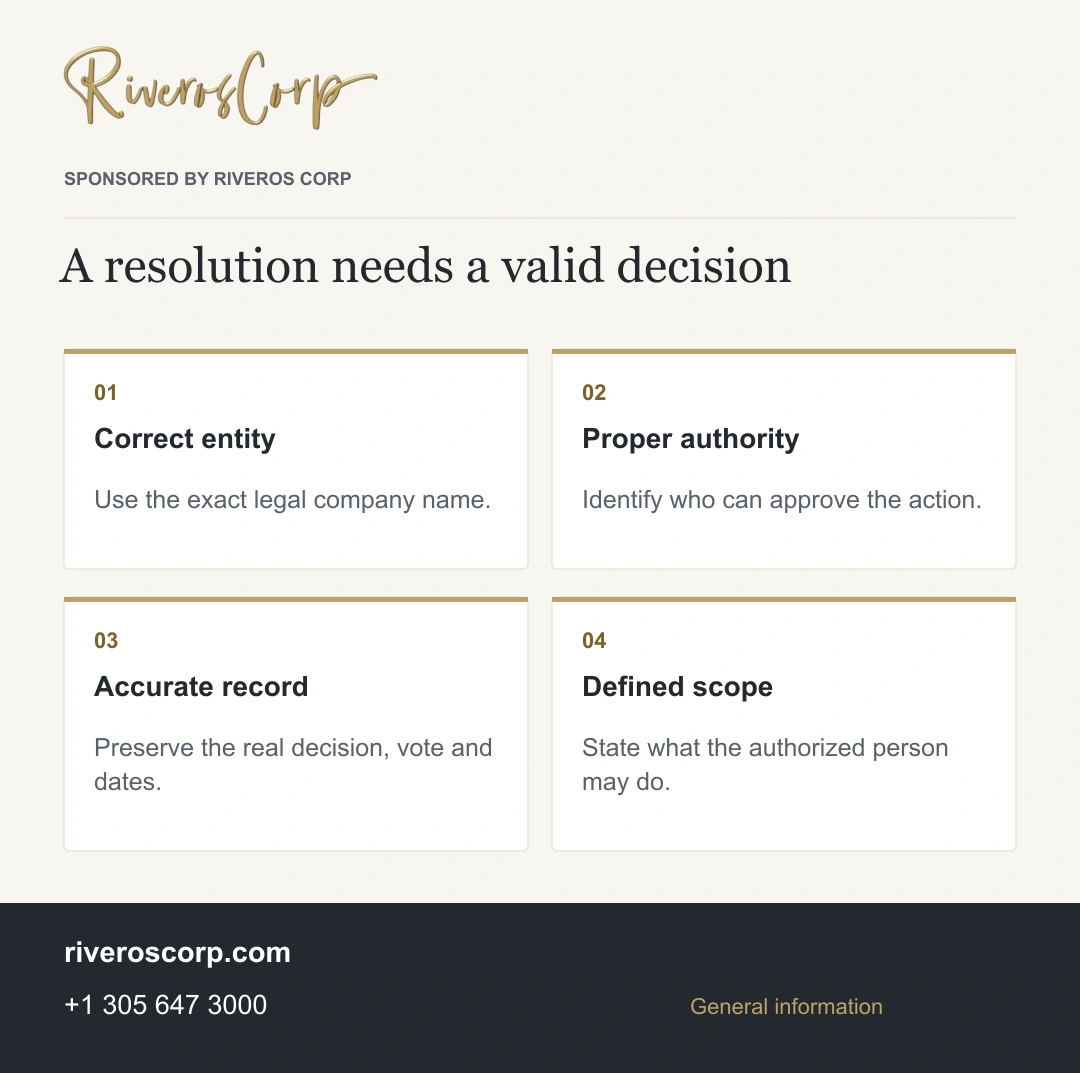
Check the legal entity name first. A trading name, a related subsidiary and the corporation itself may be different. A resolution issued for one entity should not be presented as authority for another just because they share an owner or office.
Next, compare the proposed signer’s role with the governing documents and current appointments. An officer who left the company should not certify a new decision without appropriate authority. A person may also need to explain the capacity in which a certification is made.
Do not invent meeting details to complete a template. Attendance, quorum, votes and dates must come from what actually happened. If the approval process was incomplete, counsel can advise whether a new action or a corrective procedure is appropriate.
Finally, confirm the recipient’s requirements. Some institutions request a particular form or wording, and documents for use abroad may raise additional questions. An authentic signature or later certification cannot repair an underlying decision that the company never validly made.
Preparing the record with Riveros Corp
Riveros Corp prepares corporate resolutions and minutes from the company’s actual decisions and records. Its service includes standard document preparation and organization in the corporate record book. Supply the governing documents, current appointments, approval record and any wording requested by the bank or other recipient.
Where the decision is complete and the authority is clear, those materials allow the document to identify the approved action and the people who may carry it out. A disputed vote, missing approval or negotiated legal term needs counsel’s attention first. Riveros can organize the information for that review without deciding the dispute or giving someone authority the company has not granted.
The finished document should state the approved action in clear terms and fit the company’s existing records. Keep a copy of the version provided to the recipient, along with evidence of approval. This helps answer later questions without reconstructing events from memory.
Frequently asked questions
Who prepares a corporate resolution?
An authorized officer, corporate secretary, attorney or service provider may help prepare the record. Preparation and approval are different tasks. The appropriate corporate decision makers must approve the action through a valid process, and the final wording should match that decision.
Does every resolution require a physical meeting?
No. Florida allows certain actions through written consent when the legal conditions are met. Board and shareholder consent rules differ. Review the articles, bylaws and applicable statute before assuming a signed document can replace a meeting.
Does a banking resolution guarantee that the account will open?
No. It addresses company authorization. The bank still evaluates identification, ownership information and its other account requirements. It may request additional records or decline an application.
Can a single-owner company skip formal records?
A small ownership structure does not eliminate the need to document corporate action. The owner may act in several capacities, but those capacities should remain clear. The governing law and company documents determine the required procedure.
Can I use a corporate resolution template for an LLC?
Only after checking the LLC’s own authority structure and the recipient’s needs. Members and managers operate under the LLC statute and operating agreement. A corporate board form may describe roles or approval rules the LLC does not have.
Identify the decision before preparing the document
Contact Riveros Corp at +1 305 647 3000 to discuss the resolution your company has been asked to provide. Have the recipient’s request and the current company records available.
General information, not legal or tax advice for a particular situation. By Zulma E Bourelly.