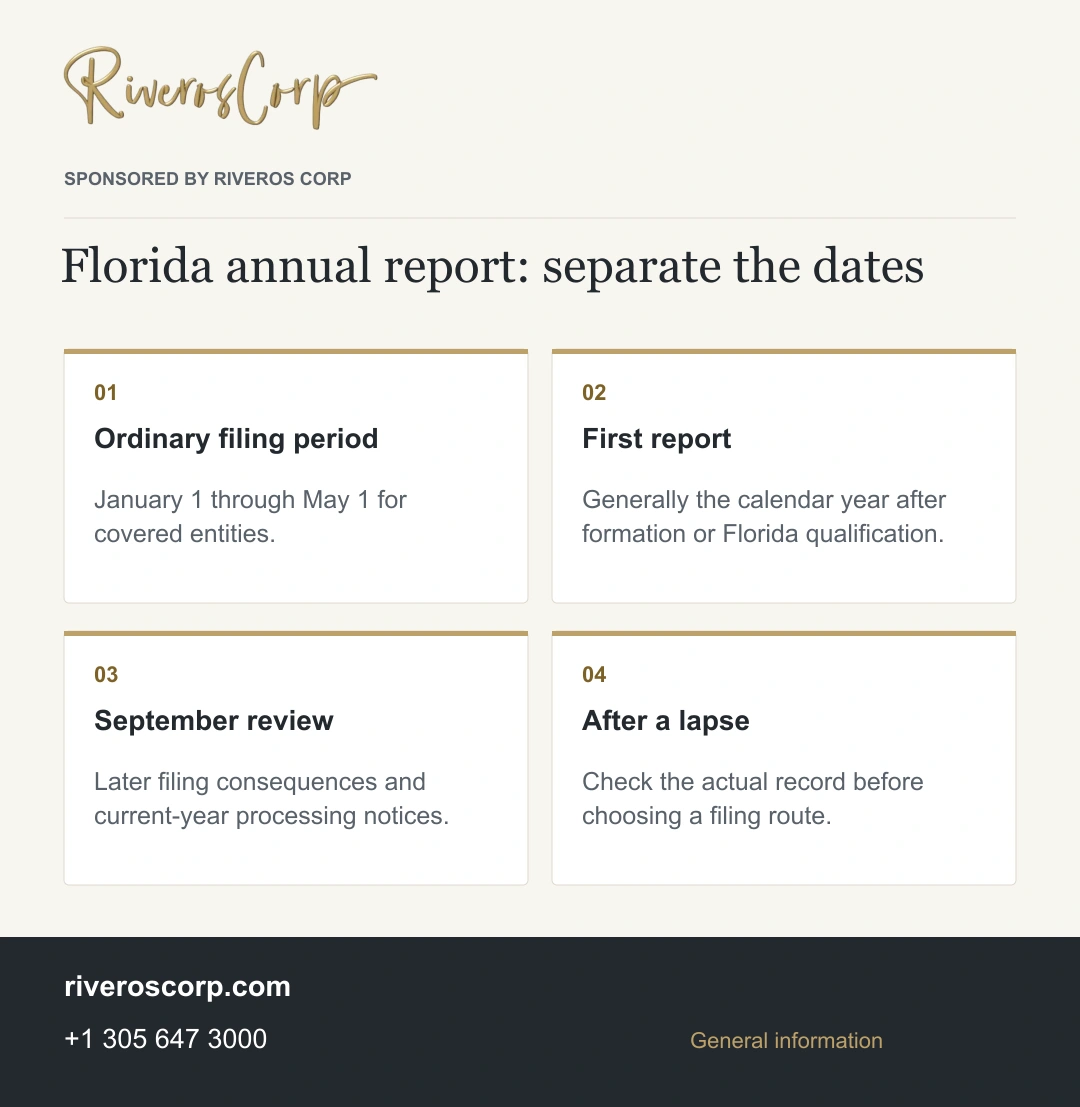
The Florida annual report deadline generally falls on May 1, with the annual filing period beginning January 1. For a newly formed Florida LLC or corporation, the first report is generally due in the following calendar year. Filing an annual report keeps specified information current on the state record. It does not serve as the company’s income tax return.
Owners often encounter another date in September and assume it replaces the spring deadline. The two dates concern different consequences. A report can be late before the company reaches the administrative dissolution stage. The entity type, filing year and current state notice all matter.
If you are reviewing a missed 2026 report now, start with the company’s current status and filing history. A calendar reminder cannot tell you whether a report was accepted, whether the entity was dissolved or whether a reinstatement is already on record. Confirm that the history belongs to the right company, especially when an owner holds several entities with similar names.
When the Florida annual report deadline applies
Florida’s LLC statute sets a January 1 through May 1 filing period for annual reports after the first year. Related provisions apply to profit and nonprofit corporations. The report is required on the entity’s own schedule, even if its tax year or internal annual meeting follows a different calendar.
For example, an LLC whose articles became effective during 2026 generally enters its first annual report cycle in 2027. A foreign LLC that obtained Florida authority during 2026 follows the corresponding first-report rule for its registration. The effective date matters; an owner’s recollection of when work began is not a substitute for the state record.
The first-year rule also means an established company cannot stop filing simply because it has no new customers or has paused its operations. If the entity remains on the register, its reporting obligation must still be evaluated. Closing the business involves separate legal and tax questions.
Do not apply these dates automatically to every kind of registration. A fictitious name, professional license or another state authorization may have its own renewal process. Confirm the legal entity and the exact filing before relying on a reminder labeled only “business renewal.”
What an annual report actually updates
An annual report supplies current information about the entity to the Florida Department of State. Depending on the entity, it covers identifying information, principal and mailing addresses, federal employer identification details and people who manage the business or serve as directors and officers.
The report may also record a registered agent change through the applicable process. A successor agent must properly accept the appointment. An owner should not enter a provider’s name or use an address merely because it appears in an old contract or a previous filing.
The document does not present the company’s profit and loss statement. It does not, by itself, file federal taxes, elect a tax classification, renew every business license or approve a transaction. Those responsibilities stay separate even when one adviser helps coordinate several of them.
Names and roles should match the company’s actual decisions and records. An annual report is not a substitute for obtaining approval to appoint an officer or change management. If the information is disputed, resolve the legal authority question before presenting it as an established fact in a public filing.
Our explanation of articles, certified copies and certificates of status helps distinguish a recurring report from documents used to prove formation or current state standing.
Who needs to review the report each year?
Florida LLCs, profit corporations and nonprofit corporations have annual report duties under their respective statutes. Foreign entities authorized in Florida also need to review their Florida obligations. An entity formed elsewhere may have a separate report in its home jurisdiction.
A foreign owner does not escape the Florida requirement by living outside the United States. Ownership location, business operations and state registration are different facts. The person coordinating the filing should know which entities exist and where each is registered.
For a group with several related companies, maintain separate records for each legal entity. Similar names can cause a report to be filed for the wrong company. The Florida document number helps distinguish the intended entity from a parent, subsidiary or dissolved predecessor.
Nonprofit corporations should not assume federal tax exemption removes their state reporting obligations. A Florida annual report and an IRS information return serve different purposes. The treatment of late filing can also differ by entity type, so applying an LLC’s rules to a nonprofit without checking them is unsafe.
Our article on corporations versus LLCs provides context for the legal structures. The report should follow the structure the company actually has, including any completed conversion or merger.
What changes after May 1?
After May 1, a report can be late while the company still appears active. Florida applies a late-filing charge to profit corporations and LLCs; nonprofit corporations are excepted from that charge. Nonprofits still have to file the report. The absence of the charge does not excuse their annual reporting duty or protect them from dissolution for failing to file.
This distinction matters when a bank or contracting party asks for proof of standing. An owner may know that the company still exists but overlook a missing report. The institution may ask for updated state documentation or clarification of the record before proceeding.
Filing late should also prompt a review of the information being submitted. Rushing to meet a later cutoff can lead to old addresses, former officers or an agent who has not accepted the role. Timeliness and accuracy are separate checks, and completing one does not establish the other.
If a report has already been submitted, check the actual filing history before making another submission. A payment confirmation, a provider’s receipt and a filed document do not always describe the same stage. Retain the state acknowledgment and confirm which reporting year it covers.
September dates and administrative dissolution
For a Florida LLC, section 605.0714 identifies failure to deliver an annual report by 5 p.m. Eastern Time on the third Friday in September as a dissolution ground. The statute schedules administrative dissolution for failure to file on the fourth Friday in September. These provisions do not change the ordinary May 1 report deadline.
For the 2026 calendar, the third Friday was September 18 and the fourth Friday was September 25. Those dates have passed. A company reviewing its missing report in November should use the current entity record to find out what happened, rather than assume that the report is merely late or that dissolution has necessarily occurred.
For a future filing year, read the Department’s instructions for the submission and payment method you will use. A payment voucher is not the accepted annual report. Keep the filing acknowledgment and verify the entry in the company’s history; those records show whether the intended entity and reporting year were actually addressed.
Once an entity has been administratively dissolved, treating the matter as an ordinary current-year report may be inappropriate. The record must be reviewed for reinstatement and any other issues. For a foreign entity, the corresponding action can involve revocation of its authority rather than dissolution of the entity in its home jurisdiction.
A missed report does not close every obligation
Administrative dissolution should not be treated as a convenient substitute for intentionally winding up a company. The LLC continues to exist for limited purposes under Florida law, and obligations to creditors, tax agencies or contractual counterparties do not disappear simply because of the state status label.
A missing report can also affect court proceedings. Section 605.0212 restricts an LLC’s ability to maintain or defend a Florida action until it files the report and satisfies the related statutory requirements. Corporate provisions use different language. When a lawsuit is pending, give counsel the entity type, filing history and state notices so the correct rule is applied.
Similarly, reinstatement can restore the entity under statutory conditions, but it does not automatically resolve every separate problem. A professional license, bank restriction or missed tax filing may need its own review. Keep those items separate rather than assuming one filing updates every agency.
Where a company has ceased activity permanently, review the appropriate closure process with qualified advisers. Keeping the entity dormant, allowing administrative dissolution and completing an orderly voluntary closure are different choices with different consequences.
A calendar that supports an accurate filing
Assign one person to coordinate the report and another to confirm completion if the first person is unavailable. The assignment should cover more than remembering a date. Someone must gather current information, obtain any required approvals and retain evidence of the accepted filing.
Review the prior report against the actual company records. Address changes, new officers, manager departures and registered agent changes deserve specific attention. Use the current company records to check last year’s report before carrying any information forward.
Make the reminder early enough to resolve discrepancies. If a company’s name, entity type or management authority is unclear, the issue may require a different filing or legal review. Discovering it shortly before a deadline leaves less room to obtain the right documents.
After filing, retain the accepted report with the company’s records and check that the public information reflects the intended update. Record which year was completed. A system that only says “done” without identifying the entity and year can create confusion when several businesses are managed together.
How Riveros Corp can assist
Riveros Corp provides Florida annual report filing support, including a review of current information and the registered agent. Give the team the legal name, Florida document number and reporting year. Changes to addresses, managers or officers should come from the company records and the people authorized to approve them.
Confirm whether the matter is a routine report, an amended report or a reinstatement issue before choosing the filing route. That distinction helps keep the work aligned with the current record. Any question about disputed ownership, authority or the legal effect of a lapse belongs with an attorney.
Agree who will supply and approve the information, and ask for the filed report or state acknowledgment when the work is complete. If several companies are involved, keep a separate confirmation for each one. An invoice for annual maintenance alone does not establish that every entity’s annual report has been accepted.
Frequently asked questions
What is the Florida annual report deadline?
The ordinary annual filing period is January 1 through May 1 for the covered LLC and corporate filings discussed here. September deadlines concern later consequences and processing cutoffs. Check the entity type and the current-year instructions rather than treating September as the regular due date.
Does a company created in 2026 file its first report in 2026?
For the Florida LLC and corporation rules discussed here, the first report is generally due in the calendar year after the articles become effective. A foreign entity follows the corresponding rule after receiving Florida authority. Confirm the effective date on the actual record.
How do I address a missing 2026 report?
Review the current state status and filing history first. By November, the entity may already require reinstatement or another response. A filing review can establish which report or reinstatement is outstanding; counsel can address any pending claim affected by the lapse.
Is the annual report a tax return?
No. It updates specified company information with the Florida Department of State. Federal tax returns, Florida tax obligations and other registrations are separate matters, even when their due dates fall near the same period.
Can a nonprofit ignore the annual report because it is tax exempt?
Federal tax exemption does not itself remove a Florida nonprofit corporation’s annual report duty. Check both the state corporate filing and the applicable federal reporting rules. Different agencies maintain different records.
Check the reporting year before you file
Contact Riveros Corp at +1 305 647 3000 to review the company record and discuss annual report support. Share the exact entity name and the year you need to address.
General information, not legal or tax advice for a particular situation. By Zulma E Bourelly.