The 1023 EZ eligibility worksheet screens organizations for the streamlined application for recognition under section 501(c)(3). It belongs before the application decision. A short form is not an option simply because a nonprofit is new, has few volunteers or expects an uncomplicated launch. Legal structure and activities matter as much as finances.
The worksheet asks about receipts, assets and organizational history. Under the IRS instructions, a “Yes” to any worksheet question makes the organization ineligible to use Form 1023-EZ. Answering every question “No” allows use of that form, but does not establish entitlement to exemption. Both application routes require the organization to meet the underlying federal standards.
The review needs the formation documents, financial records and a description of the programs the organization actually plans to operate. Earlier IRS correspondence matters too, particularly after a revocation or a change in structure. These records help explain the answers and show where a tax or legal question needs to be resolved before anyone signs the application’s attestations.
What the 1023 EZ eligibility worksheet does
Form 1023-EZ is a streamlined request for IRS recognition of federal charitable tax exemption. The eligibility worksheet screens applicants for access to that filing method. It does not create the organization, supply missing articles or authorize activities that do not qualify under federal law.
The IRS requires applicants to complete the worksheet before completing Form 1023-EZ. It stays in the organization’s records and does not have to accompany the application. Keep the completed version with the financial information and other records used for the review. That file shows how the organization reached its answers if its leadership changes or the IRS later asks about eligibility.
Completing the short application also involves attestations about eligibility and exemption requirements. Those statements should reflect an actual review. An officer should not treat them as routine acknowledgments that a preparer can select without discussing the underlying facts.
Use the version linked to the current IRS instructions when the application is being considered. A screenshot saved years ago or a commercial website’s abbreviated checklist can omit an exclusion. The current worksheet, together with its explanations, is the relevant starting document.
Financial eligibility requires more than a bank balance
The worksheet examines past gross receipts, projected gross receipts and the fair market value of total assets. These are separate questions. An organization with little cash today may still have assets or expected receipts that affect its eligibility.
Gross receipts are not the same as the amount left after program expenses. The IRS definition generally looks at amounts received before subtracting costs. Treating the operating surplus as receipts can make an organization appear smaller than it is for this purpose.
Projected receipts need a reasonable factual basis. Consider the organization’s actual plans, expected support and existing commitments with the adviser reviewing eligibility. Do not lower a projection merely to fit the streamlined route or ignore a known funding arrangement.
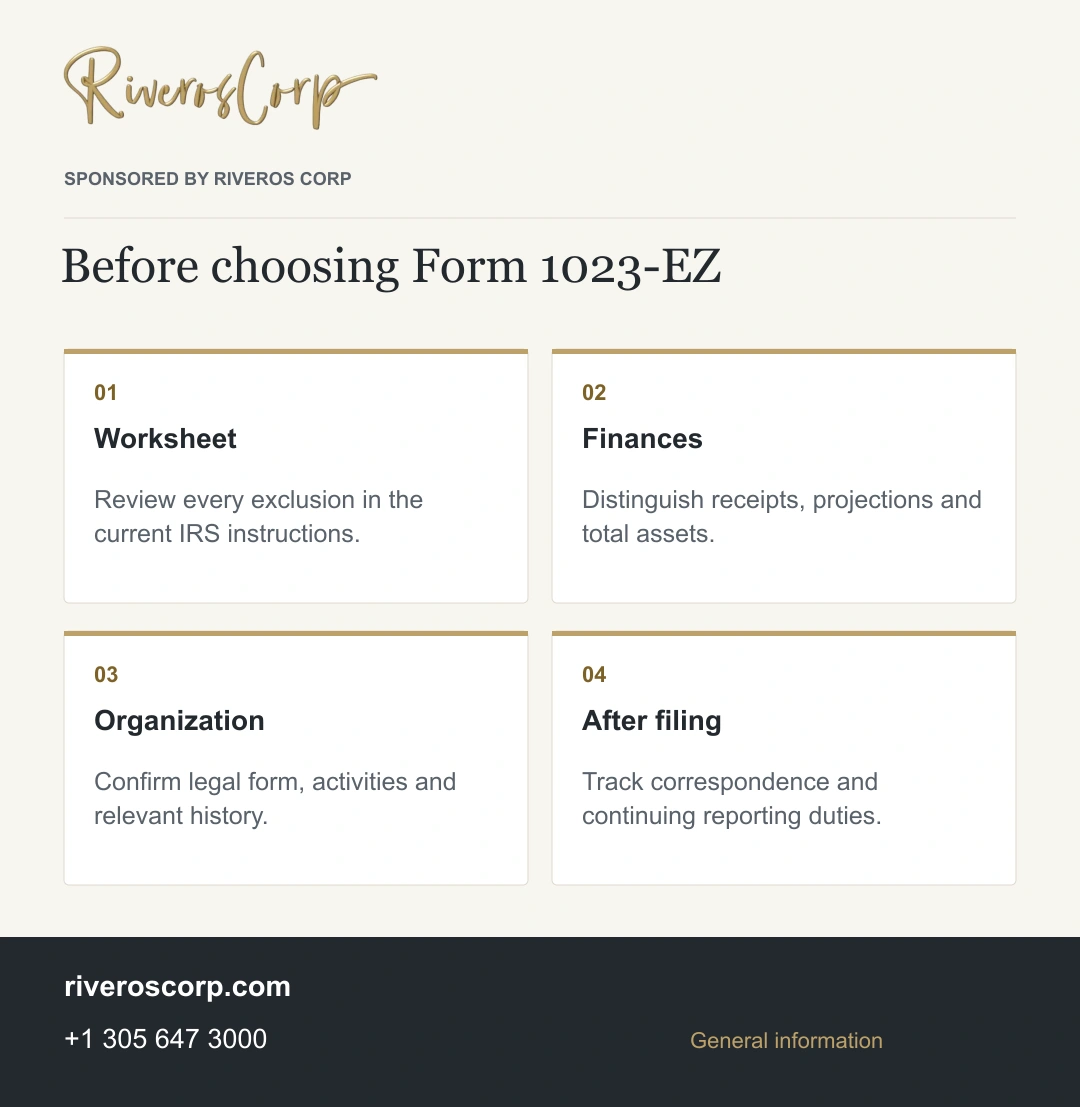
The projection question covers the current year and the next two years; another question examines receipts in the preceding three years. Assets are measured at fair market value and include property and receivables as well as cash. The reviewer needs figures for each applicable period and a complete asset record to compare with the current worksheet’s financial limits.
Legal form and organizational history can exclude applicants
An applicant’s state-law structure matters independently of its size. The worksheet excludes LLCs from Form 1023-EZ. That exclusion does not mean every LLC is categorically unable to qualify for any federal exemption; it means this streamlined application is not its route.
Foreign formation, a foreign mailing address and certain predecessor relationships also require attention under the worksheet. A nonprofit that took over an existing operation should disclose that history rather than describe itself as entirely new simply because it has a new name.
A prior IRS revocation also matters. The worksheet treats revocation for reasons other than automatic revocation differently from automatic revocation for three consecutive years of missing required annual filings. Leaders reviewing an older organization need the actual notice and filing history. Describing every loss of status simply as ‘expired’ can conceal the reason the IRS acted.
Provide complete information about earlier entities, legal conversions and previous applications. A short initial interview can miss facts that change the appropriate form. The person reviewing eligibility needs the real history, including facts that make the full application necessary.
Some activities require the full application
Churches, schools and hospitals are among the categories excluded from Form 1023-EZ. Other exclusions address specific types of organizations and activities. The categories have definitions; everyday descriptions such as “small school” or “community health project” do not settle their application.
For example, calling a program educational does not automatically make it a school under the relevant classification. Conversely, an organization that actually meets the school definition cannot avoid the exclusion by using a different label in its mission statement.
The worksheet should be read as a whole. Checking only the financial questions leaves much of the eligibility analysis unfinished. Every answer needs to reflect the organization’s present facts and the plans covered by the question.
A program description should explain its activities before assigning a tax classification. For a school, for example, the worksheet considers a regular faculty, curriculum and enrolled student body at a place where instruction occurs. If those facts are uncertain, the adviser needs to resolve them. A longer application allows more explanation, but the organization’s purposes and activities must still qualify.
Why churches follow a distinct path
Churches that meet section 501(c)(3)’s requirements can qualify for exemption without applying for IRS recognition. That exception is different from permission to use Form 1023-EZ. A church seeking its own determination letter uses the full application route rather than the streamlined form.
A religious ministry should first establish whether it is a church for federal tax purposes. Religious language in its name or articles does not answer that question. Actual organization, worship and congregational facts can be relevant to the classification.
The decision to seek recognition may involve the needs of donors, institutions and the organization’s own recordkeeping. A determination letter can be useful documentation, but the absence of a letter does not by itself prove that a qualifying church lacks exemption.
Do not answer the worksheet to obtain a preferred classification. Explain the ministry’s activities accurately and have the appropriate professional assess them. Religious identity, state nonprofit incorporation and federal church classification are related subjects with different legal functions.
What changes between Form 1023 and Form 1023-EZ
The full Form 1023 requests more detailed information about activities, finances and the organization. It also calls for organizing documents and adopted bylaws. Form 1023-EZ relies more heavily on attestations, while leaving the organization responsible for meeting the underlying requirements.
Both routes concern recognition under the same section of federal tax law. An eligible organization does not receive a lesser category of 501(c)(3) status because it used the short form. Equally, the shorter filing does not remove restrictions on private benefit or other exempt-organization obligations.
The available requests also differ. An organization seeking certain determinations or an annual-return filing exception may need the full form. Those needs should be discussed before selecting a route based only on the amount of information requested.
The IRS can request additional information, including through review of selected streamlined applications before making a determination. Keep copies of the submission and correspondence, and identify who will receive and respond to requests. Filing electronically does not complete the review; the organization needs to follow the application through to the agency’s decision.
The organizing documents still need review
A streamlined application does not eliminate the organizational test. The legal purposes and dedication of assets still need to satisfy the applicable requirements. State acceptance of incorporation papers does not establish that those papers meet federal exemption standards.
Our article on 501(c)(3) articles of incorporation requirements explains that distinction. For the broader formation record, see nonprofit articles of incorporation. Those documents should be reviewed before someone attests that the organization meets the federal requirements.
The organization also needs its own EIN for the exemption application, even without employees. An EIN identifies the organization for federal tax administration; its issuance does not grant charitable exemption. Do not substitute another organization’s number because a sponsor or founder already has one.
Keep the legal name, formation date and records consistent. If the articles were amended, the review needs the operative version and the amendment history. A correct application begins with the actual organization, rather than a mixture of an old draft and current plans.
Approval does not end financial and filing review
An organization’s growth can change its annual reporting obligations and require review of its public-charity classification. The initial application route does not permanently fix the return it must file. Keep financial records that support the appropriate filing decision each year.
The financial screen for choosing Form 1023-EZ and the rules for maintaining exemption answer different questions. After recognition, the organization still needs to track its activities, finances and applicable reporting duties. A later increase in receipts requires an updated filing review; it should not be assessed by simply reusing the eligibility worksheet completed at formation.
The often-mentioned one-third public-support test concerns certain public-charity classifications. It is separate from the Form 1023-EZ financial eligibility screen. It is also not a universal rule requiring a particular share of every nonprofit’s spending, donations or board seats.
Required annual returns or notices must be addressed even while an exemption application is pending. Organizations should identify who monitors those obligations. An application in progress is not a general suspension of the filing calendar.
Preparing an eligibility discussion with Riveros Corp
Gather the organizing documents, EIN record, financial history, budget assumptions and any prior IRS correspondence. Include a plain description of actual and planned activities. The most useful description explains whom the organization serves and what it does, without promotional claims.
Identify issues that remain undecided, such as a predecessor relationship, a church classification question or a planned funding arrangement. It is better to flag an uncertainty than to provide a definite answer based on a guess. The appropriate adviser can then address the legal or tax question.
Riveros Corp provides nonprofit formation and exemption-application document preparation. Its work includes preparing the file and completing forms from information the organization supplies. The client and any retained legal or tax adviser need to resolve classification and eligibility questions before that information becomes a signed declaration. Confirm which records and approvals the preparer needs for the agreed work.
Frequently asked questions
Is the eligibility worksheet filed with Form 1023-EZ?
The IRS generally does not require submission of the worksheet with the form. It must still be completed first and retained in the organization’s records. The application includes eligibility attestations that should be supported by that review.
What happens if one worksheet answer is Yes?
Under the current instructions, any Yes answer makes the organization ineligible to use Form 1023-EZ. The full Form 1023 is the application route to consider. Ineligibility for the short form does not by itself decide whether the organization qualifies for exemption.
Can a church use Form 1023-EZ?
No. A church seeking recognition through an individual exemption application uses the full Form 1023. A church that meets section 501(c)(3)’s requirements may be exempt without applying, but that exception does not make it eligible for Form 1023-EZ.
What if receipts grow after approval?
Review the annual return or notice required for the new financial circumstances and any effect on public-charity classification. The initial application does not permanently fix those obligations. Keep the original eligibility records as well, because the accuracy of the application and the organization’s later operations are separate subjects.
Does completing the worksheet guarantee approval?
No. It determines access to the streamlined application, not entitlement to exemption. The organization must satisfy the substantive requirements, and the IRS may ask for more information. Neither worksheet completion nor electronic submission guarantees an outcome.
Review the appropriate application route
Contact Riveros Corp at +1 305 647 3000 to discuss your nonprofit document preparation. Have the formation records, activity description and financial information available so eligibility questions can be identified before filing.
General information, not legal or tax advice for a particular situation. By Zulma E Bourelly.